Lessons
Stargate
Stargate is a popular science fiction franchise that has captured the imagination of fans around the world. Starting with a single movie, it grew into a universe of TV shows, books, comics, and games. Its unique blend of adventure, science, and mythology makes it a favorite among sci-fi enthusiasts.
By Farhan Sayed2 years ago in History
Fascinating Wonders of Nature: From Flying Dogs to Walking Trees
Is that a dog in the sky? Don’t get too excited—dogs haven’t evolved to fly just yet! But we’ve all seen realistic shapes in clouds. Some think it’s Mother Nature sending us coded messages. However, it’s our brain’s ability called pareidolia that makes us see patterns or faces in random objects. This skill likely helped our ancestors survive by spotting potential threats like predators hiding in shadows. Speaking of odd shapes, ever seen an orange “having a baby”? This phenomenon, called vivipary, happens when seeds sprout while still attached to the fruit. It’s rare in plants but fascinating, as it’s comparable to live birth in animals. On the topic of nature’s wonders, the giant African snail can grow up to 8 inches and live 10 years. These snails, while fascinating, are illegal to own in some countries due to their invasive nature and potential health risks. Another striking phenomenon is the "dirty thunderstorm," where volcanic eruptions generate lightning within ash clouds. This occurs when static electricity forms as ash particles collide, creating lightning near the ground. Nature never ceases to amaze! Did you know that tigers have striped skin beneath their fur? Unlike zebras, whose skin is all black, tigers’ striped patterns extend to their follicles. It’s a feature that makes them even more unique. Hailstones the size of tennis balls are another wild occurrence. These form when raindrops are lifted to freezing altitudes by strong updrafts, growing larger as they collect more layers of ice. Once heavy enough, they crash to the ground, often causing significant damage. Ever find a pearl while eating oysters? It’s rare, with a 1 in 10,000 chance, but possible. Pearls form when debris irritates the oyster, prompting it to coat the intruder in layers of nacre. Edible oyster pearls can be worth up to $4,000, while high-end jewelry store pearls fetch much more. Nature’s adaptability is also evident in the walking palm tree, found in Central and South America. It appears to “move” by growing new roots in a desired direction while older ones die off, enabling the tree to shift position slowly over time. In the ocean, the lingcod fish stands out with its electric blue flesh. This unique coloring is linked to a chemical called biliverdin, but the phenomenon remains poorly understood. Interestingly, the blue hue fades when cooked. Have you ever seen Zen stones? These natural formations occur when rocks sit atop melting ice, leaving slender pedestals behind. The process involves sublimation, where ice transitions directly to gas, creating these surreal shapes. Butterflies, with their intricate wing patterns, use them for both survival and attraction. The patterns help them camouflage, warn predators, or impress mates. Some species, like the zebra longwing, have unique feeding habits, consuming pollen directly for better nutrition and longer lifespans. Bioluminescence is another marvel, where creatures like plankton and shrimp emit light. Beaches with glowing waves, caused by these organisms, create magical sights. Similar wonders include Bolivia’s Salar de Uyuni, a salt flat that turns into a giant mirror after rainfall. Lastly, nature’s creativity extends to multi-fruit trees through grafting. By combining compatible fruits on one tree, you can grow several varieties in a single space. However, they require careful maintenance to ensure balance. These natural phenomena remind us of the planet’s beauty and complexity, from striped tigers to glowing oceans and moving trees. Each discovery adds to our appreciation of the world we live in.
By Nora Ariana2 years ago in History
The Paris Climate Treaty
The Paris Climate Treaty, also known as the Paris Agreement, is an important global agreement aimed at fighting climate change. It was created during the United Nations Climate Change Conference (COP21) in December 2015 in Paris, France. Representatives from almost every country in the world came together to make this deal. The goal of the treaty is to protect the Earth by reducing greenhouse gas emissions and keeping global warming under control.
By Farhan Sayed2 years ago in History
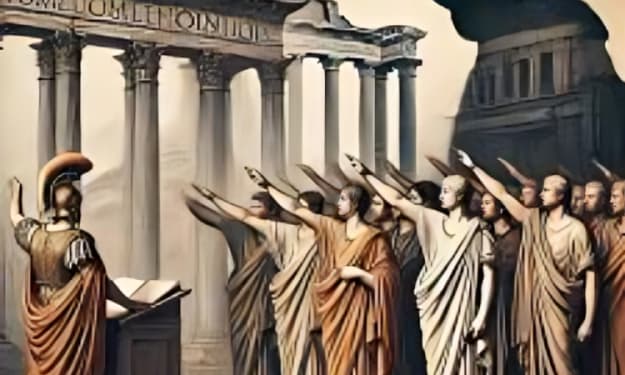
The Roman Salute
The Roman salute is a gesture where a person raises one arm forward with the palm facing down or slightly up. It is often associated with ancient Rome, but its real history and meaning are much more complicated. Over the years, this gesture has taken on different meanings in art, politics, and culture, making it a topic of debate and interest.
By Farhan Sayed2 years ago in History
The Roman Salute: History, Misconceptions, and Modern Interpretations"
Introduction The Roman salute, an iconic gesture often associated with ancient Rome, has become a topic of intrigue and controversy. Widely depicted in art and literature as a symbol of allegiance, it is commonly imagined as an outstretched arm raised with the palm facing downward. Despite its widespread recognition, much of what is believed about the Roman salute is rooted in misconceptions and modern reinterpretations rather than historical evidence.
By Razia Aman2 years ago in History
Exhibits of Fortitude Even with Fiasco. Content Warning.
History is stacked up with depictions of outstanding boldness during times of crisis. Two flight fiascoes — one out of 1982 and one more in 2009 — highlight the strength and unselfishness of individuals who put others before themselves. These episodes, but numerous years isolated, share a run of the mill subject: human mental guts despite overwhelming gamble.
By SHAPNA SARKAR2 years ago in History
Mahakumbh Mela
The Mahakumbh: A Spiritual Odyssey The Mahakumbh Mela, often regarded as the world’s largest spiritual gathering, is a festival that embodies the essence of India’s rich cultural and religious tapestry. Held once every twelve years, it is a celestial confluence of faith, mythology, and community. Millions of devotees, ascetics, pilgrims, and tourists from across the globe flock to the designated holy sites to immerse themselves in the sanctity of this grand event.
By NEERAJ KUMAR SINGH2 years ago in History
Snowstorm Weather Forecast for the UK
The United Kingdom is preparing for a significant snowstorm, and weather experts are warning people to get ready. Winter weather can bring beauty, but it can also cause challenges for travel, homes, and daily life. Here's everything you need to know about the upcoming snowstorm in simple terms.
By Farhan Sayed2 years ago in History
Dr. Martin Luther King Jr. Day
Dr. Martin Luther King Jr. Day: Honoring a Legacy of Justice and Equality Dr. Martin Luther King Jr. Day, celebrated annually on the third Monday of January, stands as a powerful reminder of the values of justice, equality, and nonviolence. This federal holiday, first observed in 1986, honors the life and legacy of Dr. Martin Luther King Jr., one of America’s most prominent civil rights leaders. His unwavering commitment to social change continues to inspire individuals worldwide.
By Sikandar prasad2 years ago in History
Blue Monday
Every year, on the third Monday of January, people around the world hear about something called "Blue Monday." It is often referred to as the "saddest day of the year." But what is Blue Monday, and why do people believe it is so depressing? Let’s explore the meaning, origins, and truth behind this idea.
By Farhan Sayed2 years ago in History
Mahakumbh mela
The Mahakumbh Mela is one of the largest spiritual gatherings in the world celebrated with great fervor and devotion by Hindus Rooted in ancient tradition and mythology the event signifies the confluence of faith culture and spirituality Held every twelve years at four holy riverbank locations in India Haridwar Prayagraj Ujjain and Nashik the Mahakumbh is an occasion where millions of devotees come together to take a sacred dip in the holy rivers believing it will purify their souls and wash away their sins Historical and Mythological Significance The origin of the Mahakumbh Mela is deeply embedded in Hindu mythology particularly the tale of the Samudra Manthan Churning of the Ocean According to legend gods Devas and demons Asuras churned the cosmic ocean to extract the nectar of immortality or Amrit As the pot containing Amrit emerged a fierce battle ensued To safeguard the nectar Lord Vishnu in the guise of Mohini took the pot and ensured its distribution among the gods During this pursuit drops of Amrit fell at four places Haridwar Prayagraj Ujjain and Nashik sanctifying these locations The Mahakumbh is celebrated to commemorate this divine event Rituals and Practices The central ritual of the Mahakumbh Mela is the Shahi Snan Royal Bath where devotees bathe in the holy river It is believed that the waters become charged with divine energy during this period offering spiritual benefits Several auspicious dates are chosen for these baths often coinciding with planetary alignments which are considered to amplify the spiritual potency of the ritual
By Anishant Singh2 years ago in History
A cutthroat love story
Some time ago, in a domain where hearts were the most valuable fortunes, there carried on with a young lady named Lyra. Her reality was one of unending magnificence, yet in addition of perpetual distress. The land, called Lumen, was managed by a strong and baffling power known as the Wanton — spirits who had lost their affection, their feelings, and their mankind. They meandered the world, unfilled and empty, trying to take the hearts of others to make up for their own shortcoming.
By Ahmad hasan Tamim2 years ago in History