Lessons
January 18, 1945 – A Soldier’s Last Goodbye from World War II
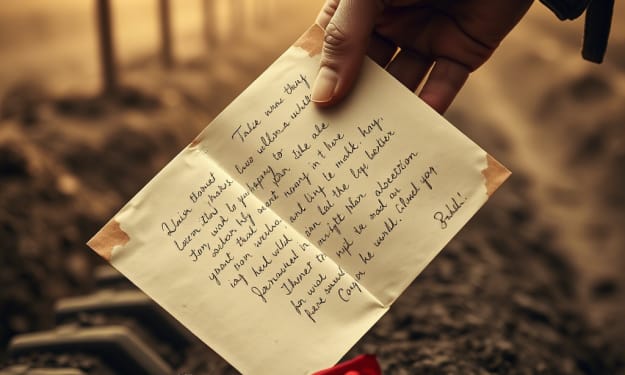
January 18, 1945 – 101st Airborne Division, Bastogne Somewhere in a frozen battlefield, with life slipping away… My dearest Eleanor, If you are reading this, it means I did not make it home. My hands tremble as I write, my fingers stained with blood—some mine, some from the brothers I fought beside. The battle still rages on in the distance, but for me, it is over. My leg is gone, taken by a landmine, and the cold is creeping into my bones faster than I can stop it. I do not have much time. But before I go, before the darkness takes me, I need to speak to you one last time. I don’t know if this letter will ever reach you, but I have to believe it will. I have to believe that some part of me will make it back to you, even if my body never does. Eleanor, my love, I am so sorry. I promised you I would return. I swore I would hold you again, that I would kiss you beneath the oak tree where I first asked you to be mine. I told you I would come home and hold our son in my arms. But fate is cruel, and war is even crueler. Our little boy is only five months old, and I have never even seen his face. That is the pain that cuts deeper than any bullet ever could. I close my eyes, and I try to picture him. Does he have your golden hair? Your warm, kind eyes? Does he have my stubbornness, my laugh? I will never know. I will never hear his first words, never watch him take his first steps. I will never get to tell him how much I love him. That is why I need you, Eleanor. You must tell him for me. Tell him that his father was not just a soldier, not just another name carved into a memorial. Tell him I was a man who dreamed of coming home. A man who fought not for war, but for peace. A man who loved him, even before he took his first breath. I am alone now. The others have moved on, charging into the fight, leaving me behind in the snow. The sky above is gray, the wind howling like the cries of the fallen. The warmth is leaving my body, but in my mind, I am not here. I am with you. I am back in our little house, sitting by the fire with you curled up beside me, your head on my chest, listening to my heartbeat. It is still beating, Eleanor. Faint, weak, but still beating. But not for long. I wish I could hold you one last time. I wish I could press my lips to yours, feel the softness of your skin, run my fingers through your hair. I wish I could watch the way your eyes crinkle when you laugh, hear you call my name, tell me everything will be alright. But I know better now. War takes everything. It takes young men and turns them into ghosts before they even die. It takes love and replaces it with silence. It steals fathers from sons, husbands from wives, leaving behind nothing but grief. But promise me one thing, my love. Promise me you will live. Do not let my death steal your joy. Do not let it darken the life we dreamed of building together. Raise our son in laughter, in love. Let him know happiness, let him chase dreams. Tell him it is okay to miss those who are gone, but that life must go on. And Eleanor, if one day you hear my name in the wind, if you feel a soft touch when no one is there, know that it is me. I will always be with you. Watching, waiting, loving you from beyond. This is not goodbye, my love. This is just a pause—a brief moment of separation—until we meet again. Forever yours, James
By News Vortex 2 years ago in History
Archaeologists Discovered 22000 Year Old Tracks That May Be From the World’s First Vehicle.
Archaeologists Discovered 22000 Year Old Tracks That May Be From the World’s First Vehicle. The discovery of 22000 year old tracks at White Sands National Park in New Mexico has shed new light on early human innovation and transportation methods. These tracks as revealed in a recent study published in Quaternary Science Advances suggest that ancient humans used a rudimentary vehicle known as a travois to transport goods or belongings. This finding challenges conventional perspectives on early transportation pushing back the timeline of non wheel based vehicles much further than previously thought. At the heart of this discovery are the linear impressions found alongside human footprints. Unlike ordinary tracks left by people walking these marks suggest the dragging of wooden poles indicating the use of a travois. This is a simple yet effective means of carrying heavy loads by lashing two poles together often in the shape of a triangle and pulling them along the ground. Such a transport method was widely used by Indigenous peoples in North America well into recent history particularly among the Plains tribes who adapted it for use with horses. However, this new discovery suggests that its use dates back much further to a time when humans were still navigating the challenges of Ice Age survival.
By Adnan Rasheed2 years ago in History
The forgotten history of The Kingdom of Cambodia. . Content Warning.
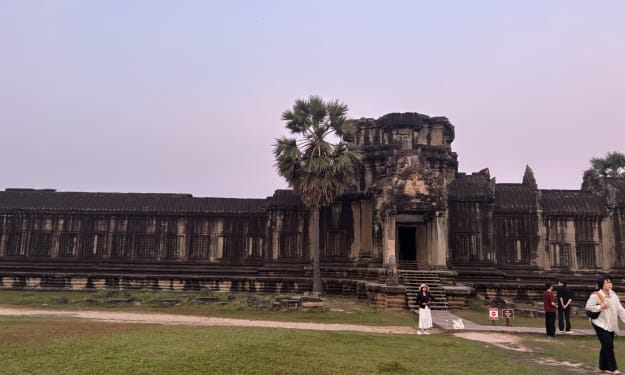
For those of us in the West who have heard of Cambodia without visiting, it may be seen as just a country in South East Asia that is not too well off. Those of us who have been lucky enough to travel to or simply read about this humble hidden gem, may know the rich yet dark history surrounding the Kingdom itself. I myself have been fortunate enough to travel here recently and spent about 3 weeks travelling throughout the country. From border towns and bustling cities with wild nightlife, to the vast green fields of rice paddies, all the way to the coast with some of the most gorgeous water I have ever seen. In my time spent in the country my eyes have been opened in more than one aspect.
By Jacob Newson2 years ago in History
The Healing Power of Kamakshi Amman Temple: A Sanctuary for Mind, Body, and Spirit
The Kamakshi Amman Temple in Kanchipuram is not just a revered religious site but also a place where devotees experience deep spiritual healing and wellness. As one of the oldest and most significant temples in India, it offers a sanctuary that nurtures not only the soul but also promotes physical and mental well-being. The temple, dedicated to Goddess Kamakshi, is believed to have a divine aura that helps people rejuvenate and heal on multiple levels, whether seeking relief from physical ailments or emotional distress.
By Sri Kamakshi Ambal Temple2 years ago in History
"Echoes from the Trenches: A Love and Loss Story of World War I"
Letter 1: Private James Whitford to Nurse Eleanor Hartley 12th November 1916, Somme Sector Dearest Miss Hartley, Do you recall the day we met? It was raining—a cold, spiteful drizzle that seeped through the seams of my greatcoat—and I’d been hauled into your field hospital on a stretcher, half-mad with pain from the shrapnel in my leg. The air reeked of carbolic and blood, and somewhere, a man was screaming for his mother. But you appeared like a specter in that chaos, your apron streaked with rust-colored stains, and pressed a tin mug of tea into my hands. “Drink this,” you said, your voice steady as a metronome. “You’ll live to see another sunrise.”
By sasanka perera2 years ago in History
Guamanian: Culture, Language & Heritage
The Guamanian Chamorro people have a unique culture deeply rooted in the Mariana Islands. This chain of islands is in the Pacific. Their culture is a mix of old traditions and new influences. It shows a strong community spirit and respect for their heritage.
By The Big Bad 2 years ago in History
A Mother’s Unconditional Love That Transcends Death
There’s a special kind of magic in handwritten letters. The way the ink curves and loops, the faint scent of paper, the smudges where the writer paused to think—it’s as if a piece of their soul is pressed onto the page. For me, letters became a lifeline to my mother long after she was gone. They were her way of reaching through time, of holding my hand when I needed her most, and of reminding me that love doesn’t end with death.
By Sharepreneur Mom2 years ago in History
Letters between Helen Keller, teacher Anne Sullivan and a modern day writer.
Helen Adams Keller (June 27, 1880 – June 1, 1968) was an American author, disability rights advocate, political activist and lecturer. Born in West Tuscumbia, Alabama, she lost her sight and her hearing after a bout of illness when she was 19 months old. She then communicated primarily using home signs until the age of seven, when she met her first teacher and life-long companion Anne Sullivan. Sullivan taught Keller language, including reading and writing. After an education at both specialist and mainstream schools, Keller attended Radcliffe College of Harvard University and became the first deafblind person in the United States to earn a Bachelor of Arts degree.
By Antoni De'Leon2 years ago in History
Civil Boundaries
Bertram, I's finelee can reeds and writes juss like u. Presdent Leenkun Lincon free us last yeer and plan ta free the hole nashun in due time. bless him tender hart. no mo hidin outs behind dat cow patch when i's git sic of it all. I's can be sic and tyrrd rite where I's wants ta!
By Lamar Wiggins2 years ago in History
The Moonlight Between Us
Introduction : Love is timeless. It stretches across distances, defies war, and lingers in the whispers of the wind long after lovers are separated. Some love stories are told in grand gestures, while others are preserved in ink—words written with longing, sealed with hope, and sent across the unknown. This is the story of Hana and Zayed, two souls bound by love but torn apart by war. Set in British India during the 1940s, their love unfolds not in whispered conversations or stolen glances but in letters exchanged between battlefields and a quiet home waiting for a reunion. But fate is not always kind, and sometimes, love must endure not just distance but the uncertainty of tomorrow. These letters capture their hearts, their fears, and their undying devotion—a testament to love that even time cannot erase.
By Silent sonnets2 years ago in History