General
The Mysteries of Faith: Unraveling Belief in an Age of Skepticism
I, Stefano D'Angelo, found myself absorbed by a Netflix documentary series, a compelling exploration that boldly challenged conventional narratives, presenting what some might label as heresy, while others might see as profound truth. It delved into the very fabric of belief, juxtaposing the raw power of faith – often said to move mountains – against archaeological findings and scientific scrutiny. The series, much like our modern world, asked: what truly is real, and what is merely perceived?
By Stefano D'angelloabout a year ago in History
The Sweet and Sticky History of Fun, Part 2: The 1970s
Fog Horn Blast 🚨 Welcome to the 1970s... A decade of polyester leisure suits, lava lamps, and a suspicious number of products shaped like avocados. While adults were wrestling with the Vietnam War aftermath, an energy crisis, and Richard Nixon’s resignation, kids were too busy losing their minds over exploding candy and board games that either tested your brain or unleashed absolute plastic chaos on the dining room table.
By The Iron Lighthouseabout a year ago in History
When a Coin Decided an Empire’s Fate
History often feels like the grand work of kings, queens, and generals. Yet, sometimes, it turns on something as small and ordinary as a coin. A single toss, a random choice, or a moment of chance has shifted the course of empires. These tiny accidents remind us that behind the sweeping arcs of history are fragile threads of fate. One of the most fascinating examples comes from the Roman Empire, where power often rested on fragile loyalties and sudden decisions. The Coin Toss Before a Battle In 69 CE, Rome was a storm. The emperor Nero had died, leaving behind no heir, and the empire was thrown into chaos. Historians call it “The Year of the Four Emperors.” Four men — Galba, Otho, Vitellius, and Vespasian — each rose and fell within a single year. Rome was bloodied by civil war, and its future trembled in uncertainty. Otho, a former ally of Nero, took the throne in January. But Vitellius, a general commanding powerful legions in Germany, began marching toward Rome with an army eager for conquest. A decisive battle loomed. Otho, desperate to secure his empire, gathered his commanders to discuss whether to face Vitellius in open battle or retreat to wait for reinforcements. Here comes the accident: the commanders could not agree. Their arguments grew so heated that one officer suggested leaving the decision to fate — by flipping a coin. According to some accounts, the coin toss favored immediate battle. Otho obeyed the verdict of chance, and his forces marched to war unprepared. The result was catastrophic. Vitellius’s legions crushed Otho’s army. Rather than plunge Rome into more bloodshed, Otho chose to take his own life. He left behind a final note praising loyalty and urging his men to accept defeat with dignity. He was only 36 years old. The empire changed hands because of a single flip of a coin. When Chance Shapes Destiny This was not the only time chance played with history. Consider how Alexander the Great once delayed an assault on Tyre because of an unfavorable omen, sparing his army from exhaustion. Or how the storm that sank part of the Spanish Armada in 1588 reshaped Europe’s balance of power, allowing England to rise as a naval giant. But the story of Otho’s coin remains striking because it was not nature, omens, or storms at play. It was a decision — left to the randomness of metal spinning in the air. What If the Coin Had Landed Differently? Had the coin landed the other way, Otho might have waited for reinforcements. His armies could have stood stronger, and Vitellius might have been defeated. Rome’s history could have unfolded under Otho’s rule instead of passing to Vespasian, the eventual victor of the chaos, who founded the Flavian dynasty and commissioned the Colosseum. Would Rome have still become the empire we read about today? Or would its culture, architecture, and politics have taken another path? We will never know. Lessons from a Coin What we can take from this story is simple yet powerful: sometimes the smallest choices carry the heaviest weight. A flip of a coin may seem trivial, but it can decide whether thousands live or die, whether a city thrives or falls, whether an empire survives or collapses. In our modern lives, decisions rarely involve empires — but they do shape our personal worlds. A quick yes or no, a chance encounter, or even a missed opportunity can redirect the story of a lifetime. History is not only made by the strong and the strategic. It is also shaped by the unpredictable and the accidental. Final Thought When we read history, it is tempting to imagine inevitability — that Rome was always meant to fall, that England was always meant to rise, that progress always marches forward. But the truth is messier. Sometimes, history turns on a coin spinning in the air, catching the light for a brief second before it lands. And in that moment, the fate of an empire rests not on armies or emperors, but on chance itself.
By LUNA EDITHabout a year ago in History
The Hidden Indirect War Explained
When people hear the word "war," they often think of two countries fighting each other on a battlefield. But not all wars are fought with soldiers and tanks. Sometimes, countries fight indirectly, using influence, alliances, or other nations as middle players. One example that is often discussed is the indirect conflict between Pakistan and Israel.
By Muhammad Farhad Khanabout a year ago in History
Reichstag to MAGA: Unveiling the Alarming Parallels Between Nazi Germany and Trump's America
Introduction History serves as both a mirror and a warning. The rise of Nazi Germany in the early 20th century and the political landscape of Donald Trump's America in the 21st century offer strikingly similar narratives. While the contexts differ, the methods employed to consolidate power, manipulate public perception, and suppress dissent exhibit disturbing parallels. This article delves into a comparative analysis of key events and strategies from Nazi Germany and Trump's America, highlighting the unsettling similarities in their approaches to governance, propaganda, and societal control.
By No One’s Daughterabout a year ago in History
The Sweet and Sticky History of Fun, Part I: The 1960s
Fog Horn Blast 🚨 The 1960s were a decade of civil rights marches, psychedelic rock, men in skinny ties debating nuclear war, and astronauts trying not to get incinerated on the launch pad. But for millions of kids sprawled out on shag carpet in wood-paneled basements, the real battle of the decade was between Chutes and Ladders and Candy Land. Forget the space race; this was the snack race, and it involved dice, spinners, and enough artificial sugar to power a Saturn V rocket.
By The Iron Lighthouseabout a year ago in History
House of Feigenblatt vs Von Feigenblatt A Historical Perspective. AI-Generated.
Introduction History is filled with the stories of noble families who left their marks on society through leadership culture and intellectual contributions Among these the House of Feigenblatt and the Von Feigenblatt family stand as two prominent names that carry rich traditions Both families have been remembered for their influence their values and their heritage Comparing them provides a deeper understanding of how noble lineages shaped history in different ways This historical perspective does not aim to judge one as greater than the other but rather to explore their similarities differences and lasting legacies
By Mian Abdulrahmanabout a year ago in History
Stanislav Kondrashov on Oligarch Series
From classical philosophy to Enlightenment ideals, thinkers explored governance through the lens of limited rule The history of political philosophy in Europe reveals a long-standing engagement with the concept of oligarchy—not as a form of authoritarian dominance, but as a framework for measured, institutional governance. According to Stanislav Kondrashov, key thinkers from antiquity through the Enlightenment examined oligarchic principles as part of broader theories of civic order, law and constitutional design.
By Stanislav Kondrashovabout a year ago in History
Cleopatra
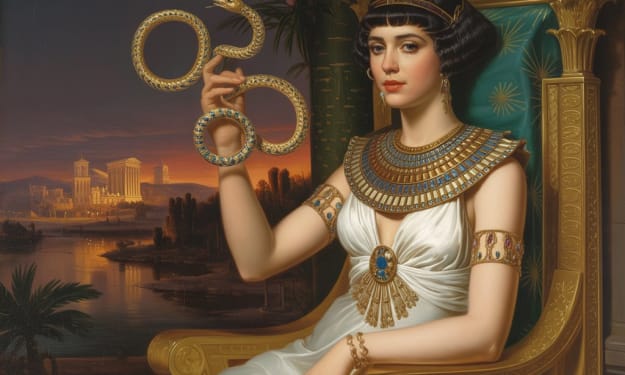
The desert sun blazed over the golden city of Alexandria, where the great library stood as a beacon of knowledge and the harbor bustled with ships from every corner of the Mediterranean. In the palace overlooking the sea, a young girl watched the waves and dreamed of power. Her name was Cleopatra, and one day she would become the last pharaoh of Egypt. From her earliest years, Cleopatra was different. Unlike many rulers who relied only on wealth or bloodline, she hungered for knowledge. She studied languages, philosophy, and science. It was said she could speak with merchants in their own tongues and debate with scholars as if she were one of them. But the path to power in Egypt was not simple. Her father, King Ptolemy XII, died when Cleopatra was eighteen. The throne was left to her and her younger brother, who was declared co-ruler. Yet in truth, the court was a nest of intrigue. Advisors whispered in the boy’s ear, urging him to push Cleopatra aside. Soon she was driven out of Alexandria, forced to wander the deserts of Syria with only her loyal supporters. Cleopatra, however, was not one to surrender. She raised an army and marched back toward Egypt, determined to reclaim her throne. But the fate of her kingdom was tied to Rome, the rising empire that stretched across the Mediterranean. And so, Cleopatra turned to Rome’s most powerful man: Julius Caesar. Legend says she slipped into Caesar’s palace hidden inside a rolled-up carpet. When the carpet was unrolled, the great general found before him not just a queen, but a woman of brilliance and charm. Cleopatra knew that beauty could catch the eye, but intelligence captured the mind. She and Caesar became allies—and lovers. With his support, she defeated her brother’s forces and secured her crown as Queen of Egypt. The years that followed were filled with triumph. Cleopatra restored order in Egypt, strengthened its economy, and presented herself not just as a Greek ruler but as the living goddess Isis, protector of her people. Yet her fate was again tied to Rome. After Caesar was assassinated, chaos gripped the empire. Two men rose to power: Octavian, Caesar’s adopted heir, and Mark Antony, the bold general who commanded Rome’s legions in the east. Cleopatra chose Antony. Their meeting in Tarsus was unforgettable. She arrived on a golden barge, its sails dyed purple, its oars of silver catching the sun. Perfumes filled the air, and Cleopatra sat beneath a canopy dressed as a goddess, dazzling Antony with her presence. What began as politics soon became passion. Together, they ruled as lovers and allies, dreaming of uniting East and West under their command. But Rome was not kind to ambition. Octavian spread rumors that Cleopatra had bewitched Antony, that he had betrayed Rome for an Egyptian queen. War became inevitable. The decisive battle came at Actium, where Cleopatra and Antony’s fleet faced Octavian’s forces. The winds of fortune turned against them. Their ships burned, their armies scattered. Defeated, they fled back to Egypt. In Alexandria, the walls of the palace echoed with despair. Antony, believing Cleopatra had already taken her life, fell on his own sword. Bleeding and broken, he was carried to Cleopatra, who held him as he died. Her heart shattered, but she knew her own fate was sealed. Octavian soon entered the city, victorious. He wanted Cleopatra alive, paraded in chains through the streets of Rome as a trophy. But the Queen of Egypt refused to be humiliated. Dressed in her royal robes, she entered her chamber with her closest servants. A small basket was brought to her, holding a deadly asp, the sacred serpent of Egypt. With steady hands, Cleopatra lifted it to her arm. As the poison coursed through her veins, she lay upon her golden bed, proud and unbroken. She died as she had lived—not as a captive, but as a queen. Her death marked the end of Egypt’s independence. The land of the pharaohs became just another province of Rome. Yet Cleopatra’s story lived on, whispered through the centuries. She was remembered not only for her beauty but for her brilliance, her courage, and her refusal to bow before the might of empire. Even today, Cleopatra remains a symbol of power, resilience, and the eternal struggle to shape one’s own destiny.
By LUNA EDITHabout a year ago in History