General
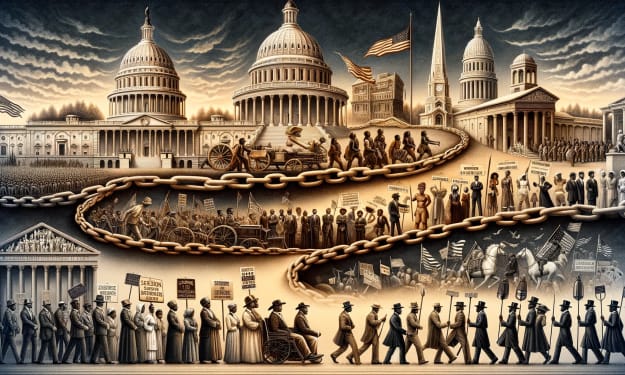
The Legal Landscape of Race
Introduction In the intricate tapestry of American history, few threads are as enduring and complex as the history of race relations. From the earliest days of colonial America to the present, the narrative of race has been inextricably linked to the laws and policies enacted by those in power. Understanding this history is not just an academic exercise; it offers vital insights into the present and future of racial dynamics in the United States. This blog post aims to trace the impact of these laws and policies, unraveling how they have shaped, and continue to influence, race relations in America.
By Dustin Vaught3 years ago in History
Ikenna Ike- Black players' influence in American football.
American football, a sport deeply ingrained in the USA's cultural fabric, has been significantly shaped and enriched by the contributions of black players. From overcoming racial barriers to becoming celebrated icons, black athletes have played a pivotal role in the history and evolution of American football. In this exploration, we will delve into the profound impact of black players, tracing their journey from pioneers breaking racial barriers to the trailblazers and icons who have left an indelible mark on the sport.
By Ikenna Ike3 years ago in History
Ancient Babylonian Civilization: Cradle of Human CivilizationThe**
**The Ancient Babylonian Civilization: Cradle of Human Civilization** The ancient Babylonian civilization was one of the oldest and greatest civilizations in the world. It arose in Mesopotamia, the region that now comprises Iraq and Kuwait, around 2300 BC. The Babylonian civilization lasted for over two millennia, until its fall to Alexander the Great in 331 BC. The ancient Babylonian civilization was renowned for its many great achievements, including: * **Writing:** The Babylonians invented one of the earliest writing systems in the world, cuneiform. Cuneiform was used to write the Babylonian language, as well as many other languages in Mesopotamia. * **Law:** The Babylonians developed the first written law code in the world, the Code of Hammurabi. The Code of Hammurabi was a collection of laws that regulated all aspects of life in ancient Babylonia, including trade, marriage, crimes, and punishments. * **Mathematics:** The Babylonians developed a highly advanced mathematical system. They were the first to use a base-60 number system, which is still used today in measuring time and angles. The Babylonians also developed complex geometrical theories, including the Pythagorean theorem. * **Astronomy:** The Babylonians were skilled astronomers. They were the first to discover that the Earth orbits the Sun, and that the planets orbit the Sun as well. The Babylonians also developed a very accurate calendar, which is still used in some cultures today. * **Architecture:** The Babylonians built many magnificent buildings, temples, and palaces. The most famous Babylonian building is the Tower of Babel, which was considered one of the Seven Wonders of the Ancient World. The ancient Babylonian civilization was a highly advanced and diverse civilization. The Babylonians left behind a rich legacy of knowledge and culture, which continues to influence the world today. **Daily Life in Ancient Babylonia:** Daily life in ancient Babylonia was very different from daily life in the modern world. Most people worked in agriculture or herding. There were also many artisans, merchants, priests, and government officials. The family was the basic unit of Babylonian society. Most people were married and had children. Women were responsible for taking care of the home and children, while men were responsible for earning a living. Education was important in ancient Babylonia. There were many schools that taught children to read, write, and do mathematics. Education was available to both boys and girls. Religion was an important part of life in ancient Babylonia. The Babylonians worshipped many gods and goddesses, and each god or goddess had their own temple. Priests were responsible for managing the temples and making offerings to the gods. The ancient Babylonian civilization was a rich and diverse civilization. The Babylonians left behind a rich legacy of knowledge and culture, which continues to influence the world today. **The Fall of the Ancient Babylonian Civilization:** The ancient Babylonian civilization fell to Alexander the Great in 331 BC. After Alexander's death, his empire was divided among his generals. Babylonia became part of the Seleucid Empire, which ruled the region for over a century. In 141 BC, the Parthians conquered the Seleucid Empire. Babylonia became part of the Parthian Empire, which ruled the region until the Islamic conquest in the 7th century AD. After the Islamic conquest, Babylonia gradually lost its importance. It eventually became an abandoned city, and all that remains today are ruins. However, the legacy of the ancient Babylonian civilization lives on today. The Babylonian language is still studied in universities, and the Code of Hammurabi is still considered one of the most important laws in history. Many of the scientific and cultural ideas that originated in ancient Babylonia continue to influence the world today. I hope this information is helpful.Start writing...
By Good Morning3 years ago in History
I rescued 100 abandoned Dogs!
The Challenge of Adoption and the Joy of Success The task was daunting. Adopting 100 dogs is no small feat, especially when considering each animal's diverse backgrounds and needs. However, the dedication of the team, equipped with trainers, walkers, and a team for affection, ensured every dog received the love and care they deserved. The approach was holistic, focusing not just on physical well-being but also on emotional support.
By Ashinparama3 years ago in History
"Odyssey of the Crystal: A Story of Interest and Grandiose Miracle". Content Warning.
Some time ago in a curious town settled between moving slopes and wandering streams, there carried on with a little fellow named Arjun. Arjun was known for his unquenchable interest and vast creative mind. He spent his days climbing trees, exploring the lush forests, and listening to the tales told by the village elders. Arjun found a mysterious old book hidden in the dusty corners of the village library one day as the sun was painting the sky pink and orange. The book was bound in leather, had intricate patterns on it, and the pages whispered of old tales and lost magic. As Arjun dove into its items, he found a story that would change his life until the end of time. The Crystal of Enigma, a long-lost artifact said to have unimaginable powers, was the subject of the narrative. Legends predicted that whoever had the gem could open the mysteries of the universe and reshape predetermination. Interested by the possibility of such a great experience, Arjun chose to set out on a mission to track down the Gem of Riddle and disentangle the secrets concealed inside. Equipped with boldness and filled by his unquenchable interest, Arjun set out on an excursion that would take him through charmed woods, tricky mountains, and mysterious domains past creative mind. He encountered bizarre creatures and wise sages who led him on his quest and taught him valuable lessons about love, life, and pursuing one's dreams. As Arjun wandered further into the obscure, he confronted difficulties that tried his solidarity as well as his mind and strength. In a thick backwoods shrouded in never-ending nightfall, he experienced the tricky Twilight Grovels, mystical creatures that main uncovered themselves to those with a good nature. Through a progression of puzzles and difficulties, the Grovels presented to Arjun a key that would open the following period of his journey. His process drove him to the Murmuring Caverns, a maze of passages cut by old streams. Legend had it that the caverns held the reverberations of failed to remember intelligence. Arjun explored through the obscurity, directed simply by the murmurs that resounded in the enormous chambers. He found a secret chamber with glowing runes on the walls in the center of the caves. Translating the old content, Arjun uncovered a piece of information that sharp him to the heavenly city of Astraloria. Ethereal beings with knowledge of the stars lived in the city of Astraloria, suspended between the stars. As Arjun climbed the drifting advances prompting the city, he wondered about the iridescent engineering that appeared to hit the dance floor with the infinite energy. Beings of pure light who lived in Astraloria greeted him and told him stories about the Crystal of Enigma that reverberated throughout the galaxies. Directed by the insight of Astraloria, Arjun took off through the enormous flows on the wings of a legendary starbird. His objective was the Heavenly Nexus, a union of real factors where the Gem of Puzzler was supposed to be watched by the Watches, old creatures who represented the progression of time itself. The Heavenly Nexus was a kaleidoscope of twirling energies and moving aspects. Arjun remained before the Watches, who moved him to demonstrate his value. Through preliminaries that rose above the limits of past, present, and future, Arjun showed boldness, empathy, and a steadfast soul. Dazzled by his flexibility, the Watches depended him with the Gem of Puzzler. As Arjun grasped the gem, he felt a flood of force flowing through him. The precious stone beat with the heartbeat of the universe, uncovering the interconnectedness, all things considered. Arjun gained a new perspective and came to the conclusion that the crystal's true power lay not in its capacity to grant wishes but rather in its capacity to illuminate the path to self-discovery. Getting back to his town, Arjun shared the examples he had learned and the marvels he had seen. The once-drowsy town currently hummed with the energy of plausibility, as its occupants embraced the sorcery inside themselves and their general surroundings. Arjun, presently a savvy narrator himself, kept on moving ages with the story of his uncommon excursion and the persevering through force of interest and boldness. Thus, the tale of Arjun and the Precious stone of Puzzle turned into an immortal legend, reverberating through the ages as an update that inside each heart lies the potential for experience, disclosure, and the enchantment of an everyday routine very much experienced.
By Nagaraj story3 years ago in History
Celebrating the New Year in North Africa: A Unique Cultural Tradition
Introduction: In the vast expanse of North Africa, a vibrant and ancient cultural celebration unfolds annually on January 13th. This event marks the commencement of the agricultural year for a distinctive community with a rich historical heritage. Amidst the arid landscapes, this New Year celebration carries profound significance, embracing age-old traditions and customs that have been passed down through generations.
By Lahouceine AIT MBAREK3 years ago in History
From Big Ben to Borough Market: London's Cultural Treasures
Step on board for an expedition of cultural discovery as we explore London's colorful and diverse fabric. London is not simply a thriving metropolis, but also a living museum of global history, art, and culture. As we enter the heart of London, we'll discover its secrets, from renowned monuments like the Tower of London and Buckingham Palace to hidden jewels in the city's many districts. Join us as we delve into London's rich history, art, gastronomy, and customs, which make it a fascinating case study in cultural inquiry.
By Jennifer Cruise3 years ago in History
The Roman Legions
1. Their Military Training During Rome's early days, its army mainly consisted of local farmers who were quickly mobilized to fight small battles with nearby settlements. However, in 390 BC, everything changed when a Gaul army defeated the Romans and launched an attack on the city.
By Nicolas J.D3 years ago in History
Unveiling the Brilliance of Arun Matheswaran's "Captain Miller" - A Tamil Cinematic Triumph
Introduction: In the realm of Tamil cinema, Arun Matheswaran's "Captain Miller" stands tall as a testament to storytelling prowess, innovative narrative, and cinematic brilliance. The 160-minute runtime of this action-packed drama never once wavers, captivating audiences with its layers of political intrigue and thematic depth. In this blog post, we'll delve into the various facets that make "Captain Miller" a standout film, drawing parallels to Quentin Tarantino's influence, exploring the intricate political subtexts, and highlighting the stellar performances that bring the narrative to life.
By boopathi raja3 years ago in History
Top 7 Deadliest Experiments in History
Science, the human endeavor to unveil the universe's secrets, has often been hailed as a noble pursuit. Yet, the path to knowledge can be paved with dark deeds, and history is littered with scientific experiments that crossed ethical lines, venturing into the realm of the macabre and monstrous. Today, we delve into the chilling annals of history to uncover seven experiments that stand out for their sheer lethality and disregard for human life.
By Maimun Riansyah3 years ago in History