General
Free Speech Workouts: Strengthening Your Voice and Empowering Expression
1. Warm-Up: Cultivating the Right Mindset Before diving into complex discussions or debates, set the foundation: Stay open-minded: Approach every conversation with curiosity and a willingness to learn.
By md Shahadat md Shahada ali2 years ago in History
Boosting Personal Health
1. The Premise Coyote, the quintessential trickster from Indigenous myths, is summoned before a divine council—an assembly of deities, spirits, or cosmic entities tasked with maintaining balance. The council accuses Coyote of pushing their tricks too far, destabilizing the cosmic order. However, this isn’t just a disciplinary hearing. Unknown to the council, Coyote has provoked another trickster god (or gods), and their chaotic influence is spilling over into realms the council oversees.
By md Shahadat md Shahada ali2 years ago in History
Rediscovering the mighty Hittite civilization
In the dynamic narrative of human history, certain civilizations stand out prominently yet ultimately fade into obscurity. Today, we set out on an intriguing exploration to uncover the tale of the Hittite civilization, a formidable power that flourished during the Bronze Age but was overlooked for many centuries.
By A História2 years ago in History
Planning Your Mahakumbh Mela 2025 Pilgrimage
Mahakumbh Mela 2025 is a big deal. It’s a once in a lifetime event and millions will be coming from all over. This guide will help you prepare for your yatra. You’ll learn how to make the most of your time at the festival.
By Yogesh Shivaji Indalkar2 years ago in History
El Clásico: The Eternal Rivalry Between Real Madrid and Barcelona
Introduction Few rivalries in sports history rival the intensity, passion, and global appeal of El Clásico, the name given to the matches between Spain's two football giants, Real Madrid and FC Barcelona. Beyond the pitch, this rivalry represents a clash of ideologies, cultures, and histories, making it one of the most compelling stories in football.
By Razia Aman2 years ago in History
irs stimulus checks eligibility
Stimulus checks are payments sent by the U.S. government to individuals and households. These checks are part of broader economic recovery efforts, often introduced during events like a recession or a global crisis, such as the COVID-19 pandemic.
By Farhan Sayed2 years ago in History
Exploring Agra, India: A Timeless Journey Through History and Culture
Agra is a city in the northern state of Uttar Pradesh, India. This city is known for housing the Taj Mahal; thus, a rich history, beautiful architectural designs, and a lively culture hold a prominent place, marking it as a destination for any traveler interested in beauty and significance in history.
By Golu Kumar2 years ago in History
10 Smallest Wars in Human History
Throughout history, wars have been waged for various reasons, including territorial disputes, political conflicts, and even personal grievances. While some wars span decades and involve millions of people, others are surprisingly brief and involve minimal casualties. These "smallest" wars often stand out for their brevity, limited scale, or unique circumstances. Here’s a closer look at ten of the smallest wars in human history. 1. The Anglo-Zanzibar War (1896) – The Shortest War in History The Anglo-Zanzibar War holds the record for being the shortest war ever recorded, lasting only 38 minutes. The conflict arose when Sultan Khalid bin Barghash took the throne of Zanzibar after the death of Sultan Hamad bin Thuwaini, against British approval. Britain, favoring a different successor, issued an ultimatum to Khalid to step down. When Khalid refused, British forces bombarded the palace. The Sultan's forces quickly surrendered, leaving 500 casualties on their side, while the British suffered just one minor injury. 2. The Six-Day War (1967) Though relatively larger in scope, the Six-Day War between Israel and neighboring Arab states (Egypt, Jordan, and Syria) is notable for its brevity. Lasting from June 5 to June 10, 1967, the war resulted in a decisive victory for Israel, which captured significant territories including the Sinai Peninsula, Gaza Strip, West Bank, and Golan Heights. The conflict reshaped the Middle East and highlighted Israel's military efficiency, despite its short duration. --- 3. The War of the Stray Dog (1925) This peculiar conflict between Greece and Bulgaria was sparked by a stray dog. A Greek soldier chasing his dog across the border was shot by Bulgarian forces, leading to heightened tensions. Greece responded by invading Bulgarian territory. The League of Nations intervened swiftly, and the conflict was resolved in a matter of days. Casualties were minimal, and Greece was ordered to pay reparations to Bulgaria. --- 4. The Cod Wars (1958–1976) The Cod Wars were a series of confrontations between Iceland and the United Kingdom over fishing rights in the North Atlantic. While the conflicts spanned years, individual skirmishes were brief and involved minimal violence. The disputes were largely settled diplomatically, with Iceland emerging victorious, expanding its exclusive fishing zone to 200 nautical miles. --- 5. The Football War (1969) The Football War, or the Soccer War, was a brief military conflict between El Salvador and Honduras, lasting just 100 hours. Tensions had been brewing over immigration issues and a series of contentious World Cup qualifying matches. The war began on July 14, 1969, but ended on July 18 after intervention by the Organization of American States. Although short, it resulted in over 2,000 deaths and deepened animosity between the nations. --- 6. The Falklands Conflict (1982) The Falklands War between Argentina and the United Kingdom lasted 74 days. Argentina invaded the Falkland Islands, a British territory, on April 2, 1982, prompting the UK to send a naval task force. The conflict ended on June 14, 1982, with a British victory. Although brief, the war claimed nearly 900 lives and had lasting political implications for both nations. --- 7. The Indo-Pakistani War of 1971 (December Conflict) The Indo-Pakistani War of 1971 is primarily remembered for the liberation of Bangladesh (formerly East Pakistan). The main conflict lasted just 13 days, from December 3 to December 16, 1971. India's decisive military action led to Pakistan's surrender and the creation of Bangladesh. While short, the war significantly altered South Asia's geopolitical landscape. --- 8. The Kettle War (1784) The Kettle War was a minor skirmish between the Holy Roman Empire and the Dutch Republic over control of the Scheldt River. It began and ended in a single day when a Dutch ship fired a single cannonball, hitting an Austrian ship’s kettle. The Austrians surrendered without further resistance, making this one of history's least violent wars. --- 9. The Moldovan-Transnistrian War (1992) This conflict between Moldova and the breakaway region of Transnistria lasted roughly four months, from March to July 1992. The war resulted from ethnic tensions and political differences following the dissolution of the Soviet Union. Despite its brevity, the conflict left several hundred dead and established Transnistria as a de facto independent region, though it remains unrecognized internationally. --- 10. The Aroostook War (1838–1839) The Aroostook War, also known as the "Pork and Beans War," was a bloodless boundary dispute between the United States and British Canada over the Maine-New Brunswick border. Both sides sent troops, but no battles occurred, and the conflict was resolved diplomatically with the signing of the Webster-Ashburton Treaty in 1842. --- Why Do Small Wars Matter? Small wars, despite their limited scale, often have significant historical, political, and social implications. They can alter national boundaries, influence international relations, and highlight the effectiveness of diplomacy. Additionally, they often serve as reminders of how even minor incidents can escalate into conflicts. Conclusion The smallest wars in human history demonstrate the diverse causes and outcomes of conflicts. From a stray dog to a soccer match, these wars remind us of the fragility of peace and the importance of resolving disputes peacefully. While their brevity and scale set them apart from larger conflicts, their lessons remain universal.
By Dipayan Biswas2 years ago in History
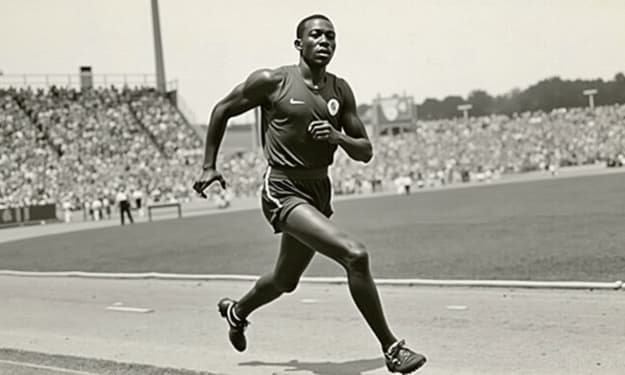
Jesse Owens
Jesse Owens: The Sports Legend Who Defied Racism and Shattered Records Jesse Owens, a name forever linked to extraordinary athletic achievements and the fight against racial injustice, is one of the greatest athletes in history. Owens was not just a fast runner; he was a symbol of determination and excellence in the face of adversity. In this article, we will explore the life of Jesse Owens, his athletic accomplishments, and his profound impact on challenging racism and breaking social barriers.
By 💓 Pulse of Stories 💓2 years ago in History
Nelson Mandela
Nelson Mandela: A Symbol of the Struggle for Freedom and Equality Nelson Mandela, a name that is always mentioned when discussing the struggle for freedom and equality, is one of the most prominent figures who left a profound impact on human history. Mandela was not just a politician or a leader; he was a symbol of humanity and tolerance. His life story is filled with lessons and morals that we can all learn from. In this article, we will explore the life of Nelson Mandela, his struggle against apartheid, his achievements, and the legacy he left behind.
By 💓 Pulse of Stories 💓2 years ago in History