General
The Civil Rights Movement in the USA: A Turning Point in American History. AI-Generated.
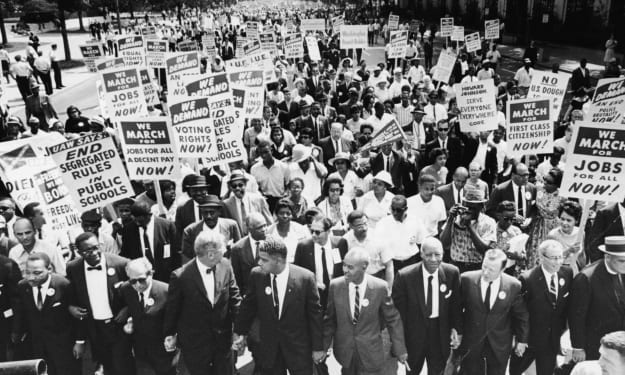
The Civil Rights Movement in the USA: A Story of Courage and Change There was a time in America when people with dark skin were not treated equally. They could not sit where they wanted, go to the same schools, or even drink from the same water fountains as white people. This was called racial segregation, and it was unfair. But things did not stay like this forever. A powerful movement started — made of brave people who stood up and said, **"Enough is enough."** This was the **Civil Rights Movement**, and it changed the face of the United States forever. Where It All Began Let’s go back to the **1950s and 1960s** — a time when America was full of rules that separated people by skin color. This was especially common in the southern states. One day in **1955**, in Montgomery, Alabama, a Black woman named **Rosa Parks** was riding a bus. When a white man asked her to give up her seat, she said **"No."** That one word was small — but it shook the world. Her arrest led to the **Montgomery Bus Boycott**, where thousands of Black people stopped riding buses for over a year. This peaceful protest hurt the bus companies financially, and finally, the courts said, “segregation on buses is illegal.” > **Highlight:** Rosa Parks’ quiet courage became a loud call for change. The Rise of Dr. Martin Luther King Jr. During the Montgomery Bus Boycott, a young preacher named **Dr. Martin Luther King Jr.** became a leader. He believed in **non-violence**, inspired by Mahatma Gandhi. He said: > “Hate cannot drive out hate. Only love can do that.” Dr. King and others led **peaceful marches**, gave **powerful speeches**, and organized **boycotts** — all to demand **equal rights for Black Americans.** One of his most famous moments was the **March on Washington in 1963**, where he stood in front of the Lincoln Memorial and said: > “**I have a dream**... that one day... children will not be judged by the color of their skin, but by the content of their character.” More than 250,000 people stood and listened that day. > **Highlight:** Dr. King’s dream became a message of hope for all generations. --- Brave Children and the Power of Schools In 1954, the **Supreme Court** ruled in **Brown v. Board of Education** that separating children in schools based on race was wrong. But many schools still refused to allow Black children. One of the bravest stories is of **Ruby Bridges**, a six-year-old Black girl who, in 1960, walked into an all-white school in New Orleans. People shouted at her, but she kept walking — protected by U.S. Marshals. She didn’t cry. She just wanted to learn. > **Highlight:** A little girl with a big heart taught America what courage really looks like. Bloody Sunday and the Fight for Voting Rights In 1965, many Black Americans still couldn’t vote due to unfair laws. To protest, activists marched from **Selma to Montgomery, Alabama.** But on **“Bloody Sunday,”** police attacked peaceful marchers on a bridge — beating them with sticks and spraying tear gas. The pictures shocked the nation. After that, President **Lyndon B. Johnson** signed the **Voting Rights Act of 1965**, which gave Black citizens the right to vote without fear. > **Highlight:** Their pain on the bridge opened the road to justice. - Civil Rights Laws That Changed America** Because of the Civil Rights Movement, the U.S. government passed powerful laws: * **Civil Rights Act of 1964** – No more discrimination in schools, jobs, or public places. * **Voting Rights Act of 1965** – Protected every citizen’s right to vote. * **Fair Housing Act of 1968** – Stopped racial discrimination in housing. These laws helped break down the legal walls that kept people apart. > **Highlight:** Protest turned into policy, and policy brought change. Not Just Black and White While the movement began to fight for **African Americans**, it inspired many others: * **Women** began fighting for equal rights in the workplace. * **Latinos**, **Asians**, and **Native Americans** started their own justice movements. * **Disabled people**, **LGBTQ+ communities**, and others found hope through civil rights actions. > **Highlight:** The Civil Rights Movement lit a flame that spread across America. Why This story matters Today Even today, the fight for justice and equality continues. People still march for **Black Lives Matter**, for **fair treatment**, and for **human dignity**. The spirit of Dr. King, Rosa Parks, and Ruby Bridges still walks in today’s streets. > **Highlight:** The movement may have started in the past — but its heart beats in the present. Conclusion: A Story of the People The Civil Rights Movement was not just about laws or leaders — it was about **people**. Ordinary people. Mothers, students, teachers, and workers. They changed the world with their voices, their marches, and their courage. It’s a story of pain, yes — but also of power. A story of hate — but answered with love. And most of all, a story that reminds us: > *When we stand together, change is possible.*
By Tanushree Dasabout a year ago in History
120 Days Underwater
In an impressive achievement that embodies human perseverance, scientific ingenuity, and extreme exploration, Rudiger Koch, a German aerospace engineer, is the new record holder for the longest time living in a submerged underwater chamber without the use of depressurization. Koch surfaced from his submerged capsule on Friday off the coast of Panama after spending an astounding 120 days, 11 meters (36 feet) under the Caribbean Sea. The feat, verified by Guinness World Records adjudicator Susana Reyes, saw Koch break the previous record of 100 days, which was set by American Joseph Dituri, who resided in an underwater lodge in a Florida lagoon.
By Rohitha Lankaabout a year ago in History
The Great Underground Pyramid of Alaska: Secrets Beneath the Frozen Tundra
Beneath the Frost, a Hidden Legacy Beneath the endless expanse of Alaska's tundra lies an enigma that has puzzled explorers, researchers, and conspiracy theorists for decades. For years, the whispers have circulated, tales of a massive underground pyramid, an ancient structure far older than anything recorded in history. Hidden deep within the wild, remote regions of the state, this pyramid is said to be a relic of an advanced civilization, one that predates all known ancient cultures.
By The Secret History Of The Worldabout a year ago in History
Cratippus of Athens
Within the intricate landscape of ancient Greek philosophy, prominent figures such as Plato, Aristotle, and Socrates often take center stage. Yet, numerous lesser-known philosophers have made substantial contributions to the evolution of Western thought. One notable individual is Cratippus of Athens, a Peripatetic philosopher from the 4th century BCE. Although his writings have not survived, remnants of his thoughts and accounts from subsequent scholars indicate a philosopher deeply involved in metaphysics, ethics, and natural philosophy. This essay delves into Cratippus' life, his philosophical impact, and his significance for later thinkers. By analyzing ancient texts, we can reconstruct the legacy of a philosopher who connected the ideas of Aristotle with those of subsequent Hellenistic philosophy.
By A Históriaabout a year ago in History
Dedan Kimathi vs. Stanley Mathenge
A rivalry between Kimathi and Mathenge fermented during the heydays of the Maumau insurgence. Kimathi was originally subordinate to Mathenge. Although he was literate, he did not have any military experience. Prior to eloping into the forest, he was working at KCC in Thompson’s falls (Nyahururu) by day and the head overseer of oathing in the Rift Valley by night. Mathenge on the other hand was an ex-soldier. Kimathi’s voice was high-pitched while Mathenge’s was deep and commanded attention. The latter standing over 6 feet, towered over Kimathi’s somewhat short stature. Whereas Kimathi was rigid in his decisions, Mathenge was reasonable and could negotiate which came in handy during a crisis.
By HINGES OF TIMEabout a year ago in History
The Mysterious Egyptian Sistrum. A Sacred Instrument That Opened Portals and Changed the Skies
The Rattle of the Gods Deep within the stone chambers of ancient Egypt, past columns carved with forgotten glyphs, lies a sound few have heard, one said to shake the heavens and stir the Earth. It is the sound of the sistrum, a sacred instrument held not by musicians, but by priestesses, pharaohs, and gods. To the untrained eye, the sistrum is a rattle. But to the initiates of the old temples, it was far more. It was a key. A tool of vibration. A portal-opener.
By The Secret History Of The Worldabout a year ago in History
Golden era of Bangladesh football . AI-Generated.
Golden Era of Bangladesh Football (1970s–1980s) The Golden Era of Bangladesh football is often considered to span from the early 1970s through the 1980s. This period, following Bangladesh's independence in 1971, saw an explosion of national enthusiasm for football, unprecedented popularity, and the emergence of legendary players and iconic clubs. --- Birth of a New Football Nation (1971–1972) After gaining independence in 1971, Bangladesh quickly sought to establish its identity, and sports—especially football—became a key unifying force. In 1971, even before the official liberation of Bangladesh, a team known as the Shadhin Bangla Football Team was formed. This team toured India during the war, playing matches to raise awareness and funds for the liberation effort. Their matches were emotionally powerful and symbolically significant, laying the foundation for football’s place in the new nation’s heart. In 1972, the Bangladesh Football Federation (BFF) was established, and Dhaka Stadium (now Bangabandhu National Stadium) became the epicenter of the country’s football activities. --- Flourishing Domestic Football (1970s) The Dhaka League, established during the British colonial period, became immensely popular in independent Bangladesh. Clubs like: Mohammedan Sporting Club Abahani Krira Chakra Brothers Union Rahmatganj MFS …rose to legendary status. Matches between Abahani and Mohammedan especially drew tens of thousands of passionate fans, often packing the stadium beyond its capacity. These rivalries weren’t just games—they were events that shaped weekends, created heroes, and stirred the national imagination. Abahani, founded by Sheikh Kamal (the son of Sheikh Mujibur Rahman), was known for its modern approach, professional attitude, and well-structured club operations. Mohammedan, with its rich pre-independence legacy, was a powerhouse. Together, they pushed the standard of the domestic game forward. --- Emergence of Legends Several legendary players emerged during this time, including: Kazi Salahuddin: A prolific striker and later president of the BFF, he was one of the first Bangladeshi footballers to play abroad (in Hong Kong). Ashrafuddin Ahmed Chunnu: Famous for scoring the first international goal for Bangladesh in a FIFA-sanctioned tournament. Monem Munna: Though he rose to prominence in the late 80s and 90s, his early years were part of this golden generation. Nowsheruzzaman, Mohsin, and others became household names. These players became icons not only for their skill but for the pride they brought to the nation. --- International Breakthroughs While Bangladesh didn't achieve major international titles during this era, they made significant strides: In 1980, Bangladesh participated in the AFC Asian Cup for the first (and still only) time. The national team regularly competed in regional tournaments like the South Asian Games and President's Gold Cup, achieving respectable performances. --- Fan Culture and Media Attention The 1970s and 80s saw unparalleled fan engagement. Newspapers dedicated full sections to football. Radio commentary was intensely followed, and even TV—then a luxury—broadcast major domestic matches. Fans identified deeply with their favorite clubs, often leading to friendly rivalries that turned the Dhaka football scene into a vibrant, passionate community. --- The Socio-Political Context In a country recovering from war and economic struggle, football became a powerful symbol of hope, unity, and identity. The successes and excitement surrounding the sport helped foster a sense of national pride. --- Decline Begins (Late 1980s) As the 1980s came to a close, the decline began: Lack of infrastructure development Poor management by the BFF The rise of satellite TV and global football pulling attention away Political interference in sports …all led to a gradual erosion of standards and fan interest. Still, the legacy of this era remains unmatched in Bangladesh’s football history. Would you like the next section—Decline and struggles (1990s–2010s)—or details on any club, player, or rivalry from the Golden Era?
By Xihan mobarokabout a year ago in History
A Candle Called Hope
The Beginning of Darkness In a small, forgotten village surrounded by endless hills and thick forests, there was a girl named Lina, just twelve years old, with eyes full of dreams. Her village, once full of joy, was now covered in shadows. The sun rarely peeked through the clouds, the trees stopped blooming, and people had started to lose their smiles. Something strange had happened a deep sadness had spread, and no one knew why.
By Muhammad Hayatabout a year ago in History