General
Rabindranath Tagore Jayanti 2025: 25+ Wishes, Messages, and Inspirational Quotes to Share
On May 9, 2025, we commemorate the 164th birth anniversary of Rabindranath Tagore—India’s Nobel laureate poet, philosopher, and cultural icon. Known as Gurudev, Kabiguru, and the Bard of Bengal, Tagore’s legacy transcends literature, music, and art, leaving an indelible mark on the world. His timeless words continue to inspire generations, making Rabindra Jayanti a day of reflection and celebration.
By Abjol Hussain Laskarabout a year ago in History
Delhi Traffic Advisory: Vehicle Restrictions and Alternate Routes Announced Amid Saket Bar Council Elections
The Delhi Traffic Police have issued a comprehensive traffic advisory in light of the ongoing Bar Council elections at the Saket Court Complex. The elections, scheduled from 8:00 AM to 8:00 PM on May 9, 2025, are expected to cause significant traffic congestion in the surrounding areas. To ensure smooth vehicular movement and minimize inconvenience to commuters, specific restrictions and alternative routes have been outlined.
By Abjol Hussain Laskarabout a year ago in History
The Byzantine Queen Who Changed Viking History Forever
Prologue: A Marriage Proposal So Wild It Actually Worked The year is 988 AD. In the golden halls of Constantinople, Emperor Basil II—the Byzantine ruler who made his enemies beg for mercy by literally blinding them—is staring at an envoy from Kievan Rus’ like he’s just been handed a ransom note written in crayon.
By The Buried Bookshelfabout a year ago in History
The Mongol Postal Service: How Genghis Khan Invented the Internet (But With Horses)
Part I: A Mongol Messenger Outruns Your Wi-Fi It’s 1220 AD, and somewhere on the vast Mongolian steppe, a lone rider is galloping at breakneck speed, his horse’s hooves kicking up dust like a toddler throwing a tantrum in a sandbox. Strapped to his back? A sack of letters and the entire future of communication.
By The Buried Bookshelfabout a year ago in History
The Real ‘300’ Spartans Feared: Persia’s Undefeatable Immortals
Part I: The Spartans Realize They’ve Messed Up Picture this: It’s 480 BC, and King Leonidas of Sparta is standing at Thermopylae, looking all heroic with his abs glistening in the sun (because, let’s be honest, that’s the only reason Gerard Butler got cast). He’s got his 300 best bros with him, ready to hold off the Persian Empire like a bunch of over-caffeinated bouncers at history’s most exclusive nightclub.
By The Buried Bookshelfabout a year ago in History
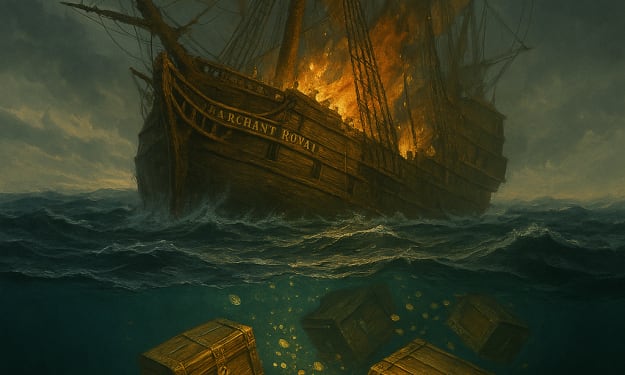
The Vanished Treasure of the Merchant Royal: The Lost Fortune of England’s Sunken Galleon
The Merchant Royal: England’s Treasure Ship In the early 17th century, England’s naval power was growing, but it still lacked the colonial riches of Spain and Portugal. However, one ship—the Merchant Royal—would momentarily carry a fortune that rivaled any Spanish treasure fleet. Built in 1627 in London, the Merchant Royal was a 700-ton galleon owned by English merchants and captained by John Limbrey. The ship primarily sailed between England and the Spanish colonies in the Americas, trading goods for silver and gold. The Merchant Royal became famous not only for its size but for the value of its cargo. By the early 1640s, Spain was struggling to ship its wealth from the Americas back to Europe due to piracy and naval warfare. English ships like the Merchant Royal stepped in to help transport Spanish wealth in exchange for political and financial favors. The Ill-Fated Voyage of 1641 In 1641, after completing a successful trade voyage to the Spanish colonies in Mexico, the Merchant Royal docked at the port of Cadiz. There, she took on an extraordinary cargo of treasure—reportedly including 100,000 pounds of gold, 400 bars of Mexican silver, and countless pieces of jewelry and coinage. This cargo was being transported to Antwerp, Belgium, as payment for Spain’s debts. However, disaster struck. After setting sail from Cadiz toward Falmouth, England, the ship began to leak while traveling through stormy seas. Reports say the pumps failed to keep up with the water pouring in. Off the coast of Cornwall, near the Isles of Scilly, the Merchant Royal sank beneath the waves, dragging its unimaginable wealth to the seafloor. Of the estimated 80 crew members aboard, only around 40 were rescued by a companion ship, the Talbot. The rest, along with the galleon and her priceless cargo, were lost forever. The Value of the Lost Treasure The treasure on board the Merchant Royal was vast. Modern estimates put its worth at over $1.5 billion, which would make it one of the largest lost fortunes at sea. The cargo included: 100,000 pounds of gold (bullion and coins) 400 silver ingots Rubies, emeralds, and other precious stones Gold jewelry and religious artifacts This enormous wealth was insured by Spain and partially backed by English merchants, creating a political and financial scandal after its disappearance. Search and Myth For centuries, treasure hunters, salvagers, and adventurers have tried to locate the wreck of the Merchant Royal, but the ship has never been officially discovered. The waters off Cornwall are treacherous, with strong currents, rocky seabeds, and poor visibility. Many claim to have found pieces of treasure in the area, but no definitive proof has emerged. The legend of the Merchant Royal continues to attract explorers, and every few decades a new wave of interest surges. In 2007, a company called Odyssey Marine Exploration announced the recovery of over 500,000 silver coins from a wreck they nicknamed the “Black Swan.” Initially, many speculated it was the Merchant Royal, but further analysis suggested otherwise. Modern Expeditions and Technology Today’s search for the Merchant Royal has become more sophisticated. Underwater drones, sonar scanning, and deep-sea mapping have replaced traditional diving. In 2019, Royal Navy divers searching for a crashed aircraft off the Cornish coast stumbled upon a shipwreck with 17th-century artifacts—but it was not confirmed to be the Merchant Royal. The British government, salvage firms, and historical societies have debated the legal rights to the treasure. If discovered, the ship’s contents would likely trigger a complex international legal battle involving claimants from Spain, the UK, private salvage companies, and descendants of the original stakeholders. Legacy and Cultural Impact The Merchant Royal is more than a lost treasure; it is a symbol of ambition, maritime risk, and the turbulent economics of colonial Europe. Its story has inspired documentaries, novels, and folklore throughout England. Often referred to as “the El Dorado of the Deep,” the ship’s legend grows stronger with every generation of treasure hunters who search the sea for her glittering prize. Even if the Merchant Royal is never found, its tale remains an enduring chapter in maritime lore—one that stirs dreams of golden fortunes hidden just beneath the waves. Would you like an image showing the sunken galleon beneath the ocean or a depiction of it at sea before it sank?
By Say the truth about a year ago in History
Cato the Elde
Marcus Porcius Cato, often referred to as Cato the Elder or Cato the Censor, was a significant figure in the Roman Republic, embodying the values, conflicts, and changes of an emerging Rome. Born in 234 BCE in Tusculum, a small town located southeast of Rome, Cato hailed from a humble plebeian background. However, through his military skill, political resolve, and strong adherence to traditional Roman values, he established himself among the prominent figures in Roman history. His literary works and public endeavors offer essential perspectives on the early identity and principles of the Roman Republic.
By A Históriaabout a year ago in History
Retro Jeans | From Workwear to Cultural Icon.
The Story Behind the Fabric That Never Fades. A Stitched Legacy: The Birth of Denim The story of jeans began in 1873 when Levi Strauss, a Bavarian immigrant in San Francisco, partnered with tailor Jacob Davis to patent a new kind of durable pants made from denim fabric, reinforced with copper rivets. These were designed specifically for miners and workers during the California Gold Rush.
By Sayed Zewayedabout a year ago in History