Fiction
The Bone-Singer's Oath
Prologue: The Blood-Snow Norway, 872 CE The ravens came first. They circled above the battlefield, their cries sharp as the wind slicing through the fjords. Astrid Gormsdóttir knelt in the crimson-stained snow, her breath ragged, her left arm hanging useless where the Saxon axe had shattered bone. Around her, the bodies of her war-band lay strewn like broken toys—men and women who’d followed her across the whale-road to claim land in this accursed, fog-choked valley.
By Digital Home Library by Masud Rana2 years ago in History
Echoes of Conquest: The Untold Effects of Invasions on History and Treasure
The Impact of Invasions: What Happened and the Treasures They Left Behind Throughout history, powerful empires and armies have launched invasions that reshaped civilizations. These invasions resulted in political upheavals, cultural transformations, economic shifts, and the movement of vast amounts of treasure. From the Mongol conquests to the European colonial invasions, these campaigns left lasting effects on the world. The Immediate and Long-Term Effects of Invasions Political and Territorial Changes One of the most immediate impacts of an invasion is the shift in political control. Empires such as the Roman Empire, the Mongols, and the British Empire expanded their territories through conquest. These invasions often resulted in the establishment of new governments, sometimes through forceful annexation or the imposition of puppet rulers. For example, the Mongol invasion of China led to the establishment of the Yuan Dynasty under Kublai Khan. Long-term effects included redrawing borders, displacing populations, and creating new states. For instance, the Spanish conquest of the Americas led to the creation of Spanish colonies, permanently altering the political landscape of South and Central America. Cultural and Social Transformations Invasions often led to the spread of languages, religions, and customs. The Islamic conquests in the Middle East and North Africa led to the spread of Islam and Arabic culture. Similarly, Alexander the Great’s campaigns spread Greek culture across Asia, influencing art, governance, and philosophy for centuries. However, cultural destruction was also a common consequence. Many historical invasions resulted in the loss of indigenous traditions and knowledge. The arrival of European colonizers in the Americas led to the suppression of native cultures and languages. The destruction of libraries, such as the Library of Alexandria, during conflicts resulted in the loss of invaluable knowledge. Economic and Infrastructural Shifts Invasions frequently altered economies by introducing new trade routes, currency systems, and labor structures. For instance, the Mongol invasions connected distant parts of the world through the Silk Road, fostering economic exchange between Europe and Asia. The British colonization of India restructured its economy, diverting wealth towards Britain and leading to centuries of economic exploitation. Infrastructure suffered during invasions, with cities being burned and looted. The destruction of major centers such as Baghdad by the Mongols in 1258 led to economic decline. On the other hand, some invaders improved infrastructure; the Romans built extensive road networks in conquered territories, facilitating trade and governance. The Fate of Treasures Plundered During Invasions Gold, Silver, and Precious Gems Treasures have been a prime target for invaders. The Spanish conquest of the Aztec and Inca Empires resulted in massive amounts of gold and silver being shipped to Europe. Hernán Cortés and Francisco Pizarro seized enormous amounts of wealth, melting down artifacts and shipping the precious metals to Spain. Similarly, the British looted treasures from India, including the famed Koh-i-Noor diamond, which became part of the British Crown Jewels. The Mongols plundered the wealth of cities they conquered, including China and Persia, taking gold, jade, and textiles back to their empire. Religious and Cultural Artifacts Invasions also resulted in the seizure of religious and cultural artifacts. The Crusades saw European knights looting relics from the Middle East, many of which remain in European churches and museums. The Parthenon Marbles, taken by Lord Elgin from Greece during Ottoman rule, remain in the British Museum, leading to ongoing disputes about their rightful ownership. Lost and Hidden Treasures Some treasures plundered during invasions remain missing. The Amber Room, a masterpiece of art looted by the Nazis during World War II, has never been found. Similarly, treasures from the Summer Palace in China, looted by British and French troops in 1860, are scattered around the world, with many pieces lost. Conclusion The history of invasions is not just a tale of battles and conquests but also of the immense changes they brought to civilizations. From the collapse of empires to the looting of priceless treasures, invasions have left an indelible mark on history. The debate over the return of stolen artifacts continues, highlighting the long-lasting consequences of these conflicts. Understanding the impact of historical invasions helps us appreciate the complexities of cultural heritage and economic transformations shaped by these tumultuous events.
By Say the truth 2 years ago in History
"The Greatest Invasion in History: Empires at War"
The Most Significant Invasions in History: When Empires Transformed the World Throughout the annals of history, formidable empires have endeavored to expand their domains through extensive invasions. These conquests shaped civilizations, redefined boundaries, and transformed cultures permanently. Below are some of the most consequential invasions in history that shaped the trajectory of humanity. 1. The Mongol Invasions (13th-14th Century) One of the most extensive and lethal military campaigns in history was orchestrated by Genghis Khan and his Mongol legions. Beginning in 1206, the Mongols invaded China, the Middle East, and Europe, establishing the largest continuous empire the world had ever witnessed. Cities such as Baghdad, Kyiv, and Samarkand were destroyed, resulting in the loss of millions of lives. The Mongols' exceptional equestrian skills, composite bows, and psychological warfare strategies rendered them nearly invincible. 2. The Roman Invasions (1st Century BC - 5th Century AD) The Roman Empire expanded through numerous invasions, but perhaps its most renowned campaigns were Julius Caesar’s conquest of Gaul (58-50 BC) and the invasion of Britain in 43 AD. Rome’s legions overwhelmed local tribes with superior discipline, engineering, and organization. Over the centuries, Rome incorporated extensive territories from Spain to the Middle East, disseminating its language, culture, and laws. 3. The Islamic Conquests (7th-8th Century) Following the emergence of Islam in the Arabian Peninsula, Muslim armies swiftly expanded into the Persian and Byzantine Empires. Under the Rashidun and Umayyad Caliphs, Islamic forces subdued Persia, North Africa, and Spain in less than a century. The proliferation of Islam, Arabic culture, and the establishment of the Caliphate transformed the political landscape of the medieval world. 4. The Norman Invasion of England (1066) One of the most renowned invasions in Western history, the Norman conquest of England by William the Conqueror in 1066, irrevocably altered England. The Battle of Hastings resulted in the defeat of Anglo-Saxon King Harold II, ushering in a new ruling class, the introduction of feudalism, and significant cultural shifts that continue to impact England today. 5. The Spanish Conquest of the Americas (15th-16th Century) The Spanish Empire, led by explorers like Hernán Cortés and Francisco Pizarro, seized extensive territories in the Americas. The Aztec and Inca Empires succumbed to Spanish forces due to superior weaponry, alliances with local tribes, and the catastrophic effects of European diseases. The conquest resulted in immense wealth for Spain but at the expense of indigenous civilizations and cultures. 6. Napoleon’s Invasion of Russia (1812) Napoleon Bonaparte’s ambitious endeavor to conquer Russia became one of the most significant military catastrophes in history. In 1812, he commanded over 600,000 troops into Russia, anticipating a swift triumph. However, severe winters, the scorched-earth tactics employed by the Russian army, and logistical shortcomings decimated his forces, culminating in a humiliating retreat and weakening the French Empire. 7. Hitler’s Invasion of the Soviet Union (1941) Operation Barbarossa, Nazi Germany's incursion into the Soviet Union in 1941, constituted the most extensive military undertaking in history. Hitler's objective was to seize Moscow and eradicate communism, yet the expansive Soviet terrain, severe winters, and resolute resistance reversed the momentum against Germany. The unsuccessful outcome of this invasion signaled the onset of the decline for Nazi Germany in World War II. Conclusion From the Mongols to the Nazis, history is replete with empires striving to expand through monumental invasions. While some of these conquests resulted in innovation and cultural interchange, others caused profound suffering and devastation. Each invasion imparted a significant influence, molding the world as we recognize it today.
By Say the truth 2 years ago in History
Secrets of the Pharaohs
Chapter One: The Discovery of the Ancient Papyrus On a scorching summer day, Dr. Ahmed Al-Najjar was working with his team at the archaeological site near Luxor. The golden sunrays penetrated the site, casting shadows over meticulously unearthed artifacts. The day seemed no different from the others; routine excavations, searching for artifacts, and documenting simple discoveries. However, Dr. Ahmed had no idea that this day would bring a discovery that would change the course of history.
By mohamed elsayed2 years ago in History
The Great Pyramid: Tomb or Ancient Power Plant?
For centuries, the Great Pyramid of Giza has stood as an enduring marvel, its towering presence sparking awe and curiosity. Mainstream history tells us it was built 4,500 years ago as a grand tomb for Pharaoh Khufu, a monument to honor a god-king of Egypt’s Fourth Dynasty. Yet, a closer look reveals a structure that defies the conventions of a burial site-lacking artifacts, hieroglyphs, or the ornate decorations typical of Egyptian tombs. No mummies have ever been found inside any pyramid, including this one. So, if it wasn’t a tomb, what was it? Some daring thinkers, including the visionary Nikola Tesla, suggest an astonishing possibility: the Great Pyramid was a colossal power plant, tapping into the Earth’s energy and distributing it wirelessly across the globe-an idea that might have been conceived not 4,500 years ago, but perhaps 13,500 years in the distant past.
By KWAO LEARNER WINFRED2 years ago in History
The Tsar and the Empress
Chapter One: The Beginning of the Plot In ancient times, when great empires ruled the world, there was a powerful empire known as the "Empire of Nova". Empress Helena ruled with wisdom and fairness, while Caesar Marcus managed the affairs of the army with an iron fist. Their palace, the Grand Palace, was surrounded by secrets and mysteries.
By mohamed elsayed2 years ago in History
"The Forgotten Riches of Alexander’s Indian Campaign". AI-Generated.
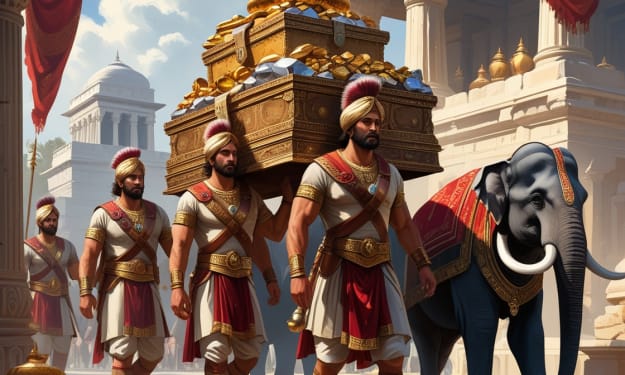
The Plundered Wealth: Alexander the Great’s Loot from India When Alexander the Great embarked on his ambitious campaign to conquer the known world, India lay as one of his final conquests. The vast subcontinent, rich in gold, gems, spices, and cultural heritage, became an irresistible prize. Though his foray into India was relatively brief, the treasures he and his army looted from the region were immense and legendary. This article delves into the historical context of Alexander’s invasion of India, the wealth he amassed during his campaign, and the lasting impact of that plundered treasure. The Historical Context: Alexander’s March to India By 327 BCE, Alexander had already conquered the powerful Persian Empire and parts of Central Asia. His sights were then set on the lands east of the Hindu Kush, which ancient Greeks described as a land of unimaginable wealth. India’s fame had spread through ancient trade networks, and tales of golden palaces, jewel-encrusted statues, and thriving cities drew Alexander’s interest. Alexander crossed into India with a massive army, initially welcomed by smaller kingdoms, but soon faced stiff resistance from local rulers, particularly King Porus of the Paurava kingdom. After a fierce battle on the banks of the Hydaspes River (modern-day Jhelum), Alexander defeated Porus and gained access to the riches of his kingdom. Treasures Taken from India The exact amount of treasure looted by Alexander’s forces is difficult to quantify, but historical accounts offer glimpses of the immense riches. Ancient sources like Arrian, Plutarch, and Quintus Curtius Rufus describe the loot acquired during the campaign: Gold and Silver: Temples, palaces, and treasuries were pillaged for gold and silver artifacts. It is believed that Alexander’s forces seized large amounts of gold coins, precious metals, and ornate vessels. Jewels and Gems: India was famed for its gemstones, especially diamonds, pearls, and rubies. These were highly prized by the Greeks, and Alexander ensured that his share of the spoils included the finest gems. Exotic Animals and Luxury Items: Alexander’s forces also seized elephants, spices, and textiles, all of which added to the allure of the East in Greek imagination. Captured Art and Relics: Temples and cultural centers were looted, with statues, idols, and other religious artifacts taken as trophies of war. The Fate of the Loot The treasure looted from India did not remain intact for long. Much of it was used to pay Alexander’s soldiers, who had endured years of continuous campaigning. Some of the wealth was sent back to Macedonia, where it funded monumental building projects and military expansions. However, a significant portion of the loot was lost during Alexander’s perilous return journey. After leaving India, Alexander’s army faced a grueling march through the Gedrosian Desert (modern-day southern Pakistan and Iran), where many soldiers perished, and supplies, including parts of the treasure, were lost to the harsh conditions. The Legacy of Alexander’s Loot The treasures Alexander took from India played a crucial role in shaping the economy and culture of the Hellenistic world. Greek cities flourished with newfound wealth, and the influx of Indian gold and gems added to the splendor of Alexander’s empire. The spread of Hellenistic art and architecture in the regions Alexander conquered also bore traces of Indian influence, suggesting a two-way exchange of cultural treasures. The Mystery of Alexander’s Lost Wealth Despite the significant looting, much of Alexander’s wealth has vanished over the centuries. Some believe that parts of the treasure were lost when Alexander’s fleet encountered storms while navigating the Indus River. Others speculate that hidden caches of loot may still lie buried along Alexander’s route through Central Asia and the Middle East. Adding to the mystery is the unknown location of Alexander’s tomb, which some legends claim was buried with immense wealth. Treasure hunters and historians have long searched for clues, but the whereabouts of both Alexander’s tomb and his lost Indian treasure remain elusive. Impact on Indian History The invasion and looting of India by Alexander, though short-lived, had long-lasting effects. His campaign exposed the subcontinent to Greek ideas, leading to the emergence of Indo-Greek kingdoms that left their own cultural and artistic legacies. However, the loss of wealth and resources weakened some Indian kingdoms, paving the way for later invasions and internal conflicts.
By Say the truth 2 years ago in History
The Legendary Wealth of Alexander the Great: Looted Treasures That Shaped History. AI-Generated.
The Legendary Loot of Alexander the Great: Unraveling the Wealth of His Conquests Throughout history, few figures have left a legacy as far-reaching and influential as Alexander the Great. Born in 356 BCE in Macedonia, Alexander was destined for greatness, and by the time of his death at the age of 32, he had created one of the largest empires the world had ever seen. However, Alexander’s conquests were not just about expanding territory. His campaigns led to the accumulation of vast amounts of wealth, as he looted palaces, temples, and treasuries across Asia, the Middle East, and parts of North Africa. This wealth, comprising gold, silver, jewels, and priceless artifacts, played a crucial role in shaping the economic, cultural, and political landscape of the ancient world.
By Say the truth 2 years ago in History
"Vanished Riches: History’s Most Mysterious Lost Treasures"
Vanished Through Time: History’s Most Enigmatic Lost Treasures Throughout the ages, treasures have been fashioned, uncovered, desired, and, at times, inexplicably lost. The fascination with gold, gemstones, invaluable artifacts, and ancient heirlooms has propelled empires into conflict, inspired numerous legends, and motivated treasure seekers to undertake treacherous expeditions. Nonetheless, certain treasures, once noted in historical records, appear to have vanished entirely, leaving behind lingering inquiries and theories enveloped in enigma. This article explores some of history’s most cryptic treasures that have disappeared and remain unaccounted for to this day. 1. The Ark of the Covenant The Ark of the Covenant is arguably one of the most renowned lost relics in human history. According to scriptural narratives, it was a wooden chest adorned with gold that housed the stone tablets inscribed with the Ten Commandments. Revered as a representation of divine presence and authority, the Ark was contained within the First Temple in Jerusalem until it mysteriously vanished after the Babylonians invaded the city in 587 BCE. Some conjecture that the Ark was concealed to safeguard it from marauders, while others theorize it was transported to Ethiopia or interred deep beneath Jerusalem’s Temple Mount. Despite centuries of efforts to locate it, the Ark remains elusive, leaving a legacy of religious and historical fascination. 2. The Lost Fabergé Eggs Crafted by the illustrious Russian jeweler Peter Carl Fabergé, the Fabergé eggs were lavish, gem-encrusted Easter gifts made for the Russian Imperial family in the late 19th and early 20th centuries. Of the 50 imperial eggs created, only 43 have been documented. The whereabouts of the remaining seven eggs remain a mystery, making them among the globe’s most coveted treasures. The eggs disappeared during the upheaval of the Russian Revolution when the Romanov dynasty was toppled and their belongings were pillaged or sold. Occasionally, a missing Fabergé egg resurfacessuch as the egg found at a flea market in the U. S. in 2014but the majority remain unrecovered, captivating collectors and historians alike. 3. The Treasure of the Knights Templar The Knights Templar, a medieval Christian military order, were reputed to possess immense riches, including gold, silver, and religious artifacts such as the Holy Grail and the True Cross. However, after the order was dissolved in the early 14th century by Pope Clement V and King Philip IV of France, a significant portion of their wealth vanished. Some surmise that the Templars concealed their riches in undisclosed sites prior to their capture, potentially in Scotland, Oak Island in Canada, or even beneath the streets of Paris. Speculations regarding the treasure’s fate have inspired numerous books, films, and treasure hunts, but the reality remains elusive. 4. The Amber Room Regarded as the “Eighth Wonder of the World,” the Amber Room was an astonishing chamber constructed entirely of amber panels, gold leaf, and mirrors. Originally built in Prussia and gifted to Peter the Great of Russia in 1716, it was situated in the Catherine Palace near St. Petersburg. During World War II, the Nazis plundered the Amber Room and transferred it to Königsberg Castle in East Prussia. As the conflict concluded, the Amber Room disappeared. Some assert that it was obliterated during the bombing of Königsberg, while others propose that it was concealed within a clandestine underground facility. Despite countless expeditions, the original Amber Room has yet to be located, although a detailed replica was finalized in Russia in 2003. 5. The Flor de la Mar’s Treasure The Flor de la Mar, a Portuguese vessel transporting one of the most substantial treasure collections in history, sank off the coast of Sumatra in 1511. The ship was heavily laden with gold, diamonds, and other precious items plundered from the Sultanate of Malacca. Valuations of the treasure range from hundreds of millions to billions of dollars. Notwithstanding numerous recovery attempts, the ship and its treasure remain submerged beneath the ocean. The perilous waters of the Strait of Malacca and shifting sediments have rendered retrieval efforts challenging, transforming the Flor de la Mar into one of the ocean’s most storied lost treasures. 6. The Lost Library of Alexandria While not a treasure in the traditional sense, the Library of Alexandria was among the most significant repositories of knowledge in the ancient era. Situated in the Egyptian city of Alexandria, it is purported to have contained hundreds of thousands of scrolls, encompassing the collective knowledge of ancient civilizations. The library was sadly annihilated, although historians debate whether it was set ablaze during Julius Caesar’s siege of Alexandria in 48 BCE, assaulted by subsequent Roman emperors, or gradually fell into decay over time. The destruction of the Library of Alexandria is regarded as one of the most profound intellectual catastrophes in history, with countless literary, scientific, and philosophical works irretrievably lost. 7. The Lost Inca Gold When Spanish conquistadors apprehended the Inca emperor Atahualpa in 1532, he proposed a ransom of a chamber filled with gold and silver in return for his liberty. While part of the ransom was delivered, Atahualpa was executed, and the remainder of the treasure was concealed by the Incas to prevent it from falling into Spanish possession. Legends narrate of extensive caches of Inca gold hidden in secret caves or buried deep within the Andes Mountains. Treasure seekers have pursued the Lost Inca Gold for centuries, but it remains one of the most persistent and elusive treasures in history. Conclusion: The Enduring Allure of Lost Treasures Lost treasures symbolize more than mere forgotten wealththey embody the mysteries of history, of civilizations that have flourished and disappeared, and of humanity's intrinsic desire to seek, discover, and unveil the unknown. Whether concealed beneath the ocean, hidden within ancient relics, or lost to the passage of time, these treasures continue to fascinate the imagination of treasure hunters, historians, and adventurers, keeping the spirit of discovery vibrant throughout the ages.
By Say the truth 2 years ago in History
"Lost Riches of the Ages: History’s Greatest Unfound Treasures"
The Unfound Treasures: History's Greatest Lost Wealth Throughout time, narratives of lost wealth have enthralled the imaginations of explorers, scholars, and treasure seekers. From maritime disasters carrying unimaginable fortunes to concealed ancient cities rumored to possess immense riches, the attraction of discovering these treasures remains irresistible. Despite centuries of investigation and technological progress, numerous legendary caches remain undiscovered, concealed beneath oceans, deserts, jungles, or mountains. This article examines some of the most mysterious and elusive treasures that treasure seekers have pursued for generations yet have never located. 1. The Wealth of the Flor de la Mar The Portuguese vessel Flor de la Mar sank off the coast of Sumatra in 1511 while transporting one of the most affluent cargoes ever assembled. Following its assistance in capturing the prosperous kingdom of Malacca, the ship was laden with a tremendous fortune in gold, precious gems, and various valuables, estimated to be worth billions today. Despite numerous attempts to find the wreck, it remains lost beneath the turbulent waters of the Strait of Malacca, evading treasure seekers for over 500 years. 2. The Abandoned City of El Dorado El Dorado, the mythical city of gold, has long represented unimaginable wealth concealed deep within the Amazon rainforest. The myth originated from stories of a golden sovereign who adorned himself in gold dust and plunged into a sacred lake during religious rites. Adventurers from Spain and other European nations initiated expeditions to discover this legendary city, but none were successful. The dense, perilous Amazon jungle and the absence of concrete evidence have rendered El Dorado one of history's most elusive treasures. 3. The Oak Island Money Pit The Oak Island Money Pit, situated off the coast of Nova Scotia, Canada, is one of the most enduring riddles of treasure. Since the late 18th century, treasure seekers have been excavating the island, convinced that a vast fortune lies buried deep below ground. Theories range from pirate treasure left by Captain Kidd or Blackbeard to the lost jewels of Marie Antoinette and even the Ark of the Covenant. Despite over 200 years of digging and millions of dollars invested, the treasureif it existsremains concealed. 4. The Wealth of the Knights Templar The Knights Templar, a medieval Christian military order, accumulated extraordinary wealth during the Crusades. Legend has it that when the Templars were dissolved in the early 14th century, they concealed their treasuresincluding gold, sacred relics, and ancient documentsto prevent them from falling into the possession of King Philip IV of France. Theories propose that the treasure may be hidden in secret sites, such as Rosslyn Chapel in Scotland, the island of Cyprus, or even beneath the streets of Jerusalem. Despite extensive searches, the treasure has never been located. 5. The Abandoned Inca Gold When the Spanish conquistadors apprehended the Inca sovereign Atahualpa in 1532, they demanded an enormous ransom in gold and silver. The Incas assembled a colossal amount of valuable metals; however, before it could be surrendered, Atahualpa was executed, and the treasure vanished. Legends propose that the Inca concealed the treasure in a clandestine cavern or subterranean passage in the Andes Mountains. Numerous expeditions have pursued the lost Inca gold, but it remains one of the most significant enigmas of the Americas. 6. The Amber Room The Amber Room, frequently referred to as the "Eighth Wonder of the World," was a stunning chamber composed entirely of amber, gold, and precious stones. Initially constructed in Prussia and subsequently bestowed to Russia, the room was plundered by Nazi troops during World War II and transported to Königsberg (now Kaliningrad). When the city was bombarded, the Amber Room disappeared without a trace. Despite extensive searches, its location remains uncertain, fueling speculation that it may be concealed in an underground bunker, a sunken vessel, or a covert vault. 7. The Lost Dutchman’s Gold Mine The Lost Dutchman’s Gold Mine is a mythical concealed gold mine in the Superstition Mountains of Arizona. According to legend, a German prospector named Jacob Waltz uncovered the mine in the 19th century and kept its whereabouts a secret. Following his demise, treasure seekers have scoured the area, driven by tales of its immense wealth. Despite numerous expeditions, no one has succeeded in locating the legendary mine, and it remains one of America’s most persistent treasure mysteries. 8. The Treasure of the Copper Scroll The Copper Scroll, one of the Dead Sea Scrolls found in the Qumran Caves, enumerates 64 sites where substantial quantities of gold, silver, and other treasures are purportedly concealed. Unlike the other Dead Sea Scrolls, which are composed of parchment or papyrus, the Copper Scroll is inscribed on metal, indicating it was intended to endure for centuries. Scholars theorize that the treasures may have belonged to the Second Temple in Jerusalem; however, despite decades of investigation, the hidden caches described in the scroll have never been discovered. 9. The San Miguel Shipwreck The Spanish treasure fleet of 1715, comprising 11 vessels transporting gold, silver, and precious gems from the New World to Spain, was struck by a hurricane off the coast of Florida. Most of the ships sank, dispersing their valuable cargo across the ocean floor. While some treasure has been retrieved, the San Miguel, believed to carry the largest share of the fleet's wealth, remains lost. Treasure hunters persist in their quest for the ship, hoping to unearth its renowned riches. Conclusion The appeal of vanished riches exists not solely in their substantial financial worth but also in the enigmas and tales that envelop them. In spite of hundreds of years of exploration, technological progress, and innumerable ventures, these riches persist in remaining concealed, poised for discovery. Whether interred beneath migrating dunes, immersed in profound depths, or masked within historic remnants, they maintain their grip on human creativity, offering adventure, intrigue, and the prospect of unthinkable affluence.
By Say the truth 2 years ago in History
A Morning Kiss's Magic
The golden rays of the morning sun trickle through the silky drapes as it languidly spreads across the sky. The house is still silent, and the outside world is still. Warm coffee mugs, leisurely breathing, and the simple pleasure of taking your time are all encouraged on this particular morning. The promise of the new, the sweetness of the familiar, and the warmth of connection are all there in the first kiss of the day, which is a magical moment among all of this peace and quiet.
By MD SHAMIM RANA2 years ago in History