Fiction
The Hidden Treasure of the Mayan Pyramid
The Hidden Treasure of the Mayan Pyramids: Myths, Discoveries, and Wealth Introduction The Maya civilization, one of the most advanced and mysterious ancient cultures, flourished in Mesoamerica for thousands of years. Their towering pyramids, elaborate temples, and intricate cities have fascinated historians and archaeologists for centuries. Among the many enigmas surrounding the Maya, one of the most intriguing is the legend of their hidden treasures. Gold, jade, and sacred artifacts are believed to be buried beneath the massive pyramids, concealed within underground chambers and undiscovered tombs. But how much of this is legend, and how much is fact? This article explores the mystery of the Mayan hidden treasure, the wealth they accumulated, and ongoing efforts to uncover their secrets. The Mayan Civilization and Their Wealth The Maya civilization, which thrived from 2000 BCE to the Spanish conquest in the 16th century, was known for its wealth and trade. They did not use currency in the way we do today but relied on valuable goods such as cacao beans, jade, obsidian, and gold for trade. Some of their wealth came from extensive trading networks that stretched from present-day Mexico to Central America. Gold and silver, though not as highly valued by the Maya as jade, were still present in ceremonial objects and jewelry. These precious metals were often used in religious offerings and buried with the elite rulers and priests. Unlike the Aztecs and Incas, the Maya didn’t create large hoards of gold but instead distributed their wealth in temples, tombs, and hidden chambers. The Legend of the Mayan Treasure The belief in a hidden Mayan treasure stems from both historical accounts and local legends. Some Spanish conquistadors, after witnessing the wealth of the Maya, wrote about golden artifacts that were hidden deep within temple pyramids or underground caves. Unlike the Aztecs, who amassed large amounts of gold, the Maya often buried their treasures as part of their religious rituals. One of the most famous stories involves the legendary treasure of King Kʼinich Janaabʼ Pakal, the great ruler of Palenque. His tomb, discovered in the Temple of the Inscriptions in 1952, contained an exquisite jade mask, intricate jewelry, and a magnificent sarcophagus. However, many believe even greater treasures remain undiscovered in other pyramids across the region. Major Discoveries of Mayan Treasure 1. The Tomb of Pakal the Great In 1952, archaeologist Alberto Ruz Lhuillier uncovered the tomb of Kʼinich Janaabʼ Pakal in the Temple of the Inscriptions, located in Palenque, Mexico. Inside, he found a jade death mask, intricate carvings, and numerous artifacts. This discovery proved that the Maya buried their elite rulers with precious items. 2. The Cenote of Sacrifice – Chichén Itzá At the sacred cenote (sinkhole) of Chichén Itzá, divers have recovered gold disks, jade figurines, and other offerings thrown into the water as sacrifices to the gods. These findings suggest that more treasures may be hidden in other sacred water sources. 3. The Burial Chambers of Tikal Excavations at Tikal, one of the largest Mayan cities, have uncovered tombs filled with jade, gold, and ceremonial objects. Some pyramids remain unexplored, leading researchers to believe more hidden treasures may exist. Where Could the Hidden Treasure Be? Despite numerous discoveries, many archaeologists believe vast amounts of Mayan treasure are still hidden. Some possible locations include: Undiscovered chambers within pyramids – Many pyramids have not been fully excavated, and advanced scanning technology has recently revealed hidden chambers within structures such as the Temple of Kukulcán in Chichén Itzá. Underground caves and tunnels – The Maya considered caves as sacred places, often using them for religious rituals and burials. Some caves, such as the Balamku cave discovered in 2018, contained ancient offerings. Rainforest-covered ruins – Many Mayan cities remain buried beneath the dense jungles of Guatemala, Belize, and Mexico. New LiDAR (Light Detection and Ranging) technology has revealed hundreds of lost structures that could contain hidden artifacts. Estimated Net Worth of Mayan Treasure It is impossible to put an exact value on the hidden Mayan treasures, but based on discovered artifacts and historical trade, experts estimate their worth in the billions. Some factors contributing to this estimation include: Jade artifacts – Priceless due to their cultural significance and rarity. Gold and silver objects – Though not as abundant as in Aztec or Incan cultures, recovered Mayan gold objects suggest hidden hoards. Ancient manuscripts and carvings – Many Mayan codices and artworks are invaluable historical treasures. Conclusion The hidden treasures of the Mayan pyramids continue to captivate the world. While many artifacts have been discovered, vast riches likely remain buried within undiscovered tombs, sacred caves, and forgotten cities. With modern technology aiding archaeological exploration, it may only be a matter of time before new discoveries rewrite our understanding of Mayan wealth and history.
By Say the truth 2 years ago in History
Three Temples of Solomon - The Mysterious Story
The story of the Red Cow is well-known to everyone. It is a cow mentioned in the Old Testament. Perhaps you have seen the episode and witnessed the red cows, or maybe you already knew about them. But hasn’t curiosity struck you? What are they waiting for? Why would slaughtering it be a reason for the construction of their alleged Third Temple? And if the awaited temple is indeed the Third Temple, what is the story of the first and second temples? How did it all begin, and where? Those who are not informed about this topic today, which is considered the foundation of the existential conflict of the nation, are ignorant. If you wish to learn more about it, you must prepare yourself, as you will dive into a sea of shocking information that has been hidden from you. You will be surprised to find that this entire conflict might not truly belong here, and that major figures have been eliminated to prevent the leakage of this information. Then, you will face the most important question: Is the temple real to begin with? And if it is real, was it truly in the land of Palestine, or in a far, faraway place? Is the Ark of the Covenant, which was and still is the basis of this search, truly real? And the shocking secret you might be unaware of—is the term "temple" truly linked to Syria, Yemen, Ethiopia, and Yasser Arafat? The questions are many and complex, but I must try to connect them so that you can understand the truth and be informed of every detail in this battle. So, take a deep breath and stay focused, because today we will search anew for the Temple of Solomon.
By QuirkTales2 years ago in History
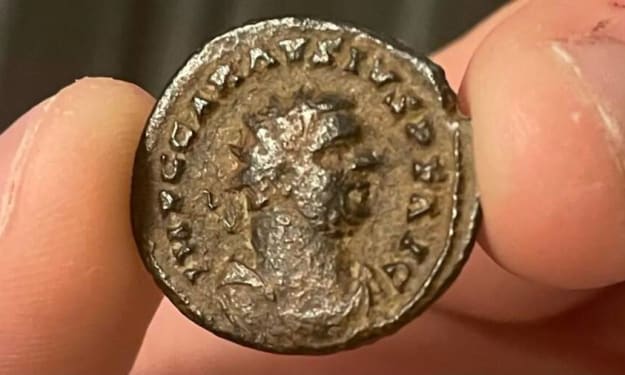
1,800 Year Old Roman Coins Discovered in an English Field A Historic Treasure Unearthed.
Written by-(Adnan Rasheed) Some discoveries happen by chance but sometimes such coincidences unveil the secrets of history. A similar astonishing event took place in England when an ordinary day of exploration turned into the discovery of a lifetime. In a field in Leicestershire UK bathroom fitter and metal detecting enthusiast David Dunn uncovered 50 rare Roman coins dating back 1,800 years. These coins are now set to be auctioned expected to fetch around $1,800. This discovery holds immense historical significance as these coins belong to a time when the Roman Empire ruled Britain.
By Adnan Rasheed2 years ago in History
Scientists Discover Lost Works of Apollonius in Arabic Manuscript
Scientists Discover Lost Works of Apollonius in Arabic Manuscript Scientists have uncovered two highly significant but previously lost books by the Greek mathematician Apollonius, known in the ancient world as The Great Geometer. These works were found in an Arabic manuscript preserved in the Leiden University Libraries in the Netherlands. This revelation is part of a recently published book Prophets Poets and Scholars which consists of 50 chapters and is published by Leiden University Press. Apollonius 262 BC – 190 BC is considered one of Greece’s greatest mathematicians. His famous book The Conics of Apollonius introduced the concepts of hyperbola ellipse and parabola. The rediscovered manuscript contains books 5 and 7 of his work which had been lost to European scholars during the Renaissance. These manuscripts were acquired by the Dutch orientalist and mathematician Jacob Golius in the 17th century during his travels to the Middle East. He brought them to Leiden University as part of a collection of over 200 Arabic manuscripts.
By Adnan Rasheed2 years ago in History
How Should Canines Stay Healthy?. Content Warning.
Canines are something past pets; they are unwavering companions, protectors, and family members. Ensuring that they stay strong is a commitment every canine owner should see in a serious manner. Particularly like individuals, canines require genuine thought, sustenance, work out, and clinical mindfulness in regards to continue with a long and euphoric presence. In this article, we will research various approaches to keeping canines strong and prospering.
By MD.NAIM MIAH2 years ago in History
Ancient Egypt Breakthrough Archaeologists Uncover Stunning Discovery.
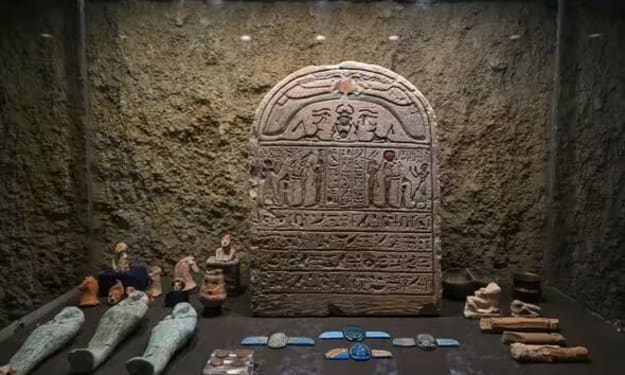
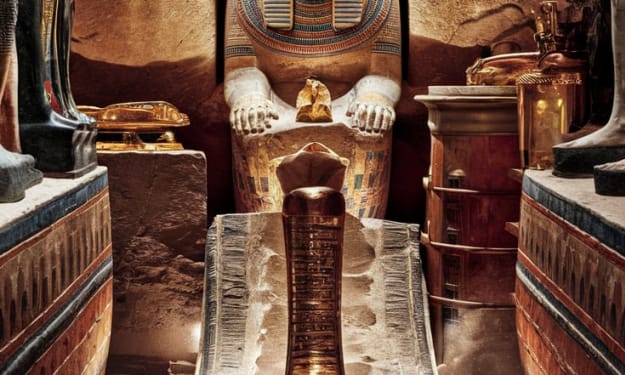
Ancient Egypt Breakthrough Archaeologists Uncover Stunning Discovery. A long lost world buried beneath the sands of time has once again emerged revealing secrets hidden for thousands of years. Egypt a land of mystery where every stone tells a tale, has become the center of global attention once more. In Luxor the very place where Pharaoh Tutankhamun’s tomb was uncovered in 1922 archaeologists have made a groundbreaking discovery one that is being hailed as a reconstruction of history. This remarkable find includes tombs coffins and artifacts that shed new light on ancient Egyptian life religious practices and funerary rituals opening doors to understanding one of the world’s oldest civilizations in a way never seen before. This is no ordinary excavation it is a glimpse into a civilization that thrived over 3,600 years ago now uncovered hundreds of feet beneath Luxor. Archaeologists have discovered 11 wooden coffins including one belonging to a child. These coffins were carefully placed within rock cut tombs and burial shafts, reflecting the ancient Egyptian belief that such burial sites provided spiritual protection for the deceased in the afterlife.
By Adnan Rasheed2 years ago in History
The Wealth and Power of the Greatest Land Empires in History
The Greatest Acreage Empires in History: Their Wealth, Acreage Area, and Rule Throughout history, all-inclusive empires accept risen and fallen, abstraction civilizations, trade, and cultural evolution. Some of these empires controlled massive acreage areas, accession abundant abundance and cardinal over assorted populations. This commodity explores the better acreage empires in history, estimates their net worth, and examines their babyminding methods. 1. Mongol Authority (1206–1368) - The Better Acreage Empire Land Area: ~24 actor aboveboard kilometers Estimated Net Worth: Trillions in today’s value How They Ruled: The Mongol Empire, founded by Genghis Khan, was the better abutting authority in history. The Mongols controlled acreage addition from China to Eastern Europe, utilizing aggressive tactics, cerebral warfare, and adept strategies. They accustomed the Pax Mongolica, a aeon of adherence that added barter forth the Cottony Road. Their taxation arrangement and annexation of baffled cities brought immense wealth. 2. British Authority (1583–1997) - The Better Overseas Empire Land Area: ~35.5 actor aboveboard kilometers at its peak Estimated Net Worth: $45 abundance (estimated by economists) How They Ruled: The British Empire, the better authority by absolute landmass, controlled colonies beyond Africa, Asia, and the Americas. It accumulated abundance through trade, industrialization, and ability exploitation. The British accustomed authoritative systems, railway networks, and acknowledged frameworks, admitting generally at the amount of bounded populations.
By Say the truth 2 years ago in History
Saturday Night 2024 Movie Review: Bold, Beautiful, and Beyond Expectations!
Introduction: The world of cinema is always brimming with new films that promise to make a lasting impact. But once in a while, a movie comes along that not only meets but exceeds every expectation. That film is Saturday Night 2024. With a buzz that began long before its official release, this movie has captivated audiences with its boldness, beauty, and cinematic mastery. In this review, we’ll take a deep dive into every aspect of Saturday Night 2024, exploring how it has redefined modern filmmaking. From its stunning visuals to its emotional depth, Saturday Night 2024 is a film that goes beyond what anyone could have expected.
By QuirkTales2 years ago in History
Ancient Strategy Games of Roman Soldiers The Fascinating Discovery of Bone Tokens in Hadrianopolis.
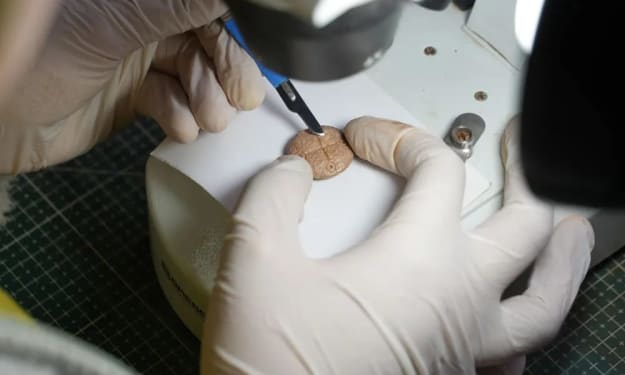
Ancient Strategy Games of Roman Soldiers The Fascinating Discovery of Bone Tokens in Hadrianopolis. The Roman civilization was not only known for its grand architecture powerful armies and advanced legal systems but also for its recreational activities intellectual exercises and strategy based games. For Romans games were not just a pastime they were an essential means of mental training tactical thinking and strategic planning. During the Roman era various types of games were popular including physical sports gambling and board games based on strategy. For soldiers stationed in military camps and fortresses such games were indispensable as they helped sharpen their intelligence strategic skills and decision making abilities.
By Adnan Rasheed2 years ago in History
The Life of Tutankhamun
Tutankhamun, one of the most famous pharaohs of ancient Egypt, has fascinated historians and archaeologists for decades. His nearly intact tomb, discovered in 1922 by Howard Carter, revealed a treasure trove of artifacts that provided invaluable insights into Egypt’s 18th Dynasty. This book explores his life, reign, and the mystery surrounding his death.
By Nada soliman2 years ago in History
The Afterlife of Socrates: Martyrdom, Philosophy, and the Amount of Truth
Athens in Crisis: The Accomplishments of a Trial The balloon of Socrates abundant adjoin a accomplishments of war, plague, and political upheaval. Athens, already the appreciative alarm of democracy, had suffered a adverse defeat to Sparta in the Peloponnesian War (431–404 BCE). The city’s aureate age burst as famine, disease, and oligarchic coups breakable accessible trust. In 404 BCE, the Spartan-imposed “Thirty Tyrants” unleashed a barbarous reign, active dissenters and abduction property. Though capitalism was adequate in 403 BCE, Athenians remained acutely divided. Socrates, again 70, had continued been a polarizing figure. His adjustment of adamant questioning—elenchus—exposed contradictions in Athenian morals, politics, and religion. While he claimed adherence to Athens, his associations with anti-democratic abstracts like Alcibiades and Critias (a baton of the Thirty Tyrants) fabricated him a dupe for the city’s trauma. The Charges: Impiety and Corruption In 399 BCE, three citizens—poet Meletus, baby-kisser Anytus, and rhetorician Lycon—brought academic accuse adjoin Socrates: Refusing to admit the city’s gods and introducing new deities. Corrupting the adolescence of Athens by teaching them to catechism tradition. These accusations stemmed from Socrates’ abstruse activity. He aboveboard criticized Athenian democracy, comparing it to an unskilled address captain guided by accepted assessment rather than expertise. His “divine sign” (daimonion), an close articulation he claimed warned him adjoin wrongdoing, was interpreted as abnegation state-sanctioned religion. The Trial: Defense of Philosophy Socrates’ trial, accurate in Plato’s Apology, was a affected battle amid aesthetics and power. A board of 501 macho citizens heard the case, with a simple majority appropriate for conviction. Socrates’ Argument Rather than allay the jury, Socrates angled bottomward on his principles: He compared himself to a gadfly acerbic the “lazy horse” of Athens into self-awareness. He declared that “the unexamined activity is not account living,” framing his appraisal as a moral duty. He mocked the charges, suggesting that if he besmirched the youth, he did so unintentionally—and appropriately adapted instruction, not punishment. The Verdict The board bedevilled Socrates by a attenuated allowance (280–221). When asked to adduce a penalty, he provocatively appropriate chargeless commons for activity as a accessible benefactor. Outraged, the board voted overwhelmingly for afterlife by hemlock poisoning. Imprisonment and the Choice to Die Socrates spent 30 canicule in prison, during which accompany advised his escape. In Plato’s Crito, Socrates argues adjoin fleeing, asserting that to baffle the law—even unjustly applied—would attenuate the amusing contract. For him, moral bendability outweighed self-preservation. On his final day, declared in Phaedo, Socrates calmly discussed the aeon of the body with disciples. When the apache handed him the hemlock, he drank it willingly. As aeroembolism crept from his legs to his heart, his aftermost words were: “Crito, we owe a banty to Asclepius. Do not balloon to pay the debt.” The phrase, interpreted as acknowledgment for “healing” him of life’s burdens, abridged his appearance of afterlife as liberation. Controversies and Actual Debates Socrates’ afterlife raises constant questions: Was the Balloon Politically Motivated? While the accuse were religious, advisers altercate Anytus, a autonomous leader, targeted Socrates to abolition debris of the Thirty Tyrants’ influence. Did Socrates Seek Martyrdom? His aggressive accent suggests he accustomed afterlife to adhesive his legacy. Yet Plato portrays him as accommodated to fate, not suicidal. Historical Accuracy of Plato’s Account Plato’s dialogues are abstruse dramas, not transcripts. Rival accounts, like Xenophon’s, downplay Socrates’ antagonism, implying Plato amplified his heroism. Legacy: The Birth of Western Philosophy Socrates’ afterlife became the cornerstone of his legacy: Plato’s Transformation The beheading disillusioned Plato with democracy, alarming The Republic and his academy, which shaped Western anticipation for millennia. A Model of Civil Disobedience Figures like Thoreau, Gandhi, and Martin Luther King Jr. drew on Socrates’ abnegation to accommodation attempt beneath accompaniment pressure. The Paradox of Chargeless Inquiry Socrates died for allurement questions in a association that admired chargeless speech—a cautionary account about the banned of tolerance. Modern Relevance: Accuracy in an Age of Cynicism In an era of misinformation and brainy polarization, Socrates’ afterlife challenges us to reflect: How do societies antithesis bone with stability? Can autonomous institutions bear adamant critique? What amount are we accommodating to pay for truth? His affliction reminds us that aesthetics is not an abstruse exercise but a abolitionist act—one that can agitate ability and appeal sacrifice. Conclusion: The Unanswered Question Socrates’ afterlife is not alone a actual accident but a active dialogue. Was he a destructive blackmail or a saint of reason? A victim of Athenian avengement or an columnist of his own fate? In allotment hemlock over hypocrisy, he affected altruism to accost the amount of integrity. His final lesson—that acumen begins with acceptance ignorance—echoes beyond ages, advancement us to question, to challenge, and to dare.
By Say the truth 2 years ago in History