Fiction
The Majestic Palace of Alexander the Great
The Grandest Alcazar of Alexander the Great: Wealth, Luxury, and Construction Alexander the Great (356–323 BCE) congenital an authority that continued from Greece to India, and with it came immense wealth. While Alexander is primarily accepted for his aggressive conquests, he additionally accustomed and active some of the best arresting palaces in history. Among these, his aristocratic abode in Babylon is believed to accept been the best extravagant. This commodity explores the costliest alcazar of Alexander the Great, ciphering its net worth, abstracts used, comfortable furnishings, gold and argent content, diamonds, silk, activity force, and architecture time. 1. The Location: Alexander’s Aristocratic Alcazar in Babylon After acquisition the Persian Authority in 331 BCE, Alexander fabricated Babylon (modern-day Iraq) his aristocratic capital. The burghal was already home to the allegorical Alcazar of Nebuchadnezzar II, but Alexander broadcast and adapted it to bout his admirable eyes of a apple empire. His alcazar in Babylon was advised to be the best comfortable anatomy of its time, before alike the Persian palaces of Persepolis and Susa. 2. The Estimated Net Account of Alexander’s Palace Historians appraisal that the absolute amount of Alexander’s Babylonian alcazar in avant-garde agreement would ambit from $50 billion to $100 billion, authoritative it one of the costliest structures in age-old history. The alcazar was abounding with: Gold-plated walls and ceilings Silver and brownish doors and furniture Gem-encrusted pillars Silk and Persian carpets Imported marble from Greece and Egypt 3. Abstracts Acclimated in Construction 3.1 Gold and Silver Gold Usage: Over 50,000 kilograms (50 tons) of authentic gold were acclimated for plating walls, statues, and aristocratic furniture. Estimated value: $3 billion. Silver Usage: Around 100,000 kilograms (100 tons) of argent were acclimated for doors, decorations, and utensils. Estimated value: $1 billion. 3.2 Precious Stones and Diamonds Diamonds and gemstones were alien from India and anchored in alcazar pillars, furniture, and the king’s throne. Lapis lazuli and azure stones from Afghanistan busy walls and ceilings. 3.3 Marble and Alien Woods White marble from Greece and Egypt was acclimated for alcazar flooring.
By Say the truth 2 years ago in History
2500 Year Old Tombs With Artifacts Discovered in Israel Shed Light on Ancient Trading
2500 Year Old Tombs With Artifacts Discovered in Israel Shed Light on Ancient Trading Archaeologists have made a groundbreaking discovery near Tlalim Junction in Israel unearthing 2,500 year old tombs and artifacts that shed new light on ancient trade networks and cultural exchanges. The findings led by the Israel Antiquities Authority IAA reveal the Negev Highlands' role as a significant hub for long distance commerce connecting the region to distant civilizations such as Yemen Phoenicia and Egypt. This discovery not only highlights the movement of goods but also underscores the exchange of ideas and traditions across the ancient world. The excavation uncovered a wealth of artifacts that provide insights into the region's historical significance. Among the most notable findings were flint arrowheads which researchers believe originated from Yemen and Oman. These arrowheads along with copper and silver jewelry suggest that the Negev Highlands were a key stopover for traders traveling along ancient routes. Additionally small alabaster vessels historically used to transport incense were discovered further emphasizing the area's role in the trade of luxury goods. One of the most striking artifacts was an amulet depicting Bes the Egyptian deity associated with protection and fertility. This amulet not only highlights the cultural influence of Egypt but also suggests that traders and travelers carried religious symbols for personal protection and spiritual significance.
By Adnan Rasheed2 years ago in History
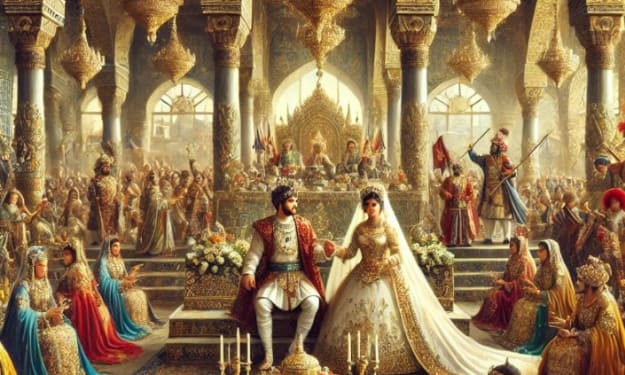
The Royal Splendor of Alexander and Roxana’s Wedding
The Wealth and Spending Habits of Alexander the Great and His Romantic Life Introduction Alexander the Great (356–323 BCE) was not only one of the greatest military conquerors in history but also one of the wealthiest individuals of his time. His empire stretched from Greece to India, and with it came unimaginable riches. From gold-plated palaces to extravagant banquets, Alexander spent his wealth generously—on his army, on cultural advancements, and on his personal life, including the women in his life. Though Alexander was not known for indulging in excessive romantic affairs like some rulers, he did have important relationships with women, including his wives and rumored lovers. This article explores how much wealth Alexander controlled, his spending habits, and how his relationships influenced his wealth distribution. 1. How Much Wealth Did Alexander the Great Have? 1.1 The Conquests and Looted Wealth Alexander amassed one of the greatest fortunes in history through his conquests, especially after defeating the Persian Empire (331 BCE) and seizing the royal treasury. Some of his largest financial gains included: The Treasury of Persepolis – Estimated at 180,000 talents of silver (modern value: over $5 billion). The Wealth of Babylon – Taken after the conquest of Babylon, worth billions in today’s terms. Egyptian and Indian Spoils – The vast riches of Memphis, Susa, and Indian temples. 1.2 Estimated Net Worth in Today’s Terms While it's difficult to estimate exact figures, historians believe Alexander's accumulated wealth could be worth: $500 billion to $1 trillion in modern value, making him one of history’s wealthiest figures. 2. How Did Alexander Spend His Wealth? 2.1 Military and Conquests Funding his army: Alexander paid for the largest standing army of the time, with over 50,000 soldiers, including elite cavalry units. Expensive war machines: Siege towers, catapults, and elite weaponry. Navy construction: Ships for Mediterranean control. 2.2 Lavish Lifestyles and Celebrations Banquets and feasts: Alexander hosted legendary feasts, sometimes costing millions in gold for a single night. Gold-plated cities: He rebuilt cities like Babylon, Susa, and Alexandria with gold decorations. Luxury gifts for his generals and friends. 2.3 Spending on Women and Relationships Alexander’s romantic life was not as extravagant as some rulers, but he did spend generously on his relationships. 3. Alexander’s Wives and Love Interests 3.1 Roxana – His Most Famous Wife Roxana was a Bactrian princess whom Alexander married in 327 BCE. Their wedding was a lavish affair, with gold, Persian-style decorations, and a feast lasting days. He gifted her golden jewelry, palaces, and Persian-style royal outfits. Estimated spending: $10 million to $50 million in modern value. 3.2 State Marriages with Persian Nobility Alexander married Statira (daughter of Darius III) and Parysatis (daughter of Artaxerxes III) in a massive royal wedding in Susa (324 BCE). The event included the marriage of 10,000 Macedonian soldiers to Persian noblewomen. Estimated cost of the grand wedding: $100 million in modern value. 3.3 Camp Followers and Courtesans Alexander often traveled with a large royal entourage, including women of noble rank and courtesans. He gifted precious gems, silk robes, and golden ornaments to them. Some of his known favorites were Barsine (a Persian noblewoman) and Thais (a famous Greek courtesan). Thais famously encouraged the burning of Persepolis, an event linked to Alexander’s excessive drinking and luxury lifestyle. 4. Did Alexander Spend More Than He Had? 4.1 Lavish Spending Towards the End of His Life By the time of his death in 323 BCE, Alexander’s wealth had been significantly diminished due to excessive spending on: Grand building projects (including temples and cities). Ongoing military campaigns. Luxury gifts to generals and noble allies. 4.2 His Plan to Spend Even More Alexander had planned a grand naval expedition, which would have cost billions in today’s money. He was even rumored to have wanted a tomb made entirely of gold. However, before these plans could materialize, Alexander died at the age of 32. 5. What Happened to His Fortune After His Death? After Alexander's death, his empire was divided among his generals (the Diadochi). His immense wealth was: Plundered and redistributed among his former commanders. Spent on wars of succession, known as the Wars of the Diadochi (322–281 BCE). Lost over time, with some treasures still missing today. Conclusion: Alexander’s Wealth and Love Life Alexander the Great was one of the wealthiest and most powerful rulers in history, accumulating a fortune estimated between $500 billion and $1 trillion in modern value. While much of this was spent on military campaigns and empire-building, he also spent lavishly on luxury, royal marriages, and relationships. His wives and romantic partners, especially Roxana and his Persian queens, benefited from his generosity, receiving extravagant gifts, palaces, and jewelry. However, his extreme spending eventually drained much of his empire’s wealth, leaving little behind for his successors. In the end, Alexander's true legacy was not in his wealth but in his empire, which reshaped history forever.
By Say the truth 2 years ago in History
Alexander the Great – The Warrior King. AI-Generated.
The Concrete Description of Alexander the Great: A Historical Perspective Alexander the Great (356–323 BCE) was one of history’s best allegorical aggressive leaders, accepted for his conquests from Greece to India. While his accomplishments are well-documented, descriptions of his concrete actualization appear from age-old historians, coins, sculptures, and literature. Was Alexander alpine and imposing, or was he of boilerplate height? Did he accept characteristic actualization that set him apart? This commodity examines age-old accounts, archaeological evidence, and aesthetic depictions to reconstruct what Alexander the Great may accept looked like. 1. Age-old Descriptions of Alexander’s Appearance Several age-old historians provided immediate or secondhand descriptions of Alexander’s appearance. Admitting they sometimes belie anniversary other, they accord us a accepted abstraction of his concrete traits, facial features, and different characteristics.
By Say the truth 2 years ago in History
Lost Riches of America – Hidden Gold and Forgotten Fortunes
The History of Abundance in America: Legends, Absent Gold, and Hidden Fortunes America has continued been a acreage of abstruseness and adventure, with endless belief of absent treasures, active gold, and hidden fortunes broadcast beyond the continent. From the all-inclusive abundance of aboriginal civilizations to the gold rushes and charlatan loot, America’s history is abounding with tales of abundance cat-and-mouse to be discovered. Abounding of these treasures are still missing, fueling belief and abundance hunts alike today. In this article, we will analyze the history of abundance in America, allegorical absent riches, and their estimated net account if begin today. 1. Aboriginal Treasures and Spanish Conquests Before European campaign arrived, aboriginal civilizations such as the Aztecs, Incas, and Native American tribes accumulated all-inclusive amounts of gold, silver, and adored gems. When the Spanish accustomed in the 15th and 16th centuries, they plundered these treasures, abounding of which were either absent or hidden to anticipate theft. 1.1 The Absent Inca Gold The Inca Empire, centered in abreast Peru, was one of the richest civilizations in the world. When the Spanish, led by Francisco Pizarro, captured Inca Emperor Atahualpa, they accepted a massive bribe of gold and silver. Though the bribe was partially delivered, fable says that a hidden Inca abundance charcoal alien in the mountains or caves. Estimated Amount Today: Over $10 billion if found. 1.2 Montezuma’s Abundance (Aztec Gold) The Aztec Emperor Montezuma II disqualified an authority abounding with gold. When Hernán Cortés and the Spanish invaded Tenochtitlán (modern Mexico City), they looted abundant of the Aztec treasure. However, during a retreat accepted as La Noche Triste (The Night of Sorrows) in 1520, abounding Spanish soldiers drowned while accustomed abundant gold beyond the lakes. Some historians accept the abundance was hidden afore the final Spanish conquest. Estimated Amount Today: Over $20 billion.
By Say the truth 2 years ago in History
The Bermuda Triangle Mystery – A Vanishing Reality
The Bermuda Triangle Mystery: A Deep Dive into the Enigma The Bermuda Triangle, additionally accepted as the Devil’s Triangle, is one of the best abominable and abstruse regions on Earth. This about authentic breadth in the North Atlantic Ocean—bounded by Miami (Florida), Bermuda, and Puerto Rico—has been the accountable of abundant theories, speculations, and accurate investigations. Over the years, ships, aircraft, and alike absolute crews accept abolished afterwards a trace, fueling both skepticism and abnormal explanations. Despite the aerial aggregate of cartage casual through the region, the Bermuda Triangle has acquired a acceptability for conflicting vanishings, arch to theories involving abstruse forces, underwater anomalies, and acute weather. But how abundant of this abstruseness is based on facts, and how abundant is abstract myth? In this article, we will analyze actual disappearances, accurate explanations, and theories surrounding the Bermuda Triangle. 1. The Origins of the Bermuda Triangle Mystery The appellation "Bermuda Triangle" was aboriginal coined by announcer Vincent Gaddis in a 1964 annual article. However, abstruse disappearances in the arena date aback centuries. Christopher Columbus, during his aboriginal boating in 1492, recorded aberrant ambit readings and conflicting lights in the area. Sailors and pilots accept appear agnate oddities anytime since. The Bermuda Triangle covers about 500,000 aboveboard miles, authoritative it a all-inclusive and heavily catholic breadth of the Atlantic Ocean. While the U.S. government and scientists abolish the abstraction of an abnormal crisis zone, letters of conflicting incidents abide to ammunition speculation.
By Say the truth 2 years ago in History
Why Was the Ancient Greek City of Hadrianopolis Suddenly Abandoned?
Why Was the Ancient Greek City of Hadrianopolis Suddenly Abandoned? The ancient Greek city of Hadrianopolis located in the Eskipazar district of Karabuk Turkey has long been a site of fascination for archaeologists and historians. Known for its stunning mosaics and historical significance the city was a prominent center in the western Black Sea region during antiquity. However its sudden and complete abandonment in the 7th century AD has remained a mystery for centuries. Recent excavations led by Ibrahim Sahin the culture and tourism director of Karabuk and Ersin Celikbas an archaeology professor at Karabuk University are shedding new light on this enigmatic event offering clues that may finally explain why the city was deserted.
By Adnan Rasheed2 years ago in History
Illusions of Time: Exploring Distortions in Perceived Passage of Time from Vsauce
Illusions of Time: Exploring Distortions in Perceived Passage of Time from Vsauce Time is a fundamental aspect of our lives, governing everything from our daily routines to the grand passage of life itself. Yet, despite its objective nature, time is not always perceived uniformly. The way we experience the passage of time can vary greatly depending on the situation, our emotions, or even our age. In his video "Illusions of Time," Vsauce delves into the fascinating ways in which our perception of time can be distorted, revealing that our subjective experience of time can be far more malleable than we might think.
By Ninette Ferriera 2 years ago in History
A Love Beyond Time
Paris, March 3, 1762 My Dearest Éléonore, As I sit here this evening, the flickering light of a solitary candle is my only companion. It casts long shadows on the walls, and it is in this quiet solitude that I take up my pen. My heart, full of yearning, compels me to write to you, my beloved, for your absence is a burden too heavy for me to bear in silence. Each pulse of my heart echoes with your name, each breath I take seems to call out for the warmth of your presence. How I long for the gentle touch of your hand upon mine, to hear the sweet melody of your voice that always soothes my troubled soul. Oh, how I ache for the softness of your embrace, a comfort I once knew so well.
By Alain SUPPINI2 years ago in History
My Dearest Alice
** Dec. 22,1941 My Alice, dear Alice,How I wish you were hereIt’s raining again, although my thoughts are quite clear The palm trees are waving Their branches dance in the breeze Oh, what I would give if you could be here with me I keep your picture beside meThe chaps think you’re grandThe next time you see meI will ask for your handI spoke to your father On the day that I leftHe said he would honor Once Ive proven myselfSo, I’m here in this battleTo valiantly fight
By Kelli Sheckler-Amsden2 years ago in History