Fiction
The History of America
The History of America Pre-Colonial and Native American Era Before European setThe History of America Pre-Colonial and Native American Eratlers arrived on the shores of what is now the United States, the land was already home to millions of indigenous peoples. These Native American tribes had been living across the continent for thousands of years, developing intricate societies, languages, cultures, and technologies. The diversity among these groups was vast: in the Northeast, the Iroquois Confederacy brought together six distinct nations under a sophisticated political structure, while the Mississippian culture in the Southeast constructed grand earthen mounds and traded across large regions. In the Great Plains, nomadic tribes like the Sioux hunted buffalo, and in the Southwest, the Puebloans built impressive cliff dwellings. The Pacific Northwest was home to the Tlingit and Haida peoples, who built totem poles and lived off the bounty of the sea. These tribes had their own systems of governance, economies, and spiritual beliefs, each deeply connected to the land they inhabited.
By Banik Sojib2 years ago in History
They Came, I Cried
April 8th, 1857. Dear Martha, The bandits took our son today. I’m tracking them down. I’m going from town to town. We were just going to make a deposit at the bank when they came. They needed a hostage. I told them to take me, but John Jim Clancy volunteered instead. As smart as he is, he can make some pretty stupid decisions.
By Alex H Mittelman 2 years ago in History
The Lord Jagannath
**1. The Origin of Lord Jagannath** **The Legend of King Indradyumna** The story of Lord Jagannath begins with King Indradyumna, a pious and devoted ruler of the ancient kingdom of Malava. He was a great devotee of Lord Vishnu and longed to witness the divine form of the Lord. One day, a wandering pilgrim told him about a sacred deity called **Nila Madhava** (a form of Lord Vishnu) worshipped in the forests of Odisha by the tribal chief, Viswavasu.
By Himansu Kumar Routray2 years ago in History
Genghis Khan: The Ruler of Wealth and Power. AI-Generated.
Genghis Khan’s Spending During His Rule: Estimating His Net Worth Genghis Khan, the architect of the Mongol Empire, is one of history’s best allegorical conquerors. Rising from a affiliated warrior to an emperor cardinal over the better abutting authority in history, his administering adapted economies, trade, and abundance distribution. But how abundant abundance did Genghis Khan absolutely possess? How did he absorb the abundance acquired from his conquests? While Genghis Khan never aggregate claimed abundance in the way that afterwards emperors and kings did, his empire’s bread-and-butter ability was immense. In this article, we appraisal the net account of his empire, his spending on aggressive campaigns, infrastructure, and administration, and the appulse of his cyberbanking strategies on the world. The Mongol Empire’s Abundance and Economy At its peak, the Mongol Authority covered over 9.27 actor aboveboard afar (23.9 actor km²), addition from China to Eastern Europe. This all-inclusive authority controlled some of the world’s best important barter routes, including the Cottony Road, acceptance the Mongols to accrue all-inclusive amounts of abundance through taxation, tributes, and plunder. Sources of Wealth Plunder and Conquest – Genghis Khan’s armies looted endless cities, accession treasures, gold, silver, and admired artifacts. Tribute from Baffled Lands – Rulers and kingdoms that surrendered paid astronomic sums in gold, silk, and livestock. Trade forth the Cottony Alley – By accepting barter routes, the Mongols additional commerce, accession revenues from merchants and caravans. Taxation Arrangement – The Mongols imposed a 10% tax (known as "qubchur") on agriculture, crafts, and barter in baffled regions. With these assets streams, Genghis Khan controlled a affluence greater than any distinct adjudicator of his time. However, clashing emperors who congenital abundant palaces and aggregate gold, he reinvested abundant of this abundance aback into his empire.
By Say the truth 2 years ago in History
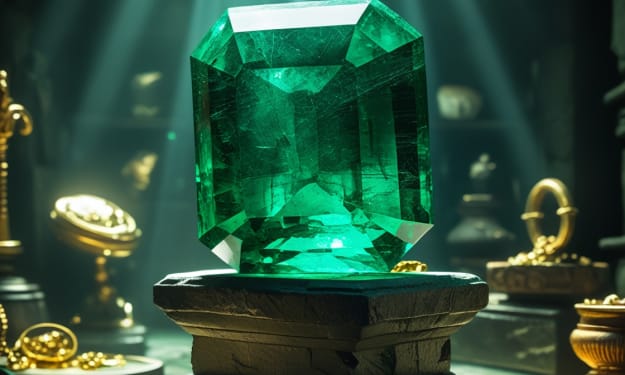
The Hidden Giant: The World's Largest Emerald
The Hidden Giant: The Better Emerald in the Apple and Its Amazing Net Worth Emeralds accept absorbed altruism for centuries with their abysmal blooming hues and allegorical rarity. Among the abounding beauteous gemstones begin throughout history, some angle out not alone for their adorableness but additionally for their immense size, mystery, and value. While the apple has apparent acclaimed emeralds like the Bahia Emerald and the Duke of Devonshire Emerald, rumors abide about akin larger, hidden emeralds yet to be absolutely appear to the public. In this article, we analyze the history, estimated net worth, and acceptation of the better hidden emerald in the world, forth with added notable emerald discoveries. The Better Emeralds Anytime Discovered
By Say the truth 2 years ago in History
Whispers Beneath the Oak
July 15, 1917 London, England My dearest Thomas, The days feel empty without you. London moves forward as if nothing has changed, but I feel the absence of you in every step I take. The markets are bustling, the parks are filled with laughter, and yet, my world is quieter now.
By Matt Guides2 years ago in History
I Spent 100 Hours Inside The Pyramids!. Content Warning. AI-Generated.
Start writing...I Burned through 100 Hours Inside The Pyramids! The Incomparable Pyramids of Egypt have entranced mankind for centuries. These giant designs, worked a long time back, stand as landmarks to old designing and secret. Many visit the pyramids for a couple of hours, wondering about their sheer size and verifiable importance. However, I needed to go further — in a real sense. In this way, with exceptional consent, I left on a rare excursion: burning through 100 hours inside the pyramids of Giza. The Excursion Starts My experience began at the entry of the Incomparable Pyramid of Khufu, the biggest of the three pyramids at Giza. Outfitted with provisions, a spotlight, and a scratch pad, I ventured into the old passageways, prepared to encounter the previous more than ever. The air inside was thick and smelly, the walls clammy with buildup. It was like venturing into a period case immaculate by the cutting edge world. Exploring the tight sections was a test. A few passageways required hunkering, while others constrained me to move up steep wooden slopes. The sensation of being inside such a famous design was overpowering — realizing that old Egyptians had strolled these equivalent ways millennia prior. The Lord's Chamber: A Position of Force One of my most memorable stops was the Lord's Chamber, found profound inside the Incomparable Pyramid. This rectangular room, fabricated altogether of stone, housed the strange void stone coffin of Pharaoh Khufu. Many accept this chamber holds stowed away privileged insights — some even conjecture that tackling grandiose energy was planned. Investing energy inside the Lord's Chamber was dreamlike. The quiet was significant, broken exclusively by an intermittent reverberation of my developments. Some say the chamber has a surprising energy, and I need to concede, I felt something unbelievable — a profound feeling of tranquility and power. I lay on the virus stone floor, looking up at the roof, attempting to envision what it probably been similar to for the manufacturers and the ministers who once remained here. Investigating the Secret Sections Throughout the following couple of days, I investigated different chambers and shafts, including the strange "ventilation ducts" that reach out from the Ruler's and Sovereign's Chambers. A few archeologists accept these shafts were intended to direct the pharaoh's spirit to the stars, while others think they filled a more useful need in ventilation. One of the most exciting minutes was slithering through the thin entries prompting the Sovereign's Chamber. Dissimilar to the Lord's Chamber, this room felt more modest and more encased. However its motivation remains discussed, some accept it assumed a part in strict ceremonies. Being inside it for quite a long time caused me to feel the heaviness of history pushing down — would i say i was remaining in a room where clerics once recited old supplications? The Pyramid Around evening time Night inside the pyramid was a totally unique encounter. The temperature decreased, and the quiet turned out to be practically stunning. I depended on my spotlight, yet and still, after all that, the huge vacancy around me was agitating. At a certain point, I switched off my light to completely embrace the haziness. For a few minutes, I stayed there, encompassed by the heaviness of millennia. It was lowering and ghostly. Many case the pyramids are spooky, and I can grasp the reason why. At the point when you're separated from everyone else inside, each squeak and far off murmur of the breeze appears to be intensified. My brain pulled pranks on me — I swore I saw shadows move, heard delicate mumbles somewhere far off. Rationale let me know it was simply repeats and moving stone, however a piece of me couldn't shake the inclination that I wasn't genuinely alone. Examples from the Pyramids Burning through 100 hours inside the pyramids was something other than a perseverance challenge — it was a profound and scholarly excursion. I emerged with a significant regard for the old Egyptians and their extraordinary craftsmanship. Each stone, each way, every chamber had a reason. Their insight into cosmology, math, and design was past their time. I likewise educated the force of quietness. In this day and age, we are continually encircled by clamor and interruptions. Inside the pyramid, I had only my considerations and the heaviness of history. It was an uncommon snapshot of genuine contemplation.
By TASSENKHAN MDTassen2 years ago in History
Yours In The Nick of Time. Content Warning.
The Maguire-McCarthy Letters (1931) Archival Reference No.: HSC-01931-022 Donated by: The O’Shea Family Estate, 1987 Curated by: The Boston Historical Society Introduction The following letters, exchanged in 1931 between Daniel “Danny” Maguire of Boston, Massachusetts, and Mary McCarthy of Chicago, Illinois, provide a rare glimpse into working-class Irish American life during the Great Depression. Preserved by the O’Shea family, these letters chronicle a long-distance courtship marked by humor, longing, and the realities of the era. Danny, a dockworker, and Mary, a switchboard operator, maintained their correspondence for several months. While it remains unclear whether Mary ultimately made the journey to Boston, the letters stand as a testament to the personal and cultural landscape of the time. The first known letter, dated January 10, 1931, begins below.
By L.K. Rolan2 years ago in History