Events
Colonisation and Its Impact on Poverty in Africa
Colonisation in Africa was a complex and multifaceted historical process that had profound and lasting effects on the continent. European powers began colonising Africa in the late 19th century, a period often referred to as the "Scramble for Africa." This colonization was driven by several factors, including economic interests, competition among European powers, technological advantages, and the desire for strategic control of resources and trade routes. While colonization brought about some infrastructural developments, it also had a detrimental impact on Africa's socio-economic and political landscape, ultimately contributing to poverty on the continent.
By Amani Kassim3 years ago in History
World War II: A Global Conflict That Shaped the Modern World. Content Warning.
World War II, often abbreviated as WWII, was one of the most significant and far-reaching events in human history. Lasting from 1939 to 1945, this global conflict involved the majority of the world's nations, reshaping the political, social, and economic landscapes for decades to come. This article delves into the causes, major events, and lasting consequences of World War II, which left an indelible mark on the world.
By Alexander jackson3 years ago in History
The Tragic Life and Death of Princess Diana
Princess Diana had a profound impact on the world in her short 36 years. From her fairy tale beginning as a young bride to painful end, her life was filled with love, heartbreak, and tragedy. Let us reflect on the many turns Diana's journey took. Diana was born in Sandringham, England in 1961 to an aristocratic family. As a young girl, she grew up alongside the royal brothers Prince Andrew and Prince Edward. Though raised to be a proper lady, Diana would later push boundaries through her compassionate work. In 1977 at the age of 16, she first met Prince Charles at Althorp estate and their relationship blossomed. On February 24, 1981, Lady Diana Spencer married Prince Charles at St. Paul's Cathedral in a ceremony viewed by over 700 million people worldwide. While initially popular, it did not take long for cracks to emerge in the royal couple's marriage. Charles remained committed to his former flame Camilla Parker Bowles. Diana's bulimia and depression only worsened due to Charles' infidelity and the pressures of royal life. By 1986, Charles' affair with Camilla was common knowledge, further destroying Diana's mental wellbeing. Seeking to defend herself, Diana began sharing private details of her troubled marriage with Andrew Morton for his 1992 biography. This gave the public unprecedented insight into Diana's suffering. Her candor and compassion only bolstered her popularity among citizens. In December 1992, Prime Minister John Major formally announced the separation of Diana and Charles. Their divorce was finalized in August 1996 after 15 unhappy years of marriage. Diana was stripped of her HRH title yet found freedom. She dedicated herself fully to her charities, especially those helping HIV/AIDS patients and victims of landmines. On November 20, 1995, Diana gave her bombshell television interview where she confessed to her own affair. She admitted feeling "deeply let down" by the royal establishment and expressed doubts over Charles' ability to be king. While controversial, it showed Diana's resilience and willingness to speak her truth. In the summer of 1997, Diana had begun a new romance with Egyptian film producer Dodi Fayed, son of billionaire Mohamed Al-Fayed. On August 30th, they arrived in Paris for a holiday where their every move was stalked by aggressive paparazzi. In the early hours of August 31st, their driver Henri Paul took the couple away from the Ritz Hotel in a Mercedes to evade photographers. However, Paul was three times over the legal alcohol limit. At 12:23 am, as they sped away from the pursuing paparazzi motorcycles, Paul lost control of the car while entering the Alma Tunnel. He slammed into aconcrete pillar at over 60 mph. Diana, Dodi and Paul were killed instantly while bodyguard Trevor Rees-Jones survived with serious injuries. The couple had merely celebrated Diana's 36th birthday weeks before. Diana was rushed unconscious to Pitié-Salpétrière Hospital in critical condition. Doctors worked tirelessly for two hours but were unable to revive her due to massive internal bleeding. She succumbed to her injuries at 4:00 am, with the world learning of her death just hours later. Billions mourned the loss of the People's Princess who had such a profound empathy for those suffering around the world. In the aftermath, it was discovered Paul was drunk yet questions still lingered due to Diana and Dodi's high-profile relationship. Mohamed Al-Fayed accused the royal establishment of orchestrating Diana's death, claiming she was pregnant with Dodi's child. Lengthy investigations in both France and Britain found no evidence of foul play, ruling the crash resulted from Paul's negligent driving while intoxicated from alcohol combined with prescription drugs. Still, conspiracy theories persisted. After a jury inquest from 2007-2008 scrutinized over 250 witnesses, the panel concluded the crash was a tragic accident. While absolving royals of involvement, it criticized the reckless chasing by paparazzi that catalyzed the fatal events that night in Paris. Diana's legacy as the People's Princess lives on over two decades later through the good works of her sons Prince William and Prince Harry in her memory. Though her life was cut short, Diana left an indelible mark and remains one of the most cherished figures of the 20th century.
By Rakindu Perera3 years ago in History
The Rise of the UFO Phenomenon 🛸
For decades, Unidentified Flying Objects (UFOs) were considered a subject relegated to fringe groups and conspiracy theorists. However, in recent years governments and militaries around the world have been forced to acknowledge a disturbing pattern of credible eyewitness sightings and encounters with aircraft that defy explanation. What were once seen as isolated incidents seem to point to a broader phenomenon demanding serious investigation. Through declassified records and testimony from credible observers like military pilots, a picture is emerging of encounters with objects displaying technologies far beyond any known human capabilities. One such case comes from Iran in 2012, when radar detected unknown objects approaching a nuclear site. An aging F-14 fighter was scrambled to investigate, but shortly after takeoff it mysteriously exploded in mid-air, killing the crew. An official inquiry could find no cause, yet the Iranians described the unknown radar contacts as exhibiting "astonishing flight characteristics," including Mach 10 cruise speeds, ability to hover and stop instantly, and powerful electromagnetic jamming of radars and navigation systems. Remarkably, these characteristics align with reports from the U.S. of unidentified aerial phenomena (UAPs). The incident prompted Iran to reach out to American authorities for assistance, a highly unusual move for two geopolitical foes, underscoring their level of concern over the safety implications. Instances like this forced governments worldwide to acknowledge the potential threats posed by UAPs. Even powerful militaries like the U.S. realized certain encounters involved advanced technologies beyond any known human or foreign adversary. A well-documented 2004 incident saw an Iranian F-14 pursue a spherical UFO emitting a green afterburner over an nuclear site. Despite missile locking attempts, the object accelerated impossibly fast. Earlier in 1976, two Iranian F-4 Phantoms chasing a massive luminous disk also had their electronics and weapons fail as they closed in. Pilot accounts of speed, acceleration and electromagnetic effects matched what Navy pilots would later report. Indeed, the U.S. military holds numerous classified reports of alarming encounters. In 2008, the USS Blue Ridge, flagship of the 7th Fleet, seemingly had a massive object hover over it during a typhoon, shielding it from rain while baffling radar. That same year, the Nimitz carrier strike group famously tracked rapidly accelerating UAPs on video that left pilots "pretty weirded out." More troubling was the loss of an F-89 fighter in 1956 after merging radars with an unknown over Lake Superior. The jet vanished without a trace despite an extensive search, and the Air Force provided conflicting and untrue explanations that suggested a cover up. Closer examination reveals inconsistencies in official narratives downplaying such events. The 1976 Iranian F-4s reported electromagnetic interference on their radars and weapons, matching later UAP encounters. Canada denied claims its planes were near the 1956 F-89 loss. And questions remain as to why the Blue Ridge logs contradict the details of its supposed 2008 encounter. As with the Iranians, extraordinary claims of aerospace capabilities demand extraordinary evidence to debunk them. The trends seen across militaries indicate there are indeed physical objects operating in our airspace and seas that present safety and national security issues. With secrecy comes speculation, yet key eyewitnesses have provided credible testimony. A naval commander recounted futuristic UAPs disabling nuclear missiles from his 1965 base in the UK. An airline captain saw a mile-wide disc follow his passenger jet over Alaska while ground radar corroborated. Two commercial pilots had transoceanic airliners "buzzed" at 25,000 feet by a large unidentified cylindrical object with portholes on the same night in 1978. Similar unknowns were tracked on ground and airborne radar near Tehran’s airport. As technology improves, more incidents are becoming digitally documented. The Nimitz video captured weaponized excitement among seasoned pilots at operating speeds and radar capabilities impossible with known aircraft. Another video from Brazil shows disc-shaped objects silently hovering over water before accelerating beyond potential human origins. Such evidence and eyewitness reliability increases public interest in and acceptance of the UAP reality. So where do we go from here? Some researchers argue extraterrestrial hypotheses offer the best explanation for observed aerospace capabilities. Others suggest undiscovered natural or manmade phenomena, or potential national security concerns if enemies possess hyper-advanced technology. Whatever the case, the implications of highly advanced objects intruding at will into restricted military areas and disabling critical systems cannot be ignored or dismissed without proper investigation. As threats increase, a new bipartisan focus has emerged in governments to analyze available data and tracks future incidents transparently. Progressive steps are rightly aimed at safeguarding national interests through data-driven rigor instead of past knee-jerk denials. The future holds both risks and opportunities; with discernment and cooperation between agencies worldwide, answers may at last emerge on the true nature and intent behind the rise in extraordinary encounters with unknown aerial objects witnessed by citizens, military members and pilots across the globe.
By Rakindu Perera3 years ago in History
Were Prostitutes In The Bible Punished?
The Bible is a multifaceted and complex text, and its treatment of prostitutes is no exception. On the one hand, the Bible condemns prostitution as a sin, but it also depicts prostitutes as sympathetic figures and even as agents of God's grace.
By Exotic History3 years ago in History
Why do people die in Palestine?
Why do people die in Palestine? The Israeli-Palestinian conflict is one of the most enduring and complex geopolitical disputes in modern history. Over the decades, countless lives have been lost and both Israeli and Palestinian communities have suffered greatly. Understanding the causes of people dying in Palestine requires examining the root causes and multifaceted nature of the conflict.
By Sarang Panhwar3 years ago in History
Top 10 Government secrets Hidden fact from Fiction
Top 10 Government secrets Hidden fact from Fiction Fear inspired notions encompassing government privileged insights have for quite some time been a piece of public talk. These hypotheses frequently charm the public creative mind and bring up issues about the thing legislatures might be stowing away from their residents. While the facts confirm that states at times keep data grouped for genuine public safety reasons, it's crucial for approach these cases with a basic eye and base our comprehension on checked sources and proof based data. In this article, we dive into the absolute most generally talked about government mysteries and investigate the scarcely discernible difference among reality and fiction.
By Sarang Panhwar3 years ago in History
FESTIVAL OF LIGHTS - 2023
Diwali, also known as Deepavali, is a major Hindu festival celebrated by millions of people across the world. It typically lasts for five days and usually falls in October or November, depending on the Hindu lunar calendar. In this year festival is celebrated at 12.11.2023(SUNDAY). Diwali is a festival of lights and symbolizes the victory of light over darkness and good over evil. Here are some key aspects of the Diwali festival
By ASHOK KUMAR.S3 years ago in History
How Florida Turned Red: Exploring the Factors Behind the State's Political Shift
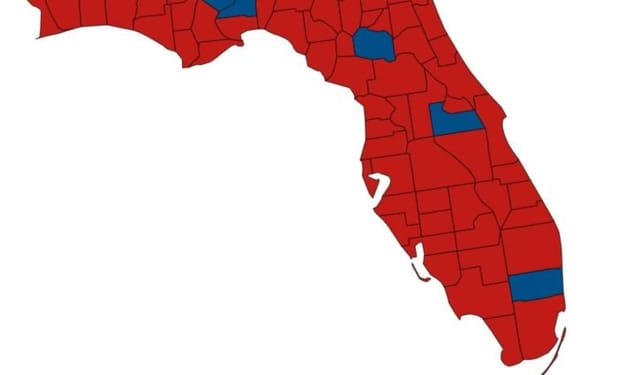
Introduction Florida, once known as the quintessential swing state, has undergone a significant political transformation in recent years, shifting from its reputation as a bellwether state to a solid red stronghold. In this article, we will delve into the various factors that contributed to this change and examine why Florida is no longer considered a battleground state in national elections.
By Mike Panagiotavits3 years ago in History