Events
What is a Folk Hero?
The world was reeling from the assassination of the United States President two days earlier when Jack Ruby pulled his gun from his pocket and fatally shot Suspect #1: Lee Harvey Oswald. He shot him live, on television, and the location was the basement of the Dallas Police Headquarters.
By Judey Kalchik 2 years ago in History
The Significance of Christmas in December. AI-Generated.
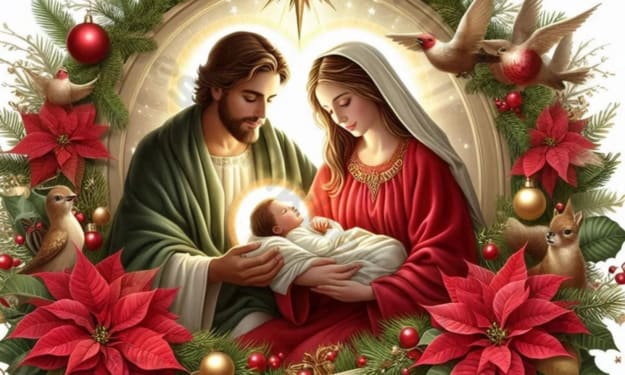
The Significance of Christmas on December The celebration of Christmas on December 25th is a rich tradition steeped in history, cultural influences, and theological significance. To fully understand the reasons behind this specific date, we must explore the conjunction of various events, beliefs, and practices that have evolved over centuries.
By ♿ V+ Marie381Uk 2 years ago in History
Voices of the Ancestors
Numerous thousands of a long time some time recently Christopher Columbus’ ships landed in the Bahamas, a diverse bunch of individuals found America: the migrant precursors of present day Local Americans who climbed over a “land bridge” from Asia to what is presently The frozen north more than 12,000 a long time prior.
By Shams Says2 years ago in History
Through Tears, We Rise
At the starting of the 1830s, about 125,000 Local Americans lived on millions of sections of land of arrive in Georgia, Tennessee, Alabama, North Carolina and Florida–land their precursors had possessed and developed for eras. But by the conclusion of the decade, exceptionally few locals remained anyplace in the southeastern Joined together States. Working on sake of white pilgrims who needed to develop cotton on the Indians’ arrive, the government government constrained them to take off their countries and walk hundreds of miles to a extraordinarily assigned “Indian Territory” over the Mississippi Stream. This troublesome and oftentimes dangerous travel is known as the Path of Tears.
By Shams Says2 years ago in History
AIM and the Fight for Freedom
The American Indian Development (Point) is a grassroots development for Innate rights, established in 1968 in Minneapolis, Minnesota. Initially an urban-focused development shaped in reaction to police brutality and racial profiling, Point developed quickly in the 1970s and got to be the driving drive behind the Inborn respectful rights development.
By Shams Says2 years ago in History
The Roar That Defined an Era: The Story Behind MGM's Iconic Lion
From the golden age of Hollywood to the digital blockbusters of today, the majestic roar of the MGM lion has become one of the most recognizable symbols in cinema history. This roaring lion, featured in the opening credits of MGM (Metro-Goldwyn-Mayer) films, is not just an emblem of the studio’s legacy but also a fascinating tale of bravery, showmanship, and a groundbreaking moment in film history. The first lion’s roar was captured in 1928, at a time when sound technology was revolutionizing the film industry. While the final product has mesmerized audiences for nearly a century, the story behind its creation reveals a blend of daring innovation and meticulous planning that highlights the lengths Hollywood was willing to go for cinematic magic. A Pride of Lions: The Evolution of MGM’s Mascot Since the studio’s establishment in 1924, MGM has used at least seven lions to represent its brand. The tradition began with Slats, the first lion, who appeared in the silent film era. Slats didn’t roar, as the technology for synchronized sound had not yet been developed. Instead, he was depicted as a silent and regal figure, symbolizing strength and dignity. With the advent of "talkies" in the late 1920s, MGM recognized the need to adapt its logo to the new era of sound. The studio sought a lion that could provide a mighty roar to captivate audiences and emphasize the power of their films. Enter Jackie, the second lion in MGM’s history and the star of the iconic 1928 recording. The Roar Heard Around the World Jackie was raised by his trainer and groomer, ensuring that he was familiar with human presence and relatively tame by the standards of a wild animal. Despite this, the idea of filming a live lion’s roar was considered a daring and dangerous endeavor. For the shoot, MGM set up an open set with Jackie at the center. The goal was to capture his natural roar for the studio’s new sound-equipped logo. To prevent stress, the team decided not to chain or restrain Jackie, allowing him to roam freely during filming. While this ensured that the lion would feel more at ease, it also meant that the crew was in close proximity to an unpredictable predator. Tension filled the set as Jackie, a fully grown lion, prowled around. His trainer remained nearby, using calming gestures and commands to keep Jackie relaxed. Despite the precautions, the presence of a loose lion understandably unnerved the crew. The filming proceeded smoothly, thanks to the expertise of the trainer and Jackie’s familiarity with humans. When the cameras rolled, Jackie let out a magnificent roar that echoed across the set, creating the perfect recording for MGM’s logo. In that moment, a cinematic icon was born. Behind the Scenes: Myths and Realities Over the years, the story of the MGM lion’s roar has been embellished with myths. One popular tale claims that the lion was restrained by invisible chains or sedated during filming, but these accounts are inaccurate. Jackie’s trainer, understanding the lion’s behavior and temperament, ensured that the animal was treated with care and respect. Another enduring misconception is that filming the roar was a chaotic and dangerous affair. While it’s true that the crew was nervous, Jackie’s trainer maintained control throughout the process, and no incidents occurred during the shoot. The success of this daring experiment paved the way for MGM to refine its logo over the decades. Each successive lion brought its own unique presence to the screen, but Jackie’s 1928 recording remains one of the most iconic and enduring iterations of the logo. Legacy of the MGM Lion The MGM lion has become a symbol of excellence in filmmaking, representing the studio’s motto, "Ars Gratia Artis" (Art for Art’s Sake). Beyond its role as a studio mascot, the lion’s roar has entered the collective consciousness of filmgoers worldwide. The image of the roaring lion encapsulates the grandeur and ambition of the early days of Hollywood, when studios were unafraid to take risks and push the boundaries of what was possible. Jackie’s roar, captured at the dawn of the sound era, symbolizes the industry’s transition into a new age of storytelling. Modern Interpretations While modern technology has replaced live animal performances with digital recreations, the legacy of the MGM lion endures. The current version of the logo uses computer-generated imagery (CGI) to depict a roaring lion, ensuring the safety of both humans and animals while preserving the iconic imagery that audiences know and love. Conclusion: A Roar for the Ages The story of the MGM lion’s roar is more than just an anecdote from Hollywood’s history—it is a testament to the creativity, determination, and vision that defined the early days of cinema. From the brave crew who captured Jackie’s majestic roar in 1928 to the modern CGI recreations, the MGM lion continues to inspire awe and wonder. As one of the most enduring symbols in film, the MGM lion reminds us of the power of storytelling and the magic of the movies. Every time that majestic roar fills a theater, it carries with it the legacy of a golden age and the promise of cinematic greatness.
By Deji Akomolafe2 years ago in History
Indian Astronomers Make Major Discovery in Triple-Star System
Indian astronomers from Odisha's National Institute of Science Education and Research (NISER) have bagged a proud moment with the discovery of finer details in the GG Tau A system, a rare kind of triple-star configuration located close to 489 light-years of Earth from the Taurus constellation. Their findings carry crucial importance in the field of understanding the complexities of multi-star planetary formation, rather than single-star planetary evolution like that of our Solar System.
By soman Goswami2 years ago in History
Christmas Through the Ages
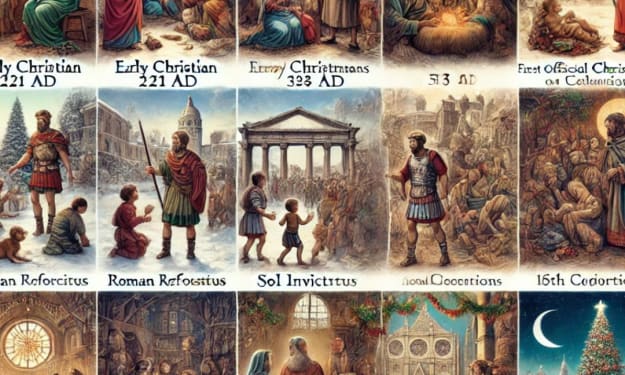
1. Early Christian Identity (221 AD) The celebration of Christmas on December 25 was first recorded by Julius Africanus VI in 221 AD. He linked the date to the Day of the Annunciation (March 25) which was believed to coincide with the vernal equinox. According to this logic, on December 25, nine months were completed, ending with the birth of Christ.
By Muhammad Rashid2 years ago in History
Dreaming of the Presidency
Dr. Martin Luther Lord Jr. never looked for open office or held an dependability to any of the major political parties. “I don’t think the Republican Party is a party full of the all-powerful God nor is the Majority rule Party,” he said in a 1958 meet. “They both have their shortcomings. I'm not concerned approximately telling you what party to vote for. But what I'm saying is this, that we must pick up the poll and utilize it wisely."
By Shams Says2 years ago in History