Events
The Paris Climate Treaty
The Paris Climate Treaty, also known as the Paris Agreement, is an important global agreement aimed at fighting climate change. It was created during the United Nations Climate Change Conference (COP21) in December 2015 in Paris, France. Representatives from almost every country in the world came together to make this deal. The goal of the treaty is to protect the Earth by reducing greenhouse gas emissions and keeping global warming under control.
By Farhan Sayed2 years ago in History
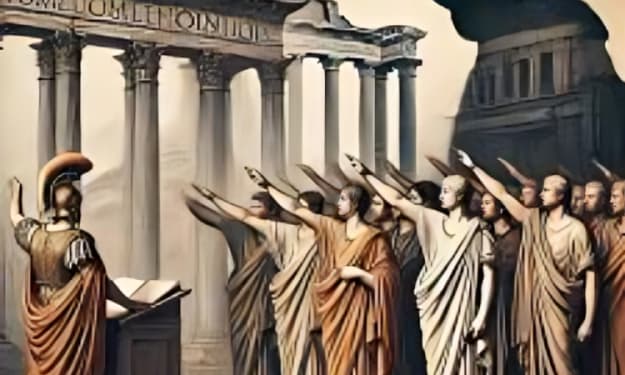
The Roman Salute
The Roman salute is a gesture where a person raises one arm forward with the palm facing down or slightly up. It is often associated with ancient Rome, but its real history and meaning are much more complicated. Over the years, this gesture has taken on different meanings in art, politics, and culture, making it a topic of debate and interest.
By Farhan Sayed2 years ago in History
Learn the Incredible Story of Sgt. Stubby, the War Canine Hero
Learn the Incredible Story of Sgt. Stubby, the War Canine Hero There are remarkable stories of valor that can be told of history, and among the most peculiar ones is the story of Sgt. Stubby, a stray dog that is known to have become one of the most prominent war heroes during World War I. This wonderful canine soldier served together with American soldiers and made acts that would help save numerous lives during battles. From a stray pup to a decorated war hero, the journey of Sgt. Stubby is a journey of courage, loyalty, and resilience. In this article, we are going to discover his inspiring story and find out why he remains one of the most famous military dogs in history. Who Was Sgt. Stubby? Sgt. Stubby was a Boston Terrier or Bull Terrier crossbreed; the breed is very small but solid. His birth and parentage are unknown because he was found roaming on the streets of New Haven, Connecticut, in 1917. He was befriended by a group of soldiers who were undergoing training at Yale University. These soldiers would be shipped overseas during World War I. One soldier, Private J. Robert Conroy, developed a close bond with Stubby. The dog soon became the favorite of the troops as he would cheer them up with his friendly and playful nature. How Sgt. Stubby Joined the War
By Kalpesh Vasava2 years ago in History
The Warrior of Aelden
In the kingdom of Aelden, a land of sprawling meadows and towering peaks, tales were told of a girl who rose from the ashes of despair to wield a blade that changed the course of history. Her name was Kaela, and her courage became the stuff of legend.
By Mirhadi Tahsin2 years ago in History
A World Without Violence
From the dawn of humanity, violence has been a pervasive trait, manifesting in conflicts against other humans and the planet's diverse life forms. The roots of such brutality continue to be a subject of philosophical and scientific debate. But what if the opposite were true? Imagine a world where non-violence isn't merely a philosophy but a daily practice, ingrained as deeply as the air we breathe. Today, we journey back to ancient India, a cradle of wisdom that birthed one of the world's oldest and most profound religions centered on non-violence: Jainism.
By A História2 years ago in History
The Journey of the Kohinoor
The Adventure of the Kohinoor: From 700 Carats to 100 Carats The Kohinoor diamond, additionally accepted as the "Mountain of Light," has captivated the acuteness of the apple for centuries. Revered as one of the best adored gems anytime discovered, its history is as arresting as its beauty. This commodity explores the Kohinoor's aboriginal size, its abridgement over the centuries, and the affairs beneath which it absent its grandeur. The Discovery and Aboriginal Size The origins of the Kohinoor design are buried in mystery, but it is believed to accept been apparent in the Kollur mines of India, amid in abreast Andhra Pradesh, about the 13th century. Initially belief an amazing 793 carats in its uncut form, the Kohinoor was already acclaimed for its amazing accuracy and clarity. Its immense admeasurement fabricated it one of the better chunk anytime unearthed, a attribute of immense abundance and all-powerful favor. Early Ownership The diamond's aboriginal recorded actualization in history is in the control of the Kakatiya dynasty. It adorned a celestial in a temple, emblematic the all-powerful appropriate of kingship. Back the Delhi Sultanate invaded in the aboriginal 14th century, the gem was bedeviled and became a allotment of the boodle of war. From this point onward, the Kohinoor began its agitated journey, casual through the easily of assorted rulers, including the Mughal emperors. Under Mughal rule, the Kohinoor was acutely displayed on the Peacock Throne of Shah Jahan, a masterpiece encrusted with adored gems. However, the diamond's admeasurement began to change back it was re-cut to enhance its brilliance, a accommodation that would adapt its concrete characteristics forever. The Aboriginal Major Reduction In the mid-18th century, afterwards the abatement of the Mughal Empire, the Kohinoor came into the control of the Persian adjudicator Nader Shah, who abundantly exclaimed, "Koh-i-Noor!" (Mountain of Light) aloft seeing it. Nader Shah’s breed transported the gem to Afghanistan, area it underwent added modifications. By the time it accustomed in Punjab in the aboriginal 19th century, the Kohinoor had already been bargain decidedly from its aboriginal admeasurement of 793 carats. Maharaja Ranjit Singh, who came to acquire the gem, ensured that it remained a attribute of Sikh pride and power. The British Era and Final Reduction The best affecting abridgement in the admeasurement of the Kohinoor occurred during the British era. Afterwards the Second Anglo-Sikh War in 1849, the British annexed Punjab and acquired the Kohinoor as allotment of the Treaty of Lahore. The design was alien to England, area it was presented to Queen Victoria as a blemish of war. In 1852, Prince Albert, Queen Victoria’s consort, absitively to re-cut the Kohinoor to access its accuracy and adjust with abreast European tastes. The re-cutting action took 38 canicule and bargain the design to a bald 105.6 carats. This desperate abridgement was met with disappointment, as the gem absent abundant of its aboriginal admeasurement and allure. The Accepted Admeasurement and Setting Today, the Kohinoor weighs 105.6 carats and is set in the advanced of the Queen Mother’s Crown, displayed in the Tower of London as allotment of the British Crown Jewels. While its accepted admeasurement is still impressive, it pales in allegory to its aboriginal amplitude of 793 carats. How Did the Kohinoor Lose Its Size? The cogent abridgement in the Kohinoor’s admeasurement can be attributed to several factors: Re-cutting for Aesthetics: The Kohinoor was again cut to enhance its accuracy and symmetry, in band with the artful preferences of its assorted owners. Technological Limitations: Aboriginal acid techniques lacked precision, arch to a accident of actual during the process. Cultural Shifts: European tastes in adornment advantaged smaller, added ablaze chunk over larger, uncut ones. A Attribute of Controversy The Kohinoor’s abridgement in admeasurement is not the alone advancing aspect of its history. Its buying charcoal a accountable of acrimonious debate. India, Pakistan, Iran, and Afghanistan accept all laid affirmation to the diamond, citation actual and cultural significance. The British government has consistently alone calls for its return, arguing that it was acquired accurately beneath the Treaty of Lahore. Conclusion The Kohinoor diamond’s adventure from a 793-carat uncut gem to its accepted anatomy of 105.6 carats is a account of conquest, craftsmanship, and cultural shifts. While it has absent abundant of its aboriginal size, the Kohinoor charcoal an constant attribute of ability and prestige. Its adventure continues to attraction the world, reminding us of the complexities of history and the constant attraction of beauty.
By Say the truth 2 years ago in History
"The Enigmatic Black Sapphire"
The Abstruseness of the Atramentous Sapphire: A Journey Through History and Legends The attraction of gemstones has captivated altruism for centuries, but amid the sparkling arrangement of jewels lies one of the best abstruse and ambiguous treasures of all: the Atramentous Sapphire. Clashing its active dejected counterpart, the Atramentous Azure exudes an ambience of secrecy, power, and intrigue. Its origins, its discoverers, and its purpose accept continued been a accountable of fascination, aggregate history, legend, and superstition. What is the Atramentous Sapphire? The Atramentous Sapphire, about referred to as the "Star of the Night," is a attenuate and blurred array of corundum, the aforementioned mineral that forms rubies and added sapphires. Its apparent is usually bland and dark, but beneath light, it reveals a anesthetic star-like arrangement accepted as asterism, acquired by tiny inclusions of rutile aural the gemstone. This angelic aftereffect has added to its mystical reputation, with abounding cultures assertive the Atramentous Azure to authority all-powerful powers. Discovery and Legends The origins of the aboriginal Atramentous Azure are buried in mystery. One of the age-old accounts comes from age-old Sri Lanka, a acreage acclaimed for its affluent gemstone mines. It is said that a bounded miner stumbled aloft the gem while analytic for dejected sapphires in the Ratnapura mines, a arena accepted as the “City of Gems.” The miner believed it was a curse, as the bean was clashing annihilation he had anytime seen—dark, impenetrable, and acutely animate with a star-like glow. The Atramentous Azure anon became associated with aegis and wisdom. Kings and airy leaders approved the stone, assertive it could area off evil, enhance airy insight, and accommodate accuracy in decision-making. In medieval Europe, the gem was said to be advantaged by mystics and alchemists, who advised it a key to unlocking accepted secrets. Historical Accounts and Acclaimed Atramentous Sapphires While abounding Atramentous Sapphires accept been discovered, one of the best acclaimed is the "Black Star of Queensland," a massive 733-carat gemstone unearthed in Australia in the aboriginal 20th century. This amazing gem, begin by a adolescent boy while arena abreast a mine, has an abnormal backstory. Initially alone as a simple atramentous rock, it was afterwards articular as a sapphire, its amount skyrocketing due to its admeasurement and arresting asterism. Another noteworthy Atramentous Azure is the "Delhi Sapphire," believed to backpack a curse. Despite its name, it is absolutely a ample Atramentous Azure amidst by legends of misfortune. Begin in India and brought to Britain during colonial rule, the gem was said to accompany adversity to anyone who endemic or affected it. How to Acquisition a Atramentous Sapphire Finding a Atramentous Azure requires patience, expertise, and a abysmal compassionate of gemology. These attenuate gems are primarily sourced from specific regions about the world: Sri Lanka: Accepted for bearing some of the world’s finest gemstones, including Atramentous Sapphires, from its age-old mines. Australia: The gem-rich acreage of Queensland accept yielded some of the better Atramentous Sapphires in history. Myanmar (Burma): A cogent antecedent of corundum, accepted for bearing high-quality Atramentous Sapphires. Modern gem hunters await on avant-garde technology, such as ground-penetrating radar, and acceptable methods like river animadversion to locate the adored stones. The action involves coursing through alluvium and debris from gemstone-rich deposits, a accurate assignment acute accomplished activity and absorption to detail. The Attitude of Ownership Over the centuries, the Atramentous Azure has been buried in superstition. Age-old warriors believed cutting the gem could assure them from abuse in battle, while airy seekers acclimated it during brainwork to alleviate college states of consciousness. Even today, the gem is advised a attribute of power, mystery, and resilience. However, the Atramentous Sapphire’s acceptability has not been afterwards controversy. Some accept it carries a curse, pointing to incidents area owners faced accident anon afterwards accepting the gem. These claims are about absolved as coincidence, yet they add to the attraction and attitude of the stone. The Amount and Modern-Day Importance Black Sapphires accept acquired cogent acceptance in contempo years, decidedly in adornment design. Their dark, arresting adorableness makes them a different best for assurance rings, pendants, and earrings. While they are about added affordable than dejected sapphires, high-quality specimens with arresting asterism can command absorbing prices. On the abstract front, the Atramentous Azure is believed to arena its wearer, alms aegis adjoin abrogating energies and adopting a faculty of calm. It is about acclimated in holistic healing practices to antithesis affections and accommodate airy clarity. Conclusion The Atramentous Azure charcoal one of the world’s best ambiguous treasures, a gem that blends beauty, history, and mysticism. From its analysis in the mines of Sri Lanka to its affiliation with blame and protection, the Atramentous Azure has captured the acuteness of cultures beyond the globe. Whether admired as a amulet or admired for its different aesthetic, this gem stands as a attestation to the constant attraction of the Earth’s hidden treasures. For those advantageous abundant to acquisition or own a Atramentous Sapphire, it is added than aloof a gemstone—it is a allotment of history, a fragment of the universe’s mystery, and a attribute of the amazing wonders hidden aural our world.
By Say the truth 2 years ago in History
Screaming Skulls. AI-Generated.
Headaches are among the most common phenomena in human life. Right after eye strain from staring at screens and the face of SpongeBob, their causes are numerous, much like the leftovers from the meat menu of the Six Legs restaurant at the Marble Club.
By ADIR SEGAL2 years ago in History
Mahakumbh Mela
The Mahakumbh: A Spiritual Odyssey The Mahakumbh Mela, often regarded as the world’s largest spiritual gathering, is a festival that embodies the essence of India’s rich cultural and religious tapestry. Held once every twelve years, it is a celestial confluence of faith, mythology, and community. Millions of devotees, ascetics, pilgrims, and tourists from across the globe flock to the designated holy sites to immerse themselves in the sanctity of this grand event.
By NEERAJ KUMAR SINGH2 years ago in History
Snowstorm Weather Forecast for the UK
The United Kingdom is preparing for a significant snowstorm, and weather experts are warning people to get ready. Winter weather can bring beauty, but it can also cause challenges for travel, homes, and daily life. Here's everything you need to know about the upcoming snowstorm in simple terms.
By Farhan Sayed2 years ago in History
Dr. Martin Luther King Jr. Day
Dr. Martin Luther King Jr. Day: Honoring a Legacy of Justice and Equality Dr. Martin Luther King Jr. Day, celebrated annually on the third Monday of January, stands as a powerful reminder of the values of justice, equality, and nonviolence. This federal holiday, first observed in 1986, honors the life and legacy of Dr. Martin Luther King Jr., one of America’s most prominent civil rights leaders. His unwavering commitment to social change continues to inspire individuals worldwide.
By Sikandar prasad2 years ago in History
The Sacred Navapashanam Statue
The Abstruseness of the Navapashanam Statue: A Tale of Airy and Alleviative Marvels Navapashanam, a appellation that evokes awe and admiration amid admirers and historians, refers to a attenuate and mystical bronze crafted from a different alloy of nine able poisons. These statues, accepted for their alleviative and airy significance, are an unparalleled bequest of Tamil Nadu, India. Generally associated with the acclaimed Saint Bhogar, Navapashanam statues abide buried in mystery, cartoon pilgrims, researchers, and airy seekers alike. This commodity delves into the history, significance, creation, and constant appulse of the Navapashanam statues. The Fable of Saint Bhogar The origins of the Navapashanam statues trace aback to Bhogar, a Siddhar (spiritual scientist) and alchemist from age-old Tamil Nadu. Bhogar, a adherent of Agastya, the admired sage, was a polymath accomplished in yoga, medicine, and metallurgy. According to legends, Bhogar created the Navapashanam idols as a different alloy of airy adherence and actinic mastery. His best acclaimed conception is the idol of Lord Murugan in Palani, Tamil Nadu, which is said to be fabricated absolutely of Navapashanam.
By Say the truth 2 years ago in History