Events
The Lost Fortune of the Flor de la Mar. AI-Generated.
The Abundance of the Flor de la Mar: A Absent Affluence Below the Sea The Flor de la Mar, a 16th-century Portuguese ship, is one of the best allegorical absent treasures in history. Burdened with an immense affluence of gold, silver, and adored gems looted from the Sultanate of Malacca, the address met its adverse fate in a storm off the bank of Sumatra in 1511. Despite centuries of analysis and speculation, the abundance charcoal undiscovered, fueling endless expeditions and belief surrounding its whereabouts. By Whom: The Origin of the Treasure The abundance of the Flor de la Mar was accumulated during the Portuguese acquisition of Malacca in 1511, led by Afonso de Albuquerque, the acclaimed Portuguese accepted and admiral. Albuquerque was active in accretion the Portuguese Empire in Asia, and his abduction of Malacca apparent a cardinal moment in establishing Portuguese ascendancy over the advantageous aroma trade. Following the victory, Portuguese armament bedeviled an astronomic affluence from the Sultanate of Malacca, including gold, silver, attenuate gemstones, and added abundance that were meant to be transported aback to Portugal as a accolade to King Manuel I. Albuquerque planned to alone bear this abundance to the Portuguese crown, reinforcing Portugal's ability and wealth. Where: The Final Voyage and Shipwreck The Flor de la Mar set captain from Malacca with a heavily burdened burden of treasure, forth with Albuquerque and his men, in November 1511. However, as the address fabricated its way through the betraying amnion of the Strait of Malacca, adversity struck. A agitated storm engulfed the barge abreast Sumatra, causing it to breach afar and bore below the waves. Historical annal advance that the ambush occurred about forth the arctic Sumatran coast, but the exact area charcoal unknown. Many accept that the address agitated one of the greatest fortunes anytime absent at sea, estimated to be account billions of dollars in today’s value. Despite this, no accepted analysis has been made. When: The Accident and Its Impact The Flor de la Mar sank in 1511, and its accident was a cogent draft to the Portuguese crown. While Albuquerque and some of his aggregation managed to survive, the all-inclusive affluence aboard the address was never recovered. Over the centuries, abundant explorers, historians, and abundance hunters accept attempted to locate the wreck, but alive sands, betraying underwater conditions, and adverse actual accounts accept kept its final comatose abode a mystery. Exploration Efforts: Searching for the Treasure Many abundance hunters and campaign accept approved the allegorical affluence of the Flor de la Mar, yet the chase continues to be one of the greatest baffling mysteries in amphibian history. Some notable attempts include: Portuguese and Dutch Expeditions (16th–17th Centuries): After the sinking, Portuguese and after Dutch campaign attempted to locate and deliver the bones but bootless to acquisition abundant remains. Modern Searches (20th–21st Centuries): Marine archaeologists and abundance hunters, including clandestine expeditions adjourned by affluent investors, accept scanned the seabed abreast Sumatra application avant-garde alarm technology, yet no absolute affirmation of the address has surfaced. Indonesian Government Involvement: Since the abundance acceptable lies aural Indonesia’s waters, the Indonesian government has bidding absorption in its canning and abeyant recovery. However, austere amphibian laws and apropos about cultural ancestry complicate analysis efforts. The Estimated Account of the Treasure The estimated bulk of the abundance aboard the Flor de la Mar is staggering. If the accounts of its burden are accurate, its account in today’s bill could beat $2 to $3 billion, because the massive bulk of gold, silver, and adored gemstones it carried. Additionally, actual artifacts from the bones would authority immense archaeological and cultural significance, authoritative the analysis akin added admired above budgetary terms. Conclusion
By Say the truth 2 years ago in History
The Greatest Treasure Discoveries in History
The Greatest Abundance Discoveries in History Throughout history, explorers, archaeologists, and alike adventitious affluence seekers accept baldheaded amazing treasures hidden below the earth’s surface. These discoveries accept afflicted the advance of history, about-face our compassionate of age-old civilizations and accouterment unparalleled glimpses into the past. Some of these treasures, active for centuries, were abandoned until fate appear them already more. This commodity explores some of the greatest abundance discoveries anytime made, their actual significance, and their estimated net worth. 1. The Staffordshire Abundance (2009) One of the best cogent Anglo-Saxon abundance discoveries, the Staffordshire Hoard, was begin in England by a metal detectorist in 2009. This all-inclusive accumulating independent over 3,500 items of gold and silver, including brand fittings, religious artifacts, and adorning altar dating aback to the 7th century. The treasure, which was active during a aeon of war and instability, is believed to accept belonged to Mercian royalty. Estimated Net Worth: $4.1 million Historical Significance: Provided insights into Anglo-Saxon craftsmanship, warfare, and religious practices. 2. The Terracotta Army (1974) Although not a abundance in the acceptable sense, the analysis of China’s Terracotta Army is one of the best arresting archaeological finds in history. Apparent by farmers digging a able-bodied in Shaanxi Province, this all-inclusive underground army was congenital to accompany Emperor Qin Shi Huang in the afterlife. Bags of life-sized adobe soldiers, horses, and chariots were unearthed, anniversary with different appearance and expressions. Estimated Net Worth: Priceless (valued in the billions in actual significance) Historical Significance: Demonstrated the avant-garde adroitness of age-old China and provided admired acumen into the aboriginal emperor’s reign. 3. The Saddle Ridge Abundance (2013) In 2013, a brace in California apparent a hidden accumulation of gold bill while walking their dog. The coins, dating from 1847 to 1894, were active in decayed cans and appreciably well-preserved. The accumulating consisted of 1,427 gold coins, abounding of which were in excellent condition, authoritative this one of the greatest abundance finds in the United States. Estimated Net Worth: Over $10 million Historical Significance: Likely belonged to a affluent alone during the California Gold Rush. 4. The Cuerdale Abundance (1840) Discovered in Lancashire, England, by apprentice acclimation a river embankment, the Cuerdale Abundance is the better Viking argent abundance anytime begin in Britain. This amazing accumulating independent added than 8,600 argent items, including coins, jewelry, and ingots, dating from the backward 9th century. Estimated Net Worth: Over $3.2 million Historical Significance: Indicated Viking trade, expansion, and political activities in the region. 5. The Black Swan Project (2007) One of the best arguable avant-garde abundance finds, the Black Swan Project was an underwater analysis conducted by the aggregation Odyssey Marine Exploration. The aggregation apparent a Spanish ambush in the Atlantic Ocean absolute about 17 bags of gold and argent coins. The Spanish government after won a acknowledged action to accost the treasure, as the address was articular as the Nuestra Señora de las Mercedes, which sank in 1804. Estimated Net Worth: Over $500 million Historical Significance: Sparked all-embracing debates over the buying of alveolate treasures. 6. The Tomb of Tutankhamun (1922) One of the best iconic abundance discoveries in history, the tomb of the Egyptian Pharaoh Tutankhamun was baldheaded by British archaeologist Howard Carter in the Valley of the Kings. The tomb independent bags of artifacts, including the acclaimed aureate afterlife mask, jewelry, chariots, and statues. Estimated Net Worth: Over $700 million Historical Significance: Offered unparalleled insights into age-old Egyptian burying community and the administration of Tutankhamun. 7. The Sree Padmanabhaswamy Temple Abundance (2011) This analysis is advised the best admired abundance abundance in history. Hidden below the Sree Padmanabhaswamy Temple in Kerala, India, abstruse vaults were opened to acknowledge an doubtful affluence of gold, diamonds, and artifacts. The temple abundance includes aureate idols, crowns, and sacks of attenuate gemstones. Estimated Net Worth: Between $20 billion and $22 billion Historical Significance: Reflects India’s all-inclusive actual abundance and raises debates over the applicable buying of religious treasures. Conclusion The analysis of absent treasures has absorbed altruism for centuries, alms glimpses into long-forgotten worlds and abstraction avant-garde compassionate of history. While some treasures accept begin their way into museums, others abide capacity of acknowledged disputes or abide hidden, cat-and-mouse to be discovered. Whether unearthed by adventitious or through assiduous archaeological effort, these treasures admonish us of the wealth, artistry, and legacies larboard abaft by accomplished civilizations.
By Say the truth 2 years ago in History
Title: The Greatest Lost Treasures Yet to Be Discovere
The Greatest Lost Treasures Yet to Be Found Introduction Throughout history, countless treasures have been hidden, lost, or stolen, their whereabouts still unknown. Legends of lost gold, hidden artifacts, and vanished riches have inspired treasure hunters and historians alike. Some of these treasures could be worth billions of dollars if found. This article explores some of the greatest lost treasures that have yet to be discovered, their historical significance, and theories about their possible locations. 1. The Treasure of the Flor de la Mar Estimated Value: Over $2.6 Billion The Flor de la Mar, a Portuguese ship carrying one of the largest treasure hoards ever recorded, sank off the coast of Sumatra in 1511. This ship was loaded with gold, diamonds, and other riches from the conquest of the Malacca Sultanate. Despite numerous expeditions, the treasure has never been found. Why It’s Important: The treasure belonged to the Portuguese empire and was one of the richest hauls ever transported by sea. It could provide insights into Southeast Asian and Portuguese colonial history. Where Could It Be? Some believe the shipwreck lies in the Strait of Malacca, but shifting sands and deep waters have made recovery difficult. 2. The Lost Inca Gold (Treasure of the Llanganates) Estimated Value: Over $10 Billion When Spanish conquistador Francisco Pizarro captured the Inca Emperor Atahualpa in 1532, the Incas tried to ransom him with a vast amount of gold and silver. However, the treasure was never delivered, and legend says it was hidden in the Llanganates Mountains of Ecuador. Why It’s Important: It represents the last great wealth of the Incan Empire. If found, it could be the largest golden treasure hoard in history. Where Could It Be? Many believe the treasure is hidden deep in the Andean mountains, but the region’s harsh terrain has prevented successful searches. 3. The Amber Room Estimated Value: Over $500 Million The Amber Room was a priceless chamber decorated with amber panels, gold leaf, and precious stones. Originally built in Prussia, it was gifted to Russia and later stolen by Nazi forces during World War II. It vanished in 1945, and its fate remains one of history’s greatest mysteries. Why It’s Important: It was considered the "Eighth Wonder of the World." It symbolizes one of the greatest art thefts in history. Where Could It Be? Some theories suggest it was destroyed, while others believe it lies in an underground bunker or sunken ship. 4. The Lost Treasure of the Knights Templar Estimated Value: Over $1 Billion The Knights Templar were a powerful medieval order, amassing great wealth during the Crusades. When King Philip IV of France disbanded them in 1307, much of their treasure vanished. Some believe it was hidden in secret locations, possibly in Europe or even North America. Why It’s Important: It could contain religious relics, gold, and historical documents. Theories link it to the Holy Grail and Ark of the Covenant. Where Could It Be? Possible locations include the Rosslyn Chapel in Scotland, Oak Island in Canada, or underground vaults in France. 5. Yamashita’s Gold Estimated Value: Over $100 Billion General Tomoyuki Yamashita of Japan allegedly buried vast amounts of gold and artifacts in the Philippines during World War II. Many believe the treasure was hidden in secret tunnels and caves, but its existence remains debated. Why It’s Important: It represents one of the largest war loot collections in history. It could reshape historical narratives about wartime plunder. Where Could It Be? Numerous treasure hunters have searched for it in the Philippines, but no major discoveries have been confirmed. 6. The Treasure of Lima Estimated Value: Over $200 Million In 1820, as revolution swept through Peru, Spanish officials attempted to safeguard their riches by shipping them to Mexico. The treasure, which included gold, silver, and religious artifacts, never arrived. Why It’s Important: It represents one of the greatest colonial-era treasures. It could include irreplaceable historical artifacts. Where Could It Be? Many believe it is hidden on Cocos Island, Costa Rica, inspiring real-life treasure hunts. 7. The Romanov Jewels Estimated Value: Over $500 Million The Russian Imperial family, the Romanovs, possessed immense wealth before the Bolshevik Revolution of 1917. While some treasures were confiscated, others vanished, including rare gems, Fabergé eggs, and gold reserves.
By Say the truth 2 years ago in History
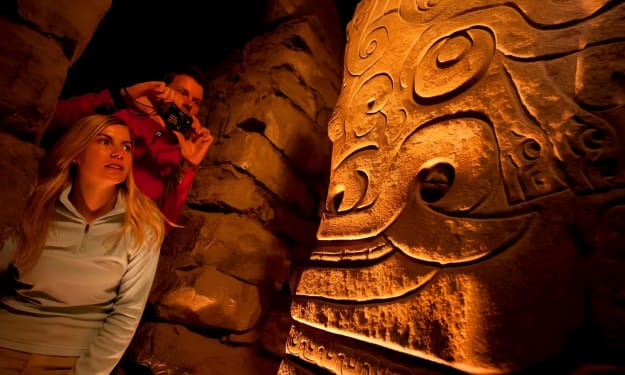
The Hidden Mysteries of Chavín de Huántar
Nestled in the core of South America, where the formidable Andes mountains converge with the verdant terrains of the Peruvian coastline, unfolds the narrative of a civilization that flourished in unity with nature, deities, and the universe. This is the saga of the Chavín culture, a society that arose more than 3,000 years ago, bequeathing a rich heritage of artistry, spirituality, and enigma that continues to intrigue archaeologists and historians alike.
By A História2 years ago in History
Hank and Jackie
Hank and Jackie The year is 1947, a post war world where Americans must come of age facing the nagging responsibility of emerging as a world power. Like an adolescent struggling to break free from childish thinking, America is forced to decide whether to accept the higher principles on which it was founded or change into something else. This is a story about Jackie Robinson and Hank Greenberg, two of the greatest baseball players during the middle part of the twentieth century. They were opposing ball players on a baseball diamond but in a larger more important role they were on the same team. Are” all men created equal?” Hank and Jackie were two of the many people who helped us decide the answer to that question. Whether they wanted it or not, they became symbols for a generation and helped usher in a new dawn in American thinking.
By Larry hart2 years ago in History
Rodrigo Duterte: A Controversial Crusade and Its Unraveling
Rodrigo Roa Duterte was never a man of half-measures. He ruled Davao City with an iron fist, earning both admiration and fear. Before he became the 16th president of the Philippines, he had already built a reputation as a leader who would do whatever it took to restore order. Under his watch, Davao, once a city plagued by crime, became one of the safest in the country. His methods were brutal, but for many, they were necessary.
By Graymore Macad2 years ago in History
March 18: A Day That Changed the World
March 18 might seem like an ordinary day, but history begs to differ! This date has witnessed revolutions, groundbreaking achievements, and heart-wrenching tragedies that shaped our world. Whether you’re a history buff or just curious, join us as we unravel six incredible events that happened on March 18 — and why they still matter today.
By Kyle Truth2 years ago in History
The Cost of Victory: Analyzing the True Winners and Losers of Modern Warfare
Imagine two neighboring nations, X and Y, that share the same language, culture, and lifestyle. To an outsider, distinguishing between their people is nearly impossible. Yet, one day, a war erupts between them over a disputed territory. Nation X loses 3,000 soldiers and approximately $1 billion (today’s value), while Nation Y suffers the loss of 5,000 soldiers and $600 million. After weeks of intense fighting, the war ends—but the borders remain unchanged. Despite this, both nations declare victory, and the territorial dispute continues to this day.
By InkForChange2 years ago in History
10 Declassified Government Secrets You Were NEVER Supposed to See
For decades, governments around the world have kept their most controversial files hidden from the public. But as declassification efforts increase, some shocking secrets are finally seeing the light of day. From UFO sightings to secret military experiments, these newly released files are rewriting history. Here are ten of the most surprising declassified government secrets—wait until you see #7!
By Muhammad Hakimi2 years ago in History
What We Fought For. Content Warning.
The United States of America is at a critical crossroads at this moment in history. The country is heavily divided over politics, religion and entitlement to basic human rights. Life is in turmoil around the board for many of those living in the US. On the political spectrum, there are two very different sides at odds over the morals and values of the country. However, there is a clear lack of understanding over the history of the United States of America, our formation, the government powers, and the US Constitution. When compared to other countries in around the world, the US is one of the youngest in existence, having only been formed about 250 years ago.
By Luna Verity2 years ago in History
The Tigoni Evictions
The seeds that led to the bloodshed at Lari were planted about 20 miles South East at a place called Tigoni. Tigoni is a fertile, well drained area bordered by the Tigoni and Ithanji Rivers. The beautiful countryside had favourable climate and was one of the most precious acreages of Kikuyu-land south of the Chania River. By 1906, the region was accupied by 10 kikuyu clans (mbari) who held ancestral claims to the land and had also employed tenants (muhoi, plural- ahoi).
By HINGES OF TIME2 years ago in History
What If You Could Time Travel to a Gladiator Fight? Here’s What You’d See. Content Warning.
Imagine stepping into a time machine, setting the dial to ancient Rome, and arriving at the peak of the Colosseum’s glory. The year? 80 AD. The event? A gladiator fight so intense it makes modern sports look like child’s play. Here’s what you’d experience as you witness the blood-soaked spectacle firsthand.
By Marveline Merab2 years ago in History