Events
Rise from Qin: The Dawn of an Emperor
Rise from Qin: The Initial Step towards Chinese Unification In the extensive narrative of Chinese history, few individuals are as prominentor as divisiveas Ying Zheng, subsequently recognized as Qin Shi Huang, the First Emperor of a consolidated China. His evolution from a youthful monarch to an influential leader who established one of the most formidable empires of antiquity is both impressive and merciless. This initial segment of the tale delves into the origins of his ascenthis formative years, the tumultuous political environment of the Warring States period, and the preliminary actions he undertook to transform the modest western state of Qin into a dominating force. The Warring States Era: A Realm in Turmoil The period into which Ying Zheng was born was one of the most brutal and disjointed epochs in Chinese history. The once-cohesive Zhou Dynasty had disintegrated, leaving behind a mosaic of competing states, each governed by warlords contending for supremacy. These were the Seven Warring States: Qi, Chu, Yan, Han, Zhao, Wei, and Qin. Each of these realms was profoundly imbued with its own regional identity, military tactics, and political coalitions. Diplomacy was a game of deceit, and treachery was as ubiquitous as warfare itself. Qin, situated on the western frontier, was formerly deemed a “barbarian” state by the eastern powers. However, that perception was on the verge of transformation. A Tumultuous Beginning Ying Zheng was born in 259 BCE in Handan, the capital of the Zhao state, under intricate circumstances. His father, Yiren (later King Zhuangxiang of Qin), was a political hostage in Zhao. Through the shrewdness and connections of Lü Buweia prosperous merchant who became his father’s patronYiren was ultimately returned to Qin and ascended the throne. This would position Ying Zheng, his offspring, as the heir to the Qin dynasty. There exist legends that cast doubt on the true lineage of Ying Zheng, insinuating he may have been Lü Buwei’s own child. Although speculative, this controversy contributed to the enigmatic allure surrounding the youth who would evolve into a formidable emperor. Ying Zheng ascended to the kingship of Qin at the age of 13 following his father’s demise. At such a tender age, the genuine authority of the kingdom resided with his regent, Lü Buwei. Yet, even then, glimpses of ambition sparked within the young sovereign. The Qin Edge In contrast to the other states, Qin had initiated significant reforms a century earlier under the Legalist thinker Shang Yang. These reforms centralized authority, dismantled nobles’ hereditary rights, and established a stringent legal framework that prioritized compliance and efficacy. Under Shang Yang’s reforms, Qin developed a meritocratic bureaucratic and military structure. Soldiers and officials advanced through the ranks based on accomplishment rather than lineage. Land was redistributed to promote individual farming, thus enhancing agricultural productivity. Infrastructure, including roads, was constructed to facilitate commerce and troop mobilization. These reforms transformed Qin into an economic and military titan by the time Ying Zheng took the throne. Seizing Control Despite being a child, Ying Zheng was not satisfied with being a mere pawn. By the age of 21, he had taken absolute command of the state, exiling Lü Buwei and eliminating power contenders. He demonstrated a ruthless realism and a readiness to act with resolvecharacteristics that would characterize his reign. One of his initial priorities was to broaden Qin's influence. The state’s disciplined military, armed with iron weaponry and seasoned by years of border conflicts, commenced well-orchestrated offensives against its rival states. Ying Zheng surrounded himself with exceptional generals and strategists. Among them was the notorious General Wang Jian, who played an essential role in forthcoming campaigns. The king’s administration utilized espionage, bribery, and diplomacy with meticulous precision to undermine enemy coalitions prior to the commencement of battles. Establishing an Empire: The Invasion Commences Ying Zheng’s primary major target was the state of Han, the weakest of the seven. In 230 BCE, following years of preparation, Qin forces invaded Han. The campaign was rapid and effective. Han was annexed, signifying the onset of an ambitious planto conquer all of the Warring States. The collapse of Han sent tremors throughout the remaining kingdoms. Qin, once perceived as a peripheral nation, had now evolved into a formidable predator with a king who would not relent until the map of China was redrawn under his dominion.
By Say the truth about a year ago in History
The Adventure of a Fox in the Morning Forest
The forest in the morning was a moving picture. Silver dew adhered to the tips of emerald leaves, refracting the gold of the morning sun into a changing light mosaic. As birds called the world awake from its sleep, ferns bowed beneath the weight of the final gift from the night. Every movement and sound was a part of a concert of branches, breezes, and breath that predated time.
By MD SHAMIM RANAabout a year ago in History
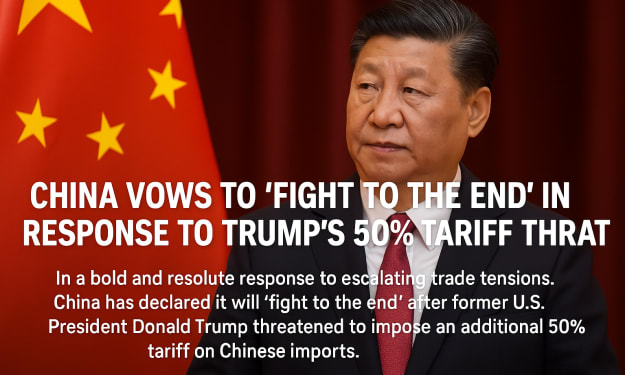
China Declares It Will "Fight to the End" After Trump Threatens 50% Tariff Hike
In response to Trump's threat of 50% tariffs, China promises to "fight to the end." China has declared that it will "fight to the end" in response to the escalating trade tensions in a bold and resolute move. President Donald Trump threatened to impose an additional 50% tariff on Chinese imports. The Chinese Ministry of Commerce called the move "unilateral bullying" and said that China will do everything in its power to protect its sovereignty and economic interests. This latest development marks a significant escalation in the ongoing trade dispute between the world’s two largest economies. The U.S. threat came shortly after China imposed a 34% tariff on American goods, prompting Trump to demand a rollback or face even harsher penalties.
By KAWSAR AHMEDabout a year ago in History
The Khoisan
Humanity has expanded into almost every part of the globe, influenced by factors such as migration, conquest, climate change, and colonization. However, few groups have maintained a consistent presence in one location as prominently and persistently as certain indigenous communities in Africa. The Khoisan, in particular, are notable—potentially the oldest human population in Africa and possibly the entire world.
By A Históriaabout a year ago in History
The Untold Story of Lego you never knew.
It’s hard to imagine a childhood without LEGO. The small, colorful plastic bricks have built their way into the hearts and minds of millions around the world. But the story of LEGO is one of resilience, creativity, and innovation—and it begins not with plastic, but with wood.
By Bob Maddenabout a year ago in History
How to Choose the Best Black Cassock for Full Figure Women
Finding the perfect attire for full-figure women in ministry can be challenging, but Black Cassocks offer the ideal combination of fit, comfort, and style. These cassocks are designed to flatter the figure while providing the modesty and elegance needed for church services. Made with soft, breathable fabrics, they Black Cassocks for Full Figure Women ensure comfort throughout long hours of service. The classic black color adds a timeless touch, while the tailored fit allows easy movement. Whether you're preaching, singing, or assisting, these cassocks are a perfect choice to feel confident and look beautiful in your ministry role.
By Sameera eclergysabout a year ago in History
Online Auctions Made Easy: Bid, Win, and Own!
The rise of online auctions has transformed the way people buy and sell items, making the process faster, more convenient, and accessible to a global audience. Whether you're a seasoned collector, a casual bidder, or a seller looking to reach a vast customer base, online auctions provide an exciting and dynamic marketplace. From rare antiques and luxury goods to real estate and artwork, online auctions cater to a wide range of interests and budgets.
By David Jamesabout a year ago in History
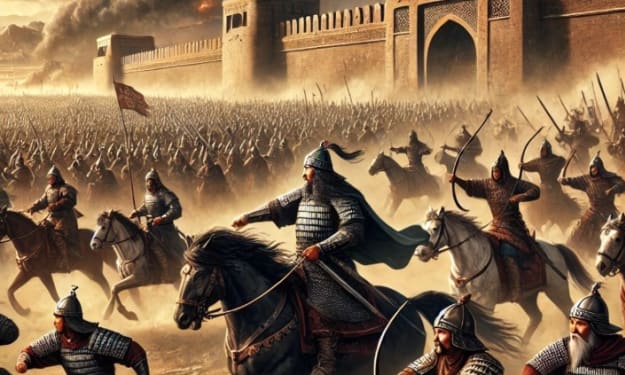
“The Emperor’s Sword: Conquest of Chu”. AI-Generated.
the fall of Han, the Qin army’s appetite for conquest only grew stronger. Their next and most formidable adversary lay in the south—the powerful State of Chu. Unlike the relatively smaller and politically fractured states Qin had defeated earlier, Chu was a colossus. Spanning vast fertile lands, steeped in rich cultural traditions, and renowned for its seasoned warriors, Chu had long been a thorn in the side of Qin's ambitions. For King Zheng of Qin, the future First Emperor, subjugating Chu would not only be a strategic necessity but a personal crusade to establish unquestionable supremacy over all the Warring States. The war with Chu was more than just a clash of swords—it was a battle of minds, tactics, and political maneuvering. Chu, under the command of General Xiang Yan, was not to be underestimated. Xiang Yan was a skilled commander and strategist, a man capable of rallying massive forces and striking fear into even the most disciplined Qin formations. Prelude to Invasion Qin’s chancellor, Li Si, and the legendary general Wang Jian urged caution. They understood that rushing into Chu’s expansive territory without proper planning could end in disaster. Qin had seen such a failure before—when a rash invasion years earlier ended in heavy losses. This time, Wang Jian proposed a different plan: a slow, calculated invasion with overwhelming force. King Zheng entrusted the campaign to Wang Jian but kept another rising star, General Meng Tian, in reserve. Wang Jian, a seasoned warrior known more for his patience than aggression, demanded an enormous army—reportedly over 600,000 men. At first, Zheng thought this excessive and was tempted to replace him. But eventually, he agreed, understanding that the risk of underestimating Chu was too great. The Art of Delay Rather than launching an immediate offensive, Wang Jian built forts along the borders, slowly inching his army forward while giving the appearance of passivity. The Chu generals, misled by this slow advance, relaxed their defenses, thinking Qin had grown fearful or indecisive. In reality, Wang Jian was waiting for the perfect moment to strike—a moment when Chu was least prepared. That moment came after months of stillness. In a sudden wave of attacks, Qin armies surged into Chu territory, overwhelming border forts and driving deep into the countryside. Clash of Titans General Xiang Yan responded fiercely, assembling Chu’s finest warriors for a counterattack. What followed was one of the most ferocious battles in Chinese history. Tens of thousands fell on both sides. The rivers ran red with blood, and the fields were trampled into mud by the weight of armored infantry. But Wang Jian had anticipated this. He feigned retreat, luring Xiang Yan into a false sense of victory. As the Chu army advanced, Wang Jian’s reserves—kept hidden behind forested hills—launched a surprise flanking attack, surrounding the Chu forces in a deadly pincer movement. Xiang Yan fell in battle, and with him, the spirit of Chu began to crumble. City after city surrendered. Qin soldiers, disciplined and ruthless, stormed the strongholds of Chu, executing commanders who resisted and integrating local forces who pledged allegiance. The End of Chu With the death of its greatest general and the fall of its capital, the State of Chu officially ceased to exist. What had once been one of the richest and most formidable kingdoms in ancient China now lay under the control of Qin. Qin’s conquest of Chu was more than a military victory—it was a turning point in Chinese history. The subjugation of Chu sent a message to the remaining states: resistance was futile. King Zheng’s vision of a unified China was now closer than ever.
By Say the truth about a year ago in History
Rise from Qin: The First Step to Chinese Unification. AI-Generated.
Rise from Qin: The First Step to Chinese Unification In the annals of world history, few figures loom as large as Qin Shi Huang, the first Emperor of a unified China. Before he wore the yellow robes of the Son of Heaven, he was known as Ying Zheng, a young king from the western frontier state of Qin. His rise marked the beginning of one of the most transformative periods in Chinese history. This first part of the series explores the early life of Ying Zheng and how the Kingdom of Qin, once considered a barbaric backwater by its eastern rivals, rose to dominate the Warring States. The Warring States: A Nation Divided Before unification, China was a fractured landscape of seven dominant states: Qi, Chu, Yan, Han, Zhao, Wei, and Qin. This period, known as the Warring States (475–221 BCE), was characterized by constant warfare, shifting alliances, and the rise and fall of powerful warlords. Philosophical schools like Confucianism, Daoism, and Legalism flourished amid this chaos, each offering solutions to disorder. Qin, situated in the far west near what is now Shaanxi Province, was long regarded as culturally inferior by the eastern states. However, it had key advantages: fertile lands, access to the Wei River, and a robust military tradition. Its rulers had adopted Legalism, a philosophy emphasizing strict laws, centralized authority, and merit-based governance, thanks to the reforms of Shang Yang in the 4th century BCE. These reforms turned Qin into a powerhouse. The Birth of Ying Zheng Ying Zheng was born in 259 BCE during a time of both internal and external tension. His father, Yiren, was a Qin prince held hostage in the rival state of Zhao. According to some accounts, Ying Zheng’s mother was a concubine of merchant background, further complicating his legitimacy. Eventually, Yiren was released and returned to Qin, where he was enthroned as King Zhuangxiang, thanks to the political maneuvering of the powerful minister Lü Buwei. When Zhuangxiang died in 247 BCE, Ying Zheng ascended to the throne at the age of 13. Due to his youth, the administration was handled by Lü Buwei, who acted as regent. Some historians believe Lü Buwei may have been Ying Zheng’s true father, though this remains speculative. What is clear is that Ying Zheng was raised amidst palace intrigue and political maneuvering, which likely influenced his later obsession with control and loyalty. Seizing Power: The End of the Regency By 238 BCE, Ying Zheng had reached maturity and staged a coup at the age of 21 to remove Lü Buwei from power. In doing so, he asserted his authority over the Qin court and began consolidating power. His early years as king were marked by purges of rival factions, the appointment of capable generals, and the centralization of authority. One of his most important allies during this period was Li Si, a brilliant Legalist scholar who helped Ying Zheng refine Qin’s administrative system and prepare for large-scale warfare. Together, they laid the groundwork for national conquest, focusing on tax reform, military logistics, and infrastructure projects such as road construction and canal systems that would allow armies to move swiftly across territories. The Qin Army: Forged for Conquest Qin's military success was not solely due to Ying Zheng's ambition; it was also the result of institutional strength. The army was highly organized and disciplined, drawing from the Legalist ideals of meritocracy and loyalty. Officers were promoted based on battlefield performance, not noble birth, a revolutionary idea at the time. Additionally, the state invested in advanced weaponry and siege technologies. Crossbows, iron weapons, and formidable cavalry units made the Qin army one of the most fearsome in the ancient world. The Great Wall, or at least early forms of it, was already being constructed in the north to ward off nomadic invasions, showcasing Qin’s commitment to defense and long-term strategy. Diplomatic Manipulation
By Say the truth about a year ago in History
LOUIS LEAKEY'S CONTROVERSIAL LEGACY
Despite having a meticulous 1400-page work about the Kikuyu people written, Jomo Kenyatta beat Louis Leakey by having the first Kikuyu ethnographic book Facing Mount Kenya, printed in 1938. As a PhD holder, Leakey could not help but hold resentment for Kenyatta who was now a published author (without even having a degree) while his own magnum opus gathered dust in a safe. Leakey was considered by many others but mostly himself as the expert on Kikuyu knowledge. Its as though he owned that knowledge and it was only his to disseminate. In fact, Leakey believed Kenyatta had plagiarized some of his material on circumcision rites without acknowledgement.
By HINGES OF TIMEabout a year ago in History