Events
New Museum Examines the History of American Public Housing—and the Stories of Its Residents
Tens of thousands of people were displaced when the Chicago Housing Authority (CHA) started demolishing its own public housing apartments in the early 2000s, despite the agency's assurances that it would soon provide them with new housing and significant community investment.
By moyensefatabout a year ago in History
What is Trump's China tariff strategy?
As Trump improvising. His stunning escalation in tariffs on China this week didn’t follow any meaningful formula. He’s acting, as he always does, like a real estate shark, raising the stakes to intolerable levels to seek leverage. It’s the latest manifestation of the “madman theory,” by which Trump conjures the most extreme of circumstances to try to spook his opponents.
By Mustafa kamalabout a year ago in History
Why England Is Rich Today and What It Took from the Indian Subcontinent
England’s historical wealth roots go deep into the colonial era — especially the period of British rule in the Indian subcontinent. They rule Indian subcontinent for 200 years(1757-1947) .They went that subcontinent for business and commerce and took they power by defeating the last independent king of Bangla(Indian subcontinent) named Sirajuddaula. Between the mid-18th century and 1947, the British systematically extracted wealth from India and the broader subcontinent. After the Battle of Plassey in 1757, the British East India Company began extracting massive wealth from Indian rulers, including gold, silver, and other valuables. Economist Dadabhai Naoroji estimated that billions of pounds (in today's value) were drained annually from India to Britain without any equivalent return. They also made exploitation of Agriculture. Indian farmers were forced to grow indigo, cotton, tea, and opium instead of food crops, leading to famines. Systems like the Zamindari system imposed heavy taxes, causing widespread poverty and landlessness. There was Human Exploitation also. Millions of Indians were shipped as indentured laborers to British colonies in the Caribbean, Africa, and Southeast Asia under harsh conditions.
By Tamzid Hasanabout a year ago in History
Discover Patrick Henry’s Legacy, Beyond His Revolutionary ‘Give Me Liberty or Give Me Death’ Speech
Tourists frequently cram themselves into the seats of a plain white church in Richmond, Virginia, to witness a reenactment of a speech that was first delivered there on March 23, 1775, 250 years ago. Here, in front of George Washington and Thomas Jefferson, Patrick Henry spoke to his fellow Virginia colonists, concluding with the famous quote, "Give me liberty or give me death!" That sentence, a passionate appeal that Americans have often used to express their dedication to freedom, has reverberated across the ages.
By moyensefatabout a year ago in History
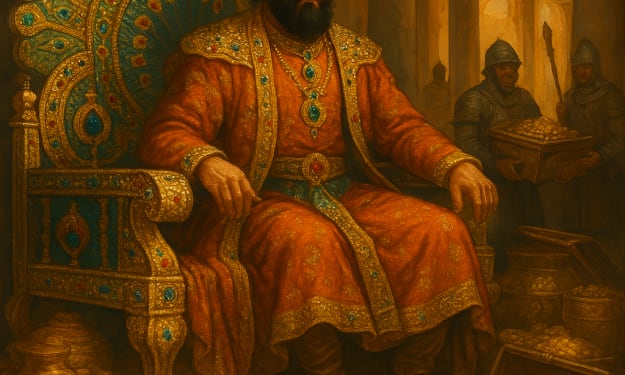
The Iranian Crown Jewels: A $20 Billion Legacy of Empire and Splendor . AI-Generated.
The Iranian Crown Jewels: An Inheritance of Authority, Radiance, and Sovereignty Concealed within a tightly secured vault beneath the Central Bank of Iran resides one of the most remarkable treasures globally: the Iranian Crown Jewels. This invaluable collection, also referred to as the Treasury of the National Jewels, encompasses an astonishing array of crowns, thrones, swords, globes, and precious stones, many of which have their roots in the period of ancient Persia, the Safavid dynasty, and the renowned plunderings of Nadir Shah. Esteemed for its cultural, historical, and symbolic significance far beyond any financial valuation, this treasure embodies the splendor, triumphs, and tumultuous history of Iran’s imperial monarchs. In this article, we examine the extraordinary history, contents, estimated worth, and lasting significance of the Iranian Crown Jewels. 1. Origins of the Treasure The foundation of the Iranian Crown Jewels traces back to the Safavid dynasty (1501–1736), one of the most formidable empires in Persian history. The Safavid monarchs, especially Shah Abbas I, amassed immense wealth, gathering treasures from across the globe. Nonetheless, a substantial portion of the collection as it exists today owes its opulence to a singular, monumental occurrence: Nadir Shah's invasion of India in 1739. Following the sacking of Delhi, Nadir Shah returned to Persia with astounding plunder, which included: The Koh-i-Noor Diamond The Darya-i-Noor Diamond The Peacock Throne of Shah Jahan Cases of rubies, emeralds, pearls, and gold While some of these artifacts (such as the Koh-i-Noor) eventually departed Iran, many of the most significant pieces endured and were inherited or augmented by later dynasties. 2. The Most Iconic Pieces in the Treasury The collection is not only extensive but also includes some of the most magnificent jewels ever created: The Darya-i-Noor (Sea of Light): This light pink diamond is among the largest in existence, weighing approximately 182 carats. Believed to have originally belonged to the Great Mughal Diamond, it currently resides in Tehran and serves as a national emblem of Persian magnificence. The Sun Throne (Takht-e Khorshid): A substantial, gem-encrusted throne utilized by the Qajar monarchs, it was named after the solar design on its backrest. The throne is embellished with hundreds of diamonds, rubies, and emeralds. The Jeweled Globe: Commissioned by Naser al-Din Shah in the 19th century, this stunning globe is crafted from 34 kg of pure gold and adorned with over 51,000 gemstones, including red rubies delineating Iran’s boundaries. The Pahlavi Crown: Designed for Reza Shah’s coronation in 1926, this crown is fabricated from platinum and gold, embellished with 3,380 diamonds, 5 emeralds, 2 spinels, and 368 pearls. It was last worn during the 1967 coronation of Mohammad Reza Shah. Swords, daggers, and tiaras: Exquisitely ornamented armaments and ceremonial attire reflect the warrior legacy and luxury of Iran’s rulers. 3. Estimating the Net Worth Given its unique cultural significance, the Iranian government does not officially assign a financial value to the Crown Jewels. However, expert evaluations and comparative analyses suggest that the collection’s estimated net worth may surpass $20 billion, potentially positioning it as the most valuable royal treasury in the world. However, the genuine worth is found not solely in the gemstones or metalsit resides in the historical narrative they embody. Each gem signifies triumphs, partnerships, dynasties, and revolutions. 4. Endurance Through Upheaval In 1979, amid the Iranian Islamic Revolution, numerous individuals were concerned that the Crown Jewels would be pilfered, smuggled abroad, or obliterated. Yet, remarkably, the collection remained whole. Ayatollah Khomeini, despite his opposition to monarchy, acknowledged the jewels as national heritage, transcending their status as royal assets. Currently, the Iranian Crown Jewels are located in the Museum of the Treasury of National Jewels, situated under the Central Bank of Iran in Tehran. Given their substantial value, they also serve as monetary support for the national currency, functioning as a form of state reserve asset. 5. A Heritage Beyond Gold The Iranian Crown Jewels comprise more than merely a collection of splendid artifactsthey reflect Persian history. They have withstood invasions, dynastic upheavals, colonial ambitions, and revolution. Their elaborate craftsmanship narrates a tale of Iran’s artistic legacy, expertise in metallurgy, and admiration for beauty and symbolism. From the splendor of the Safavid era to the opulence of the Qajar period and the modernization of the Pahlavi dynasty, these jewels have observed and endured the ebbs and flows of empire. They persist not merely as silent observers of magnificence but also as formidable emblems of national identity. Conclusion The Iranian Crown Jewels serve as a monument to centuries of authority, conquest, and artistic excellence. While secured in vaults today, they radiate with the narratives of kings and empires, both respected and dreaded. In a realm of ever-shifting fortunes, these jewels continue to remind us of Persia’s imperial legacy and the lasting heritage of beauty, affluence, and history.
By Say the truth about a year ago in History
Nadir Shah’s Loot: The Billion-Dollar Plunder That Shook an Empire. AI-Generated.
The Looting of an Empire: Nadir Shah’s Enormous Fortune and the Pillaging of Delhi In the chronicles of global history, few conquerors exhibited the extreme cruelty and opportunistic nature of Nadir Shah, the Persian monarch who invaded India in the early 18th century and departed with one of the most significant treasures ever seized in a singular military endeavor. In 1739, during the declining years of the Mughal Empire, Nadir Shah invaded India, overcame Emperor Muhammad Shah, and memorably plundered Delhi, acquiring an astonishing trove of gold, silver, gemstones, and renowned relicsincluding the Peacock Throne and the Koh-i-Noor diamond. This article examines the context of Nadir Shah’s incursion, the magnitude of his looting, the projected value of his wealth in contemporary terms, and how this solitary act of conquest transformed the political and economic dynamics of Asia. 1. The Ascendance of Nadir Shah Nadir Shah (1688–1747), a military prodigy from modest beginnings, ascended to power in Persia amid a period of turmoil. He initially gained recognition for defeating Afghan forces that had occupied regions of Persia, and by 1736, he had declared himself Shah of Iran. With a disciplined military and a thirst for conquest, he turned his gaze eastwardto the faltering Mughal Empire. At the time, India under Mughal dominion remained affluent but politically splintered. Provinces functioned semi-independently, and central authority had diminished under Muhammad Shah. Recognizing an opportunity, Nadir Shah commenced his invasion in 1738, rapidly seizing Ghazni, Kabul, Lahore, and then advancing toward Delhi. 2. The Plundering of Delhi: A City Soaked in Blood and Wealth Nadir Shah’s pivotal triumph at the Battle of Karnal in February 1739, where he obliterated Mughal forces, opened the gates to Delhi. Upon entering the city, he initially exhibited respectbut a miscommunication involving a clash between Persian and Indian troops resulted in a massacre of thousands of civilians. The city of Delhi, one of the most affluent capitals of the era, was transformed into a battleground and a treasure trove. Nadir Shah demanded the relinquishment of all valuables, and Mughal courtiers, merchants, and aristocrats were divested of their wealth. The Shah’s forces looted gold, silver, precious gems, fabrics, and armaments. However, the crowning jewels of the plunder were: The Peacock Throne: A lavish seat adorned with rubies, emeralds, pearls, and diamonds, originally commissioned by Shah Jahan. The Koh-i-Noor Diamond: A 186-carat diamond that would eventually become part of the British Crown Jewels. The Darya-i-Noor Diamond: Another invaluable diamond, now preserved in the Iranian Crown Jewels. 3. The Estimated Value of the Plunder Historical records indicate that Nadir Shah departed India with treasures valued at 70 crore rupees in the currency of that period.
By Say the truth about a year ago in History
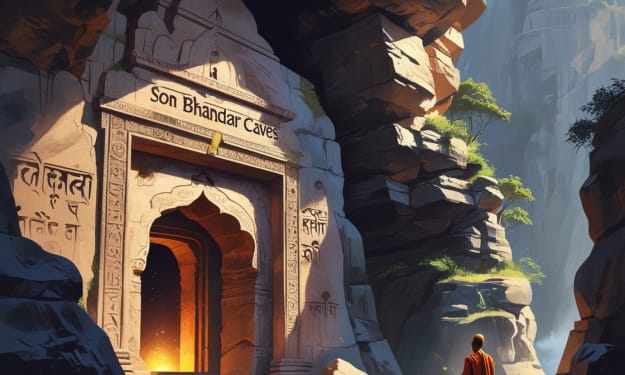
Son Bhandar Caves: Bihar’s Hidden Vault of Gold and History. AI-Generated.
The Son Bhandar Caves of Bihar: Vaults of History and Enigma In the serene city of Rajgir, situated amidst the craggy Vaibhagiri Hills in Bihar, are two ancient rock-carved chambers referred to as the Son Bhandar Caves. Frequently eclipsed by more renowned Buddhist locations such as Nalanda and Bodh Gaya, these caves possess their own allure. Originating from the 3rd or 4th century AD, the Son Bhandar Caves are enveloped in enigma, with regional tales asserting they were formerly utilized to conceal a vast royal treasure. Sculpted from a singular rock face and inscribed with characters in the ancient Brahmi script, the caves represent a combination of architectural accuracy, historical significance, and folkloric fascination. This article delves into the origins, structure, and persistent legends associated with the Son Bhandar Caves, illuminating one of India’s lesser-explored archaeological treasures. 1. The Location and Configuration Situated within the Rajgir Wildlife Sanctuary, the Son Bhandar Caves comprise two adjacent rock-cut chambersone large and one smallercarved into the cliffside. They are frequently compared stylistically to the more famed Barabar Caves, which were fashioned during the Mauryan Empire. The larger chamber features a rectangular form with a smooth interior wall surface, whereas the smaller one appears incomplete or more weathered. Both caves have been hewn from solid granite and are reachable by a stone pathway leading from the plains below. The site, providing sweeping views of Rajgir, suggests it may have once fulfilled strategic or religious functions. 2. Historical Context and Gupta Link Researchers assign the Son Bhandar Caves to the Gupta era (320–550 AD), regarded as a golden period for Indian artistry, literature, and temple construction. While preceding Mauryan caves were predominantly affiliated with the Ajivika sect, the Son Bhandar Caves are thought to have ties with Jainism. This notion is bolstered by the inscription in Brahmi script engraved near the entrance of the cave. It is inscribed in Gupta-period lettering and is said to assert that the caves were created for Jain ascetics. Jain sculptures, presumed to have been added later, were also unearthed within the caves, further supporting the concept that these served as sites for spiritual retreat. 3. The Tale of the Golden Hoard What distinguishes the Son Bhandar Caves from other rock-cut structures is the tale linked with their designation. In Hindi, “Son Bhandar” translates directly to “Store of Gold. ” According to local folklore: The larger chamber is reputed to be a concealed treasury of King Bimbisara, the ruler of Magadha and a contemporary of the Buddha. The entrance to this treasure is supposedly sealed behind a substantial stone door equipped with a concealed mechanism. A cryptic inscription on the wall, if accurately decoded, is purported to disclose the method to access the vault. The treasure remains undisturbed due to challenges in interpreting the inscription and apprehension about disturbing the site. The conviction persists that unimaginable wealth of gold and gemstones lies hidden beyond that sealed barrier. Numerous unsuccessful endeavors have been made over the centuries to unlock the alleged treasure chamber, including efforts during the British colonial period. 4. Archaeological Importance Beyond the myths, the caves possess significant archaeological value:
By Say the truth about a year ago in History
The Hidden Passage of Hyderabad: Unearthing the Charminar Tunnel Mystery
Beneath the Minarets: Revealing the Concealed Passage of Charminar, Hyderabad In the core of Hyderabad, the historic Charminar rises as a splendid emblem of Indo-Islamic architecture and the heritage of the Qutb Shahi dynasty. Erected in 1591 by Sultan Muhammad Quli Qutb Shah, the edifice has fascinated historians, tourists, and locals for centuries. While the four minarets above ground are celebrated by all, there exists a lesser-known, considerably more enigmatic legend that resides belowthe presence of a clandestine subterranean tunnel that supposedly links Charminar to Golkonda Fort, approximately 11 kilometers distant. This article delves into the historical, architectural, and cultural backdrop of the Charminar Tunnelscrutinizing its genesis, the myth versus reality discourse, its purported function, and the persistent intrigue it evokes among adventurers and scholars. 1. The Inception of Charminar: Monument of Affliction and Pride To grasp the tunnel, one must first revisit the genesis of Charminar. It was erected as a symbol of victory following the cessation of a lethal plague that had ravaged Hyderabad. Some narratives suggest the Sultan vowed to construct a mosque if his populace were spared from the epidemic. The outcome was not merely a site of worship but a central element of urban planning, with Charminar as the nucleus of a grid-patterned city. Strategically positioned at the convergence of historical trade routes, Charminar served as a venue for both commerce and culture. However, beyond its external magnificence, the structure may have concealed defensive secretsincluding escape passages beneath the surface. 2. The Myth of the Tunnel: Charminar to Golkonda For centuries, oral traditions, local legends, and colonial accounts have alluded to a tunnel extending from Charminar to Golkonda Fort, the epicenter of Qutb Shahi authority prior to the establishment of Hyderabad. According to these narratives: The tunnel acted as a secret route for the royals during times of siege. It was expansive enough to facilitate movement on foot or horseback. It connected to various underground chambers and potentially even concealed treasure troves. What perpetuates the legend is that numerous ancient structures in the vicinityparticularly near Mecca Masjid and Purani Havelihave exhibited sealed entrances or enigmatic chambers beneath them, which locals believe to be remnants of this underground network. 3. Archaeological Indications and Theories Over the years, several minor excavations and unintended findings have alluded to subterranean cavities near Charminar and Golkonda. In 2008, laborers excavating in the old city reportedly uncovered a stone-paved pathway beneath a structure adjacent to Charminar, igniting renewed interest in the tunnel hypothesis. Nonetheless, the Archaeological Survey of India (ASI) has not officially corroborated the existence of a tunnel. Their justifications include: Structural safety concerns: Excavating beneath centuries-old monuments could jeopardize their stability. Urban development: Much of the route is now heavily constructed with markets, residences, and roads. Absence of consistent documentation: Despite oral histories, written records from the Qutb Shahi period do not definitively confirm the existence of such a tunnel. However, Hyderabad's traditional guardiansresidents, historians, and enthusiasts of folkloreremain steadfast in their beliefs. Numerous individuals propose that the tunnel has been either obstructed or partially collapsed but was once a completely operational passageway. 4. Function and Tactical Design If the tunnel indeed existed, its tactical significance cannot be undervalued. During the 16th and 17th centuries, political intrigues, internal uprisings, and threats from competing kingdoms necessitated the design of subterranean escape routes. Architectural historians observe that Mughal and Persian architecture frequently featured secret tunnels, concealed compartments, and intricate ventilation mechanisms. Considering the Qutb Shahis' Persian heritage and military acumen, it is plausible they integrated similar elements into the urban planning of Hyderabad. 5. The Tunnel in Cultural Tradition and Tourism The notion of a concealed tunnel linking Charminar and Golkonda has evolved into a cultural legend. Tour guides often reference it, residents transmit the tale to younger audiences, and social media perpetuates the myth through occasional “sightings” or rediscoveries. Although largely uncorroborated, the legend contributes a sense of intrigue to Hyderabad’s cultural legacy and amplifies the charm of Charminar and Golkonda. If strategically marketed, it could serve as a tourism narrative that attracts explorers and history enthusiasts alike. 6. Contemporary Relevance and Urban Challenges
By Say the truth about a year ago in History
"Early Morning Letters from History"
is an idea that can provoke in-depth contemplation on time, human development, and the ways that ancient letters can preserve the knowledge, feelings, and ideas of people from earlier generations. In a "Dao" context, these letters might represent more than just communication; they might represent a profound philosophical investigation of the Tao, the path of least resistance, and life's inherent flow.
By MD SHAMIM RANAabout a year ago in History