Events
Stylish Women's Clergy Suits for Every Ministerial Event
When it comes to serving in ministry, women often face the challenge of finding the right clothing that combines both comfort and elegance. Women's Clergy Suits are a crucial part of any woman’s wardrobe, offering both style and dignity for church services, weddings, and other important religious events. However, shopping for these suits can be tricky. Women often struggle with sizing, fabric choices, or simply finding a suit that fits their personal style while maintaining the decorum of their role. This article will explore the common problems women face when choosing clergy suits and offer practical solutions.
By Sameera eclergysabout a year ago in History
BAPS Temple & Abu Dhabi Wonders: A Tapestry of Faith and Modernity
The BAPS Abu Dhabi Temple is a holy wonder that shines as a light of spiritual unification and cultural reverence in the center of Abu Dhabi, where the golden sands of the desert meet the glittering cityscape of a contemporary metropolis. This architectural wonder, which was unveiled on February 14, 2024, combines the traditional Hinduism with the progressive spirit of the United Arab Emirates to create more than just a house of worship. An Abu Dhabi Tour with Temple provides a trip that blends faith, artistic expression, and the lively pulse of a city that embraces variety for anyone looking for a life-changing experience.
By Dubai Executive Toursabout a year ago in History
TET Trung Thu – Vietnam Full Moon Festival
Origins of Full Moon Festival The Full Moon festival or Mid-Autumn Festival (Trung Thu Festival in Vietnamese) dates back to the Rice Civilization of the Red River delta, over 4,000 years ago. It is not only held to celebrate a successful harvest but also a chance for parents to make up for their children after spending much time on harvest season which was usually done by September (Mid-August in the Lunar calendar). In this special occasion, the parents often do something special with them by preparing many different foods – moon cakes, candies, fruits. It was held under the full moon. At this time, the moon’s orbit is at its lowest angle to the horizon, making the moon appear larger and brighter than at any other time of the year. People would gather to watch this auspicious event, and pray for the fullness and prosperity of life.
By Thousand Sunnyabout a year ago in History
Bangla Noboborsho: The Bengali New Year That Inspires the World
Every April, a wave of color, culture, and community sweeps across Bengal—and increasingly, the world. It’s called Bangla Noboborsho, the Bengali New Year, and it’s not just a celebration. It’s a living, breathing cultural experience—one that combines ancient roots with modern spirit, artistic expression with community unity, and joy with deep meaning.
By Sanjoy Ganguly about a year ago in History
Where to See the Lyrid Meteor Shower 2025:. AI-Generated.
Where to See the Lyrid Meteor Shower 2025: A Complete Guide with Top Viewing Tips Every year in April, stargazers around the world turn their eyes toward the night sky to witness one of nature's oldest and most enchanting spectacles — the Lyrid meteor shower. With records dating back over 2,700 years, the Lyrids are among the oldest known meteor showers. In 2025, this dazzling event will grace our skies from April 15 to April 29, with peak activity expected on the night of April 22 through the early morning of April 23.
By Mamunur Rashidabout a year ago in History
"Echoes Through the War"
The year was 20 45 Dr. Kamrul Hasan Ali , a gentle physicist with messy hair and tired eyes, had just done the impossible. In the basement of his grandfather's old house in Dhaka, he completed a prototype time machine. This is a lifelong obsession inherited from the faded side of my grandfather's war diary.
By Araf Kabirabout a year ago in History
Astronomers say they’ve found strongest ever ‘hints’ of life beyond our solar system
In a groundbreaking announcement, astronomers have revealed what they believe are the strongest ever "hints" of life beyond our solar system. After years of research and technological advancements, this discovery marks a significant turning point in humanity's quest to determine whether we are truly the only species in the universe. While the evidence is far from definitive, it opens new doors for exploration and raises tantalizing questions about the potential for extraterrestrial life.
By Mahmodul hassan mojahidabout a year ago in History
Emily in Paris’ Season 5 cast announced with one major character missing from the lineup
Netflix’s hit romantic comedy Emily in Paris is officially returning for its highly anticipated fifth season, promising more chic fashion, romantic entanglements, career drama, and scenic European backdrops. However, the announcement of the Season 5 cast has stirred up both excitement and concern among fans. While many familiar faces will return, one beloved character will be noticeably absent from the new lineup: Camille, played by French actress Camille Razat.
By Mahmodul hassan mojahidabout a year ago in History
Returning Without Questions
Returning Without Questions They came a little closer to me one odd evening, I recall. Despite its simplicity, the relationship had an odd depth. There was a kind of connection between them that spoke before words, the language of their eyes—even when they were silent in front of each other, they understood each other. However, despite being by each other's side, there are times in life when people move on. There came a time when the two of them moved far away from each other.
By Arshad Aliabout a year ago in History
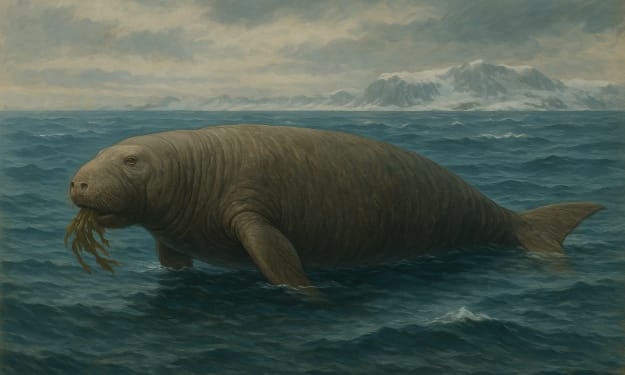
Giants of the Frozen Sea: The Tragic Tale of the Stellar Sea Cow. AI-Generated.
The Stellar sea cow, a massive marine herbivore discovered in the 18th century, is one of the most tragic examples of rapid extinction in recorded history. A close relative of the dugong and manatee, the Stellar sea cow was first documented by German naturalist Georg Wilhelm Steller in 1741 during the Great Northern Expedition led by Danish explorer Vitus Bering. Found in the icy waters surrounding the Commander Islands near the Bering Sea, the sea cow’s tale is a haunting reminder of how quickly human activity can impact fragile ecosystems. Discovery and Description Georg Steller was the first and only scientist to study the Stellar sea cow while it was still alive. According to his journals, the creature was an enormous, peaceful, slow-moving herbivore that could grow up to 10 meters (33 feet) in length and weigh over 10 tons. It lacked teeth and used keratinous pads to chew on kelp, which made up its primary diet. These sea cows were believed to live in small family groups and had thick, wrinkled brown skin similar to the bark of an old tree. Their large, whale-like tails helped them glide gracefully through the frigid waters. What struck Steller the most was the sea cow’s docile temperament. Unlike many wild animals, the sea cow showed no fear of humans, a trait that would ultimately seal its fate. A Brief Existence At the time of discovery in 1741, the sea cow population was already geographically restricted to a small area around the Commander Islands, most likely due to centuries of climate changes and possible hunting by Indigenous peoples. But it wasn’t until European sailors and fur traders began arriving en masse that the animal's extinction was accelerated. Within just 27 years of its discovery, by 1768, the Stellar sea cow was declared extinct. Its size and docile nature made it an easy target for hunters. The sea cow's thick blubber, which could be boiled down into oil, and its meat, which was reported to be both tasty and able to feed crews for weeks, made it a valuable resource for Russian fur traders and sailors navigating the treacherous Bering Sea. Ecological Importance and Extinction The sea cow was an essential part of the kelp forest ecosystem. As a grazer of seaweed, it helped maintain the health and balance of underwater vegetation. Its disappearance not only marked the loss of a species but also may have had ripple effects on the broader marine environment in the North Pacific. Its extinction serves as one of the first well-documented cases of human-driven extinction of a marine species. Unlike many prehistoric animals whose fates are inferred through fossils and legends, the Stellar sea cow was studied, hunted, and wiped out within the span of a single generation. This makes its story particularly heartbreaking and poignant in the context of conservation biology. Legacy and Scientific Interest Despite its extinction, the Stellar sea cow continues to fascinate scientists, conservationists, and the public. Numerous efforts have been made to study its bones and fossils to better understand its physiology and evolutionary path. As a member of the order Sirenia, which includes modern-day dugongs and manatees, the sea cow provides insights into how these animals adapted to different environments. Its rapid extinction is often used as a cautionary tale in ecological studies and biodiversity conservation. It demonstrates the devastating impact that unregulated hunting and ecological ignorance can have on isolated and vulnerable species.
By Say the truth about a year ago in History
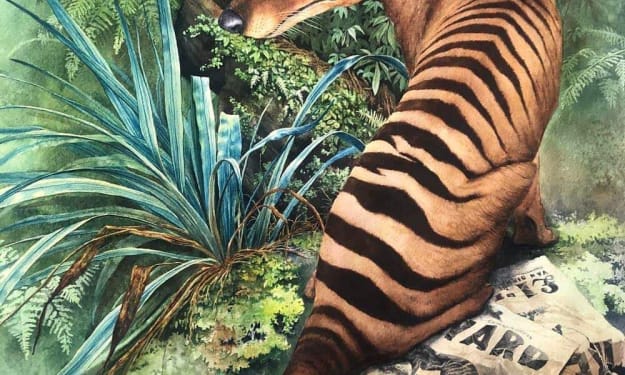
"The Tasmanian Tiger: Echoes of a Lost Predator". AI-Generated.
The Tasmanian Tiger: Echoes of a Lost Predator The narrative of the Tasmanian tiger, or thylacine (Thylacinus cynocephalus), is one of the most heartrending accounts in the records of extinction. Indigenous to Tasmania and once prevalent throughout mainland Australia and New Guinea, this carnivorous marsupial was the largest recognized member of its species. With its characteristic striped lower back, wolf-like cranium, and pouch reminiscent of a kangaroo’s, the thylacine was both a scientific wonder and a cultural symbol. Origins and Evolution The thylacine was classified within the Dasyuromorphia order, which encompasses contemporary carnivorous marsupials such as the Tasmanian devil. Fossil evidence indicates that thylacines roamed the Australian mainland and regions of New Guinea over two million years ago. However, by the time European colonizers arrived in Australia, the species had already disappeared from the mainlandmost likely due to competition from humans and the introduction of dingoes. Tasmania, an island devoid of dingoes, remained the ultimate refuge for the thylacine. Its seclusion allowed the species to flourish for millenniauntil the arrival of European settlers in the 19th century. Biology and Behavior Despite its moniker, the Tasmanian tiger was not a feline and bore no relation to the tiger. It was a marsupial, with greater affinities to the kangaroo or wombat. Fully mature thylacines measured up to 180 cm (6 ft) in length from nose to tail and weighed approximately 20–30 kg (45–66 lbs). Its jaw could open to an astounding 80 degrees, an attribute that intrigued researchers and rendered it an adept predator. The thylacine was a nocturnal hunter, likely preying on kangaroos, wallabies, and small rodents. Its unique stripes were believed to provide camouflage in the Tasmanian bushland. What further distinguished the thylacine was that both males and females possessed pouchesan exceedingly rare characteristic in the animal kingdom. The Road to Extinction Regrettably, the thylacine’s extraordinary adaptations were unable to withstand human encroachment. European settlers regarded the thylacine as a menace to their sheep and livestock. Despite limited evidence of widespread predation, the government began issuing bounties in the late 1800s10 shillings per specimen, equivalent to hundreds of dollars today. This systematic eradication, combined with habitat destruction and the proliferation of diseases, devastated the population. By the early 20th century, sightings became increasingly uncommon. The last confirmed wild thylacine was shot in 1930, and the final captive thylacine, known as "Benjamin," perished in the Hobart Zoo on September 7, 1936ironically, just two months after the species was afforded legal protection. Legacy and Scientific Mystery Despite its formal extinction, the Tasmanian tiger has never genuinely vanished from public awareness. Numerous unsubstantiated sightings, indistinct images, and anecdotal accounts continue to surfaceeven into the 21st century. These narratives have fueled a combination of optimism, mythology, and scientific exploration. The thylacine’s heritage has also inspired initiatives in the realm of de-extinction. In recent years, researchers have sequenced its genome utilizing preserved specimens. This has ignited serious discussions regarding cloning and the potential resurrection of the species through advancements in genetic engineering. While such endeavors remain nascent, they evoke ethical and ecological dilemmas concerning human accountability and the ramifications of bringing back extinct species. Cultural Influence Aboriginal rock art, with some pieces dating back thousands of years, illustrates creatures akin to the thylacine. This highlights its enduring importance to indigenous populations, where it may have been viewed as both a spiritual and natural entity. In modern culture, the thylacine features in literature, documentaries, and cinema. It has emerged as an emblem of lost wilderness and serves as a cautionary narrative about the consequences of neglecting nature. Economic and Scientific Significance Although the thylacine is no longer a component of Tasmania’s natural ecosystem, its narrative sparks considerable interest and tourism. Museums, wildlife reserves, and entire research projects focus on examining this extinct predator. If ever revived or conclusively observed, the global scientific and commercial ramifications would be substantialpotentially valued at millions of dollars in media exposure, funding, and eco-tourism.
By Say the truth about a year ago in History
Hatshepsut's Revenge
Chapter One: The Beginning of Revenge The grand hall of the king's palace was filled with sorrow and hushed whispers. Hatshepsut, the heir to the Egyptian throne, sat beside the body of her late father, the king, trying to conceal her inner turmoil behind a mask of royal grief. She wasn’t just grieving; she was increasingly anxious about the future of her reign following her father’s death.
By mohamed elsayedabout a year ago in History