Events
India vs England Cricket Team Timeline
India vs England Cricket Team Timeline: A Historic Rivalry The cricketing rivalry between India and England is one of the most enduring and historic in international cricket. Spanning nearly a century, this duel has evolved from a colonial backdrop to a fiercely competitive modern-day showdown, rich in iconic moments, dramatic encounters, and evolving cricketing philosophies.
By Manoj Chhonkarabout a year ago in History
Three myths in one perfume
“What do you wear to bed? Why, Chanel N° 5, of course.” This iconic phrase, spoken by Marilyn Monroe during a 1952 interview, has forever linked the famous actress to the world’s most famous perfume: Chanel N° 5. Instantly, every time we think of this fragrance, Marilyn’s image comes to mind. Monroe is not only one of the most celebrated women in film history but also the person who, indirectly, helped make this perfume an eternal icon. Her simple response, which seemed almost like a lighthearted joke, had an impact that transcended time, connecting her figure to that of Coco Chanel and her famous perfume, creating a bond that would last for decades.
By Halina Piekarska (UltraBeauty Blog)about a year ago in History
The Boy Who Carried a Dream
In a quiet village nestled between the green hills of Bangladesh, lived a boy named Imran. He was only twelve years old, but his eyes sparkled with a maturity far beyond his age. He lived with his mother in a small, tin-roofed house. His father had died when Imran was just three, and since then, his mother had worked at a local rice mill to support them.Imran loved books. But not just any books—he loved science books, books about stars, planets, machines, and inventions. While other boys played football in the fields after school, Imran would sit under the old banyan tree with his nose buried in pages filled with wonder.His dream was simple: he wanted to be an engineer. Not just any engineer—but one who would create machines that could help farmers, like his neighbors, work more easily.But dreams, as Imran would learn, are expensive.His school was several kilometers away, and he walked barefoot every day to attend. The books he read were all borrowed—sometimes from school, sometimes from an old teacher who had taken a liking to the curious boy. His mother barely made enough to feed them, let alone buy extra books or materials.One night, as rain poured down from the heavens and thunder shook their little house, Imran studied by the light of a kerosene lamp. The wind blew in through the cracks in the wall, but he didn’t stop. His mother watched him quietly, a mix of pride and worry in her eyes.“You should sleep,” she said softly.“I will, Ma. Just one more chapter,” he replied, eyes still fixed on the page.Days turned into months. Imran won the district science fair with a handmade model of a solar-powered irrigation system. The local newspaper featured his photo. For the first time, people in the village began to believe—this boy might go far.But life had its tests.One day, his mother collapsed at work. The doctor said she needed surgery and months of rest. Imran was devastated. The hospital bills were beyond anything they could He stood outside the hospital, staring at the sky, tears streaming down his face. He could feel his dream slipping away.The next morning, he went to the market. He took up a job cleaning dishes at a roadside tea stall. Before school, after school, sometimes instead of school. He did whatever he could to pay for his mother’s medicine.But he never stopped reading. He carried a small notebook in his pocket where he wrote ideas, drew machines, and jotted questions he hoped to find answers to one day.One evening, as he cleaned the stall, a well-dressed man watched him curiously. The man noticed Imran scribbling in his notebook during breaks.“What are you writing, boy?” he asked.Imran hesitated but then showed him. The man flipped through the pages—diagrams, notes, even simple engineering designs. He was surprised.“Where did you learn all this?”“Books… school… I just try to learn on my own,” Imran said shyly.The man smiled. “I’m Professor Rahman. I teach at Dhaka University. Would you show me more tomorrow?”That meeting changed everything.Professor Rahman visited Imran’s house the next week. He spoke to the principal of his school and arranged a scholarship. He ensured his mother received proper medical treatment. He even brought books—so many that Imran’s little shelf overflowed.Years passed. Imran went on to study engineering at Dhaka University. He topped his class. His ideas began to attract attention. His final year project—an affordable, solar-powered water pump for rural farmers—won an international award.News spread back to the village. People gathered around the old banyan tree, reading about the boy who once walked barefoot to school and now stood on world stages speaking about innovation.Imran didn’t forget his roots.He returned to his village, not as a visitor, but as a builder. He opened a small research center to train young students. He worked with local farmers to introduce simple technologies that saved them time and effort.One day, while walking through the fields, a young boy came running to him.“Sir, I want to be like you,” the boy said.Imran smiled, handing him a small notebook.“Then start by writing your dreams here,” he said.That night, under the same banyan tree, the village children gathered around as Imran spoke—not just about machines or technology, but about belief, sacrifice, and the strength of never giving up.Because dreams, he now knew, could grow even in the hardest soil—if only someone cared to water them. afford.
By Sumaiya’s Wordboxabout a year ago in History
The Silent Scream of Smyrna: The Overlooked Massacre of 1922
The Silent Scream of Smyrna: The Overlooked Massacre of 1922 During the final moments of the Greco-Turkish War, an ancient metropolis that once prospered as a center of culture and commerce in the Mediterranean became the backdrop for a calamitous event that altered the trajectory of history: the Great Inferno of Smyrna. Currently known as İzmir in present-day Turkey, Smyrna was not only among the most affluent cities of the Ottoman Empire but also one of the most heterogeneous. Greeks, Armenians, Jews, and Turks coexisted for centuriesuntil 1922. This massacre, frequently termed “The Smyrna Catastrophe,” stands as one of the most somber and least reported incidents in contemporary history. It persists as an emblem of treachery, ethnic cleansing, and the inadequacy of the global community to take action. The aftermath resulted in a vast humanitarian crisis and the annihilation of a culture that had thrived for millennia. A City on the Verge By 1922, the Greco-Turkish War had culminated in a violent crescendo. Greek forces, who had occupied Smyrna in 1919 with Allied assistance, were decisively repelled by the Turkish National Movement led by Mustafa Kemal Atatürk. As Turkish troops regained control of Smyrna on September 9, 1922, what ensued was not merely a military triumphit was a thorough alteration of the region’s demographic and cultural identity. In the days following the Turkish arrival, violence erupted. Eyewitnesses from Western consulates, missionaries, journalists, and survivors recounted mass executions, assaults, and looting predominantly targeting the Greek and Armenian populations. The climax was the Great Inferno, which ignited on September 13, consuming the Greek and Armenian districts of the city while the Turkish and Jewish neighborhoods remained intact. An Inferno and a Massacre The precise number of fatalities remains uncertain due to the chaotic circumstances of the event, but estimates indicate that over 100,000 individuals were either slain or succumbed to the ensuing fire, starvation, and illness. More than 400,000 Greeks and Armenians fled the city, with many seeking refuge in overcrowded vessels docked in the harbor. Some were denied entry or assistance by foreign warships positioned nearbyan international betrayal that continues to mar diplomatic histories. Eyewitness narratives described the sea turning crimson with blood, the atmosphere thick with smoke and cries, and flames consuming centuries of heritage and legacy. American relief worker Asa Jennings and British author George Horton were among the few who chronicled the atrocities, although their accounts were suppressed beneath diplomatic apathy. Cultural and Economic Devastation The annihilation of Smyrna was not merely a slaughter of individualsit was an extermination of culture. Ancient libraries, churches, manuscripts, and artifacts were reduced to ashes. The city's economic prosperity, once celebrated as the "Pearl of the Aegean," was consumed by flames. The projected financial damage to properties, artifacts, and infrastructure surpassed $3 billion USD in current value. However, no valuation can adequately reflect the loss of human life and cultural heritage. Smyrna was among the few cities that possessed not only economic affluence but also an exceptional cosmopolitan essence. Its obliteration concluded an era of pluralism in Asia Minor. Greek and Armenian civilization in the region, which had thrived for over 2,500 years, was eradicated within days. Global Inaction Despite the presence of numerous foreign powers in Smyrna at the timeincluding British, American, French, and Italian naval vesselsnone intervened to halt the atrocities or provide assistance to the fleeing population. This inaction exacerbated the death toll and further deepened the trauma for survivors. Records indicate that political interests, war fatigue, and post-WWI diplomacy muffled global response. Many historians contend that the massacre of Smyrna constituted a form of ethnic cleansing, aimed at transforming Anatolia into a solely Turkish homeland. Although seldom recognized as such, it persists as a haunting precedent in contemporary history. Legacy and Acknowledgment For decades, the massacre of Smyrna was obscured beneath political narratives and nationalist agendas. Survivors and their descendants frequently transmitted their trauma through oral histories and familial records. It is only in recent years that academic interest has begun to reexamine and reveal the truth. Memorials, literary works, and historical accounts such as Lou Ureneck’s The Great Fire have rekindled interest in the tragedy. Nonetheless, formal acknowledgment, apologies, or reparations remain elusive. Conclusion The downfall of Smyrna and the massacre of 1922 was not only the obliteration of a cityit was the silencing of an entire civilization. Forgotten by many and unrecognized in historical texts, the blood of Smyrna’s innocents continues to mark the annals of a century that witnessed innumerable atrocities. In commemorating Smyrna, we honor not only the victims but also the enduring truth that no massacre should remain concealed beneath the remnants of diplomacy.
By Say the truth about a year ago in History
Silent Genocide: The Hidden Massacre of Balochistan. AI-Generated.
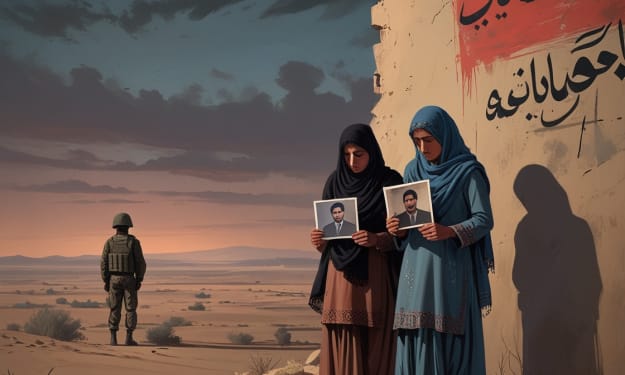
The Concealed Afflictions: The Balochistan Massacre – An Overlooked Episode of Contemporary History In spite of being one of the least addressed atrocities of the contemporary period, the persistent turmoil and purported massacres in Balochistan stand as a distressing reminder of the muted agony of a populace ensnared in the realm of politics and power. This article reveals the concealed particulars of decades of discord in the Baloch region, examining its historical origins, political conflicts, and the human toll that persistspredominantly disregarded by international media and historical narratives. The Concealed Afflictions: The Balochistan Massacre – An Overlooked Episode of Contemporary History When history is recorded by the triumphant, entire segments of anguish are frequently excluded. One such segment transpires in the rugged mountains and arid terrains of Balochistanan extensive, resource-abundant region divided among Pakistan, Iran, and Afghanistan. Although lesser-known to the global community, Balochistan has suffered a harrowing legacy of political oppression, insurrections, and brutal crackdowns, prompting numerous historians and human rights advocates to label the conflict as a contemporary silent massacre. A Land of Abundance, A People Marginalized Balochistan is the largest province of Pakistan in terms of area, yet the least inhabited. It possesses ample natural resources, including natural gas, gold, coal, and copper. In spite of this affluence, the area endures as one of the most destitute and underdeveloped in South Asia. Baloch nationalists contend that the federal government has long exploited Balochistan’s resources while providing minimal returns to its inhabitants. This sentiment is not novel. The impetus for unrest was initiated soon after the establishment of Pakistan in 1947. The princely state of Kalat (part of Balochistan) initially pursued independence but was subsequently annexed by Pakistan in 1948, igniting the first of several Baloch revolts. Each insurrectionwhether in 1958, 1962, 1973, or the more recent movementshas been met with forceful military response. Oppression and Alleged Massacres Since the early 2000s, the conflict has intensified considerably. The Pakistani military and intelligence agencies have been accused by numerous human rights organizations of executing enforced disappearances, extrajudicial killings, and acts of torture. Thousands of Baloch activists, students, intellectuals, and ordinary villagers have reportedly gone missing. Their remains are sometimes later discovered disfigured, discarded in remote siteswhat locals grimly label as “kill and dump” operations. While precise statistics are challenging to corroborate owing to restricted access to the area and fear of reprisals, estimates from various NGOs indicate that over 20,000 individuals may have vanished over the past two decades. Human Rights Watch and Amnesty International have both documented severe violations in the region; however, global political focus has been scantpartly owing to Balochistan's geopolitical sensitivity.
By Say the truth about a year ago in History
"Genghis Khan: The Shadow of Conquest – A Chronicle of the Bloodiest Campaigns in History"
Genghis Khan: The Shadow of Conquest – A History of His Fatalities Genghis Khan, the architect of the Mongol Empire, stands as one of history's most formidable and contentious personalities. Celebrated for his military acumen and the unification of the Mongol tribes, his campaigns of conquest resulted in the demise of millions and the collapse of entire civilizations. This article delves into the magnitude, context, and enduring consequences of the mass fatalities attributed to Genghis Khan, assessing the impact on humanity and culture. Article: When the name Genghis Khan is invoked, it conjures images of thundering horsemen, sweeping victories, and vast expanses of territory unified under a singular emblem. Born as Temujin in 1162, Genghis Khan ascended from tribal obscurity to emerge as the paramount sovereign of the largest contiguous empire in global history. However, his journey to triumph was marked by rivers of blood, devastated cities, and obliterated populations. By the time of his demise in 1227, Genghis Khan had established an empire that spanned from the Pacific Ocean to the Caspian Sea. Yet, beneath this extensive territorial acquisition lies a darker inheritance: an unparalleled fatality record. Contemporary historians estimate that Genghis Khan and his Mongolian forces were accountable for the deaths of over 40 million individuals, an astonishing total that represented approximately 10% of the global population at that era. The Ascendancy of the Khan Temujin was born into a fragmented and turbulent steppe society, where fidelity was rare, and treachery was prevalent. After experiencing exile, destitution, and internal tribal conflicts, he ultimately united the Mongol tribes under his authority. In 1206, he was proclaimed “Genghis Khan,” signifying “Universal Sovereign. ” From that point, he embarked on a path of conquest. His initial campaigns targeted neighboring steppe tribes and kingdoms, yet his aspirations swiftly expanded. China, Central Asia, Persia, and segments of Eastern Europe succumbed to his might. Campaigns of Widespread Annihilation One of the most infamous incidents during Genghis Khan’s reign was the obliteration of the Khwarazmian Empire (present-day Iran, Turkmenistan, Uzbekistan). Following a diplomatic incident in 1218, where a Mongol trade convoy was slaughtered and their envoys executed, Genghis Khan retaliated with relentless vengeance. Entire cities, including Nishapur, Herat, Merv, and Samarkand, were annihilated. Merv, one of the most populous cities within the Islamic world at that time, was reportedly home to over 500,000 residents. According to contemporary narratives, the Mongols exterminated every man, woman, and childallegedly around 700,000 fatalities in that city alone. In Nishapur, in retaliation for the death of one of Genghis Khan’s sons-in-law, an infuriated Mongol general purportedly executed over 100,000 inhabitants. While the precision of medieval death tolls is contested, even the most conservative assessments position the Mongol death toll in the tens of millions. Tactics of Terror Unlike other empires, Genghis Khan utilized fear as a weapon. His psychological warfare included not only military strategies but also deliberate brutality. He frequently offered cities the choice to capitulate peacefully. If they declined, they faced total destruction. News of his savagery spread ahead of his forces, prompting many cities to surrender without resistance. Estimated Net Worth of the Plunder Genghis Khan did not amass personal riches in the manner of contemporary rulers or billionaires; however, the wealth seized during his campaigns was immense. Although it is challenging to assess in today's currency, historians approximate that his conquests extracted the equivalent of trillions of dollars in gold, silver, silks, spices, livestock, and land value. From the Chinese Jin Dynasty alone, the Mongols procured vast amounts of silver and tributes, amounting to hundreds of billions in current value. In the Islamic realm, they acquired treasure from Persia and the Silk Road cities that had traded wealth for centuries. The slave trade also thrived, as skilled artisans and laborers were often preserved solely to be enslaved. Long-Term Impacts While Genghis Khan was indisputably brutal, his reign also yielded paradoxical advantages. He fostered trade along the Silk Road, initiated postal systems, and endorsed meritocracy. His empire demonstrated religious tolerance and technological innovation. Yet the overwhelming scale of human loss, both in terms of lives and cultural heritage, looms large. Entire libraries were incinerated, intellectuals were executed, and civilizations crumbled. For instance: The ancient city of Balkh, once a hub of Buddhist scholarship, was obliterated. In Baghdad, a subsequent Mongol campaign led by his grandson Hulagu resulted in the deaths of over 200,000 individuals, decimating one of the world’s most dynamic centers of intellect. Legacy Genghis Khan’s legacy remains intricate. In Mongolia, he is celebrated as a national icon. In China and parts of Central Asia, he is remembered as a unifier and lawgiver. However, in Iran, Iraq, and Afghanistan, his name still evokes memories of terror and devastation. To this day, no other conqueror has attained such extensive dominance while leaving behind a death toll of this scale. The 40 million fatalities attributed to Genghis Khan’s conquests serve as a stark reminder of what unrestrained power can inflict in the hands of a relentless leader.
By Say the truth about a year ago in History
“The Children of Alexander: The Legacy, The Succession, and the Birth of New Empires”
When Alexander the Great died in 323 BCE in Babylon, he left behind the largest empire the world had ever seen—stretching from Greece to Egypt, across Persia and into the Indian subcontinent. But perhaps more striking than the size of his empire was the void he left behind: Alexander died without a clear, adult successor. What followed was a dramatic saga of betrayal, war, and the slow unraveling of a unified dream.
By Say the truth about a year ago in History
The Most Unique Easter Traditions Around the World
For many, celebrating Easter usually involves Easter egg decorating and hunting. Painting Easter eggs is such a fun activity as the eggs are painted with many vibrant colors as well as pastels to reflect the spring season. Colorful eggs are hidden in yards; some nestled in between Easter lilies and tulips as children eagerly search for them.
By Jasmine Aguilarabout a year ago in History
Real Madrid - Athletic
**Real Madrid continued their impressive La Liga campaign with a 2-0 win over Athletic Club at the Santiago Bernabeu Stadium on **March 31, 2024**. The match was crucial in cementing their hold on the top spot of the league, as **Rodrigo Goes** put in a superb performance for Los Blancos, scoring two goals.
By Rahul Sanaabout a year ago in History