Events
Ephorus of Cyme
In the intricate landscape of ancient Greek historiography, figures such as Herodotus, Thucydides, and Xenophon frequently take center stage. However, Ephorus of Cyme (c. 400–330 BCE) emerges as a significant historian whose contributions, despite being largely lost, were instrumental in enhancing our comprehension of the ancient world. As a forerunner of universal history, Ephorus endeavored to create a thorough narrative of the known world from mythical origins to his contemporary period. His monumental work, Histories—a 30-volume collection—established him as one of antiquity's most methodical historians. This article delves into Ephorus’ life, his approach to historiography, his significant contributions, and the lasting impact of his work. Although only fragments of his writings remain, his influence is evident in the works of later historians like Polybius, Diodorus Siculus, and Strabo.
By A Históriaabout a year ago in History
A Tragic Turning Point in India-Pakistan Relations
The recent massacre of 26 tourists in Pahalgam, Indian-administered Kashmir, has reignited long-simmering tensions between nuclear-armed neighbors India and Pakistan, pushing the region to the brink of a potential military confrontation. This attack, the deadliest on civilians in Kashmir since 2000, has not only shattered the fragile semblance of peace in the disputed territory but also triggered a rapid deterioration in diplomatic relations, with India imposing punitive measures against Pakistan, including the suspension of a critical water-sharing treaty and the closure of key border crossings. As both nations trade accusations and prepare for possible retaliation, the international community watches with bated breath, fearing an uncontrollable escalation in one of the world’s most volatile flashpoints.
By Ahmad Dostabout a year ago in History
Lest We Forget – Rosemary for Remembrance, Two-Up for Tradition
Tomorrow, April 25, is ANZAC Day in Australia. For Australia and New Zealand, it is like Remembrance Day in the UK and Veterans Day in the US. It is a day when those who gave their lives in the Gallipoli campaign are remembered.
By Calvin Londonabout a year ago in History
The Secret Power of Nikola Tesla’s Earthquake Machine: Fact, Fiction, or Forgotten Invention?
The Man Behind the Mystery Nikola Tesla was no ordinary inventor. Known for his eccentric brilliance and a mind that often outpaced his time, Tesla gifted the modern world with technologies like alternating current, the Tesla coil, and wireless communication. But among the many remarkable, and sometimes controversial, ideas attributed to him, one stands out for its strange combination of science fiction and frightening potential: the so-called Earthquake Machine.
By The Secret History Of The Worldabout a year ago in History
The Ice Storm 2025
Winter this year in Northern Michigan has been very tough. Record snowfalls grounded me from working for many days. After two broken shovels and a wrenched back I welcomed the thought of spring. I was looking forward to exchanging the shovel for a rake. Neither of those two objects would have been any help during the ice storm.
By Sheila L. Chingwaabout a year ago in History
The River of Riches: Unveiling the True Net Worth of the Nile. AI-Generated.
The Living Gold of Africa: Assessing the Net Worth of the Nile River For over 5,000 years, the Nile River has been the vital core of North and East Africa. From the ancient Egyptian civilization that regarded it as a divine blessing to the millions of individuals today who rely on its waters, the Nile embodies more than a riverit is a lifeline, a source of cultural identity, and an economic catalyst that drives entire nations. But if we were to evaluate its significance in the contemporary worldits net worthhow much would the Nile be valued? Is it possible to assign a monetary value to the water that irrigates millions of acres, sustains entire nations, generates electricity, and bolsters billion-dollar economies? In this article, we examine the remarkable wealthboth quantifiable and unquantifiablethat the Nile River signifies. The Longest River with the Greatest Impact Extending approximately 6,650 kilometers (4,130 miles), the Nile is the longest river globally, traversing 11 nations, including Uganda, Ethiopia, Sudan, and Egypt. It sustains an estimated 500 million individuals, either directly or indirectly, making it one of the most crucial natural resources on the planet. To comprehend the Nile’s net worth, we must categorize it into several essential areas: 1. Agricultural Value: Nourishing Nations Over 70% of the Nile’s water is allocated for agricultural purposes. Nations such as Egypt, Sudan, and South Sudan depend almost entirely on Nile water for cultivation. Egypt, in particular, yields millions of tons of cropsrice, wheat, sugarcane, cottonirrigated by canals fed by the Nile. The Nile Delta alone constitutes more than 60% of Egypt’s agricultural yield, contributing billions of dollars annually to the national GDP. Estimated agricultural value: $50–70 billion per year 2. Hydropower and Energy: The River of Electricity The Nile is a powerhouseliterally. Countries along the river have built significant hydroelectric dams to exploit its flow. Aswan High Dam (Egypt): Generates 2. 1 gigawatts of electricity, powering residences, industries, and infrastructure. Grand Ethiopian Renaissance Dam (GERD): Once fully operational, it is anticipated to produce over 6. 5 gigawatts, positioning it as one of Africa’s largest energy projects. The long-term economic worth of hydroelectric power from the Nile could amount to hundreds of billions of dollars over the coming decades. Estimated energy value: $20–30 billion annually (with long-term worth in the trillions) 3. Transport and Trade: A Natural Thoroughfare Historically and in the present, the Nile functions as a significant trade route. It facilitates the economical and efficient transport of goods across regions. In Egypt, boats and ferries continue to convey goods and people, reducing fuel expenses and alleviating congestion. Port cities situated along the river benefit from trade, fishing, and local tourism. Though less economically substantial than agriculture or energy, the river’s trade network supports millions of jobs and boosts local economies. Estimated transport value: $2–5 billion per year 4. Tourism and Culture: The Essence of a Civilization From the pyramids of Giza to the temples of Luxor, a significant portion of ancient Egyptian tourism revolves around the Nile. Cruise vessels glide along the river, providing visitors with the opportunity to experience historic grandeur alongside contemporary luxury. Egypt’s tourism industry is valued at approximately $13 billion annually, with a substantial segment linked to attractions along the Nile. The Nile also fosters cultural sectors, encompassing crafts, regional cuisine, and celebrations. Estimated tourism/cultural worth: $5–10 billion per year 5. Ecological and Environmental Worth The Nile sustains ecosystems abundant in biodiversityfishes, avian species, flora, and fauna. It also supplies potable water and mitigates desertification. Wetlands adjacent to the Nile shelter species found nowhere else. The quality of water and ecological integrity of the Nile influence public health, climatic resilience, and local food security. Though challenging to quantify in monetary terms, the environmental significance of conserving the Nile is immense.
By Say the truth about a year ago in History
The Vanished Gold of Giza: What Happened to the Pharaohs’ Lost Treasures? . AI-Generated.
The Abandoned Wealth of Giza: What Became of the Treasures of the Pyramids? The Pyramids of Gizamajestic edifices of stone, feats of engineering from the ancient eraserve as mute sentinels of Egypt's pharaonic heritage. Constructed over 4,500 years ago during the Old Kingdom, they were intended to be eternal resting sites for influential pharaohs like Khufu, Khafre, and Menkaure. These royal sepulchers were not only erected with remarkable accuracy, but they were also reputed to contain unimaginable richesgold, gemstones, sacred artifacts, and funerary items meant to accompany the pharaohs into the afterlife. Yet, when archaeologists ultimately accessed the inner chambers of these ancient marvels, they encountered something astonishing: the treasures were missing. What transpired with the wealth of the pyramids of Giza? Were they plundered? Concealed? Or never actually placed there? The Allure of Wealth Ancient Egyptian theological beliefs posited that pharaohs were divine entities. Upon their demise, they would embark on a journey to the afterlife, necessitating possessionsgold, furnishings, sustenance, weaponsto uphold their status in the subsequent realm. The erection of a pyramid symbolized not merely a show of power but also a spiritual safeguard. Inscription from tombs and temples throughout Egypt depict pharaohs interred with vessels, golden thrones, elaborate sarcophagi, canopic jars, and treasures intended to captivate both deities and mortals. It follows logically that the pyramids of Giza, particularly the Great Pyramid of Khufu, once harbored immense wealth. Vacant Chambers and Concealed Passageways When the Great Pyramid was initially accessed in antiquity, potentially as early as the First Intermediate Period (c. 2181–2055 BCE), the burial chamber was discovered devoid of contents. The grand sarcophagus was ajar, and any remnants of funerary treasures had evaporated. The same predicament applied to the second and third pyramids at Gizathose belonging to Khafre and Menkaure. Their interiors were found disturbed, looted, or in some instances completely stripped. No shimmering gold, no sacred figuresjust stony walls and empty sarcophagi. This prompts a crucial inquiry: Who absconded with the treasuresand when? Ancient Larceny: The Earliest Crime Scenes It is widely acknowledged among Egyptologists that the treasures of the Giza pyramids were pilfered in antiquity, likely within a few centuries of their construction. The tombs were not well concealedthey were colossal structures, readily discernible on the horizon. The enticement they represented was immense, particularly during times of political turmoil. The First Intermediate Period, characterized by drought, famine, and the disintegration of central governance, likely marked the initial wave of tomb plundering. Larceny was so prevalent that subsequent pharaohs constructed tombs in secluded valleys (such as the Valley of the Kings) and concealed them underground. Even in ancient Egypt, tomb robbers faced grave repercussionsincluding capital punishment. Yet the risk was deemed worthwhile by many, as the treasures were far too alluring. Contemporary Exploration and Disillusionment By the time modern archaeologists ventured into the Giza pyramids in the 19th and 20th centuries, they had long been devoid of contents. Giovanni Battista Caviglia, Howard Vyse, and others who investigated the Great Pyramid in the 1800s discovered no valuables. The shafts, corridors, and concealed chambers had either been plundered or sealed with nothing inside. In contrast, Tutankhamun’s tomb, uncovered intact in 1922 in the Valley of the Kings, provided a glimpse of what might have resided within a royal pyramid centuries priorgolden masks, jewelry, furnishings, and ceremonial chariots. Were They Ever Present? An intriguing hypothesis among certain Egyptologists is that the pyramids may not have been filled with treasures in the manner we envision. The construction of such monumental tombs might have been the ultimate demonstration of affluence, negating the necessity for material wealth within. Some posit that smaller, now-vanished satellite tombs around the pyramids may have held the king’s burial belongings. Others suggest that ritual and symbolism, rather than riches, were the focus of these early pyramid interments. This theory gains momentum when compared to subsequent Egyptian tombs, where wealth and ornamentation peaked not in pyramids, but in rock-cut tombs of later dynasties. The Hidden Chambers Enigma Recent technology, such as cosmic-ray scanning and thermal imaging, has reignited interest in the pyramids. In 2017, researchers detected a significant void above the Grand Gallery in Khufu’s pyramid, potentially indicative of a concealed chamber. Could treasures still remain undiscovered within the pyramid’s expansive stone core? Some assert that secret caches were intentionally sealed to safeguard them from looters. Others warn that these “voids” may be structural, rather than ceremonial.
By Say the truth about a year ago in History
Forgotten Fortunes: The Lost Wealth of Alexander the Great’s Children
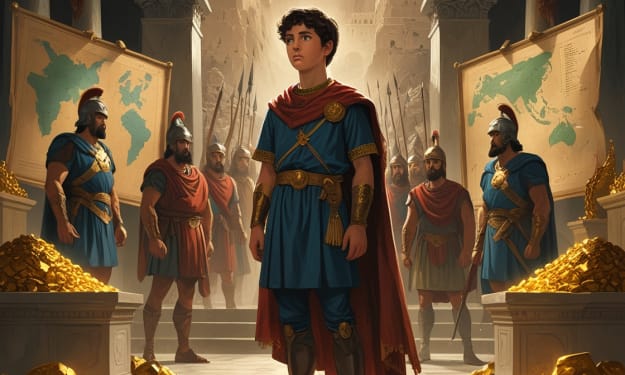
Forgotten Fortunes: The Wealth and Legacy of Alexander the Great’s Children he Great, one of the most legendary conquerors in world history, created an empire that stretched from Greece to India. At the time of his death in 323 BCE, he was not only a military genius but also one of the richest men in history. But what became of this enormous wealth after his death? Specifically, what happened to the children he left behind—and did they inherit the riches of an empire or the weight of its collapse? This article explores the story of Alexander’s children, particularly his son Alexander IV, the wealth they were meant to inherit, and the political forces that turned their fate into one of history’s most tragic tales. The Heir to the World Alexander the Great’s most prominent child was Alexander IV of Macedon, the son he had with his Persian wife, Roxana. Born after Alexander’s death, Alexander IV was technically the rightful heir to the Macedonian throne and the vast empire his father built. At birth, Alexander IV became one of the richest infants in history—at least in theory. His inheritance included: Access to immense imperial wealth: Gold, silver, and plundered treasures from Persia, Egypt, and beyond. Control of cities and provinces: From Babylon to Bactria, he was heir to lands ruled by satraps (governors). A multicultural empire: Stretching from Greece to the Indus Valley, with tribute pouring in from subject peoples. However, power in ancient times was rarely secure, especially when the heir was a child. The Struggle for Control After Alexander's death, his empire quickly descended into chaos. His generals—known as the Diadochi—began to fight for control. The question of who would rule was settled not by law or succession, but by swords. Roxana and Alexander IV were placed under the protection of Perdiccas, one of Alexander’s top commanders. Though Alexander IV was declared king (alongside his half-uncle Philip III), he was merely a symbolic figurehead. Soon, regents ruled in his name, each trying to control the boy to gain legitimacy over parts of the empire. The Disappearance of Wealth The wealth of the empire did not remain centralized. As civil wars raged among the Diadochi, Alexander’s treasures were divided up, looted, or spent on military campaigns. Babylon’s treasury, one of the richest of the ancient world, was raided and drained. Generals like Ptolemy, Seleucus, Antigonus, and Cassander carved up territories and established their own kingdoms. Much of the wealth Alexander IV was entitled to was either lost or absorbed by these breakaway states. Though technically still a king, Alexander IV had no real control, no army, and eventually, no safety. A Silent End In 310 BCE, at the age of just 13, Alexander IV and his mother Roxana were assassinated by Cassander, one of Alexander the Great’s former officers who had taken power in Macedon. Cassander feared that the boy, as the legitimate heir, could one day challenge his rule. The murder was done in secret, and Alexander IV's death was concealed for years. With him, the Argead dynasty ended, and the direct bloodline of Alexander the Great disappeared. The Fate of Other Possible Children Some sources suggest that Alexander may have had other children with his Persian wives Stateira II and Parysatis, both of whom he married during the grand wedding at Susa. However, there is no definitive historical record of children from those marriages surviving. There were also illegitimate children rumored to exist, but none emerged to claim the throne with any authority. The vacuum left by the death of Alexander IV meant that his wealth was never consolidated, and the empire permanently fractured. The Legacy of a Lost Fortune While Alexander IV never got to wield the wealth of his inheritance, the material legacy of Alexander the Great's conquests lived on:
By Say the truth about a year ago in History
Get a Blast From the Recent Past with 2000s “Historical” Fiction. Content Warning.
A Look Back at the Early 2000s: The Emergence of "Historical" Fiction Historical fiction has long been associated with ancient civilizations, past wars, and the romanticism of earlier centuries. However, as time progresses, what was once considered modern is now viewed as historical. The early 2000s—an era characterized by flip phones, low-rise jeans, My Space, and dial-up internet—has now entered the sphere of historical fiction. An increasing number of authors and creators are setting their novels, films, and television series in this decade, reflecting on the culture, politics, and technology of the time with both nostalgia and critical perspective.
By Tanzid hossen irfanabout a year ago in History
Defending Identity, Managing Change: How South Indian States Are Responding to Northern Migration
Defending Identity, Managing Change: How South Indian States Are Addressing Northern Migration South Indiahome to ancient Dravidian languages, dynamic regional identities, and economic centers such as Bengaluru, Chennai, and Hyderabadhas experienced a significant increase in the influx of migrants from North India in recent decades. As this migration escalates, authorities in Tamil Nadu, Karnataka, Kerala, Telangana, and Andhra Pradesh are implementing various strategies to safeguard their indigenous cultures, ensure social cohesion, and manage the strain on their infrastructure. This article examines the tangible measures undertaken by Southern states to address this internal migration while upholding constitutional principles and fostering economic progress. Understanding the Strain Migration, while inherent in a vast and diverse nation like India, presents challenges when not aligned with local requirements. South India’s flourishing IT sector, improved public services, and comparatively higher wages have rendered it an attractive destination for workers and families from states such as Uttar Pradesh, Bihar, and Rajasthan. Nevertheless, the cultural, linguistic, and economic disparities between these groups and the resident populations have raised concerns regarding job competition, wage suppression, and cultural dilution. This has resulted in a strong public demand for protective actions from Southern governments. 1. Language Preservation Laws and Policies Tamil Nadu: "Tamil First" Policies Tamil Nadu has been the most outspoken and proactive in resisting the perceived imposition of Hindi. The state government has long advocated a bilingual policy: Tamil and English, rejecting the trilingual model promoted by the central administration. Employment Regulation: Government recruitment examinations are predominantly conducted in Tamil. Signage Legislation: Public signs, boards, and advertisements must prominently feature Tamil. Education: Tamil is compulsory in all schools, including private institutions, up to Class 10. Karnataka: Kannada Language Emphasis Karnataka has adopted a “Kannada-first” strategy to safeguard its linguistic heritage. Kannada Language Act: Requires the use of Kannada in government offices, banks, and public sector entities. Private Sector Adherence: The Kannada Development Authority encourages businesses to perform basic communication in Kannada, especially with clients. Cinema and Media Quota: Guarantees a percentage of content in multiplexes and broadcast media remains in Kannada. 2. Local Employment Protection Initiatives Amid increasing job competition, particularly in low-skill sectors, several South Indian states are actively instituting local employment preference policies. Andhra Pradesh: Local Quota Legislation 75% Local Jobs Reservation: In 2019, Andhra Pradesh enacted a law mandating that 75% of jobs in private industrial units be allocated for local youth. This was a significant measure aimed at mitigating economic displacement attributed to migrant workers. Tamil Nadu: Emphasis on Skill Development Priority in State Projects: Numerous government tenders and construction initiatives promote the employment of local laborers. Youth Training Programs: Programs such as “Naan Mudhalvan” concentrate on equipping Tamil youth with skills to diminish reliance on external labor. Karnataka: Local Employment Requirement The government advocates for the hiring of Kannadigas in both public and private sectors through pressure from local organizations and incentives for compliant companies. 3. Urban Planning and Migrant Regulation Kerala: Migrant Registration Systems Awas Portal (Kerala): The Kerala administration implemented a registration system for migrant laborers, enabling the state to oversee population influx and distribute health and housing resources effectively. Language and Integration Programs: Malayalam language courses for migrant workers are offered in certain districts to enhance integration and mitigate tensions with local residents. Bengaluru’s Smart Regulation Strategy As a migrant hub, Bengaluru encounters overcrowding and infrastructure stress. The city’s approach encompasses: Stringent zoning and construction regulations to manage migrant communities. Migrant mapping by municipal authorities to prevent slum proliferation. Promoting bilingual communication in public services to alleviate conflicts. Cultural Integration and Public Awareness Several states have transitioned towards integration via respect, rather than confrontation. Cultural Events: Tamil Nadu and Telangana have utilized Pongal and Bathukamma festivals to incorporate migrants into local customs. Media Campaigns: Public initiatives promote respect for local languages and traditions while fostering national unity. Neighborhood Committees: Local municipalities engage residents and migrants in collaborative activities to enhance cultural understanding. Political Mobilization and Regional Parties' Stand Regional parties such as DMK (Tamil Nadu), JD(S) and Kannada organizations (Karnataka), and TRS (Telangana) have adopted vigorous positions to uphold their linguistic and cultural autonomy. They frequently contest central policies advocating Hindi or universal education curricula. These parties campaign on platforms that prioritize regional identity and resist central encroachment in cultural and linguistic affairs. Challenges and Criticism While these initiatives have garnered substantial public backing in the South, they are not devoid of critique: Some accuse the governments of prioritizing regionalism over national cohesion. Businesses sometimes express concerns that stringent language or hiring regulations hinder efficiency. Migrant rights advocates contend that excessive regulation may result in discrimination. Nonetheless, the majority of South Indian governments assert that their policies are not anti-migrant, but rather pro-local, aimed at ensuring equitable coexistence rather than assimilation or dominance. Conclusion South Indian states are navigating a delicate balancemaintaining their identity, supporting local communities, and addressing the phenomenon of internal migration. Through language regulations, employment policies, cultural assimilation, and intelligent governance, they are establishing a framework that could serve as a blueprint for other regions experiencing similar challenges. The effectiveness of these initiatives will hinge on equilibriumsafeguarding the essence of the South while extending a welcoming hand to others with fairness, not apprehension.
By Say the truth about a year ago in History
Emma
Emma is a delightful and witty novel written by Jane Austen, one of the most beloved authors in English literature. First published in 1815, this story is filled with humor, romance, and clever observations about society and relationships. It follows the life of a young woman named Emma Woodhouse, who thinks she knows everything about love but ends up learning some very important lessons.
By Muhammad Hayatabout a year ago in History