Discoveries
Angel Number 626: Unlocking the Meaning Behind Your Twin Flame Journey
Have you been seeing the angel number 626 everywhere you look? Whether it appears on license plates, clocks, or receipts, this repetitive sequence is more than just a coincidence. It's a divine message from the universe, and its 626 angel number meaning is deeply connected to love, balance, and your soul's purpose. For many, this number holds a special significance, particularly on their twin flame journey.
By Sthephanieabout a year ago in History
The Untold Story of the Amazigh: The People Who Refused to Disappear
Long before maps divided North Africa into modern nations, before the pyramids rose in Egypt, and before Rome claimed dominion over the Mediterranean, there lived a people who called themselves Imazighen – “the free ones.” Their history is as old as the desert winds, yet much of it has been buried, renamed, or forgotten. The Amazigh story, however, is not one of disappearance, but of survival, identity, and resilience that has lasted thousands of years.
By Youssef Khabchiabout a year ago in History
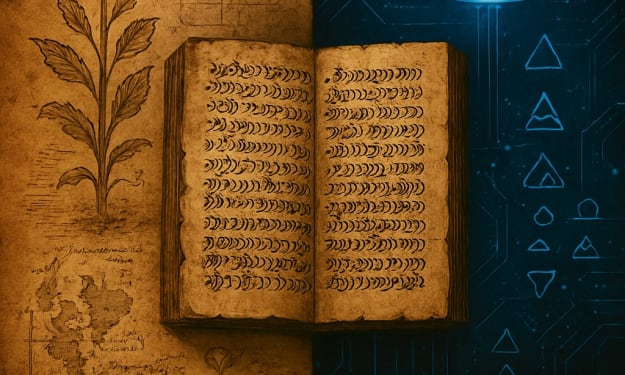
The 600-Year-Old Mystery That Still Defies Decoding
Imagine this: You open an old chest in a dimly lit library, and inside lies a book so strange, it doesn’t even feel human. Its pages are made of ancient vellum smooth but yellowed with time filled with strange, looping script no one has ever read, and illustrations that make your brain go, Wait… what am I looking at?
By Muhammad Ayaan about a year ago in History
Is the God of the Old Testament the Same One Jesus Spoke Of?
Is the God of the Old Testament the Same One Jesus Spoke Of? This is one of the most challenging and provocative questions in the history of religion. At its heart lies the tension between two seemingly different portraits of the divine: on the one hand, Yahweh of the Hebrew Bible, a God who appears deeply invested in law, sacrifice, and judgment, and on the other hand, the Father of Jesus Christ, a God of love, mercy, and boundless forgiveness. The Church has long held that these two figures are the same, that the stern ruler of Sinai is also the compassionate Father of the Sermon on the Mount. Yet when we look closely, the differences seem so stark that reconciliation is not easily achieved.
By The Secret History Of The Worldabout a year ago in History
The Last Dawn of Swat
The Last Dawn of Swat A forgotten tale of courage, faith, and sacrifice in the valley of kings The first rays of dawn broke across the valley, painting the snow-capped peaks of Swat in hues of gold and crimson. The year was 1519, and the mountains stood as eternal witnesses to centuries of invaders, poets, and kings. Yet, this morning was unlike any other. It was the morning that would decide the fate of Swat.
By Wings of Time about a year ago in History
The 9 Unknown Men of Ashoka, The Secret Society That Has Guarded Knowledge for Over 2,000 Years
Imagine a secret so powerful that it could change the fate of the world… What if such knowledge was hidden away not destroyed, but kept in the hands of a few chosen individuals, passed down silently from generation to generation for over two millennia?
By Muhammad Ayaan about a year ago in History
The Titanic: A Ship That Dreamed of Immortality but Drowned in the Sea
The Story of the World’s Most Famous Maritime Tragedy When we think of the sea, we imagine beauty, vastness, and mystery. But the sea also holds stories of loss—stories that echo through history like waves crashing on a silent shore. Among them, no tale is as unforgettable as the sinking of the RMS Titanic.
By Zakir Ullahabout a year ago in History
The Ghost of Coco Chanel: How One Woman Reinvented Fashion Forever
The Ghost of Coco Chanel: How One Woman Reinvented Fashion Forever The dark, glamorous, and complicated legacy of Chanel. The name Coco Chanel lingers in the world of fashion like a ghost — ever-present, elusive, and immortal. To this day, her designs define elegance, her fragrance whispers of timeless femininity, and her persona embodies both brilliance and controversy. More than a designer, Chanel was a revolution, a woman who dared to dismantle the corseted cages of her era and replace them with freedom, power, and allure.
By waseem khanabout a year ago in History
The History of the Danube's Cauldrons
The History of the Danube's Cauldrons: A Legend Sculpted in Time Part I: The Land of Decebalus and Roman Power Before the rock of Ghița mountain bore the face of Decebalus, and before the road narrowed into a gorge where the waters of the Danube thrashed like a wounded dragon, the Cauldrons were a sacred place. For the Dacians in the area, the mountains were sanctuaries, and the river was a living being with a powerful spirit. The deep waters and strong currents were considered a manifestation of the gods, who protected the land from enemies. When rival tribes approached, the sound of the troubled waters hitting the rocks would drive them away, as a warning that here, the land itself was defending itself.In those times, the elders of the villages would whisper stories about Zamolxe, who had sat on a rock, with his gaze fixed on the sun, and had merged with the mountain. Thus, his spirit became the protector of the Cauldrons, watching over his people. Every rock had a legend, every waterfall a secret. It was believed that in the hidden caves lived beings of the earth, who appeared only on full moon nights to bless those who respected nature.Then, the Romans came. With their shiny weapons and disciplined legions, they descended towards the Danube, seeking to conquer and civilize. For them, the river was not a sacred being but a transportation route, a strategic border. When they reached the Cauldrons, they understood why the Dacians revered them. The waters were agitated, the currents were strong, and the narrow rocks made navigation almost impossible. They were forced to build a network of roads on the bank to transport troops and supplies, and the testimony of their work is still inscribed in the famous Tabula Traiana, a commemorative plaque that stands as a testament at the entrance to the gorge today.Trajan, the Roman emperor, understood that to conquer Dacia, he also had to conquer this water route. But the Dacians were not easy to defeat. Fearless warriors, led by King Decebalus, they knew every crevice, every hidden rock. They retreated into the mountains, using the rugged terrain as an ally. Fierce battles took place, and their echoes can still be heard when the wind blows strongly through the rocks. After the death of Decebalus and the conquest of Dacia, the Romans remained. But the spirit of the place refused to be subdued. The Dacian stories continued to be told in whispers around campfires, and the Romans, although they considered them superstitions, felt an unseen force, a weight of history that hovered over the Canyon. That is why the Tabula Traiana was not just a monument to Roman victory, but also a recognition of the power of the place. It was as if the Romans were telling the world: "We came, we conquered, but this place is more than just land. It has a soul." For centuries, the Cauldrons were a border, a place of passage and conflict. Romans, migrants, foreign peoples, all passed through here. But the Dacian spirit, that of freedom and love for the land, remained.
By alin butucabout a year ago in History