Discoveries
The Net Worth of the First United Chinese Empire’s Treasure: Wealth of the Qin Dynasty
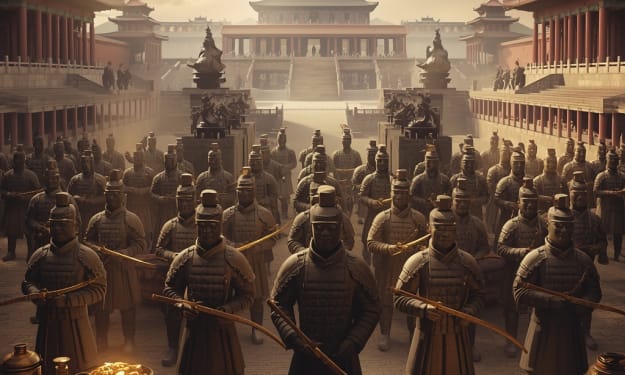
What Do We Mean by “Treasure” of the First United Empire? The Qin Empire’s treasure comprised several layers: Royal treasury assets (gold, silver, bronze, jade) Weaponry and military stores produced at industrial scale Land and taxation systems newly centralized Monumental projects (roads, canals, walls, palaces) Imperial burial wealth, including the mausoleum of Qin Shi Huang Unlike earlier feudal states, Qin centralized ownership. Wealth flowed into the state, not dispersed among nobles. This centralization is crucial to understanding the empire’s net worth. Precious Metals and Materials: A Conservative Valuation Archaeological finds from Qin sites reveal extensive use of bronze, gold, silver, and jade. Gold was not as dominant as in some Western empires, but jade held immense ritual and political value—often exceeding gold symbolically. Bronze: Tens of thousands of bronze weapons and tools have been excavated, many standardized and mass-produced. If valued today (material + craftsmanship), these alone could reach $5–10 billion USD. Gold and Silver: Direct quantities are unknown, but records suggest large royal reserves. A conservative modern estimate places precious metals at $10–20 billion USD. Jade: High-grade ancient jade artifacts today sell for millions per piece. The Qin court’s jade holdings—ritual disks, seals, burial objects—could conservatively be valued at $15–30 billion USD. Subtotal (materials only): $30–60 billion USD The Terracotta Army: Military Wealth Frozen in Clay The Terracotta Army is often discussed as art, but it also represents military capital. Each figure mirrors real soldiers, officers, chariots, and horses of the Qin army. Over 8,000 soldiers Hundreds of chariots and cavalry Originally equipped with real bronze weapons If this were valued as: Artistic heritage Military representation Technological achievement …the Terracotta Army alone would be worth $50–100 billion USD, comparable to the most valuable cultural assets on Earth. Importantly, this is just one component of the emperor’s burial complex. Infrastructure as Treasure: Roads, Canals, and Walls The Qin Empire invested heavily in infrastructure, which in modern economics is a core component of national net worth. Imperial road system spanning thousands of kilometers Early versions of what later became the Great Wall Canals enabling troop movement and trade Standardized measurements, coinage, and writing If these projects were valued as state assets today, similar to highways, dams, and defense systems, their worth would exceed $100–150 billion USD. This is “hidden treasure”: wealth not stored in vaults, but embedded in the empire itself. Weapons and Industrial Output The Qin state operated state-run workshops producing weapons at an industrial scale centuries ahead of its time. Mass-produced swords, crossbows, arrowheads Advanced metallurgy and quality control Stockpiles sufficient to conquer all rival states Valued as a military-industrial complex, these assets could add another $20–40 billion USD to the empire’s net worth. Land, Taxation, and Human Capital Perhaps the largest source of Qin wealth was land and people. By unifying China, the Qin emperor effectively controlled: Tens of millions of acres of agricultural land Millions of taxpayers Forced labor systems for state projects In modern economic terms, this is equivalent to state GDP control. When translated conservatively, the annual productive value of Qin-controlled land and labor could equate to hundreds of billions of dollars today. Even if we limit this to a single-year snapshot, it would add $100–200 billion USD to the empire’s net worth. The Mausoleum of Qin Shi Huang: The Ultimate Hidden Treasure Historical texts describe the emperor’s tomb as containing: Rivers of mercury simulating China’s geography Palaces, towers, and treasure chambers Traps to prevent looting Modern scientific surveys confirm abnormally high mercury levels, suggesting these accounts may be partly true. If fully excavated (which it has not been, for preservation reasons), the mausoleum could rival or exceed Egyptian royal tombs in value. Estimated potential value of the mausoleum contents: $50–100+ billion USD Total Estimated Net Worth of the First United Chinese Empire’s Treasure Combining conservative estimates: Precious materials & artifacts: $30–60 billion Terracotta Army: $50–100 billion Infrastructure assets: $100–150 billion Weapons & industry: $20–40 billion Land & productive control: $100–200 billion Imperial mausoleum: $50–100 billion 👉 Estimated total net worth: $350–650 billion USD This figure rivals or exceeds the estimated wealth of many modern nations and places the Qin Empire among the wealthiest political entities in human history. Conclusion: Wealth Beyond Gold The true net worth of the first united Chinese empire cannot be measured by gold alone. Its real treasure was centralization, standardization, and control—systems that outlived the dynasty itself and shaped China for over two millennia. While the Qin Dynasty was short-lived, its accumulated wealth—material, structural, and symbolic—was immense. Even today, as artifacts continue to be uncovered, the empire’s net worth continues to rise, not in bank accounts, but in historical value and global fascination.
By Say the truth 8 months ago in History
When the Circus Came to Town
Long before stadium tours, streaming premieres, or “limited engagement” billboards glowing along the interstate, there was a different kind of announcement. It arrived quietly... Sometimes on a handbill tacked to a feed store, sometimes by rumor passed between kids at school.
By The Iron Lighthouse8 months ago in History
Frederick the Great: Winning When Surrounded
Few leaders in history have faced danger as relentlessly as Frederick II of Prussia, better known as Frederick the Great. He ruled a small, newly elevated kingdom with powerful enemies on every border, a limited population, and an army that could never afford large losses. Yet time and again, Frederick survived—and often triumphed—when surrounded by foes who should have crushed him. His genius was not conquest for its own sake, but the art of winning when defeat seemed inevitable.
By Fred Bradford8 months ago in History
South Asia on Edge: Why Small Crises Carry Big Global Risks
South Asia on Edge: Why Small Crises Carry Big Global Risks South Asia is one of the most sensitive regions in the world today. It is home to a very large population and includes countries with strong militaries and nuclear weapons. Because of this, even small problems can turn into serious crises very quickly. Tensions, mistrust, and long history make the region fragile, and the whole world watches closely when situations become tense.
By Wings of Time 8 months ago in History
Coordinated Attacks and Regional Stability: Why Pakistan’s Security Situation Matters Globally
Coordinated Attacks and Regional Stability: Why Pakistan’s Security Situation Matters Globally How internal security challenges, regional rivalry, and geopolitics are deeply connected
By Wings of Time 8 months ago in History
The Net Worth of the Golden River: Measuring the Value of History’s Greatest Myth
So what is the net worth of the Golden River? While it cannot be calculated like a bank account or a gold reserve, its value can be estimated through economic loss, potential mineral wealth, cultural impact, and historical influence. When all these dimensions are considered, the Golden River may be worth more than any physical treasure ever discovered. Understanding “Net Worth” in a Mythical Context Net worth usually refers to assets minus liabilities. In the case of the Golden River, there is no confirmed physical asset—but there is a massive historical and economic footprint. To calculate its net worth, historians and economists consider: The gold believed to exist in river systems linked to the legend The wealth spent and lost chasing it The empires enriched or ruined by the belief The cultural and media value that still generates income today In short, the Golden River’s net worth is a mix of imagined wealth and real-world consequences. Estimated Physical Gold Value South America is one of the richest gold-bearing regions on Earth. Rivers across the Andes and Amazon basin contain real alluvial gold deposits. Some modern mining regions linked historically to El Dorado legends have produced hundreds of tons of gold. If the Golden River were interpreted as a symbolic reference to multiple gold-rich rivers combined, modern geological estimates suggest that these river systems may have yielded gold worth over $100–150 billion USD across centuries. This does not mean all of it belonged to a single river—but it shows that the legend was not born from nothing. Small truths were exaggerated into a myth of infinite wealth. Cost of Expeditions: The Wealth Lost Chasing the River The Spanish Empire, followed by English and Portuguese explorers, spent enormous sums chasing the Golden River. Ships, weapons, horses, supplies, and manpower Decades of military funding Loss of thousands of lives Failed colonies and abandoned settlements Historians estimate that hundreds of millions of dollars (in today’s value) were wasted directly on failed Golden River expeditions. When adjusted for inflation and economic opportunity loss, this figure may exceed $10–20 billion USD. Ironically, the river that promised infinite wealth instead drained the wealth of empires. Net Worth in Human Lives and Power Another uncomfortable but real dimension of net worth is human cost. Thousands of indigenous people were enslaved or killed as explorers forced them to reveal the “location” of the Golden River. Entire ecosystems were damaged, and cultures were erased. Empires rose and fell based on belief in this legend. Sir Walter Raleigh lost his fortune and eventually his life pursuing it. Spanish commanders destroyed their reputations chasing a river that never delivered. From a historical perspective, the Golden River’s “net worth” includes: Political power gained and lost Colonial expansion Cultural destruction These impacts alone place its value beyond traditional economics. Cultural and Intellectual Net Worth Today, the Golden River is worth more as an idea than as a resource. Books, documentaries, films, video games, tourism, and academic research continue to generate revenue from the legend. The El Dorado myth alone has inspired billions of dollars in global entertainment and educational industries. Museums, travel content, YouTube channels, and historical platforms profit from the mystery. Writers and creators earn ongoing income by retelling and reimagining the Golden River. In the digital age, the intellectual net worth of the Golden River may exceed $1–2 billion USD, and it continues to grow. Theoretical Market Value If It Were Real If a single river flowing with massive quantities of gold were discovered today, its value would be almost impossible to contain. Gold price (average): ~$65 million per ton Even 1,000 tons of gold = $65 billion USD Control of such a resource would alter global markets If the Golden River truly existed as described, its net worth could rival or exceed the largest national gold reserves in the world. This hypothetical value is one reason the legend never dies. Psychological and Symbolic Value The Golden River’s greatest asset is human obsession. It represents: The promise of effortless wealth The danger of greed The mystery of the unknown
By Say the truth 8 months ago in History
The Golden River: History’s Greatest Lost Mystery of Wealth and Wonder. AI-Generated.
Origins of the Golden River Legend The story of the Golden River originates in South America, among indigenous civilizations long before European contact. Native tribes of the Andes and Amazon basin spoke of sacred rivers where gold dust shimmered beneath the water, believed to be gifts from the gods. Gold, for these cultures, was not currency—it was divine. When Spanish explorers arrived in the 16th century, they misinterpreted these spiritual stories as literal descriptions of infinite wealth. Indigenous tales of ritual bathing in gold dust were transformed into European fantasies of a river whose banks glittered with precious metal. This transformation marked the birth of the Golden River as a global obsession. El Dorado and the River of Gold The Golden River became inseparably tied to El Dorado, a legendary ruler or city said to be overflowing with gold. According to early accounts, a king would cover himself in gold powder and bathe in a sacred lake—often believed to be connected to a golden river system. Spanish chroniclers expanded the legend, claiming that entire rivers flowed with gold flakes and nuggets. Some maps from the 1500s even labeled unexplored regions as Río del Oro—the River of Gold. The idea was simple and dangerous: follow the river, find the gold, claim immortality. The Conquistadors’ Deadly Quest The Golden River legend triggered some of the most reckless expeditions in history. Spanish conquistadors such as Gonzalo Pizarro, Francisco de Orellana, and later English explorer Sir Walter Raleigh launched massive journeys into unknown lands. Thousands of men marched into dense jungles guided by rumors, hallucinations, and manipulated indigenous testimonies. Hunger, disease, venomous animals, and hostile terrain killed most of them. Sir Walter Raleigh famously searched for the Golden River in present-day Guyana, convinced it led to a golden empire. He returned empty-handed, his reputation destroyed, and was later executed—partly due to the political fallout of his failed quest. The Golden River consumed not only lives, but empires. Was the Golden River Real? Modern historians believe the Golden River legend may have been based on real geological phenomena. South America contains vast gold deposits, especially in riverbeds where erosion washes gold downstream. Indigenous people often collected gold dust from rivers, which may have inspired exaggerated stories.
By Say the truth 8 months ago in History
The Net Worth of the Codex Gigas: Valuing the Devil’s Bible
Why the Codex Gigas Has No Official Price The Codex Gigas is currently housed in the National Library of Sweden, where it is protected as a national cultural treasure. Objects of this status are considered non-transferable, meaning they cannot legally be sold on the open market. Because of this, the manuscript has no official market value. However, experts often calculate an estimated net worth by comparing it to other rare manuscripts, historical artifacts, and unique works of cultural heritage. When this approach is used, the numbers become astonishing. Factors That Determine the Net Worth of the Codex Gigas The value of the Codex Gigas is driven by several key factors that set it apart from any other manuscript on Earth. 1. Absolute Uniqueness There is only one Codex Gigas. Unlike printed books or even other medieval manuscripts that exist in multiple copies, this manuscript is entirely singular. Its size, structure, and contents have never been replicated. In the world of collectors, absolute uniqueness equals maximum value. 2. Physical Scale and Craftsmanship The Codex Gigas is the largest medieval manuscript in existence, weighing nearly 75 kilograms and made from the skins of over 100 animals. The precision of its calligraphy, consistent handwriting, and durability after 800 years make it a monumental achievement of human labor. Such craftsmanship alone would be worth millions. 3. Historical Importance Created in the early 13th century, the Codex Gigas preserves: The complete Latin Bible Medical and scientific knowledge of the Middle Ages Historical texts Religious rules Magical formulas and exorcisms This makes it not just a religious artifact, but a compressed archive of medieval civilization. 4. The Devil Illustration and Global Myth The full-page illustration of the Devil is unmatched in medieval manuscripts. It transformed the Codex Gigas from a historical book into a global legend. Myths of a monk making a pact with the Devil have amplified its cultural value far beyond academic circles. In valuation terms, myth equals demand, and demand drives price. Estimated Monetary Value: What Experts Suggest While no auction has ever listed the Codex Gigas, experts have proposed estimates based on comparable artifacts. The Codex Leicester by Leonardo da Vinci sold for $30.8 million in 1994. The Gutenberg Bible has been valued at $35–50 million. The Book of Kells is considered priceless but estimated at $100+ million. When compared to these works, the Codex Gigas surpasses them in: Size Physical uniqueness Mythological influence Because of this, historians and cultural economists estimate the Codex Gigas would be worth between $70 million and $140 million USD, if it were ever allowed to be sold. Some extreme estimates even suggest that, due to its unmatched nature and global recognition, its value could exceed $200 million in a private collector’s market. Cultural Net Worth vs Monetary Net Worth The true net worth of the Codex Gigas may not lie in currency at all. From a cultural perspective, the manuscript represents: 800 years of survival The intellectual world of medieval Europe The blending of faith, fear, and knowledge If destroyed, it could never be replaced. Cultural historians often argue that artifacts like the Codex Gigas have infinite value, because their loss would permanently erase irreplaceable human history. Insurance Value and State Protection When priceless artifacts are displayed or transported, institutions assign them an insurance value. While Sweden has never publicly disclosed the Codex Gigas’s insurance amount, experts believe it would be insured for tens of millions of dollars, possibly exceeding $100 million during international exhibitions. Insurance valuation often reflects replacement impossibility, not resale value—further proving how extraordinary the manuscript is. Could a Private Collector Buy the Codex Gigas? In theory, ultra-wealthy collectors might pay hundreds of millions for such an artifact. However, in practice, the Codex Gigas is legally untouchable. Cultural heritage laws prevent its sale, export, or private ownership. If it ever appeared on the black market, its price would be astronomical—but such a transaction would be illegal and heavily monitored by international agencies. The Psychological Value of Fear and Fascination Another rarely discussed aspect of the Codex Gigas’s net worth is psychological value. Objects associated with fear, forbidden knowledge, and the supernatural consistently attract global attention. From haunted paintings to cursed jewels, human curiosity increases value. The Devil’s Bible benefits immensely from this effect. It is not just a manuscript—it is a story, and stories are priceless. Digital Age Value In the modern era, the Codex Gigas has gained a new form of wealth: digital value. Millions of people search, read, and watch content about it online. Museums, documentaries, YouTube creators, and writers continue to profit indirectly from its legend. In this sense, the Codex Gigas generates ongoing intellectual and media value, something few artifacts can claim. Conclusion The Codex Gigas is far more than an old book. It is a symbol of human obsession, faith, fear, and perseverance. While its estimated monetary net worth ranges from $70 million to over $140 million, its true value cannot be measured in dollars alone. As long as humanity remains fascinated by mystery and the unknown, the Devil’s Bible will continue to grow in worth—not as a commodity, but as a legend carved into history.
By Say the truth 8 months ago in History
The Devil’s Bible: Mystery, Myth, and the Codex Gigas. AI-Generated.
What Is the Codex Gigas? The Codex Gigas was created in the early 13th century, most likely around 1229, in the Kingdom of Bohemia (modern-day Czech Republic). The name Codex Gigas literally means “Giant Book”, and the title is well deserved. The manuscript measures about 92 cm tall, 50 cm wide, and 22 cm thick, weighing nearly 75 kilograms. It takes at least two people to lift it. The manuscript contains 310 parchment pages, made from animal skin—estimated to come from over 100 donkeys or calves. Its sheer physical scale alone sets it apart from any other medieval book. Why Is It Called the Devil’s Bible? The Codex Gigas earned its ominous nickname because of a full-page illustration of the Devil, one of the most striking and unsettling images in medieval manuscripts. The Devil is depicted with claws, horns, greenish skin, and an eerie expression, standing alone on a blank background. Opposite this illustration is a depiction of the Heavenly City, symbolizing the eternal conflict between good and evil. According to legend, the manuscript was created by a single monk who had broken his monastic vows and was sentenced to be walled alive as punishment. To escape this fate, the monk promised to write a book in a single night that would glorify God and contain all human knowledge. As midnight approached and he realized the task was impossible, he allegedly made a pact with the Devil, who helped him complete the book. In gratitude—or submission—the monk included the Devil’s portrait inside the manuscript. While historians dismiss this tale as folklore, the legend has significantly contributed to the Codex Gigas’s dark reputation. Contents of the Devil’s Bible Despite its sinister nickname, the Codex Gigas is largely a religious and scholarly work. Its contents include: The complete Latin Bible (Vulgate) The Rule of St. Benedict, guiding monastic life Historical texts, including works by Josephus Medical treatises on diseases and remedies Calendars and necrologies Exorcism formulas and magical incantations This combination of sacred scripture, medicine, history, and magic reflects the medieval worldview, where religion, science, and superstition often coexisted without clear boundaries. The One-Hand Theory One of the most intriguing aspects of the Codex Gigas is that the entire manuscript appears to be written by a single hand. Paleographic analysis suggests the same handwriting style, ink composition, and formatting throughout the book. This raises an extraordinary question: How could one person create such a massive work? Modern scholars estimate that even if a monk worked nonstop, it would have taken at least 20 to 30 years to complete the manuscript. This fact alone undermines the legend of the book being written in one night, yet it deepens the mystery of the dedication—and isolation—required to produce it. Missing Pages and Dark Speculation Originally, the Codex Gigas had 320 pages, but 10 pages are missing. No one knows exactly what they contained. Some theories suggest they may have held secret rituals, forbidden knowledge, or even names of demons. Others believe the missing pages included the monastery’s internal records, deliberately removed for political or religious reasons. The absence of these pages has fueled speculation that the manuscript once contained dangerous or heretical content, adding another layer to its devilish aura. A History of War and Plunder The Codex Gigas has survived wars, fires, and the fall of empires. In 1648, during the Thirty Years’ War, Swedish forces looted Prague and took the manuscript to Sweden as war booty. Today, it is preserved in the National Library of Sweden in Stockholm, where it remains one of the library’s most valuable treasures. Despite its turbulent history, the manuscript is remarkably well preserved, further contributing to beliefs that it is protected by supernatural forces.
By Say the truth 8 months ago in History
They Built Farms on Ice-Then Disappeared
Imagine this: It's a crisp September day in 1408, somewhere on the rugged southwestern coast of Greenland. A small wedding party gathers inside a stone church-simple vows exchanged, a few witnesses scribbling names on a document that somehow survives five centuries. The bride and groom smile (or at least we hope they did), the priest nods solemnly. They sign, they celebrate quietly, and then… nothing. That piece of paper becomes the very last whisper we ever hear from an entire community of Norse people who had carved out a life in one of the most unforgiving places on Earth.
By KWAO LEARNER WINFRED8 months ago in History
The Biggest Unsolved Mysteries in History That Still Baffle the World
1. The Disappearance of the Indus Valley Script The Indus Valley Civilization, which flourished around 2500 BCE in present-day India and Pakistan, was one of the world’s earliest urban societies. It boasted advanced city planning, sophisticated drainage systems, and standardized brick construction. However, one of its greatest mysteries is its undeciphered script. Thousands of inscriptions have been found on seals, pottery, and tools, yet no one has been able to decode their meaning. Unlike Egyptian hieroglyphs or Mesopotamian cuneiform, the Indus script lacks a bilingual inscription that could serve as a key. Without understanding their language, historians remain uncertain about their political systems, religious beliefs, and even the reasons behind the civilization’s decline. 2. The Lost City of Atlantis First mentioned by the Greek philosopher Plato around 360 BCE, Atlantis was described as a powerful and technologically advanced civilization that sank into the ocean “in a single day and night of misfortune.” Ever since, Atlantis has captured the imagination of scholars, explorers, and conspiracy theorists. Some believe Atlantis was purely allegorical—a moral lesson created by Plato. Others argue it may have been inspired by real events, such as the volcanic destruction of the Minoan civilization on the island of Thera (Santorini). Despite centuries of searching, no definitive archaeological evidence has proven Atlantis existed, leaving it suspended between myth and history. 3. The Construction of the Great Pyramids of Giza The Great Pyramids of Egypt, built over 4,500 years ago, remain among the most astonishing architectural feats in human history. The largest, the Pyramid of Khufu, consists of over two million stone blocks, some weighing more than 80 tons. The mystery lies not in who built them, but in how they were constructed with such precision using ancient tools. How were massive stones transported across vast distances? How were they lifted and placed so accurately? While theories range from ramps to complex pulley systems, no single explanation fully satisfies all the evidence. The pyramids continue to challenge our understanding of ancient engineering capabilities. 4. The Voynich Manuscript Discovered in 1912 by rare book dealer Wilfrid Voynich, the Voynich Manuscript is a handwritten book filled with strange illustrations, unknown symbols, and an indecipherable script. Radiocarbon dating places its creation in the early 15th century. Despite intense analysis by cryptographers, linguists, and even artificial intelligence, the text remains unreadable. Some believe it is a sophisticated code, others think it represents a lost language, while skeptics argue it could be an elaborate hoax. The manuscript’s purpose—whether medical, astronomical, or magical—remains one of the greatest puzzles in literary history. 5. The Amber Room Often referred to as the “Eighth Wonder of the World,” the Amber Room was a chamber decorated with panels made entirely of amber, gold leaf, and precious stones. Created in Prussia in the early 18th century, it was later gifted to Russia and installed in the Catherine Palace. During World War II, Nazi forces dismantled the room and transported it to Königsberg. After the war, it vanished without a trace. Countless searches have failed to locate it, leading to theories that it was destroyed, hidden in underground bunkers, or lost at sea. Its fate remains one of the most enduring art mysteries of modern history. 6. The Identity of Jack the Ripper In 1888, a series of brutal murders terrorized London’s Whitechapel district. The killer, known as Jack the Ripper, murdered at least five women and vanished without being identified. Despite numerous suspects proposed over the years—ranging from doctors and artists to members of the royal family—no conclusive evidence has ever confirmed the killer’s identity. Advances in forensic science, including DNA analysis, have reopened the case multiple times, yet the truth remains elusive, preserving Jack the Ripper as history’s most infamous unidentified criminal. 7. The Nazca Lines Etched into the desert plains of southern Peru, the Nazca Lines are enormous geoglyphs depicting animals, plants, and geometric shapes. Created between 500 BCE and 500 CE, these figures are best seen from the air. The mystery lies in their purpose. Were they astronomical calendars, religious symbols, irrigation markers, or ceremonial pathways? How did the Nazca people design such large-scale drawings without an aerial perspective? While scholars lean toward ritualistic and astronomical explanations, no definitive answer has been found. 8. The Fate of the Roanoke Colony In 1587, English settlers established a colony on Roanoke Island in present-day North Carolina. When supply ships returned three years later, the entire settlement had vanished. The only clue left behind was the word “CROATOAN” carved into a post. There were no signs of violence or struggle. Theories suggest the settlers may have assimilated with Native American tribes, relocated, or perished due to disease or famine. Despite extensive research, the true fate of the “Lost Colony” remains unknown. Why These Mysteries Endure What makes these mysteries so compelling is not just their unanswered questions, but what they reveal about humanity. They highlight the limits of our knowledge and remind us that history is not a complete record, but a fragmented story shaped by time, loss, and interpretation. Even with satellites, artificial intelligence, and advanced archaeology, some truths remain just out of reach. These unsolved mysteries continue to inspire research, debate, and imagination, proving that the past is far from silent—it is waiting for us to listen more closely.
By Say the truth 8 months ago in History