Discoveries
Dr. Hofmann's Cosmic Key
In the serene laboratories of Sandoz Labs in Basel, Switzerland, Albert Hofmann, a dedicated scientific expert, was on the verge of embarking on an unintentional odyssey that would alter the trajectory of human awareness. Little did he know that his discovery would become the catalyst for a psychedelic transformation, unlocking the doors to the unexplored realms of the mind.
By Josef Valda3 years ago in History
A Brief History Of Disney
Although it is now one of the largest corporations in the world, the Walt Disney Company started as a small animation studio in the garage of Walt and Roy Disney’s grandfather. This tiny venture was founded on October 16, 1923 – and in 2006, Walt Disney’s company had grown to revenues of $34.3 billion.
By Brent J. Smith (J Smith)3 years ago in History
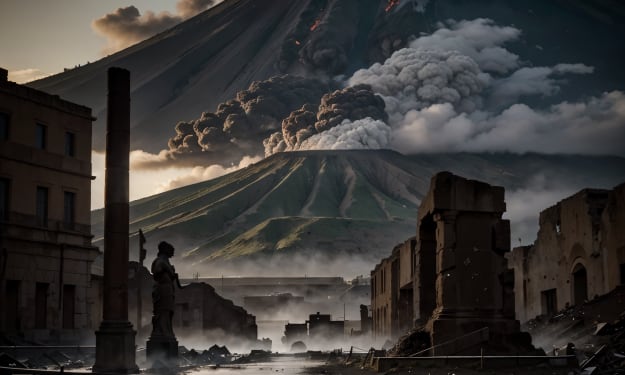
The Tragic Saga of Pompeii: A City Lost in Time
The ancient Roman city of Pompeii thrived in the shadow of Mount Vesuvius, with busy streets packed with people engaged in trade and cultural activities. Established in the sixth century BC, Pompeii served as a symbol of Roman wealth until the tragic events of August 24, AD 79, inscribed its sorrowful history. Pompeii was preserved in a state similar to a time capsule when layers of ash and pumice covered the city following Mount Vesuvius' eruption. Pompeii was discovered and rebuilt in the eighteenth century, and the results showed an unusual picture of Roman daily life, offering priceless insights into the customs, architecture, and artwork of the century.
By Isabel Martinez3 years ago in History
Egypt's Astonishing Revelation: A Discovery That Sends Shivers To Scientists
Throughout history, Egypt has been renowned for its mysteries and incredible feats of structural engineering that captured the imagination of the ancient world. Despite ongoing discoveries, much of Egypt's ancient past remains elusive, hidden among the endless scorched sands. The secrets held by this fascinating land are often well-preserved, with only occasional glimpses into its enigmatic history.
By Jheanne Franz Malto3 years ago in History
The Unseen Planet In Our Solar System
For millennia, humans were aware of only five planets: Mercury, Venus, Mars, Jupiter, and Saturn, observable with basic telescopes or the naked eye under favorable conditions. In the late 18th century, Sir William Herschel, a renowned astronomer, discovered a new planet—a frosty blue one initially mistaken for a star—later recognized as Uranus. It orbits the Sun 19 times farther than Earth and takes 84 years to complete one revolution. Herschel also detected double stars and nebulae. In the mid-1800s, astronomers detected anomalies in Uranus' orbit, leading to the discovery of Neptune in 1846. Despite theories about another planet between Mercury and the Sun, known as Vulcan, corroborated by the peculiar behavior of Mercury's orbit, no concrete evidence surfaced. Einstein's theory of general relativity later explained Mercury's orbit irregularity, suggesting space-time curvature by massive celestial bodies like planets alters orbits. While the Vulcan theory persisted, Einstein's explanation gained traction, and tests during solar eclipses aimed to validate his theory. Additionally, hypotheses about an undiscovered Planet 9 or Planet X beyond Neptune, affecting objects in the Kuiper Belt, emerged. The Nibiru myth, claiming a doomsday scenario in 2012, proved baseless, as calculations disproved its existence. Moreover, the 2011 Comet Elenin briefly misconstrued as Nibiru, dissipated harmlessly. These astronomical mysteries continue to intrigue, shaping our understanding of the solar system's complexities.
By Cudjoe Justice3 years ago in History
Perhaps The Enigmatical History Of The Cerne Abbas Giant Will Be Solved
The Cerne Abbas Giant is a massive chalk figure of a butt-naked man with a bat and a powerful erection that stands in the hills of Dorset, England. Its origins have been a centuries-long controversy, but a recent study suggests it may finally hold the key.
By Francis Dami3 years ago in History
A Roman New Year's Celebration
The ancient Roman celebration of New Year, known as the Kalends of January, held a special significance in their culture, echoing the cyclical nature of time and the perpetual cycle of beginnings and endings. Unlike our modern New Year's Eve festivities, which focus on a single night of revelry, the Roman New Year extended over several days, providing a more profound and reflective period to mark the passage of time and welcome the new year with open arms.
By Festive Fusion Finds3 years ago in History