Discoveries
The Mystery of Easter Island REVEALED?. AI-Generated.
Easter Island, known as Rapa Nui to its indigenous inhabitants, is one of the most remote and mysterious places on Earth. Located in the southeastern Pacific Ocean, this small island is famous for its monumental statues, or moai, which have captivated the imagination of explorers, historians, and the general public. The story of Easter Island encompasses its discovery, the construction of the moai, the island’s ecological collapse, and the enduring cultural legacy of the Rapa Nui people.
By Marveline Merab2 years ago in History
The Baghdad Battery - MYTH or Reality?. AI-Generated.
The Baghdad Battery, often referred to as the Parthian Battery, is an intriguing artifact that has sparked considerable debate among historians, archaeologists, and scientists. Discovered in modern-day Iraq, this ancient object has led to much speculation about its purpose and the technological capabilities of ancient civilizations. This story explores the discovery, theories, and controversies surrounding the Baghdad Battery.
By Marveline Merab2 years ago in History
Echoes of the Ancestors
Title: Echoes of the Ancestors In the bustling streets of Seoul, South Korea, Ji-Yoon wandered through the narrow alleys of Bukchon Hanok Village, surrounded by the traditional wooden houses that stood as silent witnesses to centuries of history. Despite being born and raised in this vibrant city, Ji-Yoon had always felt a sense of detachment from her roots, a longing to uncover the mysteries of her family's past.
By David Chinonso 2 years ago in History
Unraveling the Mystery: The Ancient Egyptian Obsession with Cats
The ancient Egyptian obsession with cats can be unraveled through their religious beliefs and cultural significance. Cats were revered in ancient Egypt as they were seen as protectors of the home and symbols of good fortune. The goddess Bastet, who was represented as a lioness or a cat, was worshipped as the goddess of home, fertility, and protection. Cats were also associated with the divine and were considered sacred animals. Their popularity as pets and their ability to protect against pests added to their significance in ancient Egyptian society. This deep-rooted cultural and religious symbolism surrounding cats in ancient Egypt helps to unravel the mystery behind their obsession with these feline creatures.
By Deepanshu Saini2 years ago in History
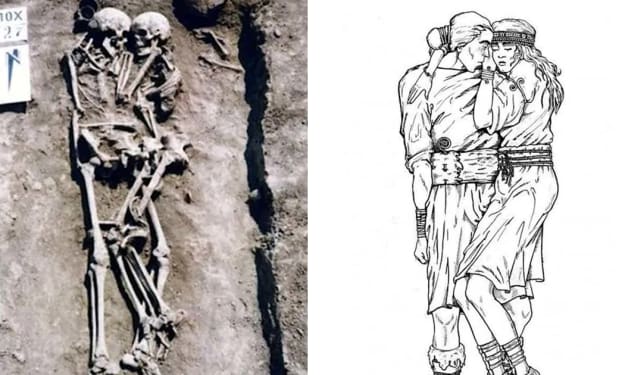
Ancient Lovers: A 3,000-Year-Old Embrace Discovered in Ukraine
In a poignant reminder of the enduring power of love, archaeologists in Ukraine have unearthed the remains of an ancient man and woman locked in a loving embrace for 3,000 years. This extraordinary discovery near Petrykiv village, south of Ternopil in western Ukraine, offers a rare glimpse into the intimate and ritualistic practices of the prehistoric Vysotskaya—or Wysocko—Culture. The Discovery The burial site, unearthed by a team of archaeologists, revealed the skeletal remains of a man and a woman, their bones intertwined in a seemingly eternal embrace. The condition of the remains suggests that the couple were buried simultaneously, with the woman positioned in a manner that indicates she was willingly entombed alive to accompany her deceased husband into the afterlife. Such a discovery is exceptionally rare and provides valuable insights into the burial customs and social dynamics of the Vysotskaya Culture, which flourished during the Late Bronze Age. This culture, known for its distinctive pottery and burial practices, inhabited regions of modern-day Ukraine, Poland, and Belarus. The Vysotskaya Culture The Vysotskaya Culture, dating back to around 1100–700 BCE, is characterized by its unique ceramic styles, fortified settlements, and complex social structures. The people of this culture practiced both inhumation (burial) and cremation, with grave goods often accompanying the deceased to signify their social status and beliefs about the afterlife. The discovery near Petrykiv adds a deeply personal dimension to our understanding of this ancient society. The joint burial of the couple suggests a profound spiritual or ritualistic significance, indicating that beliefs about life, death, and the afterlife were central to their culture. The Loving Embrace The positioning of the bodies in a loving embrace is not only a testament to the couple's bond but also a reflection of the cultural and spiritual practices of the time. The woman's decision to be entombed alive is a dramatic illustration of the depth of their connection and the societal expectations placed upon individuals in the Vysotskaya Culture. Archaeologists believe that such practices were part of a broader tradition in which individuals, often women, would voluntarily accompany their deceased partners into the grave. This act, while shocking by modern standards, was likely seen as a noble and honorable gesture, ensuring that the couple would remain united in the afterlife. The Archaeological Significance This discovery is significant not only for its emotional impact but also for its archaeological value. The well-preserved state of the remains allows for detailed analysis, providing insights into the health, diet, and lifestyle of the individuals. Additionally, the grave goods and artifacts found at the site can shed light on the material culture and technological advancements of the Vysotskaya people. The careful excavation and study of the site will enable archaeologists to piece together the broader context of the burial, offering clues about the social hierarchy, gender roles, and spiritual beliefs of this ancient society. Broader Implications The discovery of the embracing couple adds to a growing body of evidence that prehistoric societies had complex social structures and deeply held spiritual beliefs. Similar finds, such as the "Lovers of Valdaro" in Italy and the "Hasanlu Lovers" in Iran, suggest that the expression of love and companionship in death was a widespread phenomenon across different cultures and time periods. These discoveries challenge the often simplistic views of prehistoric peoples as purely survival-focused and highlight the emotional and spiritual dimensions of their lives. They remind us that the desire for connection and the fear of separation are timeless aspects of the human experience. Conclusion The ancient couple found near Petrykiv village in Ukraine, locked in a loving embrace for 3,000 years, offers a touching and profound glimpse into the past. Their story is a testament to the enduring power of love and the complex cultural practices of the Vysotskaya Culture. As archaeologists continue to study and interpret this remarkable find, we gain a deeper appreciation for the humanity of our ancestors and the ways in which they sought to navigate the mysteries of life and death. In a world where so much remains uncertain, the discovery of this ancient embrace serves as a poignant reminder that love, in all its forms, transcends time and endures through the ages.
By Deji Akomolafe2 years ago in History
The Milky Way Galaxy: A Cosmic Tapestry Unraveled
In the vast expanse of the cosmos, one entity stands out as both familiar and mysterious: the Milky Way galaxy, our celestial home. Stretching across unimaginable distances, it is a tapestry woven from billions of stars, planets, nebulae, and dark matter, bound together by the invisible threads of gravity. To comprehend the complexity and wonder of the Milky Way, one must embark on a journey through its structure, its inhabitants, its mysteries, and its significance in the grand narrative of the universe.
By Abel Priyakumar P2 years ago in History
The Fisherman's Hidden Treasure
### The Fisherman's Hidden Treasure In a small coastal village in Sri Lanka, the sea was both a giver and a taker of life. It provided bountiful fish, but it also held many dangers. Among the villagers was a fisherman named Aravinda, known for his kindness and unwavering dedication to his family. He had inherited his father’s old fishing boat, which he used daily to venture into the deep blue waters. One evening, as the sun dipped below the horizon, painting the sky in hues of orange and pink, Aravinda prepared for a night of fishing. The villagers whispered among themselves, for a storm was predicted, and the sea could be unforgiving. But Aravinda, driven by the need to provide for his family, decided to take the risk. As he rowed out, the calm waves lapping against his boat lulled him into a false sense of security. He cast his nets and waited, humming an old song his father used to sing. Hours passed, and the storm clouds began to gather, blotting out the stars. The sea grew restless, and soon, a fierce storm engulfed him. The boat rocked violently, and Aravinda struggled to maintain control. Suddenly, a colossal wave struck, capsizing his boat. Aravinda plunged into the cold, dark water, clinging to a piece of debris. The current pulled him under, and he fought desperately to stay afloat. As he drifted in and out of consciousness, he saw a faint glow beneath the waves, unlike anything he had ever seen. When Aravinda awoke, he found himself on a deserted shore. The storm had passed, and the morning sun bathed the beach in a golden light. Weak and disoriented, he stumbled along the sand until he came upon a hidden cove. There, nestled among the rocks, was an ancient, weathered chest partially buried in the sand. With trembling hands, Aravinda pried the chest open. Inside, he discovered a trove of treasures: gold coins, jeweled necklaces, and artifacts that seemed to tell stories of long-forgotten voyages. But among these riches, a small, intricately carved wooden box caught his eye. Opening it, he found a delicate compass, its needle pointing not north, but to the very heart of the sea. Curiosity and a sense of destiny stirred within him. Aravinda knew this was no ordinary compass. It seemed to pulse with a life of its own, drawing him to an unknown purpose. With newfound determination, he took the compass and set off towards the village, eager to share his discovery. The villagers listened in awe as Aravinda recounted his tale. The village elder, an old man with a deep knowledge of the sea, examined the compass and gasped. "This is the Compass of Serendib," he said. "It is said to guide its bearer to unimaginable fortune and wisdom. But it also carries a responsibility: to use its power for the good of all." Guided by the compass, Aravinda's fortunes changed. He discovered new, abundant fishing grounds that provided enough for the entire village. With the treasures from the chest, they repaired homes, built a new school, and ensured no one went hungry. The once-struggling village thrived, and Aravinda became a beloved leader, respected for his bravery and wisdom. Yet, Aravinda never forgot the storm that had led him to the hidden treasure. He often stood by the shore, watching the horizon, the compass hanging around his neck. He understood that true wealth was not just in gold and jewels, but in the well-being of his community and the bonds that held them together.
By Muhamad yasin2 years ago in History
The Legend of Leak Bali. AI-Generated.
In the heart of Bali, where lush forests whispered ancient secrets and mist-clad mountains stood sentinel, there lived a village nestled amidst the verdant landscape. This village was home to a group of powerful sorcerers, their mastery of magic renowned far and wide.
By Andi Suhartono2 years ago in History