Discoveries
Returning Without Questions
Returning Without Questions They came a little closer to me one odd evening, I recall. Despite its simplicity, the relationship had an odd depth. There was a kind of connection between them that spoke before words, the language of their eyes—even when they were silent in front of each other, they understood each other. However, despite being by each other's side, there are times in life when people move on. There came a time when the two of them moved far away from each other.
By Arshad Aliabout a year ago in History
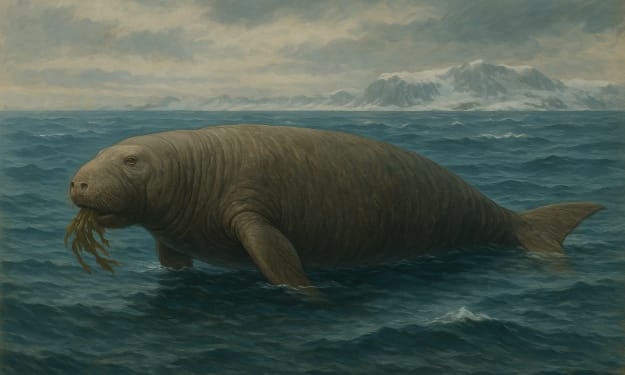
Giants of the Frozen Sea: The Tragic Tale of the Stellar Sea Cow. AI-Generated.
The Stellar sea cow, a massive marine herbivore discovered in the 18th century, is one of the most tragic examples of rapid extinction in recorded history. A close relative of the dugong and manatee, the Stellar sea cow was first documented by German naturalist Georg Wilhelm Steller in 1741 during the Great Northern Expedition led by Danish explorer Vitus Bering. Found in the icy waters surrounding the Commander Islands near the Bering Sea, the sea cow’s tale is a haunting reminder of how quickly human activity can impact fragile ecosystems. Discovery and Description Georg Steller was the first and only scientist to study the Stellar sea cow while it was still alive. According to his journals, the creature was an enormous, peaceful, slow-moving herbivore that could grow up to 10 meters (33 feet) in length and weigh over 10 tons. It lacked teeth and used keratinous pads to chew on kelp, which made up its primary diet. These sea cows were believed to live in small family groups and had thick, wrinkled brown skin similar to the bark of an old tree. Their large, whale-like tails helped them glide gracefully through the frigid waters. What struck Steller the most was the sea cow’s docile temperament. Unlike many wild animals, the sea cow showed no fear of humans, a trait that would ultimately seal its fate. A Brief Existence At the time of discovery in 1741, the sea cow population was already geographically restricted to a small area around the Commander Islands, most likely due to centuries of climate changes and possible hunting by Indigenous peoples. But it wasn’t until European sailors and fur traders began arriving en masse that the animal's extinction was accelerated. Within just 27 years of its discovery, by 1768, the Stellar sea cow was declared extinct. Its size and docile nature made it an easy target for hunters. The sea cow's thick blubber, which could be boiled down into oil, and its meat, which was reported to be both tasty and able to feed crews for weeks, made it a valuable resource for Russian fur traders and sailors navigating the treacherous Bering Sea. Ecological Importance and Extinction The sea cow was an essential part of the kelp forest ecosystem. As a grazer of seaweed, it helped maintain the health and balance of underwater vegetation. Its disappearance not only marked the loss of a species but also may have had ripple effects on the broader marine environment in the North Pacific. Its extinction serves as one of the first well-documented cases of human-driven extinction of a marine species. Unlike many prehistoric animals whose fates are inferred through fossils and legends, the Stellar sea cow was studied, hunted, and wiped out within the span of a single generation. This makes its story particularly heartbreaking and poignant in the context of conservation biology. Legacy and Scientific Interest Despite its extinction, the Stellar sea cow continues to fascinate scientists, conservationists, and the public. Numerous efforts have been made to study its bones and fossils to better understand its physiology and evolutionary path. As a member of the order Sirenia, which includes modern-day dugongs and manatees, the sea cow provides insights into how these animals adapted to different environments. Its rapid extinction is often used as a cautionary tale in ecological studies and biodiversity conservation. It demonstrates the devastating impact that unregulated hunting and ecological ignorance can have on isolated and vulnerable species.
By Say the truth about a year ago in History
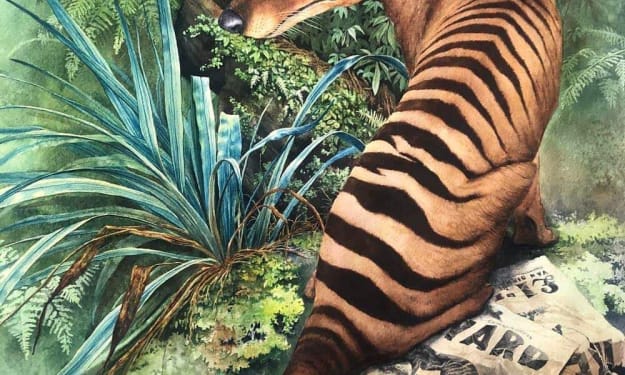
"The Tasmanian Tiger: Echoes of a Lost Predator". AI-Generated.
The Tasmanian Tiger: Echoes of a Lost Predator The narrative of the Tasmanian tiger, or thylacine (Thylacinus cynocephalus), is one of the most heartrending accounts in the records of extinction. Indigenous to Tasmania and once prevalent throughout mainland Australia and New Guinea, this carnivorous marsupial was the largest recognized member of its species. With its characteristic striped lower back, wolf-like cranium, and pouch reminiscent of a kangaroo’s, the thylacine was both a scientific wonder and a cultural symbol. Origins and Evolution The thylacine was classified within the Dasyuromorphia order, which encompasses contemporary carnivorous marsupials such as the Tasmanian devil. Fossil evidence indicates that thylacines roamed the Australian mainland and regions of New Guinea over two million years ago. However, by the time European colonizers arrived in Australia, the species had already disappeared from the mainlandmost likely due to competition from humans and the introduction of dingoes. Tasmania, an island devoid of dingoes, remained the ultimate refuge for the thylacine. Its seclusion allowed the species to flourish for millenniauntil the arrival of European settlers in the 19th century. Biology and Behavior Despite its moniker, the Tasmanian tiger was not a feline and bore no relation to the tiger. It was a marsupial, with greater affinities to the kangaroo or wombat. Fully mature thylacines measured up to 180 cm (6 ft) in length from nose to tail and weighed approximately 20–30 kg (45–66 lbs). Its jaw could open to an astounding 80 degrees, an attribute that intrigued researchers and rendered it an adept predator. The thylacine was a nocturnal hunter, likely preying on kangaroos, wallabies, and small rodents. Its unique stripes were believed to provide camouflage in the Tasmanian bushland. What further distinguished the thylacine was that both males and females possessed pouchesan exceedingly rare characteristic in the animal kingdom. The Road to Extinction Regrettably, the thylacine’s extraordinary adaptations were unable to withstand human encroachment. European settlers regarded the thylacine as a menace to their sheep and livestock. Despite limited evidence of widespread predation, the government began issuing bounties in the late 1800s10 shillings per specimen, equivalent to hundreds of dollars today. This systematic eradication, combined with habitat destruction and the proliferation of diseases, devastated the population. By the early 20th century, sightings became increasingly uncommon. The last confirmed wild thylacine was shot in 1930, and the final captive thylacine, known as "Benjamin," perished in the Hobart Zoo on September 7, 1936ironically, just two months after the species was afforded legal protection. Legacy and Scientific Mystery Despite its formal extinction, the Tasmanian tiger has never genuinely vanished from public awareness. Numerous unsubstantiated sightings, indistinct images, and anecdotal accounts continue to surfaceeven into the 21st century. These narratives have fueled a combination of optimism, mythology, and scientific exploration. The thylacine’s heritage has also inspired initiatives in the realm of de-extinction. In recent years, researchers have sequenced its genome utilizing preserved specimens. This has ignited serious discussions regarding cloning and the potential resurrection of the species through advancements in genetic engineering. While such endeavors remain nascent, they evoke ethical and ecological dilemmas concerning human accountability and the ramifications of bringing back extinct species. Cultural Influence Aboriginal rock art, with some pieces dating back thousands of years, illustrates creatures akin to the thylacine. This highlights its enduring importance to indigenous populations, where it may have been viewed as both a spiritual and natural entity. In modern culture, the thylacine features in literature, documentaries, and cinema. It has emerged as an emblem of lost wilderness and serves as a cautionary narrative about the consequences of neglecting nature. Economic and Scientific Significance Although the thylacine is no longer a component of Tasmania’s natural ecosystem, its narrative sparks considerable interest and tourism. Museums, wildlife reserves, and entire research projects focus on examining this extinct predator. If ever revived or conclusively observed, the global scientific and commercial ramifications would be substantialpotentially valued at millions of dollars in media exposure, funding, and eco-tourism.
By Say the truth about a year ago in History
Hatshepsut's Revenge
Chapter One: The Beginning of Revenge The grand hall of the king's palace was filled with sorrow and hushed whispers. Hatshepsut, the heir to the Egyptian throne, sat beside the body of her late father, the king, trying to conceal her inner turmoil behind a mask of royal grief. She wasn’t just grieving; she was increasingly anxious about the future of her reign following her father’s death.
By mohamed elsayedabout a year ago in History
Bangladesh News
Yes, former President Donald Trump (or any future president) could potentially push for revoking Harvard University’s tax-exempt status, but the process is complex and subject to legal and political constraints. The following is information regarding the law and possible outcomes: 1. The Basics of Harvard's Tax-Exempt Status According to the Internal Revenue Code, Harvard, like the majority of universities, is a 501(c)(3) nonprofit organization, which means that it is not subject to federal income taxes. This status depends on the institution operating for educational purposes and not engaging in excessive political activity or private benefit.
By Md Tanjilur Rahman about a year ago in History
The Echo House
Lila and Sam had been looking for an escape from the city's noise. And when they caught sight of the weathered Victorian farmhouse out in the country, it was idyllic. Wide windows flooded the rooms with light, birds sang in the distance, and the only neighbors were trees. The real estate agent had called it a "fixer-upper," but to Lila, it was a tabula rasa.
By Shuvo Khanabout a year ago in History
The Platinum River: Legend, Wealth, and the Secrets of a Forgotten Stream. AI-Generated.
The Origins of the Platinum River Legend The legend of the Platinum River traces back to ancient Southeast Asian lore, particularly among tribal groups living along the current borders of Laos, Thailand, and Vietnam. Oral traditions speak of a sacred river, hidden deep in the jungle, whose bed was layered not with sand or stone—but with platinum nuggets, glimmering beneath crystal-clear waters. Local chiefs believed the river was a divine gift, a celestial pathway connecting earth to the heavens. Only the most spiritual shamans or brave warriors could approach it, and even then, only during certain lunar alignments. The river, they believed, was protected by elemental spirits and guarded by natural curses. Colonial Obsession and the Search for the River European colonists in the 19th century, particularly the French during their rule over Indochina, heard these stories and were immediately obsessed. Expeditions were launched in the mid-1800s, including one led by a French nobleman, Count René de Lafarge, who disappeared under mysterious circumstances near the Annamite Range after claiming he had discovered “a silver fire flowing through the jungle.” Though no concrete proof was ever documented, scattered journal entries and field sketches recovered decades later described water that glowed under moonlight and heavy “stone” clumps resembling platinum ore. These documents, now stored in the archives of the National Museum in Paris, are considered one of the few semi-credible clues to the river’s existence. Modern Exploration and Speculation Despite advancements in satellite imaging and geological surveys, the Platinum River has never been conclusively found. This has led many to believe the legend is symbolic—a metaphor for the region's untapped mineral wealth or perhaps a coded tale masking a hidden mine. However, several modern explorers and historians argue differently. Dr. Kumari Veerasamy, a renowned Southeast Asian archaeologist, claims to have satellite data indicating an anomaly consistent with metal-rich sedimentation in central Laos. Her research has drawn international attention, but the Laotian government, citing environmental and cultural concerns, has denied any exploratory permits in the suspected zone. In 2021, a team of independent explorers from Singapore claimed to have discovered traces of platinum-rich sand near a tributary of the Xe Bang Fai River. Their samples, sent to a London-based lab, confirmed the presence of high-purity platinum, though they couldn't prove a direct connection to the legendary river. Net Worth Estimation If the Platinum River does indeed exist as described in ancient texts and early colonial notes, its estimated net worth could be astronomical. Platinum, being rarer than gold and essential for modern electronics, medical devices, and clean energy technologies, trades at around $900 to $1,000 per ounce. Assuming the river stretches 20 km with a sediment depth of just 1 meter, and even a fraction (say 0.5%) of it consists of platinum nuggets or particles, we could be looking at over $30 to $50 billion in recoverable platinum. That would make it one of the most valuable natural sites on Earth—surpassing gold deposits in South Africa or the diamond mines of Siberia. Cultural and Ecological Considerations Beyond its monetary value, the Platinum River holds deep cultural significance. Indigenous communities view the river as sacred, and any exploitation could lead to severe ecological consequences. Platinum mining, especially in riverbeds, is notoriously disruptive to aquatic ecosystems. Thus, any potential discovery must be met with global responsibility—balancing the economic opportunity with cultural preservation and environmental sustainability. Conclusion: Myth or Undiscovered Marvel? The Platinum River remains one of Southeast Asia's greatest unsolved mysteries. Whether it truly exists or is a glittering metaphor passed through generations, its legend continues to inspire curiosity, ambition, and a yearning for discovery. In a world where most frontiers have been charted and mined, the story of a hidden platinum river flowing beneath untouched canopies offers a tantalizing reminder: there may still be treasures left in the world—if not in gold or metal, then in mystery and myth.
By Say the truth about a year ago in History
“The Forgotten Fortune: The Tale of Southeast“The Forgotten Fortune: The Tale of Southeast Asia’s Largest Treasure Discovery” . AI-Generated.
A Sea of Riches Beneath the Waves In 2004, an accidental discovery off the coast of Cirebon, Java, stunned historians and treasure hunters alike. A fisherman reported unusual objects emerging from the seafloor after a powerful current had shifted the sands. What followed was one of the largest and most valuable underwater excavations in Southeast Asian history: the discovery of a 10th-century shipwreck, later known as the Cirebon shipwreck.
By Say the truth about a year ago in History
"Yamashita's Gold: The Elusive Treasure of Imperial Japan". AI-Generated.
Yamashita’s Gold: The Elusive Treasure of Imperial Japan In the shadowy world of wartime legends and hidden fortunes, few tales are as captivating or controversial as that of Yamashita’s Gold—an alleged treasure trove looted by the Japanese Imperial Army during World War II. Believed to contain billions of dollars' worth of gold, religious relics, and ancient artifacts, this treasure has inspired adventurers, fueled conspiracy theories, and stirred international intrigue for decades. The Origin of the Legend During the early 1940s, the Japanese Empire expanded rapidly across Asia, occupying territories in China, Southeast Asia, and the Pacific. As the Imperial Army invaded countries like the Philippines, Indonesia, Malaysia, and Thailand, they seized national treasures, private wealth, religious artifacts, and gold from central banks. The mastermind behind the systematic plunder was said to be General Tomoyuki Yamashita, a high-ranking officer nicknamed the "Tiger of Malaya." Under his command, looted treasures were transported to the Philippines—Japan’s strategic military base—with the intention of later shipping them back to the Japanese mainland. However, as the tide of the war turned and Allied forces closed in, the Japanese buried the loot in elaborate underground tunnels and caves across the Philippine islands, particularly in Luzon. The Buried Fortune Estimates suggest that the value of Yamashita’s Gold could range from $100 billion to $200 billion in today’s currency. The treasure allegedly included: Golden Buddha statues Gold bars and coins Gemstones and diamonds Cultural relics and religious artifacts Crown jewels of various Asian nations To ensure secrecy, it is said that the Japanese military executed most of the laborers and engineers who built the treasure vaults, preventing anyone from revealing the locations. Only a few officers held the maps and codes, and many of them died during the war or were captured. Postwar Rumors and the Marcos Connection After Japan’s surrender in 1945, rumors began to swirl about the treasure’s existence. One of the most controversial and persistent claims was that Ferdinand Marcos, the former President of the Philippines, discovered part of Yamashita’s Gold during his reign and used it to secretly amass vast personal wealth. Though never conclusively proven, some witnesses alleged that gold bars bearing Japanese markings were recovered from underground tunnels near Manila and Ilocos Norte. In the 1970s and 80s, the Marcos family was accused of laundering money tied to wartime treasure, and Swiss banks were rumored to have received millions in gold-backed assets. Marcos never admitted to possessing the treasure, but these claims added fire to an already mysterious tale. Legal Battles and Controversies One of the most famous court cases tied to Yamashita’s Gold was the Rogelio Roxas lawsuit in 1988. Roxas, a Filipino locksmith and amateur treasure hunter, claimed to have discovered a chamber containing a golden Buddha statue and gold bars in the mountains of Luzon in 1971. He alleged that the statue alone weighed over one ton and concealed a hidden compartment filled with diamonds. Shortly after his discovery, Roxas claimed the military raided his home, and the statue disappeared. He sued Marcos in a U.S. court, and a Hawaiian jury awarded his estate $22 billion in damages. Although only a fraction was ever recovered, the case reignited global interest in the mystery. Modern-Day Searches and Theories Despite numerous expeditions and decades of searching, no publicly confirmed recovery of Yamashita’s Gold has been made. Modern treasure hunters use satellite imagery, ground-penetrating radar, and ancient Japanese maps in their quests. Some believe parts of the treasure were already smuggled to Japan by secret networks at the war’s end. Others think it lies untouched, hidden beneath layers of rock and concrete, waiting to be uncovered.
By Say the truth about a year ago in History
"The Sacred Vessel: Unraveling the Mystery of the Container Said to Hold Jesus’ Blood"
The Sacred Vessel: Unveiling the Mystery of the Holy Grail – The Container Said to Hold the Blood of Jesus Summary: The legend of the Holy Grail, the sacred vessel believed to have held the blood of Jesus Christ, is one of the most enduring and enigmatic mysteries in history. Revered by Christians and pursued by knights, monarchs, and seekers for over two millennia, the story intertwines faith, myth, and archaeology. This article delves into the historical origins of the Grail, its significance in Christian theology and medieval lore, and explores various claims regarding its current location—whether in ancient cathedrals, secret vaults, or hidden across Europe. With a cultural and symbolic worth that far exceeds any monetary value, the Holy Grail continues to inspire awe and spiritual fascination.
By Say the truth about a year ago in History