Discoveries
The History of Stress . AI-Generated.
The History of Stress: From Ancient Struggles to Modern Science In today's fast-paced world, the word "stress" is frequently used to describe deadlines, financial stress, or emotional strain. However, stress is not a recent phenomenon at all. The idea has changed over time as a result of cultural shifts, scientific discoveries, and the ever-evolving nature of human existence.
By articelmunafabout a year ago in History
Knights of the Sun
Chapter One: The Beginning of the Journey The morning was bright in Cairo, where Nahlah sat in her office at the Egyptian Museum of Antiquities, staring at a mysterious artifact in her hands. It was part of an ancient puzzle, one of the hidden secrets she had discovered during her latest archaeological expedition. She sighed deeply, trying to decipher the symbols engraved on its surface.
By mohamed elsayedabout a year ago in History
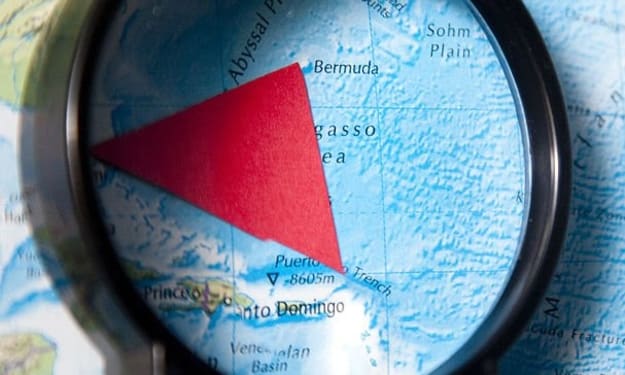
The Mysteries of the Bermuda Triangle: Fact, Fiction, and Fascination. AI-Generated.
The Bermuda Triangle, also referred to as the Devil's Triangle, is one of the most fascinating and enigmatic places on Earth. Spanning a loosely defined area in the Atlantic Ocean between Bermuda, Florida, and Puerto Rico, it has captivated the imagination of adventurers, scientists, and conspiracy theorists alike. Stories of mysterious disappearances, strange phenomena, and legends have built an aura of intrigue around this triangular stretch of ocean. While the Bermuda Triangle's reputation is partially based on myths, it continues to inspire curiosity and debate.
By Noob Hackerabout a year ago in History
Astronomers Detect a Possible Signature of Life on a Distant Planet
Introduction Astronomers have discovered a potential biosignature in the atmosphere of a distant exoplanet, making a ground-breaking discovery that has the potential to alter our understanding of life in the universe. Scientists have found traces of a gas that is mostly made by living things on Earth using cutting-edge telescopic technology. One of the most compelling hints of extraterrestrial life to date, the findings are not yet conclusive.
By Tech Alaminabout a year ago in History
The Silent Scream of Smyrna: The Overlooked Massacre of 1922
The Silent Scream of Smyrna: The Overlooked Massacre of 1922 During the final moments of the Greco-Turkish War, an ancient metropolis that once prospered as a center of culture and commerce in the Mediterranean became the backdrop for a calamitous event that altered the trajectory of history: the Great Inferno of Smyrna. Currently known as İzmir in present-day Turkey, Smyrna was not only among the most affluent cities of the Ottoman Empire but also one of the most heterogeneous. Greeks, Armenians, Jews, and Turks coexisted for centuriesuntil 1922. This massacre, frequently termed “The Smyrna Catastrophe,” stands as one of the most somber and least reported incidents in contemporary history. It persists as an emblem of treachery, ethnic cleansing, and the inadequacy of the global community to take action. The aftermath resulted in a vast humanitarian crisis and the annihilation of a culture that had thrived for millennia. A City on the Verge By 1922, the Greco-Turkish War had culminated in a violent crescendo. Greek forces, who had occupied Smyrna in 1919 with Allied assistance, were decisively repelled by the Turkish National Movement led by Mustafa Kemal Atatürk. As Turkish troops regained control of Smyrna on September 9, 1922, what ensued was not merely a military triumphit was a thorough alteration of the region’s demographic and cultural identity. In the days following the Turkish arrival, violence erupted. Eyewitnesses from Western consulates, missionaries, journalists, and survivors recounted mass executions, assaults, and looting predominantly targeting the Greek and Armenian populations. The climax was the Great Inferno, which ignited on September 13, consuming the Greek and Armenian districts of the city while the Turkish and Jewish neighborhoods remained intact. An Inferno and a Massacre The precise number of fatalities remains uncertain due to the chaotic circumstances of the event, but estimates indicate that over 100,000 individuals were either slain or succumbed to the ensuing fire, starvation, and illness. More than 400,000 Greeks and Armenians fled the city, with many seeking refuge in overcrowded vessels docked in the harbor. Some were denied entry or assistance by foreign warships positioned nearbyan international betrayal that continues to mar diplomatic histories. Eyewitness narratives described the sea turning crimson with blood, the atmosphere thick with smoke and cries, and flames consuming centuries of heritage and legacy. American relief worker Asa Jennings and British author George Horton were among the few who chronicled the atrocities, although their accounts were suppressed beneath diplomatic apathy. Cultural and Economic Devastation The annihilation of Smyrna was not merely a slaughter of individualsit was an extermination of culture. Ancient libraries, churches, manuscripts, and artifacts were reduced to ashes. The city's economic prosperity, once celebrated as the "Pearl of the Aegean," was consumed by flames. The projected financial damage to properties, artifacts, and infrastructure surpassed $3 billion USD in current value. However, no valuation can adequately reflect the loss of human life and cultural heritage. Smyrna was among the few cities that possessed not only economic affluence but also an exceptional cosmopolitan essence. Its obliteration concluded an era of pluralism in Asia Minor. Greek and Armenian civilization in the region, which had thrived for over 2,500 years, was eradicated within days. Global Inaction Despite the presence of numerous foreign powers in Smyrna at the timeincluding British, American, French, and Italian naval vesselsnone intervened to halt the atrocities or provide assistance to the fleeing population. This inaction exacerbated the death toll and further deepened the trauma for survivors. Records indicate that political interests, war fatigue, and post-WWI diplomacy muffled global response. Many historians contend that the massacre of Smyrna constituted a form of ethnic cleansing, aimed at transforming Anatolia into a solely Turkish homeland. Although seldom recognized as such, it persists as a haunting precedent in contemporary history. Legacy and Acknowledgment For decades, the massacre of Smyrna was obscured beneath political narratives and nationalist agendas. Survivors and their descendants frequently transmitted their trauma through oral histories and familial records. It is only in recent years that academic interest has begun to reexamine and reveal the truth. Memorials, literary works, and historical accounts such as Lou Ureneck’s The Great Fire have rekindled interest in the tragedy. Nonetheless, formal acknowledgment, apologies, or reparations remain elusive. Conclusion The downfall of Smyrna and the massacre of 1922 was not only the obliteration of a cityit was the silencing of an entire civilization. Forgotten by many and unrecognized in historical texts, the blood of Smyrna’s innocents continues to mark the annals of a century that witnessed innumerable atrocities. In commemorating Smyrna, we honor not only the victims but also the enduring truth that no massacre should remain concealed beneath the remnants of diplomacy.
By Say the truth about a year ago in History
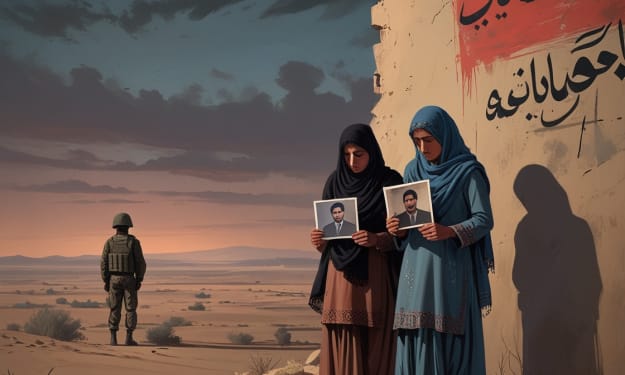
Silent Genocide: The Hidden Massacre of Balochistan. AI-Generated.
The Concealed Afflictions: The Balochistan Massacre – An Overlooked Episode of Contemporary History In spite of being one of the least addressed atrocities of the contemporary period, the persistent turmoil and purported massacres in Balochistan stand as a distressing reminder of the muted agony of a populace ensnared in the realm of politics and power. This article reveals the concealed particulars of decades of discord in the Baloch region, examining its historical origins, political conflicts, and the human toll that persistspredominantly disregarded by international media and historical narratives. The Concealed Afflictions: The Balochistan Massacre – An Overlooked Episode of Contemporary History When history is recorded by the triumphant, entire segments of anguish are frequently excluded. One such segment transpires in the rugged mountains and arid terrains of Balochistanan extensive, resource-abundant region divided among Pakistan, Iran, and Afghanistan. Although lesser-known to the global community, Balochistan has suffered a harrowing legacy of political oppression, insurrections, and brutal crackdowns, prompting numerous historians and human rights advocates to label the conflict as a contemporary silent massacre. A Land of Abundance, A People Marginalized Balochistan is the largest province of Pakistan in terms of area, yet the least inhabited. It possesses ample natural resources, including natural gas, gold, coal, and copper. In spite of this affluence, the area endures as one of the most destitute and underdeveloped in South Asia. Baloch nationalists contend that the federal government has long exploited Balochistan’s resources while providing minimal returns to its inhabitants. This sentiment is not novel. The impetus for unrest was initiated soon after the establishment of Pakistan in 1947. The princely state of Kalat (part of Balochistan) initially pursued independence but was subsequently annexed by Pakistan in 1948, igniting the first of several Baloch revolts. Each insurrectionwhether in 1958, 1962, 1973, or the more recent movementshas been met with forceful military response. Oppression and Alleged Massacres Since the early 2000s, the conflict has intensified considerably. The Pakistani military and intelligence agencies have been accused by numerous human rights organizations of executing enforced disappearances, extrajudicial killings, and acts of torture. Thousands of Baloch activists, students, intellectuals, and ordinary villagers have reportedly gone missing. Their remains are sometimes later discovered disfigured, discarded in remote siteswhat locals grimly label as “kill and dump” operations. While precise statistics are challenging to corroborate owing to restricted access to the area and fear of reprisals, estimates from various NGOs indicate that over 20,000 individuals may have vanished over the past two decades. Human Rights Watch and Amnesty International have both documented severe violations in the region; however, global political focus has been scantpartly owing to Balochistan's geopolitical sensitivity.
By Say the truth about a year ago in History
"Genghis Khan: The Shadow of Conquest – A Chronicle of the Bloodiest Campaigns in History"
Genghis Khan: The Shadow of Conquest – A History of His Fatalities Genghis Khan, the architect of the Mongol Empire, stands as one of history's most formidable and contentious personalities. Celebrated for his military acumen and the unification of the Mongol tribes, his campaigns of conquest resulted in the demise of millions and the collapse of entire civilizations. This article delves into the magnitude, context, and enduring consequences of the mass fatalities attributed to Genghis Khan, assessing the impact on humanity and culture. Article: When the name Genghis Khan is invoked, it conjures images of thundering horsemen, sweeping victories, and vast expanses of territory unified under a singular emblem. Born as Temujin in 1162, Genghis Khan ascended from tribal obscurity to emerge as the paramount sovereign of the largest contiguous empire in global history. However, his journey to triumph was marked by rivers of blood, devastated cities, and obliterated populations. By the time of his demise in 1227, Genghis Khan had established an empire that spanned from the Pacific Ocean to the Caspian Sea. Yet, beneath this extensive territorial acquisition lies a darker inheritance: an unparalleled fatality record. Contemporary historians estimate that Genghis Khan and his Mongolian forces were accountable for the deaths of over 40 million individuals, an astonishing total that represented approximately 10% of the global population at that era. The Ascendancy of the Khan Temujin was born into a fragmented and turbulent steppe society, where fidelity was rare, and treachery was prevalent. After experiencing exile, destitution, and internal tribal conflicts, he ultimately united the Mongol tribes under his authority. In 1206, he was proclaimed “Genghis Khan,” signifying “Universal Sovereign. ” From that point, he embarked on a path of conquest. His initial campaigns targeted neighboring steppe tribes and kingdoms, yet his aspirations swiftly expanded. China, Central Asia, Persia, and segments of Eastern Europe succumbed to his might. Campaigns of Widespread Annihilation One of the most infamous incidents during Genghis Khan’s reign was the obliteration of the Khwarazmian Empire (present-day Iran, Turkmenistan, Uzbekistan). Following a diplomatic incident in 1218, where a Mongol trade convoy was slaughtered and their envoys executed, Genghis Khan retaliated with relentless vengeance. Entire cities, including Nishapur, Herat, Merv, and Samarkand, were annihilated. Merv, one of the most populous cities within the Islamic world at that time, was reportedly home to over 500,000 residents. According to contemporary narratives, the Mongols exterminated every man, woman, and childallegedly around 700,000 fatalities in that city alone. In Nishapur, in retaliation for the death of one of Genghis Khan’s sons-in-law, an infuriated Mongol general purportedly executed over 100,000 inhabitants. While the precision of medieval death tolls is contested, even the most conservative assessments position the Mongol death toll in the tens of millions. Tactics of Terror Unlike other empires, Genghis Khan utilized fear as a weapon. His psychological warfare included not only military strategies but also deliberate brutality. He frequently offered cities the choice to capitulate peacefully. If they declined, they faced total destruction. News of his savagery spread ahead of his forces, prompting many cities to surrender without resistance. Estimated Net Worth of the Plunder Genghis Khan did not amass personal riches in the manner of contemporary rulers or billionaires; however, the wealth seized during his campaigns was immense. Although it is challenging to assess in today's currency, historians approximate that his conquests extracted the equivalent of trillions of dollars in gold, silver, silks, spices, livestock, and land value. From the Chinese Jin Dynasty alone, the Mongols procured vast amounts of silver and tributes, amounting to hundreds of billions in current value. In the Islamic realm, they acquired treasure from Persia and the Silk Road cities that had traded wealth for centuries. The slave trade also thrived, as skilled artisans and laborers were often preserved solely to be enslaved. Long-Term Impacts While Genghis Khan was indisputably brutal, his reign also yielded paradoxical advantages. He fostered trade along the Silk Road, initiated postal systems, and endorsed meritocracy. His empire demonstrated religious tolerance and technological innovation. Yet the overwhelming scale of human loss, both in terms of lives and cultural heritage, looms large. Entire libraries were incinerated, intellectuals were executed, and civilizations crumbled. For instance: The ancient city of Balkh, once a hub of Buddhist scholarship, was obliterated. In Baghdad, a subsequent Mongol campaign led by his grandson Hulagu resulted in the deaths of over 200,000 individuals, decimating one of the world’s most dynamic centers of intellect. Legacy Genghis Khan’s legacy remains intricate. In Mongolia, he is celebrated as a national icon. In China and parts of Central Asia, he is remembered as a unifier and lawgiver. However, in Iran, Iraq, and Afghanistan, his name still evokes memories of terror and devastation. To this day, no other conqueror has attained such extensive dominance while leaving behind a death toll of this scale. The 40 million fatalities attributed to Genghis Khan’s conquests serve as a stark reminder of what unrestrained power can inflict in the hands of a relentless leader.
By Say the truth about a year ago in History
“The Children of Alexander: The Legacy, The Succession, and the Birth of New Empires”
When Alexander the Great died in 323 BCE in Babylon, he left behind the largest empire the world had ever seen—stretching from Greece to Egypt, across Persia and into the Indian subcontinent. But perhaps more striking than the size of his empire was the void he left behind: Alexander died without a clear, adult successor. What followed was a dramatic saga of betrayal, war, and the slow unraveling of a unified dream.
By Say the truth about a year ago in History
Gaza: A Land of Struggle, Resilience, and Uncertain Hope
The Gaza Strip, a slender stretch of land hugging the Mediterranean Sea, has become one of the most contentious and talked-about places on the planet. Frequently making headlines for its violence, blockades, and humanitarian crises, Gaza is much more than just a conflict zone—it’s home to over two million people, many of whom are simply trying to live, love, and endure amidst unimaginable challenges.
By M.i.a. Hossain Rudhraabout a year ago in History
Ancient Thebes History Myths and Legacy of the Powerful Greek City State
Ancient Thebes History Myths and Legacy of the Powerful Greek City State Explore the rise mythological roots and historical significance of Thebes one of ancient Greece’s most influential and legendary city states.
By Adnan Rasheedabout a year ago in History