Discoveries
Have We Misunderstood Our Past? 12,000-Year-Old Calendar Found in Turkey Rewrites Human History
Have We Misunderstood Our Past? 12,000-Year-Old Calendar Found in Turkey Rewrites Human History Imagine standing in front of a towering stone carved by hands that lived 12,000 years ago. No cities no written language no smartphones just a community of early humans looking up at the sky and trying to understand their place in the universe. In southern Turkey near the city of Şanlıurfa lies Göbekli Tepe an ancient archaeological site that continues to puzzle and fascinate scientists. But now a recent discovery at this site may shake the very foundations of our understanding of history a calendar older than any known system of timekeeping in the world.
By Adnan Rasheedabout a year ago in History
Whispers of the Lost River
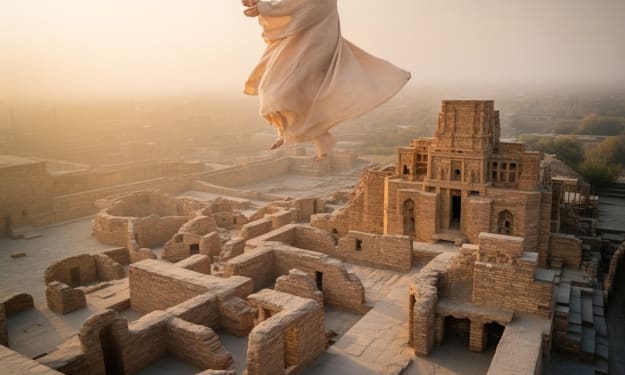
In the twilight of history, where time itself lingers like a mystic dervish spinning in silence, the Indus Valley Civilization once breathed with a rhythm as ancient as the stars. It was not merely a cluster of mud-brick cities etched along a river’s edge—it was a hymn sung in clay, stone, and spirit. Before Babylon dreamed of ziggurats or the Nile whispered secrets to the pyramids, the Indus had already woven a tapestry of life where the sacred and the mundane danced hand in hand. It is said by Sufi sages that every soul is born from a divine sigh, a breath of beauty that carries the essence of truth. So too was this civilization—a sigh of the earth, born of water, fire, wind, and silence. The River That Remembered The Indus River, known in whispers as Sindhu, did not simply carve valleys; it carved destinies. It was the bearer of stories and the drinker of time. On its sacred banks bloomed cities like Harappa and Mohenjo-daro, where people moved in harmony, their lives choreographed like the turning of prayer beads. Unlike the kingdoms of war that roared elsewhere, the Indus people were quiet architects of peace. Their cities were not built for conquest but for communion—with nature, with each other, and perhaps, with the divine. Streets ran straight, as if in meditation. Homes, humble yet wise, bore no thrones, no grand palaces, no signs of kings. No temples scraped the sky. Instead, wells were dug deep—perhaps to drink from the same silence the mystics later sought. The Great Bath of Mohenjo-daro, still echoing with droplets unseen, hints not at mere hygiene but a ritual of purification. In its waters, one might imagine pilgrims washing off the dust of illusion. A People of Gentle Strength They left behind no tales of bloody conquest. No records of dynastic arrogance. Only seals pressed with animal motifs and undeciphered script—fragments of thought suspended like Sufi verses waiting to be understood by hearts rather than eyes. What wisdom did they guard so quietly? What song hummed through their pottery and jewelry, their games and grain stores? Perhaps their true temple was life itself. Perhaps they saw no boundary between the sacred and the everyday. A potter shaping clay was no less than a priest shaping spirit. A farmer coaxing wheat from soil was a poet whispering couplets into the ears of the earth. Trade routes blossomed like gardens, connecting them not only to lands far beyond—Mesopotamia, Central Asia, the Arabian Gulf—but to the idea of shared humanity. They traded beads and lapis lazuli, yes—but perhaps, too, they traded silence and understanding. Perhaps in every transaction was a gesture of trust, a recognition of divine presence in the other. Mystery as the Message It is the silence of the Indus that speaks most. Their language, etched in delicate script upon terracotta seals, remains unread. But maybe, just maybe, they never meant it to be read with the eyes. Maybe their script was for the heart—a mantra not to be translated but to be felt. In this silence, the Sufi finds kinship. Rumi once said, “Silence is the language of God, all else is poor translation.” The Indus people, then, may have been early disciples of this ineffable tongue. What they left behind is not a riddle to be solved, but a presence to be experienced. Their disappearance, too, is not a tragedy but a transcendence. Civilizations often die with a scream; the Indus vanished like a breath returning to the Beloved. No great wars, no plagues carved on walls. Just a slow ebbing, like the river that gave them life retreating to some higher realm. The Soul’s Architecture Walk through the ruins of Mohenjo-daro, and you may still hear it—the quiet dignity of baked brick, the geometry of spirit made manifest. Every courtyard, every granary, every drain whispers that life is sacred when lived with balance. Their cities mirrored a philosophy later echoed by Sufi thought: that heaven is not above but within; that order and beauty arise from inner clarity. Could it be that the Indus people were the first mystics of the subcontinent? That their unbroken harmony with nature, their measured life, and their graceful exit from history were all part of a deeper truth? Sufis speak of fana—the annihilation of the ego, the merging into the divine. What if the Indus did not fall but simply melted into time, leaving behind no kings or battles, only stillness? What if their ruins are not reminders of loss, but doorways to that truth? Legacy of Light Today, in Pakistan’s Sindh and Punjab, or India's Gujarat and Haryana, children still play near those sacred mounds. Farmers till the same soil. The river still flows, though thinner now, as if mourning or remembering. Sufi shrines dot the landscape now—at Sehwan, Multan, and beyond. Pilgrims gather, spinning in trance, seeking the same truth the Indus may have once lived: that God is in the grain of the brick, in the flow of the river, in the breath of the wind. Archaeologists study the material remains, but perhaps the Indus Valley’s real inheritance lies not in what is seen but what is felt. It is in the patience of the potter, the silence between words, the space between heartbeats. As you hold a shard of their pottery or gaze at their seals in a museum, close your eyes. Listen. You may just hear the song they left behind. Not a song of war or power. But a lullaby of balance. A whisper of harmony. A sigh of the eternal.
By Kaleem Ullah about a year ago in History
Rising Shadows, Shifting Powers. AI-Generated.
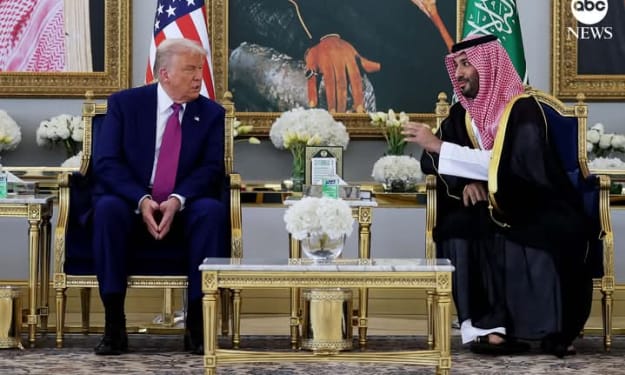
In the name of Allah, the Most Gracious, the Most Merciful The world stands at a delicate crossroads. Time is spinning swiftly, and the destinies of nations are being redrawn on new lines. Circumstances are changing before our eyes, yet the common person remains unaware. What lies ahead will not only shake global politics but also deeply impact the hearts and minds of the Muslim Ummah. All of this is happening silently, but those who can see, know that deep changes are taking root beneath the surface. The epicenter of this transformation is the Middle East, where countries like Israel, Arab states, Pakistan, Iran, and Turkey are preparing for monumental decisions. When the future is analyzed through the lens of artificial intelligence, the focus turns first to Israel. Israel's policy is clear: power, control, and total dominance. It doesn't just want to remain in control of Palestine but also has its sights set on neighboring Arab nations. Its grip on technology, intelligence, and global media shows that it is not alone — some of the world’s most powerful forces stand behind it. The United States and European powers see it as a strategic partner. Backed by this support, Israel is no longer just a state; it has become an ideology — one that seeks to reshape the Middle East on its own terms. This is why many Arab countries that once stood firmly in support of Palestine are now falling silent. The UAE, Bahrain, and others have already normalized relations with Israel, and behind closed doors, more nations are preparing to follow. Their aim is simple: economic gains, security, and the preservation of power. These regimes now prioritize the survival of their monarchies over Islamic brotherhood. They have realized that opposing Israel comes at a high cost — international pressure, economic sanctions, and internal instability. This silence could spread further. According to AI-based forecasts, in the coming years, North African countries like Morocco, Tunisia, and Sudan may formally recognize Israel. Following them, Oman, Qatar, and possibly even Indonesia might form ties with Israel under global pressure and economic incentives. Their ruling elites are seeking Western approval and investments, yet their populations’ hearts beat for Palestine. This contradiction will inevitably lead to an explosion. In the midst of all this, the question arises: what will Pakistan do? Will Pakistan also recognize Israel? A country founded on the ideology of Islam, one that has always raised its voice for Palestine — will it also bow to global pressure? AI-driven analysis predicts that Pakistan will come under intense pressure in the coming days. Global financial institutions, Arab regimes, and certain international powers will attempt to coerce Pakistan into recognizing Israel. But Pakistan’s true strength lies in its public consciousness — in a population that sees Israel as a tyrannical occupier and cannot remain silent on Palestinian suffering. For this reason, Pakistan will not recognize Israel in the near future. There may be secret diplomatic engagements, intelligence exchanges, or softened rhetoric in global forums. However, the public outcry will be so intense that no government will dare make such recognition openly. If Pakistan becomes internally stable, achieves economic self-reliance, eradicates corruption, and sees the rise of ideological leadership, it could assume a leading role in the Islamic world. Its military, youth, scientists, and Islamic intellectuals could transform the nation into a new kind of state — an ideological fortress that not only defends itself but also speaks out for the oppressed Ummah. Turning to Palestine, its fate hinges on two possible paths. The first path — complete Israeli domination, where Gaza, the West Bank, and Jerusalem come under tighter Israeli control, and Palestinians are reduced to a marginalized minority. The second path — a surge of public awakening, a movement that shakes Muslims worldwide. Social media, independent journalism, and the youth will drive this awakening, potentially forming a global narrative against Israeli aggression. The case of Saudi Arabia is even more sensitive. Home to Islam’s holiest sites — the Haramain — Saudi Arabia also seeks to modernize under Vision 2030. Entertainment, arts, Western investment, and cultural transformation are accelerating. But the question remains: will the Haramain be protected from these changes? According to AI predictions, the next decade could witness an intense ideological debate across the Muslim world — should the Haramain be safeguarded solely by the Saudi government, or should they be administered through a global Islamic council? This is already being discussed informally, but in the future, it could become a formal demand — especially if the current leadership continues to prioritize Western alignment over Islamic interests. Iran and Turkey hold distinct positions. Iran, with its revolutionary ideology, uses proxies like Hezbollah, the Houthis, and its influence in Iraq to directly oppose Israel. Turkey, considered the successor of the Ottoman Caliphate, seeks influence in the Muslim world through soft power — diplomacy, media, and economic strength. These two countries take different paths but share the same direction — leadership. But where will true leadership emerge from? AI analysis suggests that it won’t arise from any government or monarchy but from public awareness. The youth — educated, conscious, and ideologically driven — are raising questions on social media. They are the ones who will ignite change. They could be Pakistani, Turkish, African, or Indonesian — but their language will be one: Islam. When Pakistan refuses to recognize Israel — while many neighboring countries have already established relations — it will have both regional and global consequences. Pakistan will face economic, diplomatic, and security challenges on the world stage, as well as internal pressures. But this very pressure could strengthen Pakistan — if its leadership is sincere, capable, and ideological. In the global arena, only those nations that remain firm on their principles under pressure are remembered by history. Pakistan’s refusal could become a global narrative — one that touches the hearts of Muslims everywhere, reminding them that there still exists a nation unwilling to compromise on the core values of the Ummah. This rejection won’t be merely diplomatic — it will be a declaration of ideological resistance, offering hope and inspiration to Muslim youth worldwide. That will be the moment when new concepts of leadership emerge in the Muslim world. Leadership will no longer rest solely on governments and militaries but on public awareness, media strategy, academic excellence, and the courage to speak truth. Those who side with truth in this time will become the future leaders of the Ummah. AI analysis also indicates that although Israel is expanding its influence through technology, media, and politics, its greatest weakness is its moral foundation. Any state built on oppression, occupation, and division is inherently unstable. It cannot withstand an awakened global conscience. The perseverance of the Palestinian people and the love Muslims feel for them will one day awaken that conscience. There is also the possibility that a global Islamic bloc will emerge — unified in economics, defense, education, and diplomacy. Pakistan, Turkey, Iran, Malaysia, Indonesia, and other key Muslim nations could be members. If such a bloc forms, it will become impossible for Israel and its allies to dictate unilateral policies in the region. In this entire scenario, Saudi Arabia’s role will be pivotal. If it handles the spiritual leadership of Islam with responsibility, treating the Haramain as a collective trust of the Ummah, it could become the center of this unity. But if it continues to prioritize Western culture over Islamic values, a new ideological movement will arise — one determined to protect the sanctity of the Haramain. In the end, the question remains: Will the Muslim Ummah awaken in this crucial era? Will it identify its enemies, reform its internal ranks, and move toward a common purpose? Or will it remain entangled in sectarianism, national interests, and internal divisions? AI analysis gives hope. Though the times ahead are tough, the eyes of the new generation are opening. A new intellectual awakening is being born — one that not only seeks to heal the wounds of the Ummah but also envisions a bright, independent, and dignified future. This generation is asking the questions that were once suppressed. It is ready to take the steps that can bring about monumental change. And this generation will become the true leadership of the Muslim Ummah — a leadership that owes nothing to any superpower or monarchy. It will follow only Allah, His Messenger, and the interests of the Ummah. This is the future we are witnessing — a decisive yet hopeful future. It is now up to us to prepare for it or be swept away by the tides of time. Time is short, but the opportunity still lies in our hands.
By RafiBinYousafabout a year ago in History
"We’re Not Trying to Recreate a Species from Ancient DNA Scraps": One of Earth’s Rarest Animals Could Be Brought Back from the Edge of Extinction.. AI-Generated.
"We’re Not Trying to Recreate a Species from Ancient DNA Scraps": One of Earth’s Rarest Animals Could Be Brought Back from the Edge of Extinction.
By Sayeed Ahmedabout a year ago in History
The Life of Albert Einstein
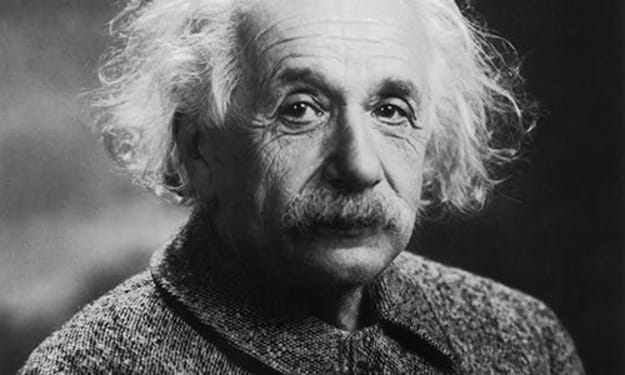
In the small German town of Ulm, on March 14, 1879, a boy was born who would one day become one of the most celebrated and influential scientists the world had ever known—Albert Einstein. From his earliest years, Einstein displayed a quiet and curious nature. He wasn’t the typical child. He spoke slowly and rarely, preferring to ponder things deeply before speaking. Some even worried about his mental development. But within his silent mind, extraordinary thoughts were already taking shape. Albert's fascination with the universe began when his father gave him a simple compass at the age of five. Watching the needle always point north, he was struck with awe—how could something invisible move the needle? That moment planted a seed of wonder that would grow throughout his life. Though he did well in subjects he loved, especially mathematics and physics, Einstein struggled with the rigid system of schooling. He disliked rote memorization and strict authority, which often caused friction with his teachers. Despite these challenges, his thirst for knowledge was unstoppable. He spent hours reading books on science and philosophy, often beyond his grade level. After finishing school in Switzerland, Einstein enrolled at the Polytechnic Institute in Zurich. There, he continued to develop his passion for theoretical physics. But life after graduation wasn't easy. For years, he couldn't find a teaching job and eventually took a position at the Swiss Patent Office in Bern. It was a modest job, reviewing technical inventions, but it offered him something more valuable—time to think. In 1905, while still working at the patent office, Einstein had what is now known as his "Annus Mirabilis" or "Miracle Year." In just one year, he published four groundbreaking scientific papers that would forever transform the way we understand the universe. One of those papers introduced the theory of Special Relativity, which included the famous equation: E = mc² This simple-looking formula revealed a profound truth: mass and energy are interchangeable. Einstein's work caught the attention of the scientific world. Over the next decade, he expanded his theory to create the General Theory of Relativity, which proposed that gravity is not just a force, but a warping of space and time itself. When his theory was confirmed by astronomical observations in 1919, Einstein became an international celebrity almost overnight. Despite his fame, Einstein remained humble and committed to his ideals. He used his voice not only for science but for peace, civil rights, and humanity. He spoke out against war, opposed the rise of fascism in Europe, and refused to remain silent during the horrors of World War II. In 1933, due to the rise of the Nazis, he left Germany and moved to the United States, where he took a position at the Institute for Advanced Study in Princeton, New Jersey. Einstein was deeply troubled by the use of science for destruction. Though he was not involved in the development of the atomic bomb, his warning letter to President Roosevelt about the potential of nuclear weapons contributed to the formation of the Manhattan Project. After the war, he became a passionate advocate for nuclear disarmament and world peace. He continued to work on complex theories, hoping to unify all the forces of nature into one "Theory of Everything," a dream that remained unfulfilled. Even in his later years, Einstein kept his curious spirit alive. He once said, "I have no special talent. I am only passionately curious." Albert Einstein passed away on April 18, 1955. His body died, but his mind lives on—not only through his contributions to science but also through his words, his values, and the way he inspired the world to question, to imagine, and to dream. Today, Einstein's name is synonymous with genius. His theories still guide physicists in understanding black holes, time travel, and the origins of the universe. But beyond equations and experiments, Einstein taught us something more profound: that wonder, imagination, and courage to challenge accepted truths can reshape the world. In the end, the story of Albert Einstein is not just about science—it's about a man whose ideas changed everything and whose legacy reminds us that even the quietest mind can shake the very fabric of the universe.
By Mati Henry about a year ago in History
The World Revolution Stage: From Ancient Times to the Present
Throughout history, revolutions have played a pivotal role in shaping the course of human civilization. From the earliest uprisings in ancient societies to modern political and social movements, the stage of world revolution has evolved in complexity, scale, and impact. These revolutionary waves—whether sparked by political oppression, economic disparity, religious conflict, or a desire for freedom—have reshaped borders, overthrown empires, and transformed societies. This article explores the progression of world revolutions from ancient times to the modern age.
By MD BILLAL HOSSAINabout a year ago in History
The Abandoned Wealth of Emperor Nero: Gold Amidst Infernos. AI-Generated.
The Ascendance of a Golden Sovereign Nero Claudius Caesar Augustus Germanicus ascended to the throne in 54 CE at the tender age of 17. Although youthful, Nero wielded considerable authority, inherited from a complicated lineage of Julio-Claudian rulers tracing back to Augustus. With the Roman Empire at its zenith in terms of territory and commerce, Nero assumed the imperial position during a period of extraordinary affluence. His mother, Agrippina the Younger, facilitated his rise to power, manipulating court dynamics and eliminating adversaries. However, Nero would soon declare his autonomynot merely through absolute governance but by expending funds at a scale that astonished even the elite of Rome. The Origins of Nero’s Wealth Nero’s fortune was derived from various streams: Imperial Taxation: Provinces throughout Europe, North Africa, and Asia Minor rendered tribute to Rome. Taxes on agriculture, commerce, and property ownership flowed into the imperial treasury. Confiscations: Nero had a notorious proclivity for accusing senators and elites of treason or conspiracy. Their assets were appropriated and added to the state (or his personal) treasury. This strategy both enriched him and eliminated political dangers. Commerce and Tribute: The Roman Empire's extensive trading network, particularly in luxury commodities from the Eastsuch as spices, silk, and gemstonesproduced substantial profits. Conquered regions also presented valuable tributes including gold, silver, and enslaved individuals. Mining and Coinage: Nero oversaw the empire’s mining activities in Hispania (Spain), Gaul, and the Balkans. He adulterated the Roman currency by diminishing the silver content in coinsan expedient that enhanced imperial liquidity but compromised long-term economic stability. Nero’s Opulence: The Golden House One of Nero’s most renowned expenditures of imperial wealth was the creation of the Domus Aurea, or Golden House. Following the Great Fire of Rome in 64 CEwhich some accounts claim Nero instigated, although evidence remains ambiguoushe appropriated a substantial expanse of central Rome to construct his palace. The Golden House was a residence unlike any other in Roman annals: Its corridors were adorned with gold leaf and precious gemstones. Rooms boasted revolving ceilings that showered fragrances and rose petals. Artificial lakes and expansive gardens encircled the edifice. A colossal effigy of Nero, the Colossus Neronis, towered outsidesurpassing 100 feet in height. This architectural wonder epitomized both the pinnacle of Nero’s wealth and the extravagance that alienated Rome’s citizens and senators from him. Financing Extravagance: Performances and Campaigns Nero perceived himself not merely as an emperor but as a creator and entertainer. He financed extravagant games, theatrical productions, and musical competitionsmany of which showcased him as the main attraction. Audiences were frequently obligated to attend and applaud his performances. In 66 CE, Nero initiated an expensive expedition in Greecenot for conquest, but to tour cities and perform. He returned with thousands of accolades and trophies, though they were predominantly symbolic; the journey depleted the state treasury. The Decline of Nero and the Disappearance of His Wealth By 68 CE, public discontent, military uprisings, and political opposition reached a pinnacle. The Senate proclaimed Nero a public adversary. Confronted with arrest and execution, Nero took his own life on June 9, 68 CE, reportedly exclaiming, "What an artist dies in me! " What transpired with his extensive fortune after his demise? Theories and Historical Narratives: Confiscated by Successors: Galba, Otho, and Vitelliuswho succeeded Nero during the chaotic "Year of the Four Emperors"likely appropriated portions of the imperial treasury to support their own aspirations for authority. Concealed Reserves: Some speculate that Nero concealed portions of his wealth in subterranean vaults or private villas prior to his death. Treasure seekers have long conjectured about hidden troves beneath the remnants of the Golden House. Destroyed or Dispersed: With the conflagration of the palace and plundering by soldiers, a significant portion of Nero’s wealth may have been lost. Priceless artworks, manuscripts, and coins likely vanished amid the turmoil. Transformed into Public Structures: Emperor Vespasian, who ultimately restored stability, repurposed the area of Nero’s palace to construct the Colosseum, reclaiming the site for civic use. Some of Nero’s appropriated funds may have subsidized this transformation. The Quest for Nero’s Treasure Today Parts of the Domus Aurea have been unearthed in Rome, revealing frescoes, gilded ceilings, and intricate mosaics. However, no treasure troves have been discoveredleading many to surmise they were either looted or remain concealed.
By Say the truth about a year ago in History
The Concealed Prosperity of Emperor Ashoka: An Enduring Heritage Beyond Wealth. AI-Generated.
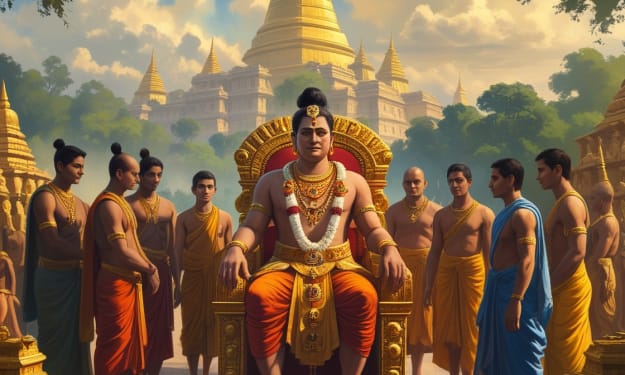
The Ascendancy of Emperor Ashoka Ashoka the Great, descendant of Chandragupta Maurya, rose to the Mauryan throne circa 268 BCE. At its pinnacle, the Mauryan Empire extended from contemporary Afghanistan in the west to Bangladesh in the east, reaching as far south as the Indian peninsula. Ashoka inherited not merely an expansive territory but also a wealth administration system refined by previous Mauryan sovereigns. Initially recognized for his military endeavors, Ashoka's subjugation of Kalinga represented a pivotal moment in his reign. The destruction he encountered prompted him to adopt Buddhism and a doctrine of Dhamma (righteous governance), which would characterize the remainder of his rule. The Mauryan Treasury: Dominance Through Wealth The Mauryan Empire sustained one of the most sophisticated administrative and economic frameworks of the ancient era. According to Kautilya’s Arthashastra, a discourse on governance potentially authored during Ashoka's grandfather’s regime, the state commanded substantial resources: Taxation: Agriculturists, craftsmen, merchants, and even religious entities contributed taxes. These finances were scrupulously managed and allocated to bolster the state structure and infrastructure. Mines and Metals: The empire oversaw mines yielding gold, silver, copper, iron, and jewels. These materials were utilized to mint currency, construct palaces, and finance military operations. State Monopolies: The Mauryan state operated monopolies on salt, alcoholic beverages, mining, and metallurgyensuring direct revenue to the monarchy. Trade and Commerce: Ashoka endorsed domestic trade and international exchanges, particularly with Hellenistic kingdoms. This facilitated a consistent influx of wealth in the guise of taxes and tributes. The Kalinga War and a Reallocation of Wealth Ashoka’s subjugation of Kalinga around 261 BCE was one of the most brutal conflicts in Indian history. Historical accounts assert that over 100,000 individuals perished, with many more displaced. The war, despite being victorious, exacted a tremendous tollemotionally, economically, and ethically. Subsequent to his conversion to Buddhism, Ashoka experienced a profound change in his application of imperial wealth: He curtailed military spending, redirecting resources toward social welfare and religious initiatives. Considerable funds were allocated for the erection of stupas, viharas (monasteries), and pillars inscribed with edicts across the empire. Ashoka also financed overseas missions, disseminating Buddhism to Sri Lanka, Southeast Asia, and the Hellenistic realm. The Ashokan Pillars and Inscriptions: Indicators of His Wealth Ashoka commissioned over 30 rock edicts and stone pillars, some exceeding 40 feet in height, inscribed with his moral precepts. The construction of these monuments was costly, necessitating high-quality stone, skilled artisans, and long-distance transportation. Interestingly, several inscriptions allude to philanthropic contributions and endowments of wealth to Buddhist establishments. These actions were not merely spiritualthey served as political instruments, securing allegiance and promoting imperial ideology. Ashoka’s Concealed Riches? Notwithstanding Ashoka’s benevolence and moral reforms, historians conjecture that a ruler of his magnitude must have retained substantial reserves of wealth, both for emergencies and to assert control. Various hypotheses regarding Ashoka’s treasure encompass: Buried Assets: Amid wars, succession disputes, and religious shifts, it is conceivable that portions of Ashoka’s treasury were concealed by loyal supporters or successors. Stashes may be buried beneath dilapidated forts or temples throughout India. Temple Wealth: A considerable share of the state’s fortune was redirected to Buddhist monasteries, which evolved into affluent institutions. Over the centuries, invasions and pillaging may have dispersed or buried this wealth. Lost in Transition: Following Ashoka’s demise, the empire deteriorated swiftly. Regional governors might have appropriated treasures and concealed them, or they may have been taken by foreign invaders. Contemporary Discoveries and Theories Archaeologists have uncovered Mauryan-era coins, artifacts, and ruins at sites such as Sanchi, Sarnath, and Nalanda. Numerous stupas are believed to house relics and gold offerings, some of which remain to be excavated. In 1898, British archaeologist Alexander Cunningham unearthed the relics of the Buddha within a stupa presumed to have been constructed by Ashoka. The relics were housed in gold caskets, indicating imperial contributions. Local folklore in areas such as Bihar, Madhya Pradesh, and Odisha recounts tales of concealed subterranean vaults from the Maurya periodpotentially containing gold, jewels, and ancient texts. The True Treasure: Ashoka’s Heritage While Ashoka’s material wealth may still be concealed or lost, his genuine treasure resides in his enduring legacy: He was among the earliest rulers in history to champion non-violence and religious tolerance. His advocacy for education, healthcare, and animal welfare established a commendable benchmark for ethical governance. Through his patronage, Buddhism proliferated across Asia, influencing civilizations for centuries. Conclusion: A Legacy of Gold and Stone Emperor Ashoka’s wealthboth economic and ideologicalplayed a pivotal role in shaping history. Although much of his treasure may have disappeared or been repurposed, the tangible remnants of his reignthe pillars, the coins, the templespersist as testaments to a ruler who wielded gold not solely for dominance, but for harmony. Whether concealed beneath ancient ruins or dispersed throughout the Buddhist realm, the quest for Ashoka’s hidden treasures continues to captivate archaeologists and historians alike.
By Say the truth about a year ago in History
The Overlooked Wealth of King Croesus: The Most Affluent Individual in Ancient History
The Ascendance of Croesus and the Lydian Kingdom During the 6th century BCE, the modest yet significant kingdom of Lydia emerged as a commercial juggernaut in Asia Minor (present-day Turkey). Its advantageous location along critical trade routes facilitated its economic prosperity. King Croesus, who assumed the throne around 560 BCE, inherited and augmented this wealth. Under his rule, Lydia experienced a period of extraordinary prosperity. Croesus extended his influence over the Greek city-states of Ionia and forged political alliances that solidified his position as a preeminent figure in the ancient world. Yet, Croesus is most famously remembered for one attribute: his immense, nearly mythical wealth. The Sources of Croesus’s Wealth Lydia boasted abundant natural resources, particularly electrum, a naturally occurring alloy of gold and silver found in the Pactolus River. This river, meandering through Sardis (Lydia’s capital), was said to be enriched with gold after the legendary King Midas washed away his “golden touch” in its waters. Croesus capitalized on this natural bounty, minting the inaugural standardized gold and silver coins in human historya groundbreaking advance in commerce. These coins featured symbols of Lydian royalty and helped establish Lydia as a hub of trade and finance. Croesus also levied tribute on the Ionian cities and received opulent gifts from allies and vassals. He accumulated a treasury replete with golden lions, shields, cups, jewelry, and religious offerings, much of which he devoted to the Oracle of Delphi. Croesus and the Oracle Croesus, profoundly devout, sent lavish gifts to the Temple of Apollo at Delphi, the most esteemed oracle in the Greek sphere. These offerings included a colossal golden lion, golden bricks, and silver vesselsmany of which were documented by Herodotus. Croesus consulted the oracle prior to declaring war on Persia. The prophecy he received was famously cryptic: “If Croesus crosses the river, a great empire will fall. ” Confident it referred to Persia, he launched an attack. Yet, it was his own empire that succumbed. The Persian Conquest and the Downfall of Croesus In 547 BCE, Croesus confronted Cyrus the Great, the architect of the Persian Empire. Following a fierce campaign, Cyrus defeated Croesus and seized Sardis. Croesus’s empire crumbled, and the once-mighty king was captured. According to legend, Cyrus ordered Croesus to be burned alive. As flames ascended, Croesus shouted the name “Solon,” recalling the Athenian lawgiver who once advised him not to deem a man happy until his life had concluded. Touched by this wisdom, Cyrus allegedly spared Croesus and appointed him as an advisor. But what became of his legendary treasure? The Vanishing of Croesus’s Gold Subsequent to the annexation of Sardis, Croesus’s extensive wealth disappeared from the historical narrative. Numerous hypotheses exist: Confiscated by Cyrus: Cyrus may have plundered Croesus’s treasury and transported the gold to Persia. Some assert that portions of it reached Persepolis or Ecbatana, Persian capitals famed for their splendor. Concealed prior to the invasion: Lydian officials or Croesus himself may have sequestered parts of the wealth in subterranean vaults, temple crypts, or isolated mountainous regions. Ancient Sardis is filled with tunnels, some yet to be explored. Dispersed through tribute and larceny: Following Cyrus’s conquest, Lydia’s administrative framework underwent a transformation. Some treasures may have been lost, pilfered by troops, or distributed as inducements to local chieftains and satraps. Consumed by time: Natural calamities and centuries of erosion may have encapsulated remnants of Croesus’s riches beneath the ruins of Sardis. Contemporary Discoveries and Evidence Archaeological excavations in Sardis since the 19th century have unveiled remarkable Lydian artifactstemples, inscriptions, jewelry, and fragments of the royal palace. In 1966, a Lydian treasure trove was discovered near Uşak, comprising gold vessels, jewelry, and ceremonial artifacts. Although looted by tomb robbers and illicitly exported, many of the items were recovered by Turkish authorities. Some scholars postulate they may constitute a part of Croesus’s royal heritage. Nonetheless, the majority of his wealth remains unaccounted fora substantial hoard of ancient gold, potentially concealed deep beneath the earth. The Heritage of Croesus Croesus emerged as an emblem of wealth itself. The expression “rich as Croesus” persists in contemporary languages, a tribute to the legend that transcended the individual. Beyond his riches, Croesus’s narrative conveys timeless insights: the transience of fortune, the capriciousness of fate, and the mirage of security constructed on gold. He was a supporter of the arts, a political tactician, and perhaps ultimately a tragic philosopher. Although he lost his empire, his name attained immortality. Conclusion: A Hoard Awaiting Discovery? Somewhere in the mountains of western Turkey, in the desiccated bed of the Pactolus, or beneath the ruins of ancient Sardis, the lost treasure of King Croesus may still await rediscovery. For archaeologists, treasure seekers, and historians alike, the pursuit of Croesus’s gold continues to be one of the most captivating endeavors in the ancient worlda golden thread interweaving myth, history, and enigma.
By Say the truth about a year ago in History
The Sacred Masquerade: How Rome Forged Christianity from Ancient Myths to Rule the World
How Rome Forged Christianity from Ancient Myths to Rule the World I. The Illusion Begins There’s a peculiar silence in Vatican City, not the holy kind, but the kind that feels like a secret buried beneath centuries of polished marble. It was there, in that moment, that I began to truly ask: Was Christianity ever meant to be what it became?
By The Secret History Of The Worldabout a year ago in History
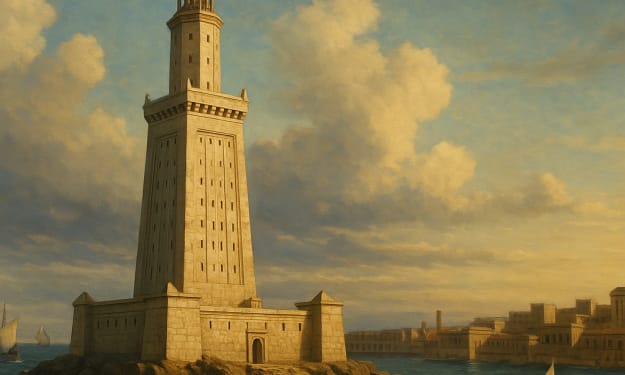
The Lighthouse of Alexandria: An Ancient Greek Engineering Marvel. AI-Generated.
The Lighthouse of Alexandria: An Ancient Greek Engineering Marvel The Lighthouse of Alexandria, also known as the Pharos of Alexandria, was one of the greatest architectural and engineering achievements of the ancient world. Built on the small island of Pharos, just off the coast of the city of Alexandria in Egypt, this magnificent structure guided sailors safely to port for centuries. It was so iconic and important that it earned its place among the Seven Wonders of the Ancient World.
By Adnan Rasheedabout a year ago in History