Discoveries
The Sunken Wealth of the Flor de la Mar: The Forsaken Treasure Vessel of the Portuguese Empire. AI-Generated.
. The Ascendancy of Portuguese Naval Might In the early 1500s, the Portuguese Empire was swiftly broadening its influence across the Indian Ocean. Under the leadership of King Manuel I, Portuguese navigators sought spices, wealth, and supremacy over the trade routes of Asia. Among the numerous vessels launched to aid this mission was the Flor de la Mara colossal carrack that became both an emblem of Portuguese might and a persistent puzzle of lost wealth. Constructed in 1502 in Lisbon, the Flor de la Mar weighed over 400 tons and was designed for extended voyages to India and beyond. Despite initial design shortcomings and repair complications, she would soon play a crucial role in one of the most profitable undertakings in the annals of European colonialism. The Conquest of Malacca By 1511, under the direction of Afonso de Albuquerque, the Portuguese set their ambitions on Malacca, the affluent trading center situated on the Malay Peninsula. Gaining control of Malacca meant dominating the lucrative spice trade that flowed between the East Indies, India, and the West. The conquest was harsh but triumphant. The Portuguese dethroned Sultan Mahmud Shah and acquired vast quantities of treasure from the royal palace and local merchants. Among the riches were gold coins, jeweled artifacts, ceremonial weapons, and rare spices. Estimates suggest the total worth could amount to billions in contemporary terms. This colossal treasure was loaded onto the Flor de la Mar, which Albuquerque personally designated to transport the spoils back to Portugal. The Fateful Journey The Flor de la Mar departed from Malacca in late 1511, escorted by several other vessels. However, her destiny was determined not by adversaries, but by nature itself. As the fleet approached the Strait of Malaccasituated between Sumatra and the Malay Peninsulathe Flor de la Mar faced a ferocious storm. The aging vessel, already notorious for structural deficiencies and an inadequate rudder system, could not endure the onslaught. She disintegrated on a reef off the northern coast of Sumatra. Most of the treasure sank along with the ship. Some survivors were rescued by nearby ships, including Albuquerque himself, but the cargovast, shimmering, and historically invaluablewas never retrieved. The Enigma of the Treasure Throughout the centuries, numerous treasure seekers, archaeologists, and maritime specialists have endeavored to locate the wreck of the Flor de la Mar. The challenges are numerous: the region is perilous, laden with shifting sandbanks, treacherous tides, and a dense thicket of coral reefs. Furthermore, the historical documentation is ambiguous. Some locate the wreckage near the contemporary Aceh coastline in Indonesia; others propose it is situated further within the Strait. Despite enhancements in underwater surveying and sonar technology, no authenticated discovery has ever occurred. If uncovered, the treasure could encompass: Golden Thrones and Religious Artefacts from the Sultan of Malacca Spices and Silks of significant worth at that time Chests of Gemstones and Coins acquired from merchants and royal reserves Documents and Relics from the initial phase of Portuguese expansion Legal and Ethical Issues The quest for the Flor de la Mar also brings forth legal dilemmas. Indonesia asserts ownership of any treasure located within its maritime boundaries, while Malaysia and Portugal may also assert claims due to historical and cultural connections. UNESCO's 2001 Convention on the Protection of Underwater Cultural Heritage discourages commercial treasure hunting, complicating recovery endeavors. Some private enterprises have attempted to negotiate salvage rights, but political unrest and national safeguards have predominantly curtailed such initiatives. Cultural Heritage and Contemporary Legends The Flor de la Mar has integrated into regional mythology. Fishermen near Aceh recount tales of spectral lights beneath the ocean and peculiar phenomena on tempestuous nights. Legends flourish of divers who disappeared while seeking the wreck or found themselves cursed after retrieving artefacts. In Melaka (Malacca), a replica of the Flor de la Mar exists as a maritime museum, enlightening visitors about the golden era of Portuguese exploration and the destiny of the fabled vessel. Yet the true treasure remains concealed, alluring each generation to uncover what centuries have consumed. Conclusion: A Fortune Beneath the Waves The Flor de la Mar persists as one of the most captivating lost treasures in history. She represented more than a mere ship; she embodied imperial aspiration, cultural intertwining, and the avarice that prompted the rise and fall of empires. Beneath the ocean, in the depths of coral and time, resides the promise of unimaginable richesa legacy of conquest, gold, and the profound silence of history.
By Say the truth about a year ago in History
The Golden Vault of the Maharaja: India’s Overlooked Regal Fortune
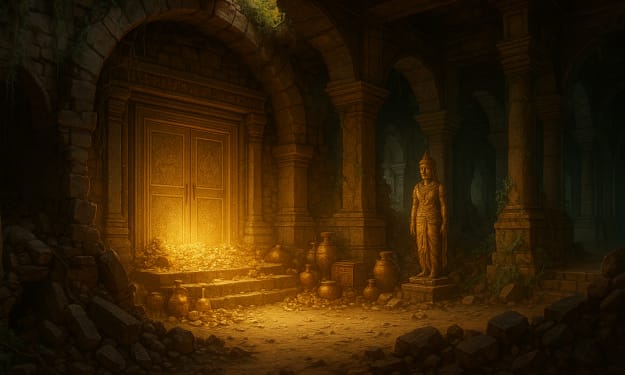
The Narrative of the Golden Vault India, with its rich mosaic of kingdoms, empires, and dynasties, has long been a land of myths and opulence. Among its most timeless narratives is that of the Golden Vault of the Maharaja, a treasure hoard believed to be concealed beneath a now-decrepit palace in southern India. The narrative alleges a secret vault that was sealed during the early 18th century, brimming with gilded thrones, ivory-carved figures, invaluable jewels, and sacred manuscripts. The treasure was not solely emblematic of royal dominance but also regarded as a divine offering for the kingdom's protection. As colonial forces started encroaching on Indian territories, the last ruling Maharaja allegedly instructed that the treasure be sealed, hidden eternally from foreign hands. The Realm of Kaliganj The narrative focuses on the once-mighty yet now obscure realm of Kaliganj, situated between the boundaries of contemporary Karnataka and Tamil Nadu. Governed by a dynasty claiming descent from the Chola monarchs, Kaliganj thrived for nearly three centuries owing to its control over trade routes linking the Bay of Bengal with the Arabian Sea. Maharaja Virendra Dev, the last distinguished sovereign of Kaliganj, was a profoundly spiritual individual, renowned for his wisdom and architectural patronage. Under his administration, the kingdom’s temples were embellished with gold, and its treasury flourished from profits derived from silk trading and gemstone mining. However, Virendra Dev anticipated the decline of Kaliganj. With the Marathas ascending in the north and the British East India Company tightening its hold, the Maharaja commenced devising a strategy to safeguard the essence of his kingdomits treasure. The Sealing of the Vault According to preserved manuscripts and oral traditions transmitted through temple priests, Maharaja Virendra Dev commissioned his craftsmen to create an underground vault within the innermost part of his palace complex. With the assistance of master architects and priests, the vault was consecrated through ancient Vedic ceremonies and sealed employing a blend of mechanical locks and mystical mantras. The vault, according to some accounts, was distinguished by a lotus emblem and shielded by inscriptions cautioning of severe repercussions for those who entered with impure intentions. It was purported that only a genuine descendant of the Maharaja, wielding the sacred key and the knowledge of ancient chants, could safely unlock it. Colonial Incursion and Vanishing In 1765, British forces invaded Kaliganj and demolished the palace during their conquest. The royal family was displaced, and many members either fled or perished. However, the vault remained untouched, entombed beneath the debris of the palace ruins. British authorities recorded hearsay regarding concealed wealth, and numerous failed endeavors were undertaken to unearth it. Nevertheless, enigmatic collapses, the abrupt sickness of workers, and unusual natural phenomena caused the British to cease their pursuit. Some even inscribed in their diaries about “a celestial force” safeguarding the treasure. Rediscovery in the 20th Century During the 1930s, archaeologists encountered partially buried temple remnants close to Kaliganj, sparking renewed fascination in the myth. Locals recounted tales of subterranean chambers and “murmurs within the earth. ” A British-Indian archaeologist, Dr. Rudranath Bose, performed excavations and asserted that he had discovered the outer boundary of the original palace framework, comprising the foundations of a substantial square chamber that aligned with ancient accounts. However, World War II interrupted the excavation process. Dr. Bose’s records and discoveries mysteriously vanished following his demise in 1951, adding yet another layer of intrigue. Modern Speculation and Theories In contemporary times, satellite imagery and ground-penetrating radar have unveiled peculiar subterranean formations beneath the ruins of Kaliganj. A square configuration with adjacent corridors and sealed passageways suggests that a vault may indeed exist. Some theorists assert that the treasure was relocated prior to the British arrival, potentially transported to a clandestine Himalayan monastery. Others contend that it remains concealed, safeguarded by spiritual entities. The Indian government has imposed restrictions on extensive excavation in the vicinity due to its religious and historical significance, further intensifying speculation. In 2021, a collective of historians and spiritual researchers proposed a hypothesis that the vault’s lock was not merely mechanical but symbolicnecessitating a spiritual “key” in the form of ancient incantations performed by a living descendant. The Cultural Impact Whether factual or legendary, the Golden Vault of the Maharaja has integrated itself into local folklore. Artists, poets, and filmmakers have found inspiration in the narrative, portraying the treasure as both a tangible hoard of riches and a metaphor for lost wisdom, cultural pride, and divine heritage. Temples in the area still host annual celebrations honoring Maharaja Virendra Dev, and prayers are offered to the vaultregarded not simply as a repository, but as a sacred domain encompassing the spirit of a lost kingdom. Conclusion The legend of the Golden Vault of the Maharaja transcends a mere tale of concealed riches; it encapsulates India’s tumultuous history, spiritual depth, and the enduring human aspiration for what lies beneath the surface. Whether buried in gold or enshrined in myth, Kaliganj's secret continues to allure the inquisitive and the intrepid.
By Say the truth about a year ago in History
Alexander the Great and the Indian Dragon: Legend, Mystery, or Forgotten History?
A Conqueror's Path Meets the Unknown Alexander the Great is one of history’s most legendary figures. Born in 356 BCE in Macedonia, his military campaigns that extended from Greece to Egypt, Persia, and as far as the borders of India. By the age of 30, he had conquered most of the known world. But it wasn’t just empires and armies he encountered along his path. According to a few ancient accounts, he may have come face-to-face with something far more mysterious, something that some describe as a dragon.
By The Secret History Of The Worldabout a year ago in History
The Battle of Karansebes, 1788: The Austrian Army Accidentally Fighting Itself in the Chaos of War
Among the most bewildering and farcical episodes in military history, the Battle of Karansebes stands out as a stunning example of miscommunication, panic, and human error spiraling out of control. Fought during the Austro-Turkish War of 1787–1791, the event is infamous not for a valiant clash with the Ottoman enemy, but for a chaotic episode where an Austrian army ended up attacking itself. Taking place on the night of September 17–18, 1788, in what is now modern-day Romania, the so-called battle involved confusion, fear, and an abundance of alcohol - ultimately leading to hundreds of Austrian soldiers dead or wounded by friendly fire, long before the Ottomans even arrived.
By History Seekerabout a year ago in History
🌷 The Tulip Mania Bubble in the Dutch Republic, 1636–1637: When Tulip Bulbs Became the World's Most Valuable Commodities Before the Crash
🏩 Part 1: A Blooming Republic - The Dutch Golden Age and the Rise of the Tulip In the early 17th century, the Dutch Republic stood at the pinnacle of European power and prosperity. This confederation of provinces, recently liberated from Spanish rule after decades of conflict, had rapidly evolved into a formidable maritime, financial, and cultural powerhouse. The Dutch Golden Age, as historians now call it, was marked by explosive growth in global trade, scientific exploration, art, and banking.
By History Seekerabout a year ago in History
Lost Art of Atropos Radsla
“This next unit is the final unit of the day. Unit A09.4.01.003 in section TA98. You’ll have a thirty second preview of the contents and then the bidding will begin at three hundred and fifty dollars. If you cross the yellow line, you will be disqualified,” said Kooky Kevin of Kooky Kevin’s Storage Emporium. He twirled his el bandito mustache in one finger and started a timer as his mousy assistant slid open the unit.
By Amos Gladeabout a year ago in History
The Malediction of the Pharaoh’s Gold: Vanished Wealth of the Egyptian Desert
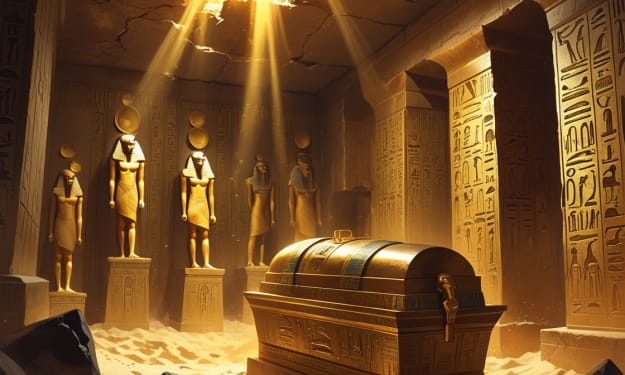
The Myth Commences In the core of ancient Egypt, during the reign of a formidable yet lesser-known pharaohNeferkare Djedkarea substantial quantity of gold was amassed. This was not merely opulence for royal extravagance; it was designated for a divine purpose: to assist the pharaoh in his voyage to the afterlife and to maintain the splendor of Egypt beyond existence. According to a now-missing segment of the Book of the Dead, Djedkare commanded the construction of a secret temple beneath the sands of the Western Desert, well removed from the Nile and beyond the reach of tomb infiltrators. There, gold effigies, gilded scrolls, and amulets were interreditems intended not for the gaze of mortals. The temple was secured with a malediction, cautioning that those who disturbed the resting place would invoke doom upon themselves. Pharaoh Djedkare and His Era Djedkare Isesi, a genuine historical pharaoh of the Fifth Dynasty, governed approximately 2414–2375 BCE. Though not as renowned as Ramses II or Tutankhamun, Djedkare was acknowledged for reorganizing the Egyptian state, expanding trade pathways, and fostering religious transformations. Under his sovereignty, Egypt attained new administrative peaks, while also beginning to shift focus from pyramid construction to concealed tombs and spiritual safeguarding. Djedkare’s tomb in Saqqara was recognized, but legends assert that he had another clandestine burial chamber created for the true treasures of his reignone that remains undiscovered to this day. The Malediction of the Pharaoh’s Gold Tales transmitted through generations recount the Malediction of the Pharaoh’s Gold. The curse was not merely a supernatural menace, but a series of lethal traps and natural perilities devised to protect the hallowed treasure. Ancient inscriptions, deciphered in the early 20th century, reportedly stated: “He who pursues the gold of the sun will consume sand and silence. The jackal will feast on the bones of the avaricious. Let the sacred repose remain undisturbed. ” Whether figurative or literal, the curse was believed to wield genuine power. Explorers who ventured in search of this lost tomb frequently vanished, descended into madness, or encountered tragic destinies. The Lost Expedition of 1898 In 1898, British Egyptologist Sir Edwin Brackley spearheaded an expedition into the Western Desert, motivated by recently uncovered scrolls pertaining to the Sanctuary of Eternal Light, thought to be Djedkare’s hidden temple. His team consisted of local guides, a photographer, and camel drivers. They departed from Dakhla Oasis and proceeded westward. According to Brackley’s journallast retrieved from a camel driver who returned alonethe group encountered peculiar ruins obscured beneath sand dunes. There were indications of an entombed structure, with shimmering fragments of gold leaf and hieroglyphs cautioning against divine retribution. The final entry in Brackley’s journal stated: “We discovered it. The sand quakes. Something observes. ” The entire team disappeared. No remains, no tents, no artifacts were ever unearthedonly scattered journals and a shattered camera lens located a year later. Modern Endeavors and Satellite Observations In recent decades, contemporary archaeology has introduced renewed optimism to the legend. Infrared satellite imaging and ground-penetrating radar have disclosed subterranean irregularities in remote desert locales, potentially artificial structures concealed beneath centuries of sand. A 2013 expedition financed by a European-Egyptian archaeology partnership reported a significant rectangular void northwest of the Black Desert, too symmetrical to be natural. However, extreme heat, shifting dunes, and governmental constraints have hindered comprehensive excavation. Several scholars contend that these irregularities may indicate a concealed burial sitepotentially the mythical Sanctuary of Eternal Light.
By Say the truth about a year ago in History
The Concealed Wealth of the Khmer Empire: Treasure of the Hidden Pagoda. AI-Generated.
The Splendor of the Khmer Empire At its zenith between the 9th and 15th centuries, the Khmer Empire governed vast territories that comprise present-day Cambodia, Thailand, Laos, and Vietnam. Its capital, Angkor, emerged as one of the most extensive and sophisticated urban centers in the pre-industrial era. The Khmer monarchs constructed grand temple complexes such as Angkor Wat and Bayon, fusing spiritual reverence with architectural excellence. Gold circulated abundantly within the empire, attributed to extensive trade routes connecting with India, China, and Arabia. The opulence of the Khmer was not merely for embellishmentit held religious significance. Gold was regarded as a divine material, frequently utilized to embellish statues, temple facades, and sacred artifacts. However, as the empire began to wane in the 15th century, whispers of a concealed pagodaan ultimate treasury intended to safeguard the kingdom’s spiritual and material wealthstarted to surface. The Tale of the Golden Pagoda Khmer oral traditions, transmitted through generations, recount the existence of a "Golden Pagoda" constructed during the empire's final years. Commissioned by a dying monarch, the pagoda was believed to be situated deep within an undisclosed jungle valley, encircled by moats and protected by sacred stone figures. This temple, referred to in local lore as Phnom Meas (Golden Hill), was purportedly adorned with gold leaf, its walls embedded with rubies and emeralds. Internally, the pagoda was said to contain: Enormous golden statues of Buddha and Hindu deities. Chests filled with royal jewels and ceremonial blades. Gold coins, trinkets, and relics from vanquished realms. To thwart foreign plunderers, the pagoda was rumored to be buried or concealed with traps and curses, safeguarded by monks who never departed the premises. Historical Indications and European Records As European explorers began to venture into Cambodia in the 16th and 17th centuries, they noted local tales of temples filled with gold hidden within the forest. Portuguese and French missionaries chronicled elusive ruins, distant golden towers visible from riverboats, and villagers murmuring about forbidden territories no outsider ought to pursue. In 1860, French naturalist Henri Mouhot famously "rediscovered" Angkor Wat for the Western audience. His accounts ignited a surge of interest in Cambodia’s lost civilizations. Nevertheless, Mouhot also documented peculiar reports from local guides about a golden sanctuary “deeper in the jungle than any man dared to venture. ” These accounts have never been substantiated, yet they have incited speculation over the centuries. Contemporary Expeditions and Search Efforts Since the 20th century, numerous expeditions have been initiated to locate the elusive Golden Pagoda. A significant number of these endeavors concentrated on remote locations adjacent to the Kulen Mountains and the Cardamom Rangeareas characterized by dense forests, rugged landscapes, and uncharted ruins. In 2007, a group of archaeologists employing LIDAR (Light Detection and Ranging) unearthed several previously unrecognized temples concealed beneath jungle undergrowth near Angkor. These included road systems and settlements long presumed to have vanished. Some scholars speculated that they were nearing the solution to the enigma of Phnom Meas. Despite these findings, no definitive proof of a gold-clad temple has ever been conclusively discovered. Theories and Discussions A variety of theories envelop the origin and authenticity of the Golden Pagoda legend: Symbolic Wealth: Some scholars contend that the pagoda signifies spiritual richesenlightenment or wisdomrather than actual gold. Vandalized by Invaders: Others propose that the treasure may have existed but was plundered or melted down by the Siamese (Thai) invaders who ravaged Angkor in the 15th century. Still Concealed: An increasing number of independent researchers and treasure seekers hold the belief that the Golden Pagoda remains hidden, buried beneath centuries of vegetation and protected by booby-trapped paths or unexploded munitions from Cambodia’s recent conflicts.
By Say the truth about a year ago in History
The Lost Golden Temple: Unraveling the Enigma of a Neglected Wonder
The Tale of the Golden Temple Throughout ancient societiesfrom the thick forests of Southeast Asia to the peaks of South Americamyths recount a splendid temple erected not from stone or timber, but from pure gold. According to various cultural narratives, this edifice served not only as a place of veneration but also as a treasury of unimaginable riches, sacred relics, and esoteric wisdom. While numerous locales assert to have sheltered such a temple, one narrative, in particular, stands outthe myth of the Golden Temple of the Sun, believed to have flourished within the ancient Incan Empire, near present-day Peru. The Temple of the Sun: A Neglected Marvel The most enduring legend revolves around the Coricancha (translated as “Golden Courtyard”), the hallowed temple dedicated to the sun deity Inti in the heart of Cusco, Peru. Initially constructed by the Inca and subsequently altered by Spanish colonizers, this sanctuary was once adorned with layers of gold, showcasing golden statues, altars, and even vegetation fashioned entirely from precious metal. According to Spanish conquistadors who arrived in the 16th century, the temple dazzled with its brilliance: Walls clad in gold. Golden effigies towering above visitors. Life-sized golden llamas, maize fields, and altars devoted to the sun. The Coricancha was not merely a site of worship; it was the spiritual and economic nucleus of the Inca Empire. Priests performed rituals, monitored celestial movements, and safeguarded royal treasure in subterranean vaults. The Conquest and Vanishing When Francisco Pizarro and his men reached the Andes, they were astonished by the wealth they encountered. However, their astonishment rapidly transformed into avarice. The Spanish plundered the Coricancha and other shrines, melting the gold and dispatching it back to Spain. Nevertheless, Incan chronicles and oral histories recount a divergent narrativeone of strategic defiance. As tidings of the Spanish incursion spread, Incan priests and nobles allegedly smuggled a significant portion of the treasure out of Cusco before it could be seized. The fate of this concealed gold has remained a mystery for centuries. Some accounts suggest it was taken deep into the jungles to the east of the Andes, to a clandestine temple constructed entirely of goldnever discovered by outsiders. El Dorado and the Temple Association The myth of a Golden Temple soon intertwined with another South American legend: El Dorado, the city of gold. Early explorers believed that within the unexplored interior, a city or temple shimmered in sunlight, its rooftops and spires adorned with pure gold. Numerous expeditions were undertaken: Spanish explorers such as Gonzalo Pizarro and Francisco de Orellana journeyed into the Amazon basin in pursuit of it. English navigators during the 17th century chased tales of a solar temple concealed within the Orinoco or Magdalena rivers. Throughout the 20th century, satellite imagery and archaeological assessments perpetuated the searchalbeit without achievement. Nonetheless, the legend of the temple persisted. Other Theories and Global Resonances Beyond South America, other cultural reflections of a golden temple exist: In India, the Golden Temple of Amritsar stands todayhowever, it is a subsequent creation from the 16th century CE and constructed more symbolically than mythically. Ancient Khmer folklore alludes to a golden shrine hidden within the Cambodian jungle, potentially predating Angkor Wat. In China, Taoist writings reference a mystical “Palace of the Golden Phoenix” situated in a mountain shrouded in mist, though historians have yet to validate its existence. Each narrative implies humanity’s fascination with sacred sites composed of the most enduring substancegold. Is the Golden Temple Authentic? Skeptics contend that the notion of a temple entirely fashioned from gold is logistically improbable, particularly in ancient epochs. Gold is pliable and dense, unsuitable for structural stability. Nevertheless, as a symbolic façade or ceremonial covering, its application is feasibleespecially in a culture where spiritual contributions were intertwined with material affluence. Archaeological excavations in Cusco have verified that Coricancha was indeed covered in gold prior to the Spanish incursion. Numerous Inca artifacts retrieved from cave systems and subterranean rivers bolster the hypothesis that substantial hoards of gold were deliberately concealed. Could the fabled Golden Temple have been an actual siteperhaps an extension or hidden sanctuary constructed by the Incas in exile? The Pursuit Persists Contemporary innovationsLIDAR, satellite imaging, and ground-penetrating radarhave unveiled new possibilities in the quest for the Golden Temple. Explorers continue to examine remote areas of the Andes and the Amazon, discovering ruins, pathways, and previously unidentified settlements. Yet, the temple itself remains elusive. Whether concealed beneath the soil, obscured by foliage, or merely a symbol of spiritual wealth lost to the annals of time, the Golden Temple endures as one of history’s most captivating enigmas. Conclusion The Golden Temple signifies more than mere architectural aspirationit embodies the zenith of ancient devotion, the human longing for immortality through prosperity, and the narratives that transcend even empires. Until it is discoveredor definitively established as a myththe legend will continue to illuminate, captivating the souls of treasure seekers and historians alike.
By Say the truth about a year ago in History
The Cold War: A Detailed Overview
🧊 The Cold War: A Detaiew Timeframe: Approximately 1947 – 1991 Main Adversaries: The United States and its NATO allies vs. The Soviet Union and its Warsaw Pact allies Ideological Conflict: Capitalism and democracy (USA) vs. Communism and authoritarianism (USSR) --- 🌍 Origins of the Cold War The Cold War emerged after the end of World War II, as the wartime alliance between the United States and the Soviet Union began to disintegrate. The primary factors contributing to the Cold War included: Ideological Differences: The U.S. championed capitalism and democracy, while the USSR advocated for communism and a centrally planned economy. Geopolitical Tensions: The Soviet Union sought to expand its influence in Eastern Europe, leading to the establishment of communist governments in countries like Poland, Hungary, and Czechoslovakia. The U.S. viewed this as a threat to democratic nations and responded with policies aimed at containing communism. Economic Factors: The U.S. implemented the Marshall Plan to aid in the reconstruction of Western Europe, while the USSR established the Comecon to support Eastern Bloc countries. ---🔑 Key Events During the Cold War 1. Berlin Blockade and Airlift (1948–1949) In an effort to gain control over the entire city of Berlin, the Soviet Union blockaded all land routes to West Berlin. In response, the United States and its allies initiated the Berlin Airlift, supplying West Berlin with food and fuel via air transport for nearly a year. 2. Formation of Military Alliances NATO (North Atlantic Treaty Organization): Established in 1949, NATO was a collective defense alliance among the U.S., Canada, and Western European nations. Warsaw Pact: Formed in 1955, this was a collective defense treaty among the Soviet Union and its Eastern Bloc allies. 3. Korean War (1950–1953) The Korean Peninsula was divided into North Korea (communist) and South Korea (capitalist). The war began when North Korean forces, supported by the USSR and China, invaded South Korea. The United Nations, led by the U.S., intervened on behalf of South Korea. The conflict ended in an armistice, restoring the original borders. 4. Cuban Missile Crisis (1962) The Soviet Union placed nuclear missiles in Cuba, just 90 miles from the U.S. coast. This discovery led to a tense 13-day standoff, bringing the world to the brink of nuclear war. The crisis was resolved when the USSR agreed to remove the missiles in exchange for a U.S. promise not to invade Cuba and the secret removal of U.S. missiles from Turkey. 5. Vietnam War (1955–1975) North Vietnam, supported by the USSR and China, aimed to unify the country under communism. South Vietnam, backed by the U.S., resisted. The war resulted in a communist victory and the unification of Vietnam under communist rule. 6. Space Race The U.S. and the USSR competed to achieve significant milestones in space exploration. Notable events include the Soviet Union launching Sputnik, the first artificial satellite, in 1957, and the U.S. landing the first humans on the Moon in 1969.
By Ahmed rahi about a year ago in History