Discoveries
The Middle East: A Tinderbox of Empires, Wars, and Unending Conflict. AI-Generated.
The Middle East: A Tinderbox of Empires, Wars, and Unending Conflict The Middle East has always been more than just a geographical region—it’s a crucible of civilizations, a battleground of empires, and a vortex of geopolitical rivalries that have shaped world history. From the ancient wars of Mesopotamia to the modern-day clashes between Israel and Iran, this land has rarely known lasting peace. Today, as tensions escalate once again, the Middle East stands at the brink of another catastrophic conflict, threatening not just regional stability but global security.
By Muhammad Salman Akbarabout a year ago in History
The Queen Who Burned Her City
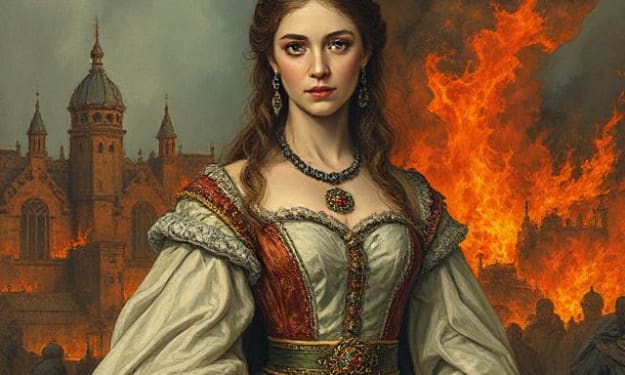
I. The Fire Beneath the Crown She was not born with fire in her hands—but when the time came, she wielded it like a sword. Boudica, Queen of the Iceni tribe, had long lived in uneasy peace with the mighty Roman Empire. Her husband, King Prasutagus, ruled as a Roman ally in what is now eastern England. The arrangement was simple: they kept their thrones, the Romans got their taxes, and the people of Britannia bent the knee—if not in body, then in silence. But when Prasutagus died, he left behind only daughters, and a will begging Rome to protect his family. Rome answered with iron. --- II. The Breaking of a Queen When Roman officials came to claim the kingdom, they did not take it peacefully. They seized Iceni lands, enslaved nobles, and—by some accounts—publicly flogged Boudica and assaulted her daughters. This was not just conquest. It was humiliation. It was betrayal. And it was war. What the Romans failed to realize was that Boudica was not a queen content to mourn in silence. She was a leader with the voice of a goddess and the rage of a storm. She would not plead. She would burn. --- III. The Gathering Storm Boudica called upon the other British tribes, long weary of Roman taxes, forced labor, and brutality. They came—not for politics, but for vengeance. Under Boudica’s leadership, a massive force rose. Some estimates say as many as 100,000 warriors rallied to her side. She was described as tall, fierce-eyed, and wild-haired. She rode a chariot, her daughters beside her, and carried not just weapons—but the memory of every insult Rome had ever carved into British skin. Their first target: Camulodunum—modern-day Colchester, the Roman capital of Britain. --- IV. Cities in Ashes The assault was swift. The Roman inhabitants of Camulodunum barely had time to flee before Boudica’s forces destroyed the city. Temples, homes, and soldiers fell to the fire and blade. Survivors were few. Then came Londinium—modern-day London. Knowing he could not defend it, the Roman governor Gaius Suetonius Paulinus abandoned the city. Boudica’s army entered and razed it. The same fate came to Verulamium (modern St Albans). The death toll across the three cities is estimated at over 70,000. Roman records speak of horrific slaughter—but one must remember: this was not senseless violence. This was rebellion, long suppressed and now unleashed. Boudica’s war was not just against Rome. It was against an empire built on injustice. --- V. The Final Stand But Rome did not build its empire by folding under pressure. Suetonius regrouped with his legion—about 10,000 well-trained soldiers. Boudica’s force, by then swollen with new recruits and tribes, still outnumbered them at least 10 to 1. They met in an unknown location—possibly Watling Street, in the English Midlands. Despite being outnumbered, the Romans used strategy and terrain to their advantage. In a narrow valley flanked by forests, they could not be surrounded. Roman discipline won over chaos. The Britons were crushed. Tens of thousands died. And Boudica? Some say she drank poison. Others say she disappeared into the forest, never to be seen again. But her legend had already been born. --- VI. Aftermath and Legacy Rome regained control—but never again underestimated the ferocity of Britain’s tribes. The revolt led to changes in Roman policy: fewer taxes, more tolerance, and a cautious respect for the people they ruled. Boudica’s name faded for centuries, buried under Roman records and forgotten kingdoms. But in the Victorian era, she was reborn as a national symbol of resistance. A statue of her now stands near the Houses of Parliament in London—a reminder that even in defeat, the human spirit can rise to challenge empires. She lost the battle. But she won immortality. --- VII. The Lesson in Fire Boudica’s story is not one of simple revenge or nationalism. It’s a story of how trauma becomes revolution, how grief becomes resistance. It's about how the oppressed can rise, even if only briefly, and remind the powerful that they rule not by right, but by fear—and that fear has limits. She was a woman against an empire. A mother turned warrior. And though the flames she lit were eventually extinguished, the smoke of her story still lingers, carried by the wind, whispered through time. She was not the first to rise against tyranny—and she will not be the last
By Soul Draftsabout a year ago in History
5 Hoaxes That Had People Fooled
Missing Link. Charles Darwin was the first person to propose evolution, even publishing a book on his findings entitled On the Origins of Species. Ever since, people have been trying to find the missing link. And it was found in 1912 by amateur geologist and archeologist Charles Dawson. The skull was given the name Piltdown Man. While many people did buy into it, there were still skeptics. Those who didn’t believe it said it looked exactly what it was: a human skull with an ape jaw. There was a ceremony in December 1912 hosted by the Geological Society of London, where Dawson could present his findings. Then, in 1917, believers felt a little vindication. Another skull was found, given the title Piltdown II. As more and more early human skulls were found in China and Africa, the legitimacy of the Piltdown skulls came under scrutiny. These new skulls had an apelike skull and humanlike jaw, the exact opposite of the Piltdown ones. Finally, in 1953, the Piltdown Man was run through some tests, which exposed the skull as a fraud. The nonbelievers were on the right track! It was revealed that it was a combination of human (skull), orangutan (jaw), and chimp (teeth). To top it all off, the fluorine dating shows the skull to be no more than 100,000 years old. While that it old, it’s still not old enough to be a missing link. There is still no answer to who the perpetrator of the hoax is, though it’s suspected it was Charles Dawson himself. Indecent Animals. A man by the name of Clifford Prout Jr. was fed up with animals just walking around in the nude. So much so that in the 1950s and 60s, he started a group called SINA: the Society for Indecency to Naked Animals. Clifford believed that animals deserved some modesty just as much as humans. According to Prout, allowing animals to wander around with their genitals out contributed to moral decay. The public took SINA so seriously that Clifford Prout received a $40,000 donation to continue his efforts. But in 1964, the truth finally came out. Clifford Prout Jr. wasn’t a real man, and SINA wasn’t a real group. The person behind this was actually career hoaxer Alan Abel, who would later impersonate Howard Hughes and offered a “euthinasia cruise” for those who were ready to go. Hoax Unintended. This one is a little bit up for debate when it comes to calling it a hoax, as it could fall under the mass hysteria umbrella as well. And that is the radio presentation of H.G. Wells’ sci-fi novel War of the Worlds. There were a few things that led to this hysteria/hoax. Prior to the radio show, there was a disclaimer that would have helped avoid the whole trouble. However, there were many people who were listening to another station and didn’t tune in until 8:12, thus missing the disclaimer. There was another thing that lent to the believability of the broadcast. The alien invasion started with a weather report and a concert. This was followed by “reports” of explosions on Mars, a meteorite touching ground in New Jersey, and finally with aliens actually invading. With the reporters starting to become more frantic, the one million people who tuned in also started to panic. People were arming themselves and crowding highways. When CBS got wind of the hysteria, Wells himself had to get onto the radio and remind everyone that it was all fiction. The Cardiff Giant. Giants have been a big part of mythology all over the world, and on October 10, 1869, two men seemingly found evidence of their existence. Gideon Emmons and Henry Nichols dug up a 10-foot petrified man while digging a well on a New York farm for owner William Newell. As word spread, Newell decided to put up a tent and charged a quarter for a peek at the giant (and eventually charged $0.50 as more and more people came). Some claimed that this body was an ancestor of the Onondaga people while others claimed that this was evidence of the Biblical giants. And many still believed its authenticity despite professionals saying that this giant was a fake. William Newell eventually sold this “mummy” to two businessmen, who took the body on tour. PT Barnum offered these men $50,000 for the giant for his own collection. When they declined, Barnum created a knockoff for his New York museum. Eventually, a man named George Hull came forward and admitted that this was a get-rich-quick scheme. He commissioned a German stone cutter to create this man and asked his cousin William Newell to bury the body. Even after the hoax was revealed, the Cardiff Giant still made its rounds before making its way to the Farmers’ Museum in Cooperstown in 1947, where he still lives today. Feejee/Fiji Mermaid. Nowadays, it’s more widely known that PT Barnum wasn’t super honest about all of his attractions and performers. So it was hard to choose just one, but one of his more famous “real” discoveries was something he dubbed the “Feejee Mermaid.” He claimed that these were the remains of a real mermaid found in the Bay of Bengal. Eventually, staff from the Peabody Museum of Archeology and Ethnology got their hands on a specimen called the Java Mermaid. While it’s not known if this is the Feejee Mermaid, at the very least it is very similar to the one Barnum had. The museum wanted to get to the bottom of the mystery. After all, if Barnum was telling the truth, then this would have been a brand new discovery. It was found that this wasn’t really a mermaid. In fact, it was just a souvenir handcrafted by Southeast Asian fishermen and sold to tourists as a mermaid. These creatures are a mix of paper-mache and fish bones and fins.
By Micah Jamesabout a year ago in History
Visit a Voodoo Village in Ghana
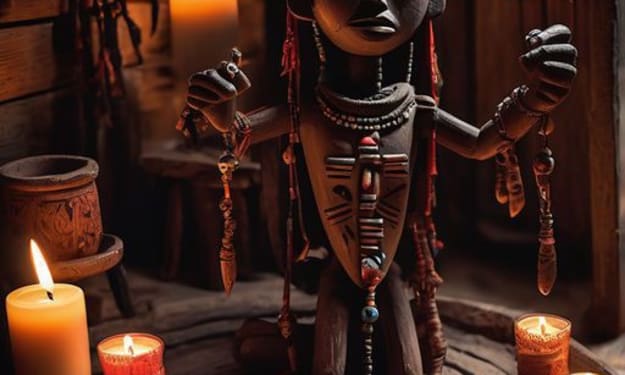
Speaking of voodoo, the images that come to mind are probably voodoo frogs and scary witchcraft. But is voodoo really as scary as we imagine? I was lucky enough to visit the voodoo wizard in the photo when I was traveling in Ghana, introduced by a friend.
By Uchenna Cosmas Nwokafor about a year ago in History
Adventure in Gambaga Witch Village in Ghana
Let’s first talk about what “witch” is! The people of the tribe believe that if the village encounters disease or misfortune, it must be the work of a witch. Even if the husband of an old lady dies, the witch may be accused of killing her husband with witchcraft. At this time, they will name a woman who may be a witch, and then use some traditional methods to determine whether she is a real witch. The most common method is herbal medicine. The chief will let the woman who is accused of being a witch eat special herbs. Only after eating the herbs will the woman answer honestly whether she is a witch. The villagers will expel the witch and warn that if she dares to return to the village to continue to cast spells, she will be killed.
By Uchenna Cosmas Nwokafor about a year ago in History
The Giants of Peru: Conquistadors' Eyewitness Accounts and the Mystery of Ancient Skeletons
The Giants of Peru When the Spanish conquistadors arrived in South America in the 16th century, they anticipated discovering gold, spices, and strange civilizations. However, they did not expect to encounter legends of giants, and even more surprisingly, reports of actual giant skeletons unearthed by the native people that they claimed to have seen with their own eyes.
By The Secret History Of The Worldabout a year ago in History
Which Prophet Could Interpret Dreams in Islam? The Story of Yusuf’s Unique Gift
Dreams have sparked curiosity and wonder for centuries. In Islamic history, dreams aren't just random images—they can warn, guide, or comfort the soul. Some of the most powerful lessons come from stories where these nighttime visions shape real lives. Among the prophets, one stands out for his rare and remarkable gift to interpret dreams: Prophet Yusuf (Joseph).
By Mike S. Hessabout a year ago in History
The Eight Kings Who Ruled Before the Flood: Unveiling the Sumerian King
A Forgotten Record of Impossible Reigns: Unraveling the Enigma of the Sumerian King List In the cradle of civilization, where the first written words were penned, and society took its earliest steps, ancient scribes inscribed a remarkable document into clay tablets: the Sumerian King List. This cuneiform text, over 4,000 years old, lists the names of kings who reigned in ancient Mesopotamia.
By The Secret History Of The Worldabout a year ago in History