Books
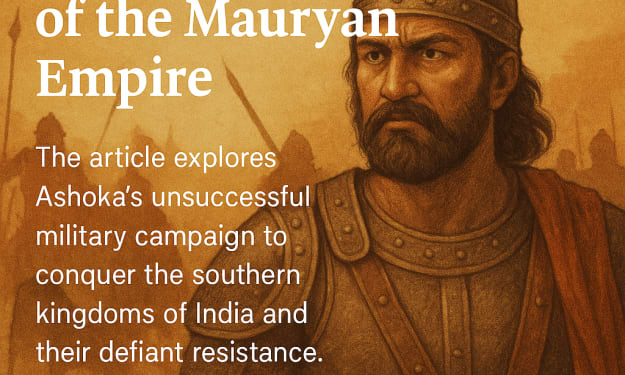
The Defeat of the Mauryan Empire: Ashoka's Southern Failure. AI-Generated.
The Defeat of the Mauryan Empire: Ashoka’s Southern Campaign and the Unyielding South History often glorifies the victors—but in the sun-scorched landscapes of ancient South India, a lesser-known chapter tells the story of resistance, pride, and resilience. It is the tale of how the great Ashoka the Great, the mighty emperor of the Mauryan Empire, met his limits at the southern frontiers—brought low not by war-weariness or internal dissent, but by the fiery defiance of the South Indian kingdoms. Ashoka the Invincible… Almost By the time Ashoka came to power around 268 BCE, the Mauryan Empire stretched from the snow-clad valleys of the Himalayas to the roaring seas of Bengal and westward into present-day Afghanistan. His reign, marked by brutal conquest and later a philosophical transformation following the Kalinga War, is often remembered for the spread of Buddhism and the ethics of Dhamma. Yet, Ashoka was also an ambitious ruler. His dream of unifying the Indian subcontinent under one flag remained incomplete as the southern territories—particularly the ancient Tamil kingdoms of the Cholas, Pandyas, and Cheras—remained out of reach. These lands, ruled by powerful monarchs with rich cultures and vast trading networks, were not easily subdued. The Southern Campaign According to scattered historical accounts and Tamil legends, Ashoka, emboldened by his successes in the north and east, launched a campaign toward the South early in his reign—before his transformation after the Kalinga War. His goal was not only military expansion but to bring the resource-rich and strategically located southern kingdoms into the Mauryan fold. Ashoka’s generals marched through the Deccan plateau, subduing minor satraps and tribes. But as they approached the borders of the Tamilakam, the terrain changed—not only physically, with thick jungles and harsh coastal winds, but also politically. The Chola and Pandya kings had already been alerted to the Mauryan presence, and they did not wait idly. The Clash at Venbai The first major confrontation is believed to have occurred near Venbai, a strategic settlement in present-day Tamil Nadu. The Pandya king, Arivazhagan Nedunchezhiyan, led a united army of Pandyas and Cholas against the advancing Mauryan forces. Though the Mauryans outnumbered the southern alliance, the terrain favored the defenders. Using guerrilla tactics, well-coordinated ambushes, and their knowledge of the land, the South Indian warriors disrupted Mauryan supply chains and divided their battalions. The battle raged for days, with neither side yielding—but eventually, disease, weather, and a surprise night assault by the Chera cavalry broke the Mauryan frontlines. Ashoka’s southern campaign had met its first great failure. A Strategic Retreat The defeat at Venbai shocked the Mauryan court. Ashoka, known for his intellect as much as his ambition, quickly understood the cost of pressing further. Instead of escalating the war, he chose a more diplomatic route—dispatching envoys and Buddhist monks to Tamilakam. This shift coincided with his spiritual transformation after the Kalinga War, during which he began to see conquest through Dhamma, not swords. Interestingly, Ashoka’s inscriptions mention friendly relations with the Cholas and Pandyas, suggesting that while military conquest failed, he succeeded in building cultural and diplomatic ties. Buddhist monks traveled freely in the south, and stupas were erected even in lands that had once resisted his armies. Legacy of Resistance In Tamil literature, particularly the Sangam poems, references to resisting northern invaders appear with pride. While these may be poetic reinterpretations, they underscore the deeply rooted independence of the Tamil kingdoms. For centuries afterward, the South remained autonomous and powerful, often engaging with Southeast Asia rather than the Gangetic plain. The defeat of Ashoka in the South is not just a military event—it’s a symbol. It represents the cultural and political uniqueness of the Tamil lands, the might of decentralized resistance, and the idea that even the greatest of emperors had limits. Conclusion Ashoka’s encounter with the South Indian kingdoms marks a rare but telling moment in Indian history—a time when steel met strategy, and the great emperor was reminded of the strength of unity, identity, and home-ground advantage. Though he may not have conquered the South by force, the episode left an indelible mark on how future emperors approached the peninsula: with respect, caution, and awe. This chapter is a reminder that history is never one-sided—and that sometimes, the most powerful stories are the ones of those who stood their ground and prevailed against the tide of empires. Would you like a title image and summary for this article too? Or should I turn this into a series about "Forgotten Battles of Indian History"?
By Say the truth 2 years ago in History
Nelson Mandela: A Legacy of Liberation, Reconciliation, and Hope
Nelson Mandela: A Legacy of Hope, Peace, and Liberation Nelson Rolihlahla Mandela, more commonly referred to as Madiba, is still regarded as an iconic figure from both the 20th and 21st centuries. His life is a source of inspiration for people all over the world who are working toward equality and human dignity. It is marked by unwavering dedication to justice, significant sacrifice, and an extraordinary capacity for forgiveness. Mandela's journey is a testament to the strength of the human spirit in the face of oppression, from anti-apartheid activist to political prisoner to first president of a democratic South Africa. Born on July 18, 1918, in the Eastern Cape of South Africa, Mandela's early life provided little indication of the monumental role he would play in shaping his nation's destiny. He learned about the systemic racial discrimination and injustice that black South Africans faced under the apartheid regime while attending the University of Fort Hare and local missionary schools. When he joined the African National Congress (ANC) in 1944, a liberation movement that was initially committed to non-violent resistance against apartheid laws, his activism took off in earnest. However, following the Sharpeville massacre in 1960, where peaceful protestors were brutally killed by police, Mandela and the ANC leadership concluded that armed struggle was a necessary last resort. He co-founded the ANC's military wing, Umkhonto we Sizwe ("Spear of the Nation"), which carried out sabotage against important government facilities. His arrest in 1962 and the infamous Rivonia Trial in 1964, in which he and other ANC leaders were charged with sabotage and conspiracy, were both as a result of this shift. His powerful speech from the dock, in which he said he was willing to die for the idea of a free and democratic society, was heard all over the world and made him into a symbol of resistance. Mandela was given a life sentence and spent the next 27 years in harsh conditions on Robben Island and other South African prisons. Mandela's influence only increased despite his imprisonment. The global anti-apartheid movement demanded his release and the end of the oppressive apartheid system, making him a global celebrity. Millions of people around the world were inspired by his unwavering resolve and refusal to compromise his values. Domestic and international pressure on the South African government increased toward the end of the 1980s. President F.W. de Klerk started reforms in the face of growing unrest and the realization that apartheid was unsustainable. These reforms led to Mandela's unconditional release on February 11, 1990. Mandela was a key player in the delicate negotiations for a peaceful transition to a multiracial democracy after his release. Together with de Klerk, he worked tirelessly to end apartheid laws, free political prisoners, and create a framework for free and fair elections. In 1993, they were awarded the Nobel Peace Prize for their collective efforts in navigating this difficult period. Nelson Mandela became the nation's first black president after its first democratic elections were held in 1994. His presidency was marked by a dedication to nation-building and reconciliation. He advocated for the Truth and Reconciliation Commission, a ground-breaking initiative that encouraged a process of healing and comprehension by allowing both perpetrators and victims of apartheid-era violence to share their experiences. His government also prioritized addressing the deep-seated inequalities created by apartheid, implementing policies aimed at improving housing, education, healthcare, and economic opportunities for the black majority. Mandela's leadership was marked by pragmatism, inclusivity, and a profound commitment to the well-being of all South Africans, despite the enormous challenges he faced. Mandela voluntarily resigned from office in 1999 after serving one term, establishing a significant precedent for democratic leadership in Africa. However, he continued to be an active global statesman, working through the Nelson Mandela Foundation to promote peace, human rights, and the fight against HIV/AIDS. On December 5, 2013, Nelson Mandela passed away at the age of 95. Global mourning surrounded his passing, but his legacy continues to inspire. In addition to his brave resistance to apartheid, he is remembered for his extraordinary capacity for forgiveness, his dedication to reconciliation, and his unwavering belief in the possibility of a just and equitable world. Mandela's legacy reaches far beyond South Africa's borders. He stands as a symbol of hope for oppressed people everywhere, a testament to the power of perseverance, and an enduring reminder that even the most entrenched systems of injustice can be overcome through courage, determination, and a commitment to human dignity. His life is a powerful example of the significance of dialogue, comprehension, and the pursuit of a shared humanity in constructing a better future for everyone. Canvas
By Tafsirul Talukdar luvdo2 years ago in History
Musk says he will step back from DOGE, refocus on Tesla after earnings plunge
In the midst of a decline in earnings, Elon Musk withdraws from DOGE and refocuses on Tesla. Elon Musk has announced plans to reduce his involvement with the United States, a significant shift in priorities. Following a sharp decline in Tesla's earnings and stock value, Department of Government Efficiency (DOGE) and devote more time to the company. This action demonstrates how much Musk is being pressured to stabilize Tesla's performance and regain investor confidence. # A Warning Sign from the Earnings Plunge Tesla's first-quarter 2025 earnings report revealed a staggering 71% drop in net income, amounting to $409 million. The most significant drop in sales in the company's most recent quarter was a 20% decline in automotive sales revenue. Analysts attribute this downturn to various factors, including decreased global demand and production line retooling. Costs have also gone up as a result of the ongoing trade war, further straining Tesla's finances. The stock price of the company has also fallen, falling by more than 40% from its peak in 2024. Tesla's market performance is closely linked to Musk's personal wealth, which has diminished as a result of this decline. # Musk's Dual Role: Finding a Balance Between Tesla and DOGE There has been disagreement regarding Musk's involvement in the DOGE of the Trump administration. Leading the Department of Government Efficiency, Musk has been instrumental in implementing significant cuts to federal agencies, including the closure of USAID. He says that these measures are meant to cut down on fraud and waste, but they've sparked a lot of protests and backlash. Tesla's brand image has been tarnished, according to critics, particularly among liberal customers. In response to mounting pressure, Musk has decided to scale back his duties with DOGE. He plans to devote more time to Tesla, starting next month, while continuing to spend one or two days per week on government matters. Musk emphasizes that his political work is "mostly finished" and that he will only remain involved as long as it is deemed usef# Tesla's Strategic Shifts The company is concentrating on a number of important initiatives in order to address the difficulties Tesla faces: 1. Autonomous Vehicles and Robotaxis Tesla is speeding up the development of its technology for autonomous vehicles. The company plans to launch its robotaxi service in Austin in June 2025, with plans for rapid expansion. This move aims to position Tesla at the forefront of the autonomous transportation industry. #2. Affordable Electric Vehicles In the first half of 2025, Tesla is on track to introduce a more affordable electric vehicle model. This initiative seeks to broaden Tesla's market reach amid global economic uncertainty and increasing competition. 3. Focus on AI and Robotics Musk has expressed an increasing interest in robotics and artificial intelligence. The humanoid robot Optimus from Tesla and developments in artificial intelligence are central to the future strategy of the company, which aims to expand its technological portfolio beyond electric vehicles. # Investor Sentiment and Market Reaction Investors have welcomed Musk's decision to refocus on Tesla. In after-hours trading, Tesla's stock price increased by more than 5% following the announcement. Analysts view this as a positive step toward stabilizing the company's performance. However, difficulties persist. The need to successfully carry out its ambitious technological initiatives, geopolitical uncertainty, and the growing competition in the market for electric vehicles all present challenges for Tesla. The company's ability to overcome these obstacles will be crucial to its future course. # In the end The urgent need to address Tesla's financial and reputational issues is reflected in Elon Musk's decision to step back from his position at DOGE. This strategic shift demonstrates Musk's commitment to getting Tesla back on track and restoring investor confidence, even though the road ahead is still full of obstacles. Musk's Strategic Shift: Refocusing on Tesla Despite Earnings Challenges
By Iftikh Ahmed2 years ago in History
The Mysterious Ark of the Covenant: A Sacred Relic of Divine Power
Throughout history, few artifacts have captured the imagination of believers and scholars like the Ark of the Covenant, known in Islamic tradition as Taboot Sakina (the Ark of Tranquility). This ancient chest is revered in Judaism, Christianity, and Islam, believed to hold divine blessings and miraculous powers. Its story weaves through prophecies, battles, and disappearances, leaving behind a legacy of faith, mystery, and eschatological hope.
By Mujeeb Baloch2 years ago in History
The Conjuring: Last Rites
The Conjuring: Last Rites isn’t just another horror movie — it’s the grand finale to the terrifying, soul-scarring journey of Ed and Lorraine Warren, the paranormal power couple that’s been haunting our dreams since 2013. Directed by Michael Chaves, this upcoming installment is set to be the darkest, most emotional chapter in the Conjuring saga yet. Forget creaky floorboards and shadowy corners — Last Rites is promising a full-on descent into demonic madness.
By James Brock2 years ago in History
Xenophon
Xenophon (circa 430–354 BCE) stands out as one of the most multifaceted and intriguing personalities of ancient Greece. As a soldier, historian, philosopher, and a disciple of Socrates, he produced a substantial body of work that offers essential perspectives on Greek culture, military strategies, and philosophical ideas. In contrast to many of his peers, Xenophon employed a clear and direct writing style, which renders his texts approachable for both ancient and contemporary audiences. His renowned works, including Anabasis and Memorabilia, remain subjects of study due to their historical importance and literary value.
By A História2 years ago in History
The Lost Fortune of the Jews: Tracing the Greatest Treasure in Jewish History . AI-Generated.
The Esoteric Wealth of Solomon: Charting the Preeminent Treasure in Jewish Heritage This article explores the mythical riches of ancient Israel, particularly those associated with King Solomon’s Templegolden relics, the Ark of the Covenant, and invaluable religious artifacts. It examines historical documents, sacred texts, and archaeological hypotheses to investigate how the affluence of one of history's mightiest ancient empires gradually disappeared through epochs of conquest, exile, and warfare. From Babylonian incursions to Roman plundering, the narrative of these treasures encapsulates both the splendor and sorrow of Jewish heritage. Article: The Esoteric Wealth of Solomon: Charting the Preeminent Treasure in Jewish Heritage Among the numerous wonders of ancient civilization, few riches evoke such persistent intrigue and spiritual ambiguity as the affluence of the ancient Jewish kingdom, particularly that accumulated during the rule of King Solomon. Esteemed in religious literature and enveloped in historical mystery, the treasures of Israelespecially those enshrined in the First Temple in Jerusalemhave transformed into the focus of myth, faith, and relentless academic inquiry. The Ascendancy of a Gilded Kingdom Based on the Hebrew Bible and various historical documents, Solomon, the progeny of King David, governed the united Kingdom of Israel in the 10th century BCE. His tenure is characterized as a golden epoch of abundance, distinguished by international diplomacy, commerce, and monumental construction. The crowning achievement of his legacy was the First Temple in Jerusalemcommonly referred to as Solomon’s Templea sacred edifice erected to shelter the Ark of the Covenant and to function as a permanent site of worship for the Jewish populace. The edification of the Temple was extravagant. Gold, silver, and exquisite stones embellished its walls. According to the Book of Kings, Solomon acquired substantial wealth from trade alliances with the Phoenicians, Egypt, Sheba, and potentially even India. The Bible asserts he possessed "silver as common as stones" in Jerusalem. Assessments of the Treasure’s Worth Though precise valuations are unattainable, contemporary scholars and economists have endeavored to approximate the wealth based on biblical depictions. One estimation suggests the gold Solomon received on an annual basis was 666 talentsa figure approximately equivalent to 25 metric tons of gold each year. At current gold market rates, that would amount to over $1. 5 billion annually. Taking into account his 40-year reign and the Temple’s grand magnificence, Solomon’s overall treasury may have exceeded $50 billion to $100 billion in present-day currency. Among the most reveredand enigmaticof these treasures was the Ark of the Covenant, purportedly housing the stone tablets of the Ten Commandments. Its ultimate fate remains uncertain. The Babylonian Pillaging (586 BCE) The First Temple endured for nearly four centuries until the Babylonian incursion led by King Nebuchadnezzar II. In 586 BCE, Jerusalem was ravaged, the Temple was annihilated, and its treasures were transported to Babylon. Both the Bible and Babylonian Chronicles document the plundering of golden vessels, altars, and sacred objects. This occasion signified the inaugural substantial dispersal of the Jewish heritage and initiated a sequence of exiles and reallocations of cultural assets that would persist for centuries. The Roman Siege and the Second Temple’s Assets Following the return from Babylonian captivity and the establishment of the Second Temple, Jewish religious practices resumedbut only temporarily. In 70 CE, Roman troops led by Titus besieged Jerusalem during a Jewish insurrection. The Temple was once again demolished, and the remaining treasures, including the renowned Menorah, Table of Showbread, and silver trumpets, were pillaged. These artifacts were displayed in Rome in a magnificent triumphal procession. The Arch of Titus continues to stand today as a carved commemoration of this occurrence. The treasures were stored in the Temple of Peace in Rome, but their fate after the fall of the Roman Empire remains uncertain. Many speculate that they were concealed, melted down, or lost to the passage of time. Contemporary Theories and Mystical Importance A multitude of contemporary theories endeavors to unveil these elusive treasures. Some propose that the Vatican harbors crucial artifacts concealed beneath its vaults. Others assert that the Knights Templar uncovered them during the Crusades and conveyed them throughout Europe. There are even assertions of hidden chambers beneath Jerusalem’s Temple Mount, containing ancient relics untouched for millennia. The treasures’ symbolic significance is as vast as their material value. They symbolize a lost realm of Jewish sovereignty, spirituality, and divine connection. The Ark of the Covenant, if ever located, would possess unparalleled religious importance, potentially transforming theological and geopolitical landscapes. Conclusion: A Treasure Beyond Monetary Value The treasure of the Jewsespecially that from Solomon’s Templerepresents more than just lost gold and silver. It is a profound emblem of faith, identity, and endurance. Through exiles, massacres, and the Holocaust, Jewish history is marked by immense suffering but also by resilience and the unyielding determination to remember and rebuild. The tangible artifacts may remain buried or dispersed across the globe, but in the hearts of the Jewish people and those who study ancient history, the greatest treasure enduresnot in vaults or ruins, but in narrative, spirit, and survival.
By Say the truth 2 years ago in History
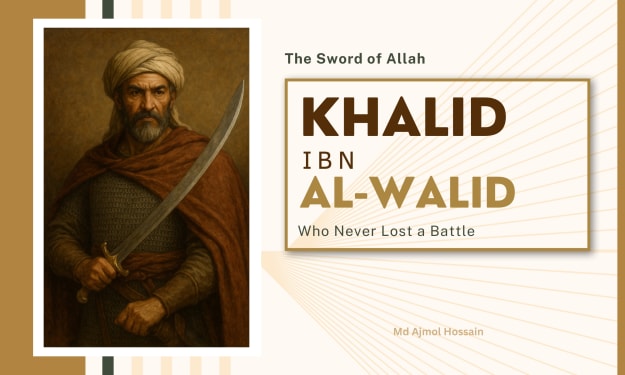
Khalid ibn al-Walid: The Sword of Allah That Never Lost a Battle
Imagine a warrior, so fearless, so effective and so loyal - that even the Prophet Muhammad (peace is on him) gave him the title: "The sword of Allah." The man was Khalid Ibn al-Walid-A Common who fought more than 100 matches and never lost a single. His name echoes through the Arab deserts, the Persian mountains and rivers in Rome.
By Md Ajmol Hossain2 years ago in History