Books
Raja Raja Chola: The Sea King and Warrior Emperor of Southern India
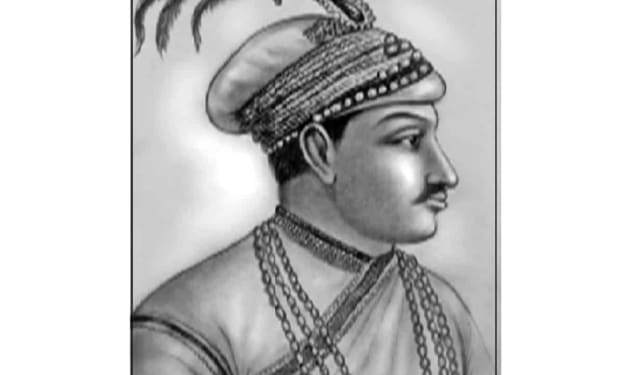
"Raja Raja Chola: The Maritime Sovereign and Warrior Emperor of Southern India" Raja Raja Chola I, the renowned sovereign of the Chola Dynasty, governed from 985 to 1014 CE and transformed military tactics in South India by establishing one of the most sophisticated and coordinated military and naval forces in ancient Asian history. His legacy is characterized by his prowess in terrestrial combat, strategic military campaigns, and the formation of a formidable navy that extended Chola influence far beyond the seasfrom the Maldives to Southeast Asia. This article examines the military genius, naval supremacy, and enduring accomplishments of a monarch who was not merely a ruler but a warrior-statesman who redefined the concept of empire. Raja Raja Chola: The Maritime Sovereign and Warrior Emperor of Southern India Within the illustrious chronicles of Indian history, the name Raja Raja Chola I stands out as one of the most remarkable kings to emerge from the Tamil regions. Referred to as “Raja Raja the Great,” he presided over the Chola Empire during an era of military evolution and significant territorial expansion. More than just a king, Raja Raja was an innovative military strategist who unified extensive territories through the strength of his army and the power of his navybecoming the first South Indian emperor to effectively project authority beyond the Indian subcontinent. Ascendancy to the Throne and Military Reforms Upon Raja Raja Chola’s rise to power in 985 CE, the Chola Empire was in a state of recovery from internal discord and regional disintegration. Acknowledging the necessity for a disciplined, professional army, he reorganized the military into structured regiments such as the Velaikkara and Uttama Chola Terinda Kaikola. These specialized units received training in infantry, cavalry, and elephant combat, with each regiment assigned specific responsibilities during military operations. Raja Raja reformed military administration by inscribing detailed records on temple walls that listed soldiers’ names, remuneration, and land endowmentsrendering the Chola military one of the earliest to be administered with bureaucratic accuracy. The Expanding Chola Military The size of the Chola military during Raja Raja’s rule is estimated to have surpassed 150,000 soldiers, reinforced by numerous war elephants and cavalry units. Chola war elephants, adorned in armor and bells, frequently led assaults that breached enemy formations. Raja Raja also dedicated resources to fortifying key cities and border regions, establishing strategic garrisons. His military endeavors included triumphs over the Pandyas, Cheras, and Gangas, as well as the annexation of the northern territories of Sri Lanka. Each military campaign exhibited exceptional strategy, swift mobilization, and the proficient integration of forces. Establishment of the Chola Navy Perhaps Raja Raja’s most revolutionary contribution to warfare was the establishment of the Chola Navythe first comprehensive naval force in Indian history. Prior to this, Indian empires were predominantly land-oriented. Raja Raja recognized the strategic significance of naval superiority in securing trade routes, protecting coastal areas, and extending influence throughout the Indian Ocean. He built colossal warships utilizing teak and iron-reinforced hulls, manned by archers and boarding crews. Ports such as Nagapattinam and Kaveripattinam evolved into naval headquarters. His fleet, estimated to comprise 300 to 500 vessels, facilitated long-range operations that competed with the naval forces of contemporary China and Arabia. Southeast Asian Campaigns and Naval Accomplishments In one of the most remarkable achievements in early Indian military history, Raja Raja initiated naval expeditions across the Bay of Bengal and seized territories in the Maldives, Sri Lanka, while also impacting coastal regions of present-day Malaysia, Indonesia, and Thailand. These campaigns not only yielded wealth and tribute but also propagated Tamil culture, commerce, and religion throughout Southeast Asia. The Chola navy secured merchant vessels, safeguarded temple riches, and upheld imperial authority on foreign shores. Through such endeavors, Raja Raja established a maritime empirean ambition centuries ahead of its era. Wealth, Resources, and Military Sustainability The expense of sustaining Raja Raja’s military apparatus was substantial. The empire’s economy was bolstered by fertile agrarian territories, regulated commerce, and tribute from subjugated regions. Temples served as financial centers, financing regiments and naval contingents. The annual defense budget, in contemporary terms, could be approximated at several billion dollars, accounting for ship construction, soldier compensation, armor, elephant enclosures, and logistical support. In spite of this, Raja Raja succeeded in maintaining the empire’s financial equilibrium, employing meticulous records and regional administrative divisions (nadus) for effective taxation and resource allocation.
By Say the truth about a year ago in History
Letters from the Underground Railroad
Letter 1 – May 5, 1852 To my dearest Mama, The day has come, and I am leaving. It is hard to write this without tears staining the paper, but I must be strong. Tonight, I will leave behind the plantation, the only life I have ever known, to seek the promise of freedom. The conductor, a kind man I’ve never met before, told me the route would be long and dangerous, but the risk is worth it. I overheard Mr. Turner, the overseer, say that there is talk of selling me to the South. They want to send me to a place where no one ever comes back. I won’t let that happen.
By Haseeb Mujaddidiabout a year ago in History
ayet.online: A Simple and Meaningful Journey Through the Qur’an in the Digital Age. AI-Generated.
The digital transformation has significantly changed the way we access information—including sacred texts. More and more people now prefer to read and reflect on the Qur’an through online platforms. ayet.online stands out in this space with its clean interface, ease of use, and comprehensive content.
By ayet.onlineabout a year ago in History
“Lasseter’s Reef: Australia’s Lost Treasure of Gold and Legend”. AI-Generated.
"The Hidden Wealth of Australia: Discovering the Continent’s Most Significant Concealed Treasure" Australia encompasses more than merely arid deserts and ancient terrainsit conceals narratives of substantial, undiscovered fortune. From the legendary Lasseter’s Reef, purported to be an unparalleled gold deposit buried deep within the outback, to the sunken Dutch vessels carrying silver and gold, as well as the loot of outlaw bushrangers hidden in the wilderness, this article delves into the most persistent and valuable treasure legends of the land down under. Join us as we investigate the history, enigma, and contemporary endeavors to reveal Australia’s greatest treasure. Image Prompt: A lifelike digital illustration of the Australian Outback featuring red sandstone cliffs, a group of adventurers examining maps and tools, alongside glimmering gold partially concealed in the desert ground. A spectral image of Harold Lasseter gesturing toward the horizon lingers in the background. Include camels, indigenous flora, and a radiant sunset sky. Title: The Myth of Lasseter’s Reef: Australia’s Most Significant Lost Treasure Introduction Nestled within the blistering core of the Australian Outback resides one of the most enduring and enigmatic legends in the nation's history: the narrative of Lasseter’s Reef. Alleged to be a considerable gold deposit concealed in the desert, this "reef" (a term utilized in mining to indicate a vein of gold-bearing rock) has fascinated prospectors, explorers, and treasure seekers for more than a century. Despite countless expeditions and relentless quests, the elusive treasure remains unlocateda spectral promise of immense wealth buried beneath limitless red sands. The Genesis of the Legend The tale commences with Harold Bell Lasseter, a man of intricate character and profound conviction. In 1929, Lasseter asserted he had discovered a colossal gold reef in Central Australia as a youth in 1897, at the age of 17. He recounted that his camel had fled during a solo expedition, and while searching for water and security, he encountered a lustrous, golden ridge extending for miles. Lacking the tools to extract it and driven by survival instinct, he memorized the site and subsequently returned to civilization. For many years, Lasseter clung to his secret, disheartened that nobody believed his account. However, as Australia grappled with the aftermath of the Great Depression in the 1930s, his narrative gained momentumproviding optimism to a desperate nation yearning for wealth and stability. The 1930 Expedition With governmental support and private investment, the Central Australian Gold Exploration Company (CAGE) was established, and an expedition was assembled to seek out the reef. Lasseter was designated as the guide and led a team of explorers, camels, provisions, and radio apparatus deep into the desert from Alice Springs. Nevertheless, conflicts rapidly intensified. Lasseter’s ambiguous instructions, secretive demeanor, and insistence on proceeding independently estranged his team. Ultimately, the group dissolved in exasperation, leaving Lasseter solitary in the desert. For several weeks, he endeavored to survive, reportedly assisted by Aboriginal individuals. His final journal entries, later discovered by rescuers, recount his ongoing pursuit of the reef, his solitude, and his gradual demise in a secluded cave near the Petermann Ranges in early 1931. His remains were located in a deteriorated state, yet his narrative endured. Reality or Fabrication? Since Lasseter’s demise, contention has erupted regarding the existence of his reef. Some theorize it was a figment of imaginationpossibly heat-induced hallucinationsor an elaborate deception. Conversely, others assert its authenticity, citing: Lasseter’s meticulous journal, in which he documented distances, sites, and details. Independent testimonies from other adventurers and Aboriginal oral histories that suggest gold in the same vicinity. The likelihood that Lasseter employed an alternative coordinate system or had forgotten the precise location after thirty years. While no conclusive physical proof has ever been discovered, numerous treasure seekers and explorers persist in exploring the myth. Contemporary Searches and Technology The evolution of satellite imaging, geological surveying, and GPS technology has rekindled interest in the quest for Lasseter’s Reef. Numerous expeditions in the 20th and 21st centuries have traversed the central Australian deserts, particularly around the Petermann and Rawlinson Ranges, yet the reef remains undiscovered. In 2005, a private exploration team asserted they had found “evidence” of a gold-rich area consistent with Lasseter’s account, but no commercial achievement ensued. Others continue to finance investigations, convinced that a concealed fortune lies beneath the crimson soil. Cultural Significance
By Say the truth about a year ago in History
Siraj-ud-doula
Siraj-ud-Daula was the last independent Nawab of Bengal, Bihar and Orissa. He was born in 1733 and became Nawab in 1756 after the death of his grandfather Nawab Alivardi Khan. He was a young, brave and determined ruler. His reign was only one year, but it was significant.
By robiul hasanabout a year ago in History
Top 10 NFT Design Services Companies in the World
In the realm of blockchain art and digital collectibles, NFT design services companies are essential in determining the distinctive visual character of tokens. Businesses and artists need top-notch designs to distinguish out in a crowded market as NFTs gain popularity worldwide. With an emphasis on technical know-how, industry repute, and creative innovation, this article lists the top NFT design services companies in the world. These NFT design services firms in the world can improve your NFT project with exceptional graphics and user experience, regardless of whether you're a brand or an individual developer.
By Naeem Abbasabout a year ago in History
The Civil Rights Movement in the USA: A Turning Point in American History. AI-Generated.
The Civil Rights Movement in the USA: A Story of Courage and Change There was a time in America when people with dark skin were not treated equally. They could not sit where they wanted, go to the same schools, or even drink from the same water fountains as white people. This was called racial segregation, and it was unfair. But things did not stay like this forever. A powerful movement started — made of brave people who stood up and said, **"Enough is enough."** This was the **Civil Rights Movement**, and it changed the face of the United States forever. Where It All Began Let’s go back to the **1950s and 1960s** — a time when America was full of rules that separated people by skin color. This was especially common in the southern states. One day in **1955**, in Montgomery, Alabama, a Black woman named **Rosa Parks** was riding a bus. When a white man asked her to give up her seat, she said **"No."** That one word was small — but it shook the world. Her arrest led to the **Montgomery Bus Boycott**, where thousands of Black people stopped riding buses for over a year. This peaceful protest hurt the bus companies financially, and finally, the courts said, “segregation on buses is illegal.” > **Highlight:** Rosa Parks’ quiet courage became a loud call for change. The Rise of Dr. Martin Luther King Jr. During the Montgomery Bus Boycott, a young preacher named **Dr. Martin Luther King Jr.** became a leader. He believed in **non-violence**, inspired by Mahatma Gandhi. He said: > “Hate cannot drive out hate. Only love can do that.” Dr. King and others led **peaceful marches**, gave **powerful speeches**, and organized **boycotts** — all to demand **equal rights for Black Americans.** One of his most famous moments was the **March on Washington in 1963**, where he stood in front of the Lincoln Memorial and said: > “**I have a dream**... that one day... children will not be judged by the color of their skin, but by the content of their character.” More than 250,000 people stood and listened that day. > **Highlight:** Dr. King’s dream became a message of hope for all generations. --- Brave Children and the Power of Schools In 1954, the **Supreme Court** ruled in **Brown v. Board of Education** that separating children in schools based on race was wrong. But many schools still refused to allow Black children. One of the bravest stories is of **Ruby Bridges**, a six-year-old Black girl who, in 1960, walked into an all-white school in New Orleans. People shouted at her, but she kept walking — protected by U.S. Marshals. She didn’t cry. She just wanted to learn. > **Highlight:** A little girl with a big heart taught America what courage really looks like. Bloody Sunday and the Fight for Voting Rights In 1965, many Black Americans still couldn’t vote due to unfair laws. To protest, activists marched from **Selma to Montgomery, Alabama.** But on **“Bloody Sunday,”** police attacked peaceful marchers on a bridge — beating them with sticks and spraying tear gas. The pictures shocked the nation. After that, President **Lyndon B. Johnson** signed the **Voting Rights Act of 1965**, which gave Black citizens the right to vote without fear. > **Highlight:** Their pain on the bridge opened the road to justice. - Civil Rights Laws That Changed America** Because of the Civil Rights Movement, the U.S. government passed powerful laws: * **Civil Rights Act of 1964** – No more discrimination in schools, jobs, or public places. * **Voting Rights Act of 1965** – Protected every citizen’s right to vote. * **Fair Housing Act of 1968** – Stopped racial discrimination in housing. These laws helped break down the legal walls that kept people apart. > **Highlight:** Protest turned into policy, and policy brought change. Not Just Black and White While the movement began to fight for **African Americans**, it inspired many others: * **Women** began fighting for equal rights in the workplace. * **Latinos**, **Asians**, and **Native Americans** started their own justice movements. * **Disabled people**, **LGBTQ+ communities**, and others found hope through civil rights actions. > **Highlight:** The Civil Rights Movement lit a flame that spread across America. Why This story matters Today Even today, the fight for justice and equality continues. People still march for **Black Lives Matter**, for **fair treatment**, and for **human dignity**. The spirit of Dr. King, Rosa Parks, and Ruby Bridges still walks in today’s streets. > **Highlight:** The movement may have started in the past — but its heart beats in the present. Conclusion: A Story of the People The Civil Rights Movement was not just about laws or leaders — it was about **people**. Ordinary people. Mothers, students, teachers, and workers. They changed the world with their voices, their marches, and their courage. It’s a story of pain, yes — but also of power. A story of hate — but answered with love. And most of all, a story that reminds us: > *When we stand together, change is possible.*
By Tanushree Dasabout a year ago in History
"The Lost Treasure of Srivijaya: Southeast Asia’s Forgotten Maritime Empire". AI-Generated.
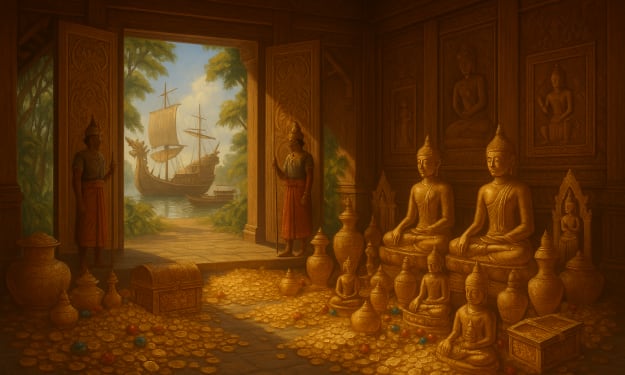
"The Golden Fortress of Srivijaya: Southeast Asia’s Forgotten Maritime Treasure" Summary: Long before the rise of modern global empires, the Srivijaya Empire ruled the waves of Southeast Asia, commanding trade routes, cultural influence, and immense wealth. Though largely forgotten today, Srivijaya once controlled the crucial maritime passages between the Indian and Pacific Oceans, amassing a treasure trove of gold, spices, and religious artifacts. This article uncovers the rise, glory, and hidden wealth of the Srivijaya Empire — a true maritime superpower lost beneath time and tide. The Rise of a Maritime Power The Srivijaya Empire emerged in the 7th century CE, centered around present-day Palembang, Sumatra in Indonesia. Unlike land-based empires, Srivijaya was a thalassocracy — a kingdom built on controlling the seas rather than territories. Its strategic location near the Strait of Malacca, one of the busiest maritime passages in the world, allowed Srivijaya to dominate global trade between China, India, and the Middle East for over six centuries. Sources of Wealth Srivijaya's treasure was built on multiple pillars: Maritime trade: Merchants from China, India, Arabia, and even Africa passed through Srivijayan ports. Goods included spices, gold, ivory, silk, porcelain, camphor, sandalwood, and textiles. Tributes: As a hub for Mahayana Buddhism, Srivijaya received religious tributes from powerful kingdoms like China and Tibet. Taxation and Tolls: All passing ships had to pay customs duties, contributing to royal coffers. One 10th-century Chinese record described the king of Srivijaya as owning ten thousand vessels and a treasury of pure gold bricks. The Royal Court and the Treasury The Srivijayan monarch, referred to as Maharaja, resided in a grand wooden palace decorated with gold-leafed ornaments, lacquerware, and foreign gifts. Archaeological evidence suggests that gold was abundant in the empire. Excavations in Sumatra have revealed: Gold jewelry weighing several kilograms Religious artifacts, including golden statues of Buddha Coinage used for trade and ceremonial offerings Gold was also used to plate royal palaces, religious shrines, and even the hulls of ships in elite fleets. Religious Treasures and Cultural Wealth Srivijaya was not just a political and commercial hub, but also a center for Buddhist learning. Monks from India and China — including the famous Yi Jing — visited and wrote about the empire’s grand monasteries and temples. These institutions were richly endowed: Temples adorned with golden stupas and relics Libraries with palm-leaf manuscripts and priceless religious texts Royal donations of jewels, incense, and spices to Buddhist communities The Srivijaya elite believed such donations earned spiritual merit and worldly prestige. Estimating the Wealth of Srivijaya Though exact records are scarce, modern historians and economists estimate the empire’s wealth by considering: Annual tribute and customs taxes from thousands of ships Gold reserves from Sumatra’s mines Trade profit margins on high-value goods like nutmeg, cloves, and camphor If valued in today’s terms, Srivijaya’s annual trade revenues could have exceeded $2 billion USD, with total stored treasure and assets reaching over $50–100 billion during its peak (8th–11th centuries CE). Naval Power and Maritime Control To protect this wealth, Srivijaya maintained a large naval fleet, including: Fast war canoes and ocean-going ships Merchant vessels with armed escorts Maritime garrisons stationed on key islands This control allowed the empire to deter piracy, enforce tolls, and maintain peace along thousands of kilometers of sea routes. Srivijaya also allied with pirate clans in the South China Sea, using them as both enforcers and intelligence agents. The Decline and the Lost Treasure In the 11th century, the Chola dynasty of South India launched devastating raids on Srivijayan ports, looting palaces and religious centers. Later, Srivijaya lost control over strategic ports to rivals like Majapahit and the Thai kingdoms. Eventually, the once-mighty empire collapsed, and its wealth disappeared into the jungles and sea. Treasure hunters, historians, and archaeologists believe that: Shipwrecks from Srivijaya’s fleet lie untouched beneath the South China Sea Buried vaults may still be hidden beneath modern Palembang Golden relics continue to be discovered — such as a golden Buddha unearthed in 2021 Legacy Today, Srivijaya’s legacy lives on in: The Malay and Indonesian languages, which carry influences from Sanskrit and Buddhism Religious monuments like Borobudur, which was funded partly through Srivijayan patronage Ongoing archaeological discoveries that continue to reveal a civilization of wealth, wisdom, and wonder Conclusion Srivijaya’s treasure wasn’t just gold and jewels — it was the wealth of ideas, trade, faith, and maritime brilliance. As modern technology uncovers more sunken ships and forgotten temples, the hidden fortune of Southeast Asia’s golden empire may still be waiting to emerge from beneath the sands and waves.
By Say the truth about a year ago in History
"The Empire Beneath the Sands: The Untold Wealth of the Persian Empire". AI-Generated.
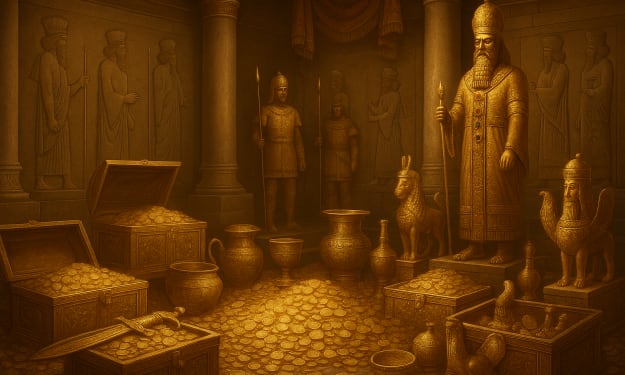
“The Empire Beneath the Sands: The Unrevealed Wealth of the Persian Empire” The Achaemenid Persian Empire, established by Cyrus the Great in the 6th century BCE, is frequently eclipsed by subsequent empires in conversations regarding ancient affluence. Nevertheless, this extensive empire, which extended from the Indus Valley to Greece and Egypt, amassed and administered one of the most significant concentrations of wealth ever witnessed. This article delves into the immense treasure reserves of the Persian monarchs, the sophisticated economic framework they devised, and an estimation of their net worth in contemporary terms. The Ascendancy of a Superpower The Achaemenid Persian Empire (circa 550–330 BCE) emerged as one of the earliest and largest global empires in human history. Under the leadership of figures such as Cyrus the Great, Darius I, and Xerxes I, it governed over 44% of the world’s population, a milestone unparalleled in historical records. Their affluence was derived from tributes, commerce, taxation, and the dominion over crucial regions abundant in gold, silver, and other valuable resources. At the zenith of the empire, the Persians had access to: Gold deposits in Armenia and Asia Minor Silver deposits in Central Asia Commerce from the Silk Road and maritime pathways Tributes from subdued territories, including Egypt, Babylon, Lydia, and India The Royal Treasuries of Persepolis and Susa One of the most intriguing aspects of the Persian Empire was its imperial treasuries, especially in Persepolis, Ecbatana, and Susa. These complexes were not merely ceremonial cities they were fortified repositories brimming with unimaginable wealth. Greek historians such as Herodotus and Ctesias documented that the Persian kings secured tens of thousands of talents (a unit of weight for gold or silver) within their palatial structures. Estimates: One talent ≈ 30 kg (66 pounds) A report during Alexander the Great's conquest indicated that the Persians had accumulated 180,000 talents of silver and gold in Persepolis alone This equates to over 5,400 metric tons of precious metals, appraised today at more than $300 billion. The Satrapy System: An Economic Engine Darius I transformed the empire's administration by instituting the satrapy system partitioning the empire into provinces, each overseen by a satrap (governor). Each satrapy was taxed according to its economic productivity. Annual tributes comprised: India: Paid in gold dust, valued at approximately 4680 talents of gold yearly Babylon: Contributed substantial quantities of grain and silver wealth Egypt: Provided gold, linen, and grain Lydia: Renowned for its gold mines and currency The empire’s yearly revenue from these tributes, converted to modern values, is estimated at $1–2 billion USD annually an extraordinary figure for the ancient world. Persian Coinage and Financial Innovation The Persians were also pioneers in finance. Darius introduced the Daric, a gold coin that became the benchmark of international commerce within the empire akin to the operational role of the U. S. dollar today. One Daric contained approximately 8. 4 grams of pure gold Minted alongside silver Sigloi for local circulation This stable currency system facilitated trade across extensive regions, from India to Macedonia. Wealth in Architecture and Art The Persians allocated their resources not solely towards grand treasuries but also towards monumental edifices. The establishment of Persepolis alone featuring its tiered platforms, ceremonial chambers, and elaborate reliefs is estimated to have incurred expenses amounting to hundreds of millions of dollars in labor and materials. The empire similarly expended considerable amounts on: Preserving imperial roadways such as the Royal Road (2,700 km in length) Sustaining extensive standing armies, including the prestigious Immortals Sponsoring artisans, stonemasons, and jewelers The Pillaging of Persia: Alexander’s Windfall When Alexander the Great invaded Persia in 330 BCE, one of his most significant rewards was not military but financial. Upon capturing Persepolis, it is reported that he seized: 180,000 talents of gold and silver Thrones and statues adorned with jewels Exotic tribute animals and scarce textiles This singular act of plunder provided Alexander with sufficient funds to: Finance his campaigns for over a decade Compensate his soldiers with bonuses Stabilize Greek economies for numerous years It was, arguably, the most substantial single appropriation of wealth in ancient history. Assessing the Net Worth Today While we cannot determine an exact figure for the wealth of the Persian Empire, cautious estimates derived from historical records and contemporary valuations indicate: Treasury Reserves: $300–500 billion (gold/silver alone) Annual Tribute Revenues: $1–2 billion in present-day terms Cultural and Artistic Wealth: Incalculable, but potentially tens of billions The total net worth of the Persian Empire at its zenith could range from $500 billion to over $1 trillion USD, considering inflation and current market conditions. Legacy of Wealth and Power The treasure of the Persian Empire encompassed more than just gold it embodied: The authority of structured governance The vigor of a diverse, multi-ethnic empire The impact of cultural patronage and acceptance Although looted and dispersed, the legacy of Persian wealth persists in archaeological discoveries, museum exhibits, and the historical framework it provided for subsequent empires.
By Say the truth about a year ago in History