Books
World War II. Content Warning.
--- Wo World War II (WWII) was the most widespread and destructive war in human history. Lasting from 1939 to 1945, it involved over 100 million people from more than 30 countries and reshaped the global order. The conflict led to the deaths of an estimated 70 to 85 million people, including civilians and soldiers. Beyond the battlefield, it also triggered massive changes in political boundaries, economies, and societies that are still felt today.
By emon Islamabout a year ago in History
Dust Between Stars
The sky did not blink. It watched. Liora stood alone on the dead plain, dust swirling weakly around her boots. There was no wind. No sound. Only the silent stretch of stars—and the impossible black sphere hovering in their midst, rimmed by faint fire. It was not a moon. It was absence. A hole punched in the fabric of space.
By UMAIR KHANabout a year ago in History
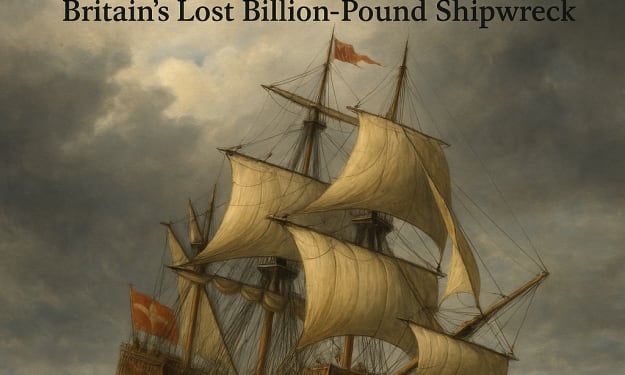
The Tragedy of the Merchant Royal: Britain’s Lost Billion-Pound Shipwreck. AI-Generated.
. A Galleon of Fortune The Merchant Royal was a substantial English galleon constructed around 1627 and owned by English traders. Under the command of Captain John Limbrey, she was a trade ship that navigated between Europe and the Spanish territories in the Americas. For years, she returned with merchandise and silver from the New World. Unlike warships or privateers, the Merchant Royal primarily operated as a peaceful trading vessel. However, what it lacked in armament, it compensated for with the immense worth of the cargo it transported. In 1641, the Merchant Royal was docked in the Spanish-controlled port of Cadiz. At the time, Spain faced financial difficulties and needed to remunerate its troops in the Netherlands. Due to political strains and a deficit of Spanish vessels, a substantial consignment of Mexican gold and silver, designated to pay the Spanish armies, was entrusted to English merchants specifically, the crew of the Merchant Royal. According to contemporary reports, the ship was laden with: 100,000 pounds of gold 400 bars of Mexican silver Over 500,000 pieces of eight (silver coins) Even in 1641, this fortune was appraised to be worth over £300,000, which would correspond to more than $1. 5 billion in today’s economy, adjusting for both inflation and the value of gold and silver. The Sinking of a Legend On September 23, 1641, the Merchant Royal commenced her voyage to England with her staggering bounty onboard. Calamity ensued just days later. Somewhere off the coast of Land’s End in Cornwall, the vessel encountered a violent storm. With her hull already deteriorated from extensive journeys and her pumps failing, the Merchant Royal began to take on water. Despite the crew’s utmost endeavors, the ship was fated. In the turmoil of the storm, the cargo comprising gold, silver, and valuable items was lost to the depths. Only 40 of the ship’s 80 crew members survived, rescued by a nearby vessel named the Dover Merchant. Captain Limbrey was among the survivors, and his account helped enshrine the loss. The precise coordinates of the wreck were never accurately documented, and in the centuries that followed, the Merchant Royal has become a contemporary Atlantis for treasure hunters. The Hunt for the Treasure The enigma of the Merchant Royal has captivated divers, historians, and treasure seekers for generations. Colloquially referred to as the “El Dorado of the Seas,” the ship has inspired numerous expeditions. Yet, despite modern sonar technology and deep-sea submersibles, the precise location of the vessel remains elusive. The most crucial moment in contemporary history occurred in 2007, when the American recovery firm Odyssey Marine Exploration declared that it had retrieved over 500,000 silver coins from a shipwreck in the Atlantic, valued at approximately $500 million. Initially, many speculated this might be the Merchant Royal. However, further investigations indicated it was actually the Nuestra Señora de las Mercedes, a Spanish galleon that sank in 1804. In that same year, British officials cautioned that anyone who discovered the Merchant Royal and neglected to report it would face legal repercussions under the legislation safeguarding historical shipwrecks. Despite all endeavors, the vessel remains missing. Some theorists propose that the wreck might be entombed beneath layers of sediment, while others contend it could have drifted into deeper waters far from its purported sinking site. The Significance of the Merchant Royal Beyond the evident appeal of its gold and silver, the narrative of the Merchant Royal encapsulates the perils and benefits of the Age of Exploration. It was an era when fortunes were created and lost at sea, when wooden ships transported the riches of empires and ventured into the unknown. The wreck also provokes inquiries regarding the ethics of treasure hunting, the ownership of cultural artifacts, and our valuation of maritime heritage. Should a salvaged treasure be repatriated to its nation of origin? Does it belong to the descendants of those who navigated the ship? Or should it remain undisturbed as a marine cemetery and time capsule? Conclusion The Merchant Royal persists as one of the most renowned and valuable shipwrecks never retrieved. Its narrative is a compelling amalgamation of ambition, misfortune, and enigma. Whether it is eventually discovered or remains eternally concealed beneath the ocean's surface it continues to captivate the imagination of those who aspire to find sunken treasures. Somewhere off the coast of England lies a billion-dollar treasure, shrouded in darkness by salt and time. And until it is located, the legend of the Merchant Royal endures.
By Say the truth about a year ago in History
"Islamic Justice: A Path to Equity and Moral Order"
Sure! Here's a story of over 700 words that illustrates justice in Islam through a historical and moral lens --- Title: Divine Balance: Understanding Justice in Islam Subtitle: A Story Rooted in Prophetic Wisdom and Islamic Ethics In the bustling city of Madinah, during the time of Prophet Muhammad (peace be upon him), the concept of justice was not just a principle—it was a lived reality. The city, once torn by tribal conflicts, was slowly transforming into a harmonious society grounded in faith, equality, and justice. One day, a troubling case was brought before the Prophet. A theft had occurred in the market, and suspicion quickly fell upon a young man named Bashir, a member of the influential Banu Makhzum tribe. The evidence was circumstantial—some goods found near his tent, and a witness who saw someone of his height and build near the scene. Despite the lack of concrete proof, the tribal elders, eager to avoid shame on their clan, insisted on clearing Bashir’s name. In their panic, they accused a poor Jewish man who worked nearby. He had no relatives in the city, no wealth, and no tribe to defend him. “He was seen near the market that night,” one elder claimed. Others quickly supported the story, shaping it to fit the needs of their community's pride. The case reached Prophet Muhammad (peace be upon him). As the leader and judge, he listened carefully. The Banu Makhzum delegation pleaded: “O Messenger of Allah, surely you would not allow a noble youth to be disgraced. The man is innocent. It must have been that foreigner.” Their voices were urgent, persuasive, even threatening in their own subtle way. But the Prophet remained quiet for a long moment. Then he spoke, not just to the parties involved, but to the entire community. “Those who came before you were destroyed because they used to let the noble go unpunished, and if a weak person committed a crime, they would punish him. By Allah, if Fatima, the daughter of Muhammad, were to steal, I would cut off her hand.” A silence fell upon the crowd. The Prophet’s words were not just bold—they were revolutionary. Justice in Islam, as he reminded them, is blind to wealth, status, or tribe. It is not subject to influence, fear, or convenience. Upon further investigation, it became clear that Bashir had indeed committed the theft. Faced with the truth, he confessed. The Prophet ordered the appropriate punishment, as laid down in Islamic law, but he also instructed that Bashir be treated with dignity and not be humiliated publicly. Justice was to be carried out with fairness and compassion, not with vengeance. Later that evening, the Prophet gathered his companions and spoke of the importance of ‘Adl (justice) in Islam. “Justice,” he said, “is the pillar of governance. It is what protects the weak, restrains the strong, and pleases Allah. Without justice, faith becomes hollow, and society crumbles.” The Qur’an echoes this principle in many verses, most notably: “Indeed, Allah commands justice and the doing of good…” (Surah An-Nahl 16:90) This verse, and many like it, form the foundation of Islamic justice. It is not merely about punishment—it’s about fairness, accountability, and moral balance. Justice in Islam extends to all aspects of life: legal, social, economic, and spiritual. The Prophet’s actions in the case of Bashir reflected this perfectly. As the city of Madinah grew under his leadership, it became a place where a poor man could stand equal to a rich one in a court of law, where women could demand their rights, and where rulers themselves were accountable. No one was above the law—not even the Prophet himself. This story passed from generation to generation, taught in schools, preached in mosques, and etched into the hearts of Muslims as a living example of true justice. In the modern world, where corruption, bias, and inequality plague many systems of law, the legacy of Islamic justice continues to inspire. It reminds us that justice is not about punishment alone, but about upholding truth, protecting the vulnerable, and serving God through fair treatment of all people. Justice in Islam is not a slogan—it is a sacred duty. --- Would you like a shorter version for a speech or presentation?
By Maryam Inked Dreams!about a year ago in History
"Tick-Tock Tales: The Boy and His Magical Watch"
Once upon a time, in the quiet village of Meadowbrook, lived a curious young boy named Arin. Arin was no ordinary child; his days were filled with endless questions, and his nights were spent dreaming of grand adventures. Yet, his world was about to change in the most unexpected way.
By Hamza Khanabout a year ago in History
Harry Potter and the Philosopher’s Stone
Harry Potter was a small boy with messy black hair and glasses. He lived with his aunt, uncle, and cousin Dudley in a house on Privet Drive. The Dursleys were not kind to Harry. They made him sleep in a cupboard under the stairs and treated him like a servant.
By Mr Rifat Ahmedabout a year ago in History