Books
🤢The Great Stink of London, Summer 1858: How the Thames River's Filth Nearly Shut Down Parliament and Sparked Sewer Reforms
The Summer That Stank to High Heaven In the sweltering summer of 1858, London became the setting for one of the foulest crises in urban history. For several weeks, an unbearable stench rose from the River Thames, the city's main waterway and open sewer, engulfing the metropolis in a nauseating miasma that no one - not even the powerful lawmakers in the Palace of Westminster - could escape. The event, which became known as "The Great Stink," was more than just a sensory nightmare; it was a pivotal moment in the evolution of public health and urban infrastructure.
By History Seekerabout a year ago in History
🧻 The Toilet Paper Panic Buying During Various Pandemics: How a Mundane Household Item Became a Symbol of Global Anxiety
Part I: A Curious Phenomenon — Panic in the Aisles In the early months of the COVID-19 pandemic, a peculiar sight became common across the globe: barren supermarket shelves where once stood neat stacks of toilet paper. This wasn’t an isolated event. From Tokyo to Toronto, from Milan to Melbourne, scenes emerged of people rushing into stores, carts overflowing with bulky packs of toilet rolls, sometimes wrestling them away from fellow shoppers in desperate attempts to “stock up.” The rush on toilet paper became one of the most vivid, surreal images of the global health crisis, replayed in countless news reports and social media posts. As viral as the virus itself, these panic-buying frenzies turned toilet paper — a soft, white, everyday necessity — into a symbol of a world unmoored by fear.
By History Seekerabout a year ago in History
Echoes in the Elderwood
The village of Blackthorn lay on the edge of the Elderwood, a sprawling forest that few dared to enter. It was not that the forest was particularly dangerous—at least, not in any way one could understand with human senses—but there was something in the air there, something that made every person who had the misfortune to wander too deep feel… unsettled.
By ibrahimkhanabout a year ago in History
Trump's Speech about Jerusalem: An Analysis on Persuasive Strategies. AI-Generated.
INTRODUCTION Jerusalem is a holy place where several beliefs and faiths live together. Islam, Christianity and Jews live and do worship in that city (BBC, 2017). Its territory surrounds Palestine and Israel. Both countries have been being a great rivalry in an old-world war since 1948 (Margolick, 2008). Donald Trump as the president of USA showed his sympathy toward both a long-world war and it was stated through his political speech. Stobbs (2012) considered that political speeches are written with a very great plan and purpose. As the president of USA, Trump is the most influential person in the world. His word will always provoke great responses from all people over the world. He showed his remark on his speech about Jerusalem on 23rd May 2017. Through his speech, he expected the three religions in Jerusalem, such as Jews, Islam and Christianity can build peace together. On 6th December 2017, Trump declared Jerusalem as the capital city of Israel. It provoked pros and cons from several leaders of nations over the world. He stated that his claim was to stop the war between Israel and Palestine, and to achieve peace. Through his speech, Trump intended to show his power and communicate what he wanted to. Speech is one the ways of having communication (Soedjarwo, 2020). In having communication, the speaker influences hearer to believe in what he says or doing something that he wants to. Alfian, Santi, and Sari (2019) stated that a good communication depends on how speaker can achieve the goal of what he says. Speaker absolutely persuades hearers to achieve the goals of communication. In Persuading hearers, speaker can uses persuasive strategies. Speaker uses persuasive strategies to influence other people through utterance without doing compulsion. Gass and Seiter (2010) stated that persuasion is an attempt to influence hearers motives and attitudes.
By Silas Blackwoodabout a year ago in History
NASA Confirms Evidence of Alien Life? Latest Findings from Europa Mission
Introduction: The Europa Enigma For decades, Jupiter’s icy moon Europa has captivated scientists as one of the solar system’s most promising candidates for extraterrestrial life. In 2025, NASA’s Europa Clipper mission delivered its most compelling data yet—potential biosignatures beneath the moon’s frozen crust. While NASA has stopped short of declaring definitive proof of life, the evidence has ignited a scientific and philosophical firestorm. This article examines: The shocking findings from Europa’s subsurface ocean How NASA’s instruments detected potential alien biosignatures The scientific debate over what constitutes "proof" of life The ethical and societal implications of confirming extraterrestrial organisms What comes next in humanity’s search for life beyond Earth
By Silas Blackwoodabout a year ago in History
A Historical Account of Difference: A Comparative History of the Literary Cultures of Lat- in America
Abstract: In his article "A Historical Account of Difference: A Comparative History of the Literary Cultures of Latin America," Mario J. Valdés addresses the well-recognized limitations of literary history as historical research. Valdés outlines the theoretical thinking that has guided the editors of The Oxford Comparative History of Latin American Literary Cultures to plan, organize, and com- plete the first history of literary culture of Latin America. The project is comparative, recognizing the radical diversity of the continent while at the same time it is an open-ended history that in- forms but does not attempt to provide a totalizing account of more than five hundred years of cul- tural development among the heterogeneous entities that make up Latin America. Valdés begins by considering the paradox of literary history, he then suggests ways that literary history can be shaped by the work of Michel Foucault, and he proposes a framework for a hermeneutics of literary history. Valdés also considers the challenges that face the literary historian whose work now in- cludes cultural history. All of these considerations are then placed within the context of an effort to create a literary and cultural history of Latin America.
By Silas Blackwoodabout a year ago in History
The history of Islam
The history of Islam is believed, by most historians, to have originated with Muhammad,mission in Mecea and Medina at the start of the 7th century CE,although Muslims regard this time as a return to the original faith passed down by the Abrahamic prophets such as Adam Noah, Abarham , Moses, David, Solomon,and Jesus with the submission (Islam) to the will of God.
By Mahmud Forhad about a year ago in History
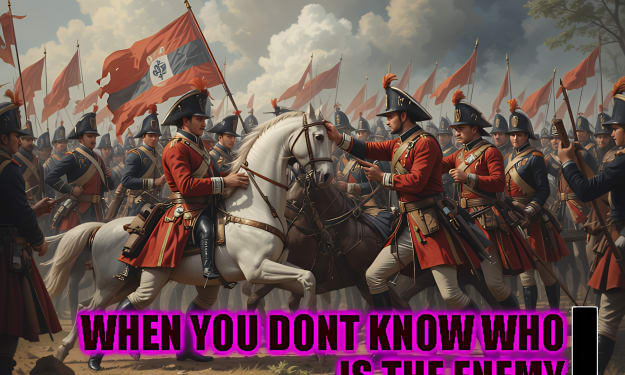
The Battle of Karansebes, 1788: The Austrian Army Accidentally Fighting Itself in the Chaos of War
Among the most bewildering and farcical episodes in military history, the Battle of Karansebes stands out as a stunning example of miscommunication, panic, and human error spiraling out of control. Fought during the Austro-Turkish War of 1787–1791, the event is infamous not for a valiant clash with the Ottoman enemy, but for a chaotic episode where an Austrian army ended up attacking itself. Taking place on the night of September 17–18, 1788, in what is now modern-day Romania, the so-called battle involved confusion, fear, and an abundance of alcohol - ultimately leading to hundreds of Austrian soldiers dead or wounded by friendly fire, long before the Ottomans even arrived.
By History Seekerabout a year ago in History
Ashes of Pompeii: The Day the Sky Fell
**Ashes of Pompeii: The Day the Sky Fell** **Pompeii, Roman Empire – August 24, 79 AD** The morning sun was already warm as Lucia, the 16-year-old daughter of a wealthy merchant, stepped onto the balcony of her family’s villa in Pompeii. The sky above was a serene blue, and in the distance, the great mountain—Vesuvius—stood quietly, cloaked in a light mist. Lucia could hear the clatter of hooves and the distant calls of market sellers echoing through the city.
By Asia khanomabout a year ago in History
NASA’s Mars Streak Mystery Might Finally Be Solved
**NASA’s Mars Streak Mystery Might Finally Be Solved – And It’s Not Great News** For over a decade, NASA scientists and space enthusiasts alike have been captivated by strange, dark streaks that periodically appear on the slopes of Mars. These features, known as *recurring slope lineae* (RSL), have been one of the most mysterious and hotly debated phenomena observed on the Red Planet. Discovered by NASA’s Mars Reconnaissance Orbiter (MRO) in 2011, the streaks appeared to behave much like flowing liquid—lengthening during warmer seasons and fading in colder months.
By Harun Or Roshidabout a year ago in History