Books
Guns, Germs, and Steel” by Jared Diamond
A story of collision, conquest, and consequences — 1. The Meeting of Two Worlds The year was 1519. On the sun-drenched coast of what the locals called Tenochtitlan, the wind carried a scent unfamiliar to native nostrils — salt, sweat, and something metallic. Canoes dotted the waters as Aztec fishermen returned with their catch, unaware that just beyond the horizon, history was changing course.
By Rafiul Jawadabout a year ago in History
Lost Voices of the Edwardians
Being obsessed with all things “Edwardian”, I couldn’t start reading this book fast enough. To read the actual ‘voices’ of children and adults who lived in the Edwardian Era just caught my attention. It was a real eye opener because these people lived in such different times, and although the Edwardian Era was the past moving into the modern, the lives and lifestyles of these ones was still a world away from the way we live today in 2025.
By Ruth Elizabeth Stiffabout a year ago in History
10 Unusual Verifiable Occasions That Sound Too Weird to possibly be Valid
Start writing...History is brimming with abnormal and staggering stories that sound more like fiction than reality. From fights battled with hallucinations to lords who delegated their canines, these stories demonstrate that reality is frequently bizarre to say the least. The following are ten of the most peculiar verifiable occasions that really occurred. 1. The Moving Disease of 1518 In the late spring of 1518, the city of Strasbourg (current France) was struck by an odd and frightening peculiarity: individuals began moving wildly. Everything started with a lady named Frau Troffea, who ventured into the road and began moving for quite a long time ceaselessly. Before long, handfuls, then, at that point, hundreds, of individuals participated. Many imploded from fatigue, while others apparently moved themselves to death. Specialists, accepting the fix was to allow them to move it out, even recruited performers to play music — just compounding the situation. History specialists actually banter what caused the Moving Disease. Some accept it was widespread panic, while others suspect ergot harming — a psychedelic shape tracked down in rye. Anything the reason, it stays one of history's most abnormal and deadliest dance parties. 2. The Incomparable Emu Battle of 1932 In 1932, Australia battled a conflict — not against people, but rather against emus. These huge, flightless birds were causing devastation for ranchers in Western Australia, obliterating harvests and demolishing land. The public authority chose to send in the military, equipped with automatic weapons, to eliminate them. The emus, be that as it may, ended up being magnificent strategists. They moved in eccentric examples, avoiding disasters and dominating the fighters. Indeed, even in the wake of terminating great many rounds, the military simply figured out how to kill a little part of the birds. The public authority in the end gave up, and the emus guaranteed triumph. Right up 'til now, the Incomparable Emu War stays quite possibly of the most odd military loss ever. 3. The Year Without a Late spring (1816) In 1816, the world encountered an unusual climate peculiarity known as "The Year Without a Late spring." Snow fell in June, waterways froze in July, and harvests flopped across Europe and North America. The offender? A volcanic emission on the opposite side of the world. In 1815, Mount Tambora in Indonesia detonated in quite possibly of the most impressive ejection ever, delivering huge measures of debris into the air. This made worldwide temperatures decrease, prompting starvations, food mobs, and one of the coldest summers at any point recorded. This peculiar environment shift even had abstract results — Mary Shelley, adhered inside because of the cold, composed Frankenstein during this bleak year. 4. The Fight That Was a Delusion (1788) Wars are battled with armed forces, yet one fight in 1788 was battled with a delusion. In Sweden, an unusual optical deception prompted a fight that never really occurred. During the Russo-Swedish Conflict, Swedish warriors positioned in Gävle revealed seeing a large number of Russian soldiers walking toward them. Overreacted, they terminated their cannons and ready for the fight to come. In any case, the foe never showed up — on the grounds that they weren't genuine. What the troopers had seen was a predominant hallucination, an interesting air peculiarity that refracts light and causes far off objects to show up a lot nearer. The "attacking armed force" was really a contorted picture of Russian soldiers positioned miles away. This stays quite possibly of the most unusual "fights" in history — one where nobody was really there. 5. The Town That Vanished For the time being (1930) The minuscule Canadian town of Angikuni Lake was home to an Inuit settlement — until, one day in 1930, it wasn't. A fur catcher going through the area was stunned to find the whole town deserted. Food was all the while cooking over flames, sled canines were viewed as stuck to death, and possessions were abandoned. However, each and every occupant — many individuals — had evaporated suddenly. Considerably seriously cooling, a pursuit party later found that close by graves had been bafflingly purged. Hypotheses range from outsider kidnappings to mass relocation, yet no great reason has at any point been found. Right up 'til now, the Angikuni Lake secret remaining parts perhaps of the most confusing vanishing ever. 6. The One Who Endure Both Nuclear Bombs (1945) Being in Hiroshima during the nuclear bombarding of August 6, 1945, was adequately appalling. Be that as it may, for Tsutomu Yamaguchi, it was just the start of his bad dream. Yamaguchi, a Japanese specialist, was in Hiroshima on business when the bomb detonated. Wonderfully, he made due with consumes and wounds. Needing to get back, he left for Nagasaki — just to encounter the second nuclear bomb on August 9. Notwithstanding experiencing radiation harming, Yamaguchi endure the two impacts and lived to be 93 years of age. He stays one of a handful of the formally acknowledged overcomers of the two bombings — a demonstration of human flexibility despite inconceivable obliteration. 7. The Pope Who Put a Cadaver Being investigated (897 Promotion) The Catholic Church has had its reasonable part of odd occasions, however none as strange as the Dead body Assembly of 897 Promotion. Pope Stephen VI had his ancestor, Pope Formosus, uncovered from his grave, wearing ecclesiastical robes, and put being investigated. The cadaver, incapable to safeguard itself, was seen as at legitimate fault for "prevarication" and "disregarding church regulation." As discipline, the dead pope's fingers were cut off, and his body was tossed into the Tiber Waterway. This abnormal display stunned individuals of Rome, prompting riots. The kickback was extreme to such an extent that Pope Stephen VI was in the long run ousted and choked in jail. It stays perhaps of the most peculiar and horrifying preliminary ever. 8. The Island That Evaporated from Guides (1876) Bermeja, a puzzling island in the Bay of Mexico, showed up on maps for a really long time — until it vanished in the nineteenth 100 years. Voyagers searching for Bermeja during the 1800s tracked down only untamed ocean. The island had disappeared suddenly. An accept it sank because of rising ocean levels, while others suspect a cartographic mix-up. Be that as it may, a more vile hypothesis recommends the island was intentionally obliterated to delete regional cases over significant oil saves. Right up to the present day, nobody knows whether Bermeja at any point existed — or on the other hand assuming that it was deleted from history deliberately. 9. The One Who "Possessed" the Moon (1980) In 1980, an American man named Dennis Trust tracked down a lawful proviso and guaranteed responsibility for Moon. Trust found that the 1967 Space Deal kept countries from guaranteeing heavenly bodies — however it didn't express anything about people. Thus, he documented a statement of possession with the U.S. government and begun selling lunar land. Until this point in time, he professes to have sold north of 600 million sections of land of Moon land, including to VIPs like Tom Voyage and previous U.S. presidents. While most legitimate specialists excuse his case, Trust keeps on running his "Lunar Consulate," making him one of the best (and uncommon) land big shots ever. 10. The Lord Who Delegated His Canine (ninth 100 years) In the ninth 100 years, Lord Athelwulf of Wessex accomplished something no ruler had at any point finished — he delegated his canine. As per legend, Athelwulf cherished his hunting canine such a lot of that he made it a respectable and gave it an authority crown. The canine was dealt with like eminence, going to dinners and getting gifts. While some accept this was implied as a joke, others think it was a political assertion — an approach to showing that honorable titles were good for nothing. Anything the explanation, Athelwulf's canine became quite possibly of the most strange ruler ever. End History is loaded up with unusual and mind blowing occasions that challenge how we might interpret the past. Whether it's militaries crushed by birds, vanishing towns, or popes putting carcasses being investigated, these accounts advise us that reality is frequently bizarre indeed.
By Rahmat Ullah Khanabout a year ago in History
The Downfall of the Ottoman Empire: Causes and Consequences
The Ottoman Empire, once a vast and powerful dynasty spanning Europe, Asia, and Africa, existed for more than six centuries. At its height during the 16th and 17th centuries, it was one of the most formidable empires in history. However, by the early 20th century, it had disintegrated into political, economic, and military chaos, eventually collapsing after World War I. The fall of the Ottoman Empire was a gradual process, marked by both internal decay and external pressures. This article explores the key causes and consequences of the empire’s decline.
By Engr. Mansoor Ahmadabout a year ago in History
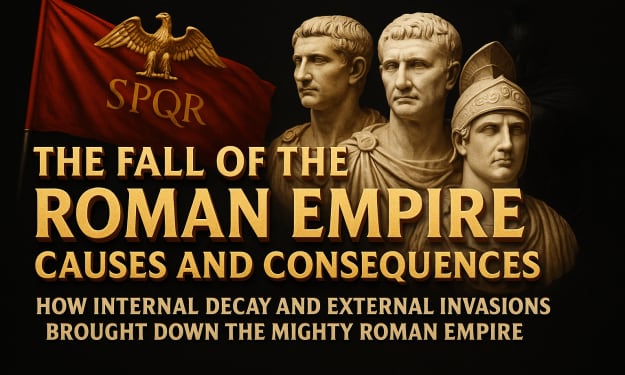
The Fall of the Roman Empire: Causes and Consequences
The Roman Empire, once the most powerful civilization in the ancient world, ultimately fell after centuries of domination across Europe, North Africa, and the Middle East. Its collapse is one of history's most significant turning points, signaling the end of classical antiquity and the beginning of the Middle Ages in Europe. Understanding the fall of the Roman Empire involves a complex combination of internal weaknesses and external pressures that eroded Rome’s ability to sustain itself. This article explores the key causes behind the downfall of the Roman Empire and the enduring consequences of its demise.
By Engr. Mansoor Ahmadabout a year ago in History
France’s Darkest Verdict Unpacked
Was He France’s Savior or Its Betrayer? A Look at Julian Jackson’s France on Trial The Case of Marshal Petain dives deep into one of the most painful and complicated chapters in modern French history the trial of Marshal Philippe Pétain for treason after World War II. It’s a book that doesn’t offer easy answers, but it certainly forces readers to wrestle with the right questions.
By Lynn Myersabout a year ago in History
🌪️ “When the Rope-Pulled Fan Stopped — and the Winds of Slavery Ceased” 🌪️
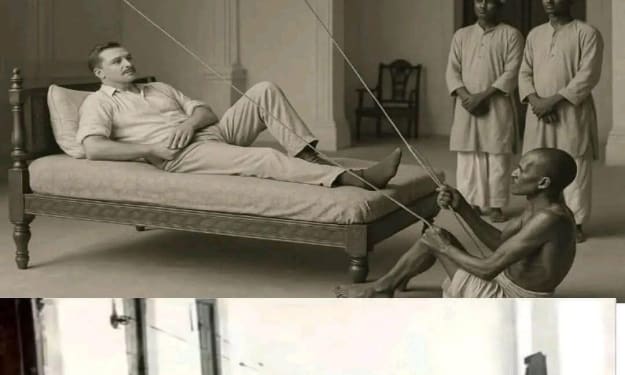
🕰️ When the British Came, the Winds of Slavery Began to Blow When the British first set foot on the rich soil of the Indian subcontinent, they didn't just seize its land, gold, and governance. They took control of the very air that flowed in the royal courts and noble mansions of Delhi, Lucknow, Lahore, and Bombay. This is not a metaphor. It is a historical reality that strikes both the mind and the heart. As British officers would kick off their shoes and settle into cushioned seats in their sprawling colonial mansions, enormous fabric fans—punkhas—would begin to sway above them, offering a cool breeze in the tropical heat. But what made these fans move was not electricity. It was human labor—the silent, invisible breath of servitude. Below the fan, lying flat on the hot floor, would be a voiceless and earless servant—a human fan operator, mute and deaf, chosen specifically for his inability to hear or speak. Why? Because the British had a chilling motto: > “We want air… not ears.” They didn’t want distractions. They didn’t want conversation. They wanted obedient bodies, not minds. These “punkha-wallahs” would pull on long ropes connected to the fans above, hour after hour, drenched in sweat, while their colonial masters enjoyed wine, music, and conversation. This wasn’t just physical slavery—it was emotional and intellectual bondage, reducing humans to mere machines before machines even existed. --- ⚙️ Technology: The Great Equalizer of Time Then came the miracle of innovation—light bulbs, motors, switches. With the wave of technological advancement, the power that once lay in the hands of cruel masters was transferred to circuits, wires, and buttons. That same punkha, once moved by a slave’s bleeding hand, was now spinning joyfully from the ceiling on the command of electricity. It seemed to laugh, whispering: > "Now, I give air… without chains, without commands!" The day electricity came, the ropes of slavery snapped. The British left. But the fans remained. And with them, a haunting reminder of the days when even air was a luxury that came at the cost of someone's dignity. --- 🎭 Interpretation: Not All Chains Are Made of Iron Slavery is not always about iron shackles or prison walls. Sometimes, a rope tied to a ceiling fan can be more symbolic than a dungeon. Think deeply: a fan swaying on the ceiling, a servant lying on the ground, pulling a rope with his feet while trying not to breathe too loud. That’s not just a system of ventilation. That’s a system of domination. And still today, in the age of artificial intelligence and remote-controlled appliances, we must ask ourselves: Are we truly free? Or are we just tied to invisible cords of modern servitude? --- 👣 A Scene Soaked in Sweat and Silence Picture it vividly: A white British man sits under a high ceiling, holding a glass of imported wine. A velvet carpet cushions his polished shoes. A female dancer sways rhythmically before him. Overhead, a large punkha swings side to side. Beneath the shadows, a servant lies on the cold floor, his body soaked in sweat, his muscles aching, his identity erased — all so that the colonizer may not feel a moment’s discomfort. This is the civilization the West called “progress.” This is the culture that some in our lands still admire and emulate — without understanding the price of the breeze that once flowed. --- 💡 The Slap of Technology Today, when we press a button and feel a cool draft, we think nothing of it. But we should. Because every whisper of air from a fan today is a reminder of freedom hard-won. When we turn on an air conditioner or control a fan with a remote, we must pause. This isn’t just comfort. This is liberation. Technology, in this case, didn’t just make life easier. It restored dignity, replacing ropes with remotes and silence with agency. --- 📝 Conclusion: A Change in System, Not Just Speed The fan is the same. The ceiling is the same. The heat, too, is unchanged. What has changed… is the system. Where once mute servants pulled at ropes like forgotten souls, now silent machines serve us, without pride, without pain. The air still flows, but no one lies on the floor to make it happen. And that, perhaps, is the greatest revolution of all — not just in technology, but in human value. So next time you enjoy the comfort of a fan, think not only of its cooling breeze — but of the generations who suffered to give you that simple joy without chains. --- > From bondage to buttons, from ropes to remotes — the journey of the fan is the story of humanity’s struggle for dignity. Never forget: even the air we breathe was once a privilege denied to the voiceless.
By Ikram Ullahabout a year ago in History
Letters from the Empire
Prologue: The Ottoman Empire—spanning over six centuries, three continents, and countless souls—was not merely built on conquest or sultans’ decrees. It lived in the hands that planted its gardens, sailed its ships, marched in its armies, and whispered secrets in its palaces. These are the letters they left behind.
By Salah Uddinabout a year ago in History
When the British Ruled Pakistan. A Story of Power, Places, and Parting.
Where the British Lived The British officials, soldiers, and their families lived in carefully chosen areas across present-day Pakistan. They picked places with cooler climates, strategic importance, and scenic beauty. Their settlements were built in the style of English countryside towns, with bungalows, clubs, churches, gardens, and markets.
By Active USA about a year ago in History
A Tail Of Two Friends
In the heart of the Amazon, where emerald canopies kissed the sky and the air thrummed with the symphony of the wild, lived a lion named Leo. Unlike the other lions of his pride, who reveled in the thrill of the hunt and the roar of dominance, Leo possessed a gentler spirit. His gaze was drawn to the kaleidoscope of life that surrounded him, the myriad creatures each with their own unique stories.
By Zakriashahabout a year ago in History