Books
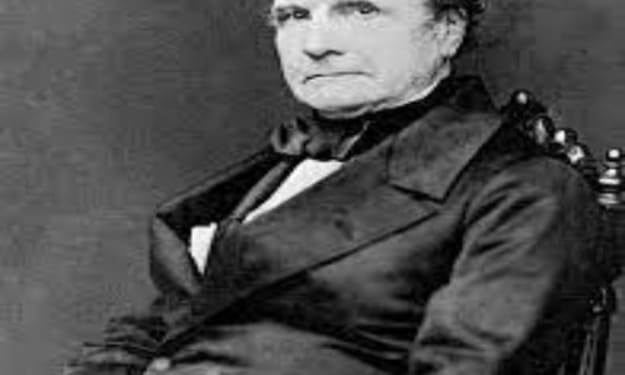
Charles Babbage's Odyssey to the Analytical Engine
A determined thinker labored against the limitations of his time in the dimly lighted chambers of early 19th-century London, where the air was thick with the aroma of ink and candles cast long shadows upon heaps of mathematical manuscripts. At the beginning of his journey, Charles Babbage—a name hardly known in history—set out on an adventure that would completely transform the field of computation.
By Tracy Kotze3 years ago in History
Echoes of the underworld: A journey into the hades kingdom
In the shadowy realms of myth and legend, where the boundaries between the living and the dead blur into a tapestry of mystery, there existed a realm known as the Hades Kingdom. Echoes of the underworld resonated through the air, drawing curious souls into an enigmatic journey that transcended mortal comprehension.
By Peculiar Beauty3 years ago in History
The raise of America
The modern United States stands as the most powerful country in human history, boasting over 800 military bases and accounting for 37% of global military spending. This dominance has positioned the United States as the leader of a vast interconnected global system, contributing to an era of unprecedented prosperity and relatively low levels of conflict.
By NICHOLAS MURIUNGI3 years ago in History
History of maths
The history of mathematics is a rich tapestry that spans across cultures and centuries, influencing various aspects of human development. Here's a concise overview: 1. **Ancient Mesopotamia (3000 BCE - 600 BCE):** The earliest roots of mathematics can be traced to Mesopotamia, where the Babylonians developed a system of counting and early forms of geometry for practical purposes like land surveying. 2. **Ancient Egypt (3000 BCE - 600 BCE):** Ancient Egyptians used mathematics for practical applications such as architecture and agriculture. They had a well-developed understanding of geometry, crucial for construction projects like the pyramids. 3. **Ancient Greece (600 BCE - 300 BCE):** Greek mathematicians, including Pythagoras, Euclid, and Archimedes, made significant contributions. Pythagoras' theorem, Euclidean geometry, and the method of exhaustion developed by Archimedes are enduring components of mathematical knowledge. 4. **Ancient India (600 BCE - 600 CE):** Indian mathematicians made strides in number theory, trigonometry, and algebra. Aryabhata, Brahmagupta, and Bhaskara II were notable contributors. 5. **Islamic Golden Age (8th - 14th centuries):** During this period, Islamic scholars preserved and expanded upon ancient Greek and Indian mathematical knowledge. Al-Khwarizmi's work laid the foundation for algebra, and advancements were made in trigonometry and geometry. 6. **Renaissance and the Scientific Revolution (14th - 17th centuries):** European mathematicians like Leonardo Fibonacci, Nicolaus Copernicus, and Johannes Kepler contributed to the development of mathematical ideas, laying the groundwork for the scientific method. 7. **17th to 19th Centuries:** The era saw the rise of calculus, pioneered independently by Isaac Newton and Gottfried Wilhelm Leibniz. Euler's contributions to graph theory and number theory were noteworthy. Meanwhile, the development of probability theory took place. 8. **19th to Early 20th Centuries:** The foundations of modern mathematics were established with the formalization of set theory by Georg Cantor. Non-Euclidean geometries emerged, challenging traditional views. David Hilbert proposed a list of unsolved mathematical problems, guiding research for decades. 9. **20th Century:** The century witnessed profound developments in various branches, including abstract algebra, topology, and mathematical logic. Computers played an increasingly vital role in mathematical research. The Four Color Theorem was proven, and Andrew Wiles solved Fermat's Last Theorem in 1994. 10. **Contemporary Era:** Mathematics continues to evolve with contributions to fields like cryptography, chaos theory, and mathematical biology. The exploration of new mathematical structures and the interplay with other disciplines remains a vibrant area of research. The history of mathematics reflects a continual quest for understanding patterns, structures, and relationships, shaping the way we comprehend the world around us.
By J.Balakrishnan3 years ago in History
Amazonian Origins: A Geological Journey"
Known as the "Lungs of the Earth," the Amazon Rainforest has a rich and intricate history spanning millions of years. With a total area of over 6.7 million square kilometers spread over nine South American countries, it is the largest tropical rainforest. This is a brief synopsis of its past: 1. Geological Origins: The rainforest began to emerge some 10 million years ago, as the Amazon basin was developed throughout geological time. The emergence of many ecosystems was facilitated by the shifting terrain and climate. 2. Indigenous Peoples: For thousands of years, a variety of indigenous tribes have called the Amazon home. Certain communities, such as the Yanomami and Kayapo, are deeply entwined with the forest, depending on its resources for both traditional practices and daily needs. 3. European Exploration: In the 16th century, Francisco de Orellana was one of the European explorers who successfully traversed the Amazon River, bringing the area to the attention of the outside world. However, large-scale colonization took some time because of the difficult environment. 4. Rubber Boom: The Amazon saw commercial interest during the late 19th and early 20th centuries due to the rubber boom. As rubber extraction from rubber trees became profitable, human activity and deforestation grew. 5. Environmental Awareness: In the second part of the 20th century, people all around the world became more conscious of how crucial rainforests are to maintaining biodiversity and controlling climate change. The necessity of shielding the Amazon from unsustainable development was emphasized by environmentalists. 6. Deforestation Challenges: Despite conservation efforts, deforestation brought on by logging, agriculture, and infrastructure projects continues to pose a threat to the Amazon. Concerns have been expressed on how this may affect biodiversity, indigenous people, and patterns of global climate. 7. Conservation Efforts: To combat deforestation, governments and international organizations have launched conservation programs. The goal of sustainable development initiatives and protected areas is to strike a balance between meeting human needs and maintaining the biological integrity of the rainforest. 8. Current Issues: Discussions on how to strike a balance between environmental preservation and economic development persisted as of January 2022, when I last updated my understanding. Policies and actions affecting the Amazon are influenced by social, political, and economic forces. 9. Global Significance: By absorbing and storing enormous amounts of carbon dioxide, the Amazon Rainforest is essential in controlling the Earth's climate. Its unparalleled biodiversity is home to innumerable species, many of which have not yet been identified. 10. Future Challenges: Sustainable management of the Amazon is crucial as the world deals with climate change. It is still difficult to strike a balance between the demands of local populations, the protection of biodiversity, and global environmental issues. In conclusion, the evolution of the Amazon Rainforest is a reflection of the complex interactions between biological, cultural, geological, and economic factors. Its future rests on cooperative efforts to resolve the intricate problems of the twenty-first century. Indeed, the Amazon Rainforest has changed over millions of years due to climatic and geological shifts. The remarkable biodiversity of the area is a result of the adaptations made by the region's flora and animals over time. For thousands of years, the region has been home to indigenous people who have depended on its resources for both cultural rituals and sustenance. Threats to the Amazon's long history are relatively new, and include issues like deforestation and environmental deterioration. The main issues facing the Amazon Rainforest today are related to deforestation, which is fueled by logging, infrastructure development, and increased agricultural production. This damages ecosystems, endangers biodiversity, and fuels climate change. With an emphasis on maintaining the Amazon's biological balance and aiding the indigenous tribes that rely on it, conservation initiatives and sustainable practices seek to address these issues. Indeed, one of the biggest threats facing the Amazon Rainforest today is deforestation. It is fueled by operations like logging, farming, and building infrastructure, which results in a loss of habitat, a decrease in biodiversity, and a contribution to climate change. The critical Amazonian ecology is being protected through international cooperation, conservation programs, and sustainable land-use practices.
By Mohammad fayaz3 years ago in History