Books
Camille Monfort: The Enigmatic Beauty Who Rewrote the Rules of Her Era
The story of Camille Monfort is one of allure, fascination, and intrigue. Known for her mesmerizing beauty, enchanting voice, and independent spirit, Camille left behind a legacy far more captivating than her short 27 years of life. Born in 1869 in France, she became a figure of mystique, celebrated and envied in equal measure. From her affluent upbringing to her scandalous affairs, Camille Monfort epitomized a life led on her terms—a rarity for women of her time.
By faisal khatri2 years ago in History
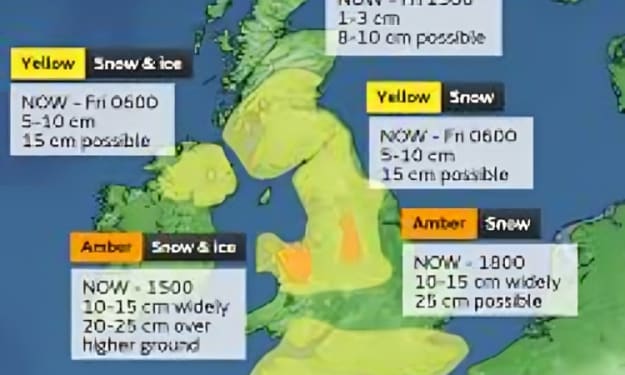
What Is the Met Office Snow Forecasts
Weather forecasts are an essential part of daily life, helping people plan their activities and stay safe. Among the many weather conditions forecasted, snow is particularly important because it can significantly impact travel, safety, and daily routines. The Met Office, the United Kingdom's national weather service, provides reliable and accurate forecasts for snow and other weather conditions. This article explains how the Met Office predicts snow, the tools and methods they use, and how their forecasts help people prepare for winter weather.
By Farhan Sayed2 years ago in History
The Secret of the Midnight Tournament: ANighttime Ques. Content Warning. AI-Generated.
As dusk gathers, an undeniable charm invites us to the land of the untrodden. My maiden journey into a mystery novel was nothing short of incredible, transporting me to an arena where valor is evaluated under the veil of the night. It was such a stormy evening shrouded in a duvet of solitude when, with every page turned, my pulse accelerated. The mystique of "The Secret of the Midnight Tournament" lies in its suspense, the anticipation of unraveling secrets, and the intrigue of hidden narratives. It is a tale of a nocturnal odyssey that invites you to step through a doorway into another world with every twist, where new facets of this mysterious story unfold, leaving you at the precipice of suspense
By vinay kumar verma2 years ago in History
Weather in the USA
The United States of America has one of the most diverse climates in the world. This diversity is due to the country's large size and varying landscapes, which include mountains, plains, deserts, and coastlines. The weather in the USA can change dramatically from one region to another, depending on the season and geographical location. Understanding the weather in different parts of the country is important for planning travel, work, and daily activities.
By Farhan Sayed2 years ago in History
south korean plane crash
On December 29, 2024, a tragic plane crash occurred in South Korea involving Jeju Air Flight 2216. The incident took place at Muan International Airport and has been described as one of the deadliest aviation disasters in South Korean history. This article will explain the details of the crash, its aftermath, and what we know so far in simple and clear terms.
By Farhan Sayed2 years ago in History
Jeanne Córdova: A Legacy of Courage and Activism
Jeanne Córdova was a trailblazing figure whose activism reshaped the landscape for LGBTQ+ rights and feminism. She inspires generations because of her unwavering determination and fearless pursuit of equality. Through her life's work, Jeanne Córdova advocated for change and became an icon for revolutionaries seeking to make a difference.
By faisal khatri2 years ago in History
Germany Through the Ages: The Rise and Fall of Empires
A Journey Through Time: Exploring the Rich History of Germany Germany has a fascinating history filled with remarkable events and transformative movements. From its early roots to its role in global events, Germany has significantly influenced the world. This article will guide you through the key periods and themes of German history, highlighting the major events that shaped the nation. From the Holy Roman Empire to the Rise of Prussia: Early German History The Holy Roman Empire: A Fragmented Realm The Holy Roman Empire was a complex political entity that existed from 800 to 1806. It included many German-speaking states, creating a diverse and fragmented landscape. At its height, the Empire covered over 1 million square kilometers, home to approximately 25 million people. Charlemagne, crowned Emperor in 800, played a vital role in early German history. His reign laid the groundwork for future nation-building and established a sense of unity among German territories. The Rise of Powerful Principalities: Competition and Conflict Throughout the Empire, various principalities emerged, leading to rivalries and conflicts. Key players included the Duchy of Bavaria and the Margraviate of Brandenburg. These power struggles defined political dynamics in Germany. Historical accounts describe frequent clashes over territory and influence, leading to notable conflicts like the War of the Bavarian Succession (1778-1779). The Reformation and Its Impact: Religious and Political Upheaval The Reformation, sparked by Martin Luther in 1517, transformed Germany's religious landscape. It challenged the Catholic Church's dominance, leading to the establishment of Protestantism. One significant outcome was the Thirty Years' War (1618-1648), a devastating conflict fueled by religious tensions. This war caused extensive destruction, with casualties estimated at 8 million people, reshaping Germany both spiritually and politically. The Unification of Germany: Bismarck and the 19th Century Otto von Bismarck: The Architect of Unification Otto von Bismarck is known as the key figure behind German unification in the 19th century. His shrewd political strategies and realpolitik effectively united various states under Prussian leadership. Bismarck's emphasis on militarism played a crucial part. He famously stated, “The great questions of the day will not be decided by speeches and majority votes, but by blood and iron.” Wars and Alliances: Paving the Way for a Unified Nation Several key wars facilitated German unification. The Austro-Prussian War in 1866, for instance, led to the exclusion of Austria from German affairs. Germany's population grew rapidly during this time, rising from around 24 million in 1860 to over 41 million by 1910. This growth demonstrated the need for a cohesive national identity. The German Empire: A New Power on the World Stage The establishment of the German Empire in 1871 marked a significant moment. Germany emerged as a global player, boasting an industrial economy and advanced technological innovations. In the years following unification, the German Empire experienced rapid industrial growth, becoming a leader in sectors like steel and chemicals. World War I and the Weimar Republic: A Tumultuous Era Germany in WWI: Causes, Consequences, and Aftermath Germany's involvement in World War I had profound effects. The nation faced severe military challenges and social unrest. Casualties were staggering, with around 2 million German soldiers losing their lives. Historian Eric Hobsbawm noted that "the war transformed Germany into a state of chaos." The Treaty of Versailles and Its Impact The Treaty of Versailles in 1919 imposed harsh penalties on Germany. The nation lost territory, faced disarmament, and owed massive reparations. This created deep resentment among the German population. The economic impact was devastating, leading to hyperinflation and widespread hardship. The burden of reparations shattered public confidence in the government. The Weimar Republic: Instability and the Rise of Extremism The Weimar Republic faced political and economic challenges from the start. Hyperinflation and unemployment led to frustration, paving the way for extremist ideologies. The rise of Nazism can be traced back to this instability. Historian Ian Kershaw commented on the volatile atmosphere, stating, "Conditions were ripe for radical political movements to gain traction." The Nazi Era and World War II: A Dark Chapter in History The Rise of the Nazi Party: Propaganda and Political Maneuvering The Nazi Party rose to prominence through intense propaganda and skilled political maneuvering. Hitler's use of media transformed public perception and rallied support. At its peak, Nazi Party membership exceeded 8 million. Their campaign capitalized on economic turmoil and national pride, evoking a sense of unity against perceived enemies. World War II: Global Conflict and the Holocaust Germany's role in World War II was marked by aggressive expansion and the horrific genocide of the Holocaust. The nation invaded many countries, resulting in immense civilian suffering. Civilian casualties exceeded 6 million during the war. A historian remarked that the Holocaust represented "the darkest chapter of human history." The Aftermath of WWII: Rebuilding and Division World War II left Germany in ruins. After the war, the country was divided into East and West Germany, marking a period of significant political and social change. The Berlin Wall, erected in 1961, symbolized this division. In the years following, West Germany saw robust economic growth, while East Germany struggled to keep pace. Post-War Germany: Rebuilding and Reunification The Cold War and the Divided Germany During the Cold War, East and West Germany experienced stark contrasts in governance and living conditions. While West Germany embraced democracy and capitalism, East Germany implemented a communist regime. The Berlin Airlift (1948-1949) underscored the tensions, as Western allies supplied West Berlin during a blockade. In 1989, the population differences between the two nations became evident, with East Germans seeking freedom and opportunity. The Fall of the Berlin Wall and German Reunification The Berlin Wall fell in 1989, marking the end of an era. This event sparked momentum for reunification. The reunification process faced challenges, such as economic disparities and cultural differences. However, it also celebrated a shared history and collective identity. Modern Germany: A European Powerhouse Today, Germany stands as a leading force in the European Union. The nation plays a vital role in shaping policies and fostering economic cooperation. Germany's economy ranks among the top in Europe, demonstrating its recovery and resilience. For those interested in deepening their understanding of German history, numerous resources, including books and documentaries, are available. Conclusion Germany's history is rich and complex, marked by significant periods of transformation and conflict. Exploration of these events reveals a nation that has continually adapted and evolved. Understanding this intricate past is essential for grasping modern Germany's role in the world. Reflect on how history shapes our present and influences our future.
By Story silver book 2 years ago in History
Understanding Mega Millions
Mega Millions is one of the most popular lottery games in the United States. Many people dream of winning the jackpot and changing their lives overnight. But what exactly is Mega Millions, and how does it work? In this article, we’ll explain Mega Millions in simple and easy words so everyone can understand it.
By Farhan Sayed2 years ago in History