Books
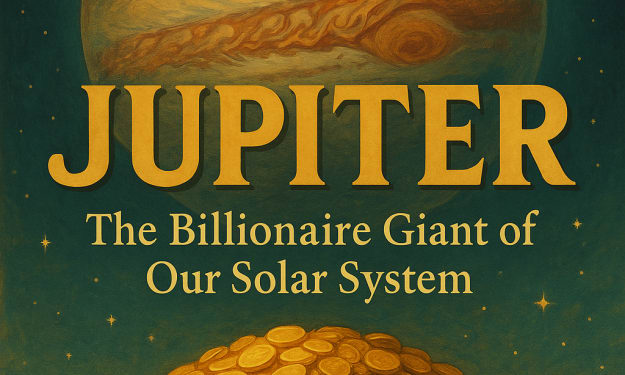
Jupiter: The Billionaire Giant of Our Solar System. AI-Generated.
Jupiter: The Billionaire Titan of Our Solar System In the vastness of the cosmos, few celestial entities attract attention like Jupiter, the most massive planet in our solar system. A tumultuous giant of gas, storms, and enigmatic magnetic fields, Jupiter represents not only a cosmic marvel but also a topic of intrigue for scientists, futurists, and speculative economists alike. But what if we evaluated Jupiter in the same manner we assess Earth’s resources? What if we endeavored to estimate its net worth? Although it may appear abstract to assign a monetary value to a gas giant, examining Jupiter’s "worth" aids us in understanding not only the planet itself but also the future of space economics, resource extraction, and cosmic colonization. 1. The Physical Scale of Jupiter Jupiter is a titan. With a diameter of approximately 139,820 kilometers, it is over 11 times broader than Earth and has a volume capable of accommodating more than 1,300 Earths. Its mass is 318 times that of Earth, containing over 70% of the planetary mass in the solar system (excluding the Sun). Unlike Earth, Jupiter is predominantly composed of hydrogen and helium, the fundamental components of stars. Its swirling atmosphere houses the renowned Great Red Spot, a storm larger than Earth that has persisted for centuries. 2. What’s Within Jupiter? Elements, Gases, and Potential Assets While Jupiter lacks a solid surface, it is not devoid of value: Hydrogen and Helium: The most prevalent elements in the universe. Liquid metallic hydrogen deep within Jupiter may one day be utilized for advanced propulsion technologies or quantum superconductors. Ammonia and Methane: Present in its upper atmosphere, these compounds could serve as potential components in synthetic fuels or bio-processors. Possible Metallic Core: Although unverified, some hypotheses propose a rocky or metallic core, which might encompass rare elements. Magnetosphere: Jupiter boasts the strongest magnetic field of any planetapproximately 20,000 times more powerful than Earth’sforming valuable radiation belts that could be leveraged for advanced research or energy acquisition. While not extractable in a traditional sense, Jupiter’s resources could be tapped through atmospheric scooping, fusion-based extraction, or future megastructures. 3. The Economics of Space: Appraising Jupiter in Tangible Terms Assessing a planet that is uninhabitable and predominantly gaseous presents challenges, yet speculative models can inspire our imagination: a. Hydrogen Valuation: Hydrogen serves as a fuel source for nuclear fusion, often regarded as the holy grail of clean energy. The value of hydrogen fluctuates based on purity and form, but liquid hydrogen is approximately $6 per kilogram on Earth. Jupiter’s hydrogen mass is estimated at around 1. 3 x 10²⁷ kilograms. Even if we value just 1% of this (accessible mass) at Earth prices, it would result in: 1. 3 x 10²⁵ kg × $6/kg = $78,000,000,000,000,000,000 That equates to $78 quintillionand that is a conservative estimate. b. Helium-3 Potential: Helium-3 is exceedingly rare on Earth but holds significant value for future nuclear fusion reactors. On the Moon, it is appraised at $3 billion per ton. Jupiter may possess millions of tons of helium-3. If even 1 million tons were feasibly extractable: 1,000,000 tons × $3 billion = $3 quadrillion 4. Jupiter’s Moons: Billion-Dollar Properties Jupiter possesses 95 verified moons, including Europa, Ganymede, and Callisto, which are regarded as leading candidates for prospective colonization. Europa may contain a subsurface ocean, potentially supporting life. Ganymede is the most substantial moon in the solar system and may be abundant in water ice. Callisto has minimal radiation, rendering it suitable for possible human settlements. If celestial objects were real estate, Jupiter’s moons would be valued in the multi-trillion-dollar range. A future extraterrestrial economy could appraise these moons similarly to how land is valued today, with advantageous locations, resources, and life-support capabilities increasing their worth. Strategic and Scientific Importance Even without direct resource extraction, Jupiter possesses significant strategic importance: A gravitational slingshot for spacecraft trajectories. A natural laboratory for examining planetary formation. A vast magnetosphere for scientific investigation. In the realm of space exploration economics, such characteristics hold immense intellectual and technological significance, potentially saving billions in propulsion and research expenditures. Risks and Limitations Jupiter is not devoid of obstacles: Its atmosphere is lethal. Radiation levels are extreme. The gravitational force is substantial, complicating both entry and exit. Extracting resources from Jupiter would demand centuries of technological progression, AI automation, and potentially interstellar-level infrastructure. Total Estimated Net Worth While conjectural, here is a conservative assessment: Hydrogen reserves (1%): $78 quintillion Helium-3 (1 million tons): $3 quadrillion Moons (strategic value): $2–5 quadrillion Scientific worth, gravitational utility: Incapable of calculation Total Estimated Net Worth: $80–90 quintillion (and increasing with technology) Conclusion Jupiter may be unwelcoming, yet it symbolizes a cosmic treasure trove for future civilizations. Its gases, gravitational capabilities, and diverse moon system establish it as the most affluent celestial body in our solar system by potential worth. As we explore deeper into space, Jupiter may ultimately be recognized not merely as the monarch of planets but as the billionaire magnate of the cosmos.
By Say the truth 2 years ago in History
vintage clothing stores Retro DS Jazz Dance Party
Dancing Through Time: How One Glance Recreated the Magic of the Jazz Age In a small, quiet vintage clothing store, nestled between trendy cafes and bustling city streets, Laila discovered something exceptional. She hadn't planned to buy anything that day; she was simply browsing the shop windows, enjoying the hum of a record playing in the background. But as she moved through the rows of clothing, her eyes fell on a display case that seemed to sparkle with stories from another era.
By Sayed Zewayed2 years ago in History
Crew Launch to Join Station Expedition 72/73 Will Be Covered by NASA . AI-Generated.
For the forthcoming crew launch that will transport astronauts to join the International Space Station's (ISS) Expedition 72/73, NASA has revealed its comprehensive coverage plans. A SpaceX Crew Dragon spacecraft will be used for the trip, which is a component of NASA's ongoing Commercial Crew Program, and will provide the crew members with necessary transportation. The launch signifies the extension of NASA's collaboration with SpaceX and the agency's dedication to guaranteeing the efficient and safe delivery of humans to the International Space Station.
By Ariyan Islam Masud2 years ago in History
The History Of Palestine 🇵🇸 . AI-Generated.
The history of Palestine is among the most intricate and deeply rooted in the ancient world, reflecting a legacy of human civilization that spans thousands of years. Geographically positioned at the crossroads of Africa, Asia, and Europe, Palestine has long been a bridge between cultures and a battleground for empires. The earliest inhabitants of the region were the Canaanites, a Semitic people who settled in the land during the third millennium BCE and established thriving city-states. In the 12th century BCE, the Philistines, believed to have come from the Aegean Sea, settled along the southern coastal plains. The term “Palestine” is thought to derive from “Philistia,” the land of the Philistines. Around the same period, the ancient Israelites settled in the central highlands, eventually forming the kingdoms of Israel and Judah, which are central to Jewish religious tradition. These kingdoms were repeatedly conquered by larger powers—first the Assyrians, then the Babylonians, who destroyed the First Temple in Jerusalem in 586 BCE and exiled many Jews to Babylon. After the fall of Babylon, the Persian Empire allowed Jewish exiles to return and rebuild the temple, initiating the Second Temple period. This era ended with the Roman conquest, during which Judea became a Roman province. Tensions between Jews and Romans culminated in a series of revolts, leading to the destruction of the Second Temple in 70 CE and the eventual expulsion of many Jews from the region. In the centuries that followed, Palestine became part of the Christian Byzantine Empire until 638 CE, when Muslim Arab forces conquered the region, marking the beginning of over a millennium of Islamic governance.
By Ikbal Siddiki 2 years ago in History
I am an authentic tale from Gaza; I am not just a number.
Do not forget my story I'd rather not be a number. Since I witnessed martyrs being buried in mass graves or called "unknown persons," that thought has persisted in my mind. There are even some body components that are unidentifiable.
By Md Golam Rabbani2 years ago in History
Dominican Republic nightclub collapse kills 98
Dominican Republic nightclub collapse kills 98 On the night of April 8, 2025, tragedy struck Santo Domingo, the capital of the Dominican Republic, when the roof of the renowned Jet Set nightclub collapsed during a merengue concert. The catastrophic event resulted in the deaths of at least 98 individuals and left over 160 others injured.
By Muhammad Hayat2 years ago in History
Trump tariffs including 104% against China come into force
Trump tariffs including 104% against China come into force Trump's new tariffs on dozens of countries, including tariffs of 104 percent on Chinese goods, have gone into effect, intensifying his global trade war. The round of so-called “reciprocal” tariffs on imports to the US – imposed from 12.01am Eastern Time (0401 GMT) – come as the US president’s punishing levies have shaken a global trading order that has persisted for decades, raised fears of recession and driven worldwide stocks sharply downward. According to Reuters, the S&P 500 fell below 5,000 on Tuesday for the first time in nearly a year and is getting closer to entering a bear market, which is defined as being 20% below its most recent high. Since Trump announced the tariffs on Wednesday, the value of S&P 500 companies' stock markets has decreased by $5.8 trillion. A sell-off across Asian markets resumed on Wednesday after a brief respite, with Japan’s Nikkei down over 3% and South Korea’s won currency sliding to a 16-year low. Additionally, US stock futures pointed to Wall Street suffering losses for the fifth day in a row. Trump nearly doubled duties on Chinese imports, which had been set at 54% last week, in response to counter-tariffs that Beijing announced last week. China has vowed to “fight to the end” over what it views as blackmail. Trump has offered investors mixed signals about whether the tariffs will remain in the long term, describing them as “permanent” but also boasting that they are pressuring other leaders to ask for negotiations. During a White House event on Tuesday afternoon, he stated, "We have a lot of countries coming in that want to make deals." At a subsequent event, he stated that he anticipated China to pursue an agreement as well.
By Danielle W. Jones2 years ago in History
As Trump’s Sweeping Tariffs Kick In, Officials Signal Openness to Talks
In a move reshaping the global trade landscape, former President Donald Trump's sweeping tariffs have officially taken effect, targeting a wide range of imports in a bid to boost domestic manufacturing and curb long-standing trade imbalances. The tariffs, which affect goods from key trading partners including China, the European Union, and Mexico, have sparked mixed reactions both at home and abroad. The administration's tough trade stance has drawn criticism from economists and business leaders who warn of higher consumer prices and potential retaliation from affected countries. However, Trump and his allies argue that these tariffs are necessary to protect American jobs and industries that have suffered under what they describe as "unfair trade practices." Despite the confrontational tone, there are growing signs of openness to diplomatic engagement. Senior officials within the administration have suggested that the tariffs are not the end goal, but rather a strategic tool to bring negotiating partners to the table. One White House official stated, "Our aim is not to start a trade war, but to create a fair playing field through strong leverage." Countries hit by the tariffs have expressed disappointment but stopped short of walking away from dialogue. Several international leaders have publicly called for renewed discussions and indicated a willingness to find common ground. Behind the scenes, quiet diplomatic efforts are reportedly underway to de-escalate tensions and explore the possibility of revised trade agreements. The coming weeks will be critical in determining whether these early signals of openness can evolve into constructive negotiations. If all parties are willing to engage in good faith, the tariffs may also open the door to a new era of trade talks, despite the fact that they have unquestionably raised the stakes.
By Danielle W. Jones2 years ago in History
Scientists Announce They Have Resurrected the Dire Wolf
9 April 2025 In an innovation that blurs the boundaries A group of geneticists who are torn between science fiction and reality and now paleobiologists declared that they have successfully restored Canis dirus, the extinct dire wolf.
By moyensefat2 years ago in History