Books
The Golden Cave.
A cave that no one dared approach was high in the misty hills of an old, forgotten village. The elders spoke of it only in whispers, saying it was cursed—guarded by spirits who punished the greedy.But they also said it held something else:gold, more than any man had ever seen.
By Ahmed Karim2 years ago in History
Palestine Rising Death Toll and Humanitarian Crisis
The situation in Palestine, particularly in Gaza, has reached a new level of humanitarian catastrophe, as Israeli military operations continue into April 2025. Israeli forces have intensified their airstrikes and ground offensives over the past few weeks, causing a tragic rise in the number of civilian deaths, the destruction of infrastructure, and an ongoing blockade that has left millions of people in desperate need of essentials.
By Ahmed Karim2 years ago in History
New NASA Sonifications: Listen to the Sound of the Universe.
The universe has always been a place of wonder, mystery, and awe. While telescopes and satellites allow us to observe it, allowing us to "hear" it is one of the most innovative and creative approaches NASA has recently adopted. NASA is converting astronomical data into sound through a process called "sonification," which provides a brand-new method for experiencing the universe. This unique approach to data representation is not only scientifically valuable but also deeply emotional and artistic. As part of its Chandra X-ray Observatory project, NASA released a new set of sonifications that transform some of the most well-known space phenomena into musical compositions that capture the imagination and bring the universe to life in a way that has never been done before. ---
By Ahmed Karim2 years ago in History
Discover Patrick Henry’s Legacy, Beyond His Revolutionary ‘Give Me Liberty or Give Me Death’ Speech
Tourists frequently cram themselves into the seats of a plain white church in Richmond, Virginia, to witness a reenactment of a speech that was first delivered there on March 23, 1775, 250 years ago. Here, in front of George Washington and Thomas Jefferson, Patrick Henry spoke to his fellow Virginia colonists, concluding with the famous quote, "Give me liberty or give me death!" That sentence, a passionate appeal that Americans have often used to express their dedication to freedom, has reverberated across the ages.
By moyensefat2 years ago in History
The Weight of Living: How Minds Have Endured Through Time
The first thing Clara noticed about the old soldier was his hands. They rested on the sanitarium’s dining table, palms upturned, as if waiting for invisible weights to be placed in them. The fingers trembled slightly—not from age, Clara thought, but from some deeper, unseen burden.
By Historical Stories2 years ago in History
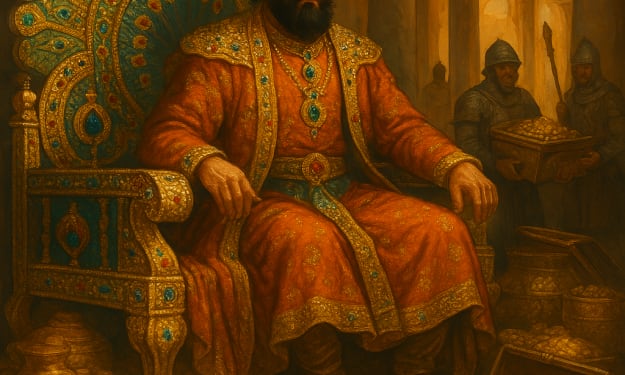
Nadir Shah’s Loot: The Billion-Dollar Plunder That Shook an Empire. AI-Generated.
The Looting of an Empire: Nadir Shah’s Enormous Fortune and the Pillaging of Delhi In the chronicles of global history, few conquerors exhibited the extreme cruelty and opportunistic nature of Nadir Shah, the Persian monarch who invaded India in the early 18th century and departed with one of the most significant treasures ever seized in a singular military endeavor. In 1739, during the declining years of the Mughal Empire, Nadir Shah invaded India, overcame Emperor Muhammad Shah, and memorably plundered Delhi, acquiring an astonishing trove of gold, silver, gemstones, and renowned relicsincluding the Peacock Throne and the Koh-i-Noor diamond. This article examines the context of Nadir Shah’s incursion, the magnitude of his looting, the projected value of his wealth in contemporary terms, and how this solitary act of conquest transformed the political and economic dynamics of Asia. 1. The Ascendance of Nadir Shah Nadir Shah (1688–1747), a military prodigy from modest beginnings, ascended to power in Persia amid a period of turmoil. He initially gained recognition for defeating Afghan forces that had occupied regions of Persia, and by 1736, he had declared himself Shah of Iran. With a disciplined military and a thirst for conquest, he turned his gaze eastwardto the faltering Mughal Empire. At the time, India under Mughal dominion remained affluent but politically splintered. Provinces functioned semi-independently, and central authority had diminished under Muhammad Shah. Recognizing an opportunity, Nadir Shah commenced his invasion in 1738, rapidly seizing Ghazni, Kabul, Lahore, and then advancing toward Delhi. 2. The Plundering of Delhi: A City Soaked in Blood and Wealth Nadir Shah’s pivotal triumph at the Battle of Karnal in February 1739, where he obliterated Mughal forces, opened the gates to Delhi. Upon entering the city, he initially exhibited respectbut a miscommunication involving a clash between Persian and Indian troops resulted in a massacre of thousands of civilians. The city of Delhi, one of the most affluent capitals of the era, was transformed into a battleground and a treasure trove. Nadir Shah demanded the relinquishment of all valuables, and Mughal courtiers, merchants, and aristocrats were divested of their wealth. The Shah’s forces looted gold, silver, precious gems, fabrics, and armaments. However, the crowning jewels of the plunder were: The Peacock Throne: A lavish seat adorned with rubies, emeralds, pearls, and diamonds, originally commissioned by Shah Jahan. The Koh-i-Noor Diamond: A 186-carat diamond that would eventually become part of the British Crown Jewels. The Darya-i-Noor Diamond: Another invaluable diamond, now preserved in the Iranian Crown Jewels. 3. The Estimated Value of the Plunder Historical records indicate that Nadir Shah departed India with treasures valued at 70 crore rupees in the currency of that period.
By Say the truth 2 years ago in History