Biographies
D-DAY AND WHAT HAPPENED
June 6, 1944, zero three hundred 3 hours and 30 minutes until the landing at Omaha Beach. The Allied fleet has come to a stop. Soldiers stand aboard wet decks preparing to launch the largest amphibious invasion ever attempted. They look at the men standing next to them, knowing that before the day is over, many of their brothers will become bloody corpses lying on the sands of Omaha Beach. The ship rocks on choppy water. The wind is supposed to be calm; the waters still. Instead, it feels like a storm is brewing. However, this storm will not be one of rain and lightning but artillery shells, machine guns, and explosions. A colonel shouts orders across the deck. The soldiers begin loading into their landing vessels. They cling to their weapons as if they were life preservers.
By Cassandra Victor3 years ago in History
The Real Life Story Of Oppenheimer
J. Robert Oppenheimer, often dubbed the father of the atomic bomb, shares a striking parallel with Prometheus, the ancient Greek Titan. This comparison isn't drawn from a shared god-like intellect but rather a tale of gifts bestowed, consequences faced, and deep-seated remorse. Oppenheimer's life was a journey marked by towering achievements and profound dilemmas. His early fascination with the cosmos's mysteries set the stage for his pivotal role in one of the 20th century's most significant scientific advancements. Oppenheimer's life story is a testament to the power and peril of knowledge. As we unravel his narrative, we'll draw the lines connecting this brilliant physicist and Prometheus, revealing a tale of ambition, responsibility, and the price of progress. Now, let's turn the pages of history and walk through the timeline of Oppenheimer's life, a journey that mirrors the myth of Prometheus in its highs and lows. In the bustling heart of New York City on April 22, 1904, a child named J. Robert Oppenheimer was born into a world on the cusp of a scientific revolution. His mother, Ella, a painter, and his father, Julius, a successful textile Alan Porter, were the first audience to his budding intellectual brilliance. His early education at Manhattan's Ethical Culture School was not just a journey through textbooks but a voyage into the vast cosmos of knowledge. The city around him, pulsating with a rhythm of progress and innovation, was a grand stage set for the young prodigy. Oppenheimer's fascination with the mysteries of the universe began to take root in this vibrant backdrop. These early years were the first notes in the symphony of his life, a melody that would eventually resonate through the halls of scientific history. His first hobby, gathering rocks and minerals, was a precursor to a lifelong trip into the heart of science. This journey eventually led him to the hallowed halls of Harvard University, where a young Oppenheimer found himself drawn to the enigmatic world of chemistry. Yet, the allure of theoretical physics truly captured his intellect. His pursuit of knowledge led him across the Atlantic to the University of Göttingen in Germany, a beacon of scientific innovation. Under the gray skies of Göttingen, Oppenheimer delved into the mysteries of quantum physics, his mind dancing with particles and probabilities. The university's grand lecture halls echoed the theories of the greatest minds in physics, and Oppenheimer was a keen listener, absorbing every word. His time in Germany was not just a period of academic achievement but a journey of intellectual exploration. As he navigated the complex landscape of quantum physics, Oppenheimer laid the foundation for his future role in one of the most significant scientific advancements of the 20th century. Oppenheimer's burning passion for physics led him to the University of California, Berkeley, where he began his academic career. There, amidst the grandeur of the university's neoclassic architecture, Oppenheimer's brilliance shone brightly. His lectures were a symphony of ideas, resonating with the theories of quantum mechanics and the mysteries of the cosmos. His contributions to theoretical physics were as profound as they were pioneering. He delved into the heart of atoms, unraveled the secrets of cosmic rays, and explored the enigmatic world of quantum field theory. His work was not just about understanding the universe but pushing the boundaries of what was possible in physics. Amidst the whirlwind of scientific discovery and political intrigue, Oppenheimer found solace in the comforts of family life. He married Catherine Pointing, a radical Berkeley student, in 1940. Together, they had two children, Peter and Catherine. His family life offered a counterpoint to his intense professional pursuits, grounding him amidst the tumultuous events of his career. The love and support of his family were his refuge during the trials and tribulations that marked his later years. The Manhattan Project beckoned Oppenheimer in 1942. He was appointed the scientific director, a role that would thrust him into the epicenter of a scientific endeavor of unprecedented scale and consequence. Oppenheimer led a team of the brightest minds of the era in the secluded landscape of Los Alamos, New Mexico. Their mission was as formidable as it was secretive: to harness the destructive power of the atom. The stakes were high, and the world's weight rested on their shoulders. Their relentless efforts culminated on a fateful day in July 1945. The New Mexico desert bore witness to the first successful test of the atomic bomb, a spectacle of terrifying beauty that marked a turning point in human history. As the mushroom cloud unfurled in the sky, Oppenheimer's life, too, was irrevocably altered.
By Aditya Dey3 years ago in History
Gipsy and his trumpet
Around the globe gypsies are known as travelers in carriages, circus entertainers, fortune tellers but also as victims of Nazis in WW1 and WW2.If you put a side the “rest of a world” gypsies are known as a musicians in the Balcan states. Serbia, Bulgaria, North Macedonia, Croatia, Hungary… Here they are seen as singers and trumpet virtuosos.
By Bleda Senka Stranca3 years ago in History
2023 Women's World Cup
In the summer of 2023, the world held its breath as anticipation for the Women's World Cup reached its crescendo. The stage was set, and nations from every corner of the globe converged in a celebration of unity and competition. This tournament wasn't just about soccer; it was about breaking barriers, shattering glass ceilings, and inspiring generations to come. The opening ceremony was a dazzling spectacle of color, culture, and music, reflecting the diversity of the participating nations. As the national anthems echoed through the stadium, a sense of camaraderie and fierce determination emanated from the players. Each team had a unique story, a narrative woven with dedication and passion. Among them was Maya Rodriguez, the captain of the underdog team from a small South American nation. With fiery determination in her eyes and a heart full of dreams, she led her team onto the field with grace and humility. Maya's journey was a testament to the power of perseverance. Growing up in a neighborhood where soccer was seen as a "boys' game," she had faced numerous challenges. But Maya never let the world's expectations define her. Through her grit and relentless pursuit of excellence, she had become a role model for young girls everywhere. As the tournament unfolded, the world watched in awe as underdogs triumphed over giants and thrilling comebacks left stadiums echoing with cheers. The passion of the players was palpable, transcending language barriers and cultural differences. The tournament was a canvas upon which tales of strength, resilience, and unity were painted with every pass, every goal, and every victory. In the knockout stages, the intensity heightened. The air was electric with anticipation as the quarterfinals approached. Maya's team had defied all odds to reach this stage, and the world held its breath as they faced off against a perennial powerhouse. The match was a rollercoaster of emotions, with Maya's team displaying unwavering resolve. In the final minutes of the game, Maya herself launched a free-kick into the net, securing a historic victory that sent shockwaves across the soccer world. But the Women's World Cup was about more than just the game; it was about breaking down barriers that had confined women in sports. The stands were a sea of colorful flags, faces painted in solidarity, and chants echoing gender equality. The stands were filled with young girls who saw their heroes on the field, and in their hearts, they knew that no dream was too big to pursue. As the tournament approached its climax, the final match was a breathtaking showdown between two teams that had earned their spot on the grandest stage. The world watched as the players poured their hearts onto the field, leaving nothing behind. The match was a masterpiece of skill, determination, and teamwork. When the final whistle blew, confetti rained down, and tears of joy flowed freely. The trophy was lifted, but it wasn't just a piece of metal; it was a symbol of triumph, unity, and empowerment. The Women's World Cup of 2023 had etched its place in history, not only for the soccer played but for the legacy it had created. And as the sun set on the tournament, Maya Rodriguez stood proudly, her team beside her, watching the fireworks light up the night sky. The journey had been long and challenging, but they had left an indelible mark on the world. The passion, dedication, and unwavering spirit displayed by these women had transcended the boundaries of the game, inspiring a generation to believe in the power of their dreams.
By Haryourmiedey Abdulsamad3 years ago in History
USWNT at the Women's World Cup
In a world where the roar of the crowd resonates with a fervor unlike any other, a group of warriors clad in red, white, and blue stepped onto the hallowed grounds of the Women's World Cup. Their mission was not just to win, but to ignite a fire in the hearts of millions and pave a path for the dreams of countless young girls. This is the emotional tale of the US Women's National Soccer Team at the Women's World Cup. Amidst the sea of cheering fans and fluttering flags, these fierce athletes carried the dreams of a nation on their shoulders. As the tournament unfolded, each match became a battleground of skill, determination, and unity. A sisterhood forged in the crucible of passion and perseverance, the team stood resolute against every challenge that came their way. In the quarterfinals, facing a formidable opponent known for their strength, the US Women's National Soccer Team themselves pushed to their limits. Amidst swirling winds and pouring rain, they fought valiantly, trading goals and breaking barriers. Their spirit was unbreakable, their resolve unwavering. As the final whistle blew, they emerged victorious, tears of triumph mingling with raindrops on their cheeks. But it wasn't just the victories that defined this journey. In the face of adversity, they demonstrated resilience. A key player sidelined by injury, a last-minute goal that shattered hopes—these moments tested their mettle. Yet, in their tears and moments of vulnerability, they found a wellspring of strength that extended beyond the confines of the field. As they moved towards the championship match, the anticipation was palpable. The air crackled with electricity, a symphony of cheers and chants echoing through the stadium. The final battle was a clash of titans, each team giving their all in pursuit of glory. With every pass, every save, every leap towards the heavens, the USWNT showcased their indomitable spirit. And then, in a breathtaking moment that would etch itself into history, a goal was scored—a single thread that connected the past to the present, and the present to the future. As the ball found the back of the net, a collective roar erupted, carrying the dreams of generations past and the hopes of generations yet to come. When the final whistle blew, the USWNT stood as champions once again, their eyes shimmering with tears of joy. Medals draped around their necks, they clutched the coveted trophy—a symbol of their unwavering commitment, their unity, and their enduring love for the beautiful game. The Women's World Cup had come to a close, but the story of the USWNT would echo through time. Their journey wasn't just about winning titles; it was about rewriting the narrative, challenging norms, and inspiring a movement. They had proved that passion knows no bounds, that strength is found in unity, and that a team can become a beacon of hope for an entire generation. And as the sun set on that fateful day, the echoes of their triumph carried on, whispered in the wind, etched in the annals of history, and forever etched in the hearts of those who witnessed their remarkable journey.
By Haryourmiedey Abdulsamad3 years ago in History
Israeli settlements, explained!
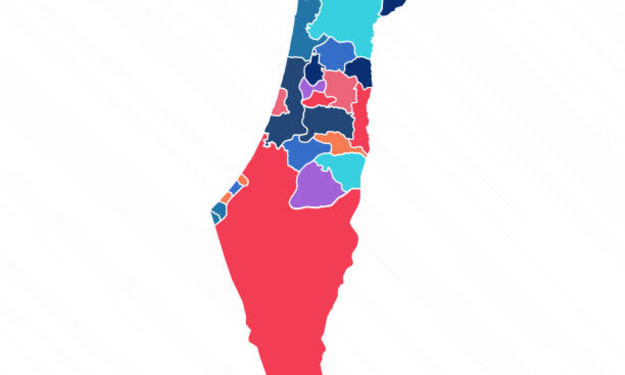
Driving through what might be one of the world's most peculiar landscapes, I find myself traversing the border between Israel and the West Bank. A glance at the map reveals a puzzle of Palestinian towns painted in green and Israeli settlements in blue. This region is often thought of as Palestine, yet what's intriguing is that almost a fifth of the three million inhabitants here are Jewish Israeli citizens. These Israelis, known as settlers, call the West Bank home while holding Israeli citizenship. As I journey along, I am witnessing the juxtaposition of two distinct nations intertwined by decades of conflict. Embarking on a quest to understand this complex panorama, I explored 15 settlements scattered across the West Bank, engaging with individuals who made the bold decision to relocate to this disputed territory. To unravel the origins of this intricate scenario, we must turn back the clock to 1948, a time when the land appeared markedly different. In those days, Great Britain held sway over this expanse. Faced with mounting tensions between Jews and Arabs, the United Nations collaborated with Britain to partition the land into separate states - Israel for Jews and Palestine for Arabs. The Jewish population embraced the proposal, heralding their independence. However, the Arab nations viewed this plan as another manifestation of European colonialism, rejecting it and subsequently engaging in war with Israel. Emerging victorious from the conflict, Israel exceeded the borders outlined by the UN. Amid peace negotiations, a ceasefire line materialized, etched in green ink and soon known as the Green Line. This demarcation was not a formal border, but rather a line separating Israel from the section now controlled by Jordan, which had seized it during the war. The land west of the Jordan River, thus acquired, earned the moniker "West Bank." The fragility of the ceasefire endured until 1967, when Israel found itself embroiled in another war with its Arab neighbors. While territorial expansion was not the objective, Israel rapidly advanced beyond the Green Line, capturing significant tracts of land, including the entirety of the West Bank. This victory posed a crucial question: should Israel incorporate the West Bank, extending Israeli citizenship and voting rights to its 1.1 million Arab inhabitants? Alternatively, should the land be returned to Jordan or given to the Palestinian people to establish their own state? This quandary ignited fervent debates within Israeli political circles. For many, the recent military triumph was perceived as a divine indication that Jews were destined to return to the land brimming with ancient Jewish heritage, the hills of ancient Judea and Samaria, encompassing the entire West Bank. While the government deliberated, Israeli civilians embarked on a bold initiative, establishing homes within the West Bank without official authorization. This grassroots movement planted the seeds of the settler movement, reshaping the dynamics of the region. However, this initiative was met with international disapproval. As settler numbers swelled, the UN issued a resolution decrying the settlements as an impediment to achieving lasting peace in the Middle East. The world witnessed the emergence of two narratives: one emphasizing Jewish civilians populating largely vacant plots of land infused with historical and spiritual significance, and the other, the predominant perspective, portraying settlers as expanding their nation through colonization. Despite global condemnation, the settler population burgeoned. Over ensuing decades, various factions within the Israeli government rallied behind the movement, channeling public resources and authorizing construction. Aiding the expansion of settlements, the Israeli housing ministry and military devised blueprints for West Bank development. Roads traversing the region facilitated movement between settlements and mainland Israel. Construction permits multiplied, and planned communities sprouted across the West Bank. From a fringe movement, settlers evolved into an integral facet of Israeli society, backed by state support. In the 1980s and 1990s, settlement activity surged, weaving these settlements around existing Palestinian towns, sparking tensions and protests. Recognizing the unsustainable nature of the situation, President Bill Clinton, Prime Minister Yitzhak Rabin, and Palestinian leader Yasser Arafat brokered the Oslo Accords in the mid-1990s. These agreements divided the West Bank into three areas: Area A granted Palestinians control over security and governance, Area B yielded Palestinian administrative power but retained Israeli security presence, and Area C remained under complete Israeli control, housing the settlements. These developments have given rise to the current state of affairs. Israelis enjoy convenient access between mainland Israel and the West Bank, traversing well-maintained roads known as "flyovers" that bypass Palestinian villages. Palestinians, on the other hand, often encounter roadblocks and checkpoints, hampering their movement. Yet, a more substantial challenge confronting Palestinians is the impact of fragmented land on their economy. The fertile agricultural land, water, and mineral resources concentrated in Area C sustain the majority of the West Bank's economy. Limited access to these resources has stifled Palestinian businesses and economic growth. An event in 2005, where Israeli Prime Minister Ariel Sharon uprooted 8,500 settlers from the Gaza Strip, reignited settler fervor. Witnessing fellow Israelis evicted from their homes galvanized the settler community, prompting further expansion efforts in the West Bank. Today, these settlers reside in established communities complete with schools, hospitals, and even a university. As thoughts turn towards resolving this intricate conflict, the idea of a two-state solution, granting Palestinians their own state within the West Bank region, emerges as a common proposal. However, the evolving settlement landscape, particularly within Area C, complicates this path. These settlements, far from being temporary encampments, have evolved into thriving communities. In conclusion, the West Bank's unique tapestry of settlements and Palestinian towns stands as a testament to the enduring complexities of the Israeli-Palestinian conflict. It is a landscape where historical narratives, religious ties, and contemporary political considerations converge, yielding a remarkable tableau that continues to shape the destiny of this region.
By Shubham Bajaj3 years ago in History
The Battle for Moses 'Burial Site'
In the annals of religious history, the enigmatic figure of Moses stands as a towering symbol of divine leadership and guidance. Yet, his departure from the mortal realm was shrouded in mystery and intrigue, giving rise to narratives that delve into the supernatural realm of angels and demons. Among these narratives, a peculiar tale emerges - one that speaks of a cosmic struggle over the earthly remains of the prophet Moses.
By Karthik john3 years ago in History
The Bravest Woman in America; who was she?
Ida Lewis is known as the bravest woman in America, a lighthouse keeper credited with saving numerous lives from drowning. When Ida was twelve her father, Hosea Lewis, was appointed lighthouse keeper in Newport, Rhode Island, unfortunately, Hosea suffered a terrible stroke after only four months. In the wake of her father’s stroke Ida and her mother, Zoraida, began to take over the duties of lighthouse keeper. In addition Ida rowed her three siblings to school everyday, greatly improving her rowing abilities, which would become very important in her many rescues. Along with her rowing skills, Ida’s swimming greatly improved which brought about the societal rumor that this was ‘unladylike.’
By Arie Redson3 years ago in History