Biographies
King Charlemagne
Charlemagne, born into the influential Carolingian dynasty, ascended to the throne as King of the Franks and Emperor of the Romans. His parents, Pepin and Bertrada, played significant roles in the Frankish kingdom and the Holy Roman Empire. The exact year and circumstances of Charlemagne's birth are subjects of debate, adding mystery to his early life. Charlemagne's birthplace remains a mystery, with various locations suggested, including Liège, Herstal, Aachen, Düren, Gauting, Quierzy, Mürlenbach, and Prüm. As the eldest of three children who reached adulthood, Charlemagne shared a special bond with his mother, which influenced his upbringing and education. The division of the Frankish Kingdom among Clovis’s sons resulted in fierce competition and bloodshed. The distribution of the king's inheritance among his sons led to frequent conflicts and power struggles, jeopardizing the unity of the Frankish realm. Real political authority was held by the Mayor of the Palace, who had significant influence over the distribution of privileges and favors. Tensions between the Merovingian Kings and the Mayors of the Palace paved the way for Charlemagne's ancestors to rise to power. Pepin of Herstal's triumph in the Battle of Tertry in 687 solidified Austrasia as the dominant force in the Frankish Kingdom. The Carolingian family, starting with Pepin's descendants, became the driving force behind the throne in Francia, utilizing royal resources to establish control over the realm. Pepin's ascent to power was further bolstered by support from the Pope.
By Isaac Ekow Anyidoho2 years ago in History
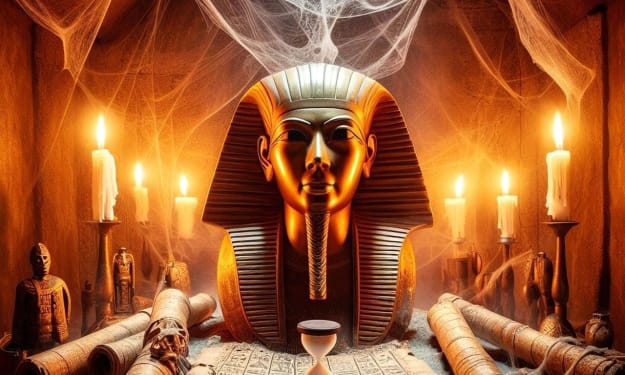
Pharaoh Thutmose III: The Napoleon of Ancient Egypt
Pharaoh Thutmose III, often referred to as the "Napoleon of Egypt," was one of the most powerful and influential rulers of ancient Egypt. He reigned during the 18th Dynasty of the New Kingdom, from approximately 1479 to 1425 BCE. His legacy is marked by his military prowess, architectural achievements, and significant contributions to Egyptian culture and administration. Early Life and Ascension to the Throne Thutmose III was the son of Thutmose II and a lesser wife named Iset. His early years were overshadowed by the reign of his stepmother, Hatshepsut, who served as regent and eventually declared herself pharaoh. During Hatshepsut’s reign, Thutmose III was relegated to a secondary role, often depicted as a junior co-regent. Despite this, he received military training and held the title of the head of her armies, which would later prove pivotal in his rule. Hatshepsut's reign lasted for about 22 years, and upon her death, Thutmose III assumed full control of the throne. One of his first acts as pharaoh was to attempt to erase Hatshepsut’s legacy. He ordered the defacement of her monuments and the removal of her name from official records, actions that historians speculate were intended to legitimize his reign by eliminating any challenges to his authority. Military Campaigns and Conquests Thutmose III is best known for his military campaigns, which expanded Egypt’s empire to its greatest extent. He conducted at least 17 known campaigns, primarily in the Near East, Nubia, and Syria, establishing Egyptian dominance over these regions. His first and perhaps most famous campaign was the Battle of Megiddo in 1457 BCE. The Battle of Megiddo was a significant military engagement between the forces of Thutmose III and a coalition of Canaanite vassal states led by the king of Kadesh. Thutmose III demonstrated exceptional military strategy by taking an unexpected route through the Aruna Pass, catching the enemy off guard. His victory at Megiddo not only solidified Egyptian control over Canaan but also set a precedent for future military engagements. The captured booty and tributes from these campaigns enriched Egypt and demonstrated Thutmose III's skill as a military leader. Administrative Reforms and Governance Thutmose III was not just a warrior king; he was also an astute administrator. He reorganized the administration of the empire to better control the vast territories he conquered. This included appointing loyal officials to key positions and establishing a network of fortresses and supply depots to support his military campaigns. He also implemented a system of annual tributes from vassal states, ensuring a steady flow of wealth into Egypt. Thutmose III’s reign saw a flourishing of arts and culture. He commissioned numerous building projects, including the construction of temples, obelisks, and monuments. One of his most notable architectural achievements was the expansion of the Karnak Temple complex in Thebes. He added the Festival Hall, also known as the Akh-menu, which was used for religious ceremonies and as a commemorative monument celebrating his military victories. Religious Contributions and Legacy Thutmose III was deeply religious and dedicated many of his conquests and achievements to the god Amun, the chief deity of the Egyptian pantheon. His devotion to Amun is evident in the numerous temples and shrines he built or renovated in the god’s honor. He also initiated the celebration of the Opet Festival, a grand religious procession that honored Amun and reinforced the divine nature of the pharaoh’s rule. The pharaoh’s legacy extended beyond his death. His reign was documented extensively in the annals inscribed on the walls of the Karnak Temple, providing historians with valuable insights into his rule and military exploits. Thutmose III’s policies and achievements set a standard for future pharaohs and helped maintain the stability and prosperity of the New Kingdom. Death and Succession Thutmose III died in 1425 BCE after a long and successful reign of approximately 54 years. He was buried in the Valley of the Kings, the traditional burial place of New Kingdom pharaohs. His tomb (KV34) is notable for its unique layout and the detailed paintings depicting the Amduat, an ancient Egyptian funerary text that describes the pharaoh’s journey through the underworld. Thutmose III was succeeded by his son, Amenhotep II, who continued his father’s policies and maintained the empire’s stability. Amenhotep II’s reign further solidified the foundations laid by Thutmose III, ensuring that his legacy endured for generations. Conclusion Pharaoh Thutmose III was a remarkable figure in ancient Egyptian history. His military genius, administrative reforms, and religious devotion transformed Egypt into a formidable empire. Often called the "Napoleon of Egypt," Thutmose III's legacy is a testament to his skills as both a warrior and a statesman. His reign represents a pinnacle of ancient Egyptian power and influence, and his contributions continue to be celebrated and studied by historians and Egyptologists today. Thutmose III’s impact on history is undeniable. He expanded Egypt’s borders, centralized its administration, and enriched its culture. His military campaigns set new standards for strategy and logistics, while his architectural projects left an indelible mark on the landscape of ancient Egypt. As a pharaoh who successfully combined military might with wise governance, Thutmose III remains one of the most iconic and revered figures in the annals of ancient history.
By Al-hassan Emam2 years ago in History
The World Warships
Warships have undergone significant transformations over the course of 400 years, adapting to the advancements in technology. From the era of galleys to the era of aircraft carriers, warships have played vital roles in military strategies. The aircraft carrier Charles de Gaulle stands as the largest vessel in the French Navy, capable of carrying approximately 30 aircraft such as the Rafale and Hawkeye, as well as helicopters for logistical and defensive purposes. With a nuclear propulsion system, this carrier has the ability to project military force across the globe and target any location. In contrast, galleys relied on oars for propulsion and had limited navigational capabilities. Despite this, galleys boasted exceptional hydrodynamic performance due to their sleek hull design and low profile in the water. Each galley required a crew of 255 men, utilizing their body weight and wooden "palomon" structures for rowing. The evolution of warships from galleys to modern frigates marked a significant shift in firepower, with galleys being phased out in 1680 due to their lack of cannons.
By Isaac Ekow Anyidoho2 years ago in History
Innovator or Overachiever
Steve Jobs, the legendary co-founder of Apple Inc., is remembered for his remarkable ability to turn visionary ideas into groundbreaking products. His last words, "Oh wow, oh wow, oh wow," symbolized a life lived in awe of the wonders he created. Yet, this brilliance propelling him to global acclaim may have also contributed to his early death.
By Horace Wasmore2 years ago in History
Mr. Nelson Mandela
Nelson Mandela was born as Rolihlahla Mandela in a village in the Cape Province to a local chief and a descendant of native royalty. His upbringing was a mix of traditional Xhosa customs and Western social influences. The early 20th century in South Africa was marked by the formation of the Union of South Africa and power struggles fueled by British colonial expansion due to the discovery of gold and diamond mines. This led to conflicts with native tribes and Boer descendants, mainly Dutch, German, and French settlers who controlled wealth and political power. Mandela married Evelyn Mase during a period of increasing struggle for black rights in South Africa, with the couple having a modest wedding due to financial constraints. The rise of the anti-black National Party and the implementation of the Apartheid policy further exacerbated tensions in the country, leading to segregation and limited civil liberties for the black population. Mandela's political involvement increased before 1948, culminating in his role in the overthrow of ANC President Xuma. Embracing Communist ideologies in the 1950s, Mandela became a prominent figure in the ANC movement, opposing the Pan-Africanist Congress and expanding the ANC network.
By Isaac Ekow Anyidoho2 years ago in History
"Contrasting Cultures: Aztecs and Mayas in Mesoamerica"
Can you pronounce the name of the Aztec capital city? Yes, it's quite difficult to say in English and above my pay grade. Okay, okay, it's Tenochtitlan. Mayan cities are hard to pronounce too. Consider Chichen Itza. They must be part of the same language, right? Well, not really. The Aztecs and the Mayas were among the most famous Mesoamerican peoples, present-day Central Americans, but they didn't speak the same language and they weren't even the same civilization. The two nations lived in different eras; the Aztecs dominated the region from the 14th to the 16th century, near the end of the Middle Ages in Europe. The Mayas came before the Aztecs; historians believe they started building city-states in the 3rd century. Their peak lasted until the 10th century.
By Nerisa Serina2 years ago in History
Assassinations of US Presidents: A Look Back at the Tragedies of American History
After the shooting of former President Donald J. Trump Senior (R-Florida) on July 13, 2024, during a campaign speech, there was great consternation. Many questions arise, such as how the shooter was able to get within range of Trump in the first place.
By Marco Röder2 years ago in History
Gwo Gwo Gwo Ngwo' Sparks Viral Dance Challenge
Nigerian folklore music legend, Gentleman Mike Ejeagha, has taken social media by storm as his timeless Igbo highlife song, "Gwo Gwo Gwo Ngwo", has sparked a viral dance challenge among content creators and celebrities worldwide.
By Clara Smith2 years ago in History
HISTORICAL FACTS ABOUT CARS
Cars have become an integral part of modern life, evolving from simple mechanical contraptions into sophisticated machines that embody cutting-edge technology and design. Their history spans more than a century, reflecting remarkable advancements in engineering, safety, and environmental consciousness.
By Ezekiel Adewale Ogunleye2 years ago in History