Ancient
Midnight Thunder: The B-2 Bombers That Struck Iran’s Nuclear Heart
Midnight Thunder: The B-2 Bombers That Struck Iran’s Nuclear Heart June 22, 2025 — 1:07 AM. Above the desolate mountains of central Iran, silence ruled the sky. No engines roared, no radar alarms blinked. Tehran slept under stars it couldn't see. And then came the ghosts.
By Ali Asad Ullahabout a year ago in History
The Punic Wars: Clash of Titans Between Rome and Carthage
Story: The Punic Wars In the ancient Mediterranean, two great powers vied for control over trade, territory, and influence—Rome and Carthage. Their conflict, known as the Punic Wars, spanned over a century and reshaped the course of history. This is the story of how these two civilizations clashed in a series of brutal wars, each shaping the destiny of the ancient world.
By Anwar Jamilabout a year ago in History
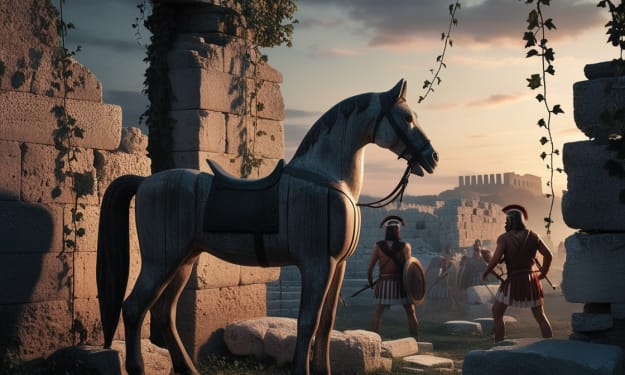
The True Story Behind the Trojan Horse
The story of the Trojan Horse is one of the most famous tales from ancient mythology, often associated with cunning, deception, and the ultimate downfall of the city of Troy. This tale, which has been passed down through centuries, combines history, legend, and myth to reveal a story that has captivated imaginations and inspired countless works of literature and art. But what is the true story behind the Trojan Horse? Was it a real historical event, or simply a metaphorical tale woven by ancient storytellers?
By Muhammad Asimabout a year ago in History
Scientists Retrace 30,000-Year-Old Sea Voyage, in a Hollowed-Out Log
In 1947, against the best navigational advice, the Norwegian explorer Thor Heyerdahl and five crew members set sail from Peru on a balsa wood raft to test his theory that ancient South American cultures could have reached Polynesia. The frail vessel, called Kon-Tiki, crossed several thousand nautical miles of the Pacific in 103 days and showed that his anthropological hunch was at least feasible.
By Zeeshan Anwar about a year ago in History
A Strange Night in Hanyang
A long time ago, when the iron and glass towers had not yet touched the skies, Seoul was called Hanyang—a city of warriors, scholars, and secrets. On a cold autumn night, under the silvery light of a crescent moon, the wind bore a whisper over the stone roads of the city. Lanterns swayed as if too fearful to confront some figure standing in the darkness. In the center city, Ha-neul, a young boy, stood against the palace wall, inscribing symbols in the ground with a twig. Not because he believed, but because it reminded him of his father, whose face he could barely remember. He was thirteen and fatherless and known to speak to objects that no one else could see. Some claimed that he was under a curse. Others simply avoided him. But Ha-neul knew the truth—what others did not believe in, he heard through the spirits that protected the land. Something was off that night. Walking home from class along a bamboo grove, the wind ceased altogether. Even the crickets fell quiet. And then there was the voice—low, musical, and cold. "Child of two worlds. why do you wander alone?" Ha-neul spun around. A woman in white robes stood among the trees. Her hair fell in waves around her, and her eyes shone like stardust. She cast no shadow. "Who are you?" he growled, his words quivering. "I was once named Sae-ryeon," she breathed. "Before they forgot me too. I am the mountain temple ghost. A darkness has been unleashed beneath Gyeongbok Palace. It is fed on grief. on forgotten names." Ha-neul's heart beat fast. He had heard the legends—old tales spoken by his grandmother, of demons imprisoned within the royal grounds. He had never believed them true. Until now. "What do you want from me?" he growled. Sae-ryeon stepped ahead and placed a radiating stone within his hand. "You can see. You can feel. That makes you the gate." "The gate to what?" "To the memory of what was lost." She led him down alleys no longer mapped, under moonlight statues whose faces followed them away, to a secret door in the wall of the palace. Passing through, the air thickened as though they had entered a dream of tears and silk. Down in the palace, deep beneath in a hidden room lit by ghost-fire, it waited. A being made up of masks—dozens of sorrowful faces, shifting and whispering—The Forgotten King. An old king, forgotten long ago, was imprisoned by jealous men who feared his power. His rage had accumulated over centuries, and now he wanted to come back. "Who dares to disturb my prison?" the beast growled. Sae-ryeon spoke, her voice flat. "He is the keeper of memories. The boy who remembers the names that others forget." Shaking, Ha-neul pulled out a cloth from his sleeve. It was his father's old headband, sewn with the royal crest. His father had once been a royal guard, shamed and executed in secret. Ha-neul stepped forward. "You were once a king. But now the people do not remember your face." The beast wailed, its masks shattering one by one. "Then remember this," Ha-neul said. "Not all who are forgotten are lost." The spirit-stone in his hand blazed with light. The room was warm with sorrow and something older than magic—truth. The Forgotten King dissolved into mist, and there was only one wooden mask left, a tear etched into it. Sae-ryeon bowed her head. "You have done what no spirit could. Tonight, history wept. and healed." When dawn broke over Hanyang, the bamboo leaves whispered once again. Ha-neul walked home, the mask tied at his waist, the spirit-stone dark. That morning, people found an old statue in the palace courtyard—one that nobody could remember ever having seen. A face unknown. but peaceful. No one recalled its name. Yet every morning, Ha-neul bowed to it—not because it was a king… but because it taught him that even the forgotten must be remembered. There are some tales that are lost to time. But some nights—strange and sacred—etch themselves into the city's soul.
By Midnight Narrator about a year ago in History
Cleopatra: Queen of the Nile, Mistress of Empires
Cleopatra: The Last Pharaoh of Egypt and the Woman Who Defied an Empire Long before the fall of Rome or the rise of modern empires, there was a woman who defied the expectations of her world. Her name was Cleopatra VII Philopator — the last pharaoh of Egypt, the seductress of two of Rome’s most powerful men, and a queen whose life has become legend. Born in 69 BCE into the Ptolemaic dynasty, Cleopatra wasn’t fully Egyptian by blood. Her family descended from Ptolemy I Soter, one of Alexander the Great’s generals, who took control of Egypt after Alexander’s death. The Ptolemies were Greek by heritage, yet Cleopatra did something revolutionary: she embraced the culture of the Egyptian people, even learning their language — something none of her predecessors had done in over 250 years of Ptolemaic rule. From the beginning, Cleopatra's life was shaped by politics, betrayal, and ambition. After the death of her father, Ptolemy XII, Cleopatra ascended to the throne at just 18 years old. But she wasn’t alone. In accordance with Egyptian tradition, she co-ruled with her younger brother, Ptolemy XIII, who was only 10 at the time — and who would soon become her enemy. The royal court was a place of conspiracy and tension. Cleopatra was quickly pushed out of power by her brother's advisors. Forced into exile, she regrouped in Syria, raising an army to reclaim her throne. But fate, as history often reminds us, would bring an even more powerful ally into her story. In 48 BCE, Julius Caesar arrived in Egypt, pursuing his rival, Pompey. Cleopatra saw an opportunity. According to legend, she had herself smuggled into Caesar’s quarters rolled up in a carpet (or perhaps a linen sack). When unwrapped, she appeared before him — radiant, confident, and politically astute. Caesar was captivated. Their alliance wasn’t just romantic; it was strategic. With Caesar’s backing, Cleopatra defeated her brother’s forces in a brutal civil war. Ptolemy XIII drowned in the Nile while trying to escape. Cleopatra returned to power, now co-ruling with another younger brother, Ptolemy XIV, though the true power rested with her alone. In 47 BCE, Cleopatra gave birth to Caesar’s son, Caesarion. She traveled to Rome to visit Caesar — and was there when he was assassinated in 44 BCE. With her protector gone and Rome thrown into chaos, Cleopatra returned to Egypt, navigating the deadly ripples of Roman politics from afar. Her next great love — and political alliance — came with Mark Antony, a general and member of the Second Triumvirate that ruled Rome after Caesar’s death. Their story would ignite both passions and wars. Mark Antony summoned Cleopatra to Tarsus (modern-day Turkey), ostensibly to question her loyalty. But Cleopatra arrived in a spectacle: dressed as the goddess Isis, sailing up the Cydnus River in a golden barge, surrounded by incense, music, and dancers. Antony, a man of action and appetite, was enthralled. They became lovers and allies. Cleopatra bore him three children. Together, they envisioned a new world — one where East and West could coexist, where Rome and Egypt could rule in harmony. But this dream made them dangerous in the eyes of Rome. Octavian, Caesar’s adopted heir (and later Augustus), saw Antony and Cleopatra as threats to his rising power. He launched a campaign of propaganda, painting Cleopatra as a temptress who had bewitched Antony and stolen him from Roman virtue. In truth, Antony had his own ambitions — but Cleopatra’s presence made him vulnerable to Rome’s suspicion and fury. In 31 BCE, the conflict came to a head at the naval Battle of Actium. Cleopatra and Antony’s forces were defeated by Octavian’s fleet. They fled back to Egypt, where their last stand would unfold. As Octavian approached Alexandria, Cleopatra prepared for the end. Antony, wrongly informed that Cleopatra had died, fell on his own sword. Mortally wounded, he was brought to Cleopatra, dying in her arms — a scene Shakespeare would later immortalize. Cleopatra, left alone, attempted to negotiate with Octavian. But realizing she would be paraded through Rome in chains, she chose death. According to tradition, she arranged to be bitten by a poisonous asp — though some historians believe she used a toxic ointment instead. She died at age 39, a queen to the end. With her death, the Ptolemaic dynasty — and pharaonic Egypt — came to an end. Egypt became a province of the Roman Empire, ruled not by its own blood, but by foreign governors. Yet Cleopatra’s story didn’t fade. She became legend — vilified by some, romanticized by others. Roman historians called her manipulative and dangerous. Renaissance painters portrayed her as a tragic beauty. Modern scholars have sought to understand the real woman behind the myths: a brilliant linguist, a skilled diplomat, a woman who wielded power in a man’s world. Cleopatra was more than just the lover of Caesar or Antony. She was a monarch who fought for her nation’s independence, a strategist who understood the tides of empire, and a woman who dared to define her own destiny. Her story is not just history — it is a reminder of how powerful women have always shaped the world, even when history tries to silence them.
By Soul Draftsabout a year ago in History
The Evaluation of Cricket Bats. Content Warning.
The Evolution of Cricket Bats: A Journey Through Time Cricket, a sport steeped in tradition and history, has undergone significant transformations over the centuries. One of the most iconic and essential elements of the game is the cricket bat. From its humble beginnings to the modern marvels of today, the cricket bat has evolved dramatically, reflecting changes in technology, player preferences, and the game's rules. In this article, we'll embark on a journey through time, exploring the different bats used in various eras of cricket history, and discuss which one might be considered the best. *The 16th Century: The Birth of Cricket Bats* The earliest cricket bats date back to the 16th century, when the game was first played in England. These primitive bats were made from a single piece of wood, typically willow or ash, and resembled a hockey stick more than a modern cricket bat. The curved shape allowed players to hit the ball with a scooping motion, as the ball was pitched underarm. The 16th-century bat's unique shape and size made it ideal for the game's early forms, but it would eventually give way to more advanced designs. *The 18th Century: The Long Handle Era* As cricket gained popularity in the 18th century, bat design began to change. The long handle era saw bats with longer handles and narrower blades. This design allowed players to hit the ball with more power and precision, as the ball was now pitched overarm. The 18th-century bat's longer handle also enabled players to generate more speed and control, making it a favorite among many cricketers. *The 19th Century: The Wide Blade Era* The 19th century witnessed a significant shift in bat design, with the introduction of wider blades. This change allowed players to hit the ball with more power and accuracy, as the larger surface area provided a bigger sweet spot. The wide blade era also saw the introduction of new materials, such as English willow, which became the preferred choice for cricket bats. *The 20th Century: The Modern Era* The 20th century saw the introduction of modern manufacturing techniques, which enabled mass production of cricket bats. The 20th-century bat featured a more balanced design, with a larger blade and a shorter handle. This design allowed players to generate more power and control, making it ideal for the modern game. *The 21st Century: The High-Tech Era* In the 21st century, cricket bat design has become more sophisticated than ever. Modern bats feature advanced materials, such as high-grade English willow, and innovative designs, like the "sweet spot" technology. The 21st-century bat is designed for maximum power and control, with a focus on ergonomics and player comfort. *Which Bat Was Better?* Now, the question remains: which bat was better? The answer depends on personal preference and the era in which the bat was used. The 16th-century bat's unique shape and size made it ideal for the game's early forms, while the 18th-century bat's longer handle enabled players to generate more speed and control. The 19th-century bat's wide blade allowed for more power and accuracy, making it a favorite among many cricketers. The 20th-century bat's balanced design made it ideal for the modern game, while the 21st-century bat's advanced materials and innovative designs have taken the game to new heights. In conclusion, each bat has its own strengths and weaknesses, and the best bat is a matter of personal preference. However, if we had to choose one bat that stands out from the rest, it would be the 19th-century bat. Its wide blade and balanced design made it ideal for the game during that era, and its influence can still be seen in modern bat designs. The 19th-century bat's unique combination of power, accuracy, and control made it a favorite among many cricketers, including some of the game's greatest players. Its design also paved the way for future innovations, making it a pivotal moment in the evolution of cricket bats. In the end, the best bat is one that feels comfortable in the player's hands, allows them to generate power and control, and helps them play their best game. Whether it's the 16th-century bat's curved shape or the 21st-century bat's advanced materials, each bat has its own unique characteristics that make it special. As we look to the future of cricket, one thing is certain: the cricket bat will continue to evolve, reflecting changes in technology, player preferences, and the game's rules. Whether you're a seasoned cricketer or a beginner, understanding the evolution of cricket bats can help you appreciate the game more and choose the right bat for your game. *The Evolution of Cricket Bats: A Timeline* - 16th century: The first cricket bats were made from a single piece of wood, typically willow or ash. - 18th century: Bats with longer handles and narrower blades became popular. - 19th century: The wide blade era saw bats with larger blades and more balanced designs, allowing for more power and accuracy. - 20th century: Modern manufacturing techniques enabled mass production of cricket bats, featuring larger blades and shorter handles for increased power and control. - 21st century: Advanced materials and innovative designs, such as high-grade English willow and "sweet spot" technology, have taken the game to new heights. *The Impact of Technology on Cricket Bat Design* The evolution of cricket bats has been significantly influenced by technological advancements. Modern manufacturing techniques have enabled the production of high-quality bats with precise specifications. The use of advanced materials, such as high-grade English willow, has also improved bat performance. *The Future of Cricket Bat Design* As technology continues to advance, we can expect to see further innovations in cricket bat design. Potential developments may include: - New materials and manufacturing techniques that enhance bat performance and durability. - Advanced designs that optimize the sweet spot and improve player control. - Increased focus on sustainability and environmental responsibility in bat production. *Conclusion* The evolution of cricket bats is a fascinating story that reflects the changing nature of the game. From the early curved shapes to the modern, high-tech designs of today, each era has brought its own unique innovations and advancements. By understanding the history and development of cricket bats, we can appreciate the game more and gain a deeper appreciation for the craftsmanship and technology that goes into creating these iconic pieces of equipment.
By Muhib Ullah about a year ago in History
7 Wonders, 1 World: Secrets, Science & Soul of Earth's Greatest Marvels
A World Beyond the Obvious There are places on Earth that don't just exist — they echo. Whispers of ancient brilliance, thunderous feats of engineering, and stories carved in stone, all waiting to be uncovered. From jungles of Peru to deserts of Jordan, humanity has sculpted legacies so grand, they defy time, weather, and logic.
By DRE Explainsabout a year ago in History
The Eternal Smile: A Story of the Mona Lisa
In the echoing halls of the Louvre Museum in Paris, behind a thick pane of bulletproof glass, hangs the most famous smile the world has ever known. The Mona Lisa—silent, mysterious, and immortal—is more than just a portrait. She is a story, a riddle wrapped in oil and wood, whose journey from the hands of a Renaissance genius to global icon status is nothing short of extraordinary. It all began in Florence, Italy, in the early 1500s. Leonardo da Vinci, the quintessential Renaissance man, had returned to his homeland after years spent in Milan. Amidst commissions for churches, scientific sketches, and engineering blueprints, he accepted a humble portrait commission—one that would defy time. The woman was Lisa Gherardini, the wife of a wealthy Florentine silk merchant, Francesco del Giocondo. By all accounts, Lisa was not famous, royal, or extraordinary. Yet Leonardo, known for infusing soul into his art, saw something in her that others might have missed. He began the portrait around 1503. But, unlike other commissions, Leonardo didn’t let this one go. He carried it with him for years—through cities, countries, even as he crossed the Alps into France. This begs the question: why? Some say Leonardo saw it as more than a portrait. It became a lifelong project, a personal obsession. The Mona Lisa was his laboratory—a place where he experimented with techniques like sfumato, the delicate blending of tones that gives her face its lifelike softness. Her smile—subtle, elusive—was a marvel of optical illusion. Depending on the viewer’s angle, it seemed to change: now amused, now distant, now knowing. The painting was alive. Leonardo never delivered the portrait to Francesco del Giocondo. Instead, he took it with him to France in 1516 when he accepted an invitation from King Francis I. After Leonardo’s death in 1519, the painting became part of the French royal collection, admired behind palace walls but not yet the cultural titan she would become. For centuries, the Mona Lisa was respected but relatively obscure. That all changed in 1911. On a quiet August morning, the Louvre’s guards discovered an empty space on the wall where the Mona Lisa had hung. Panic spread. Paris was stunned. The police interrogated everyone—even Pablo Picasso. But the real thief was Vincenzo Peruggia, an Italian handyman who believed the painting belonged in Italy and had simply walked out with it hidden under his smock. For over two years, the Mona Lisa was missing. Newspapers around the world printed her image, and the public obsession began. When she was finally recovered in 1913, in a hotel room in Florence, the Mona Lisa returned to France not just as a masterpiece—but as a legend. From then on, her fame soared. Tourists flocked to see her. Writers and poets wrote about her. Scholars debated her secrets. Was she smiling or sad? Was she truly Lisa Gherardini—or someone else entirely? Some claimed she was a vision of femininity; others suspected hidden messages and codes. Through it all, she never said a word. In World War II, the Mona Lisa was hidden in various secret locations to protect her from the Nazis. She traveled in padded crates, watched over like royalty, always returning to the Louvre once peace was restored. In the modern age, she has traveled less—but her image has gone everywhere. She has been parodied by Dali, adored by Warhol, and replicated on mugs, t-shirts, and memes. She has starred in Hollywood films, inspired novels like The Da Vinci Code, and graced textbooks in classrooms across continents. Yet despite the fame, the real Mona Lisa remains as she always has: quiet, serene, unknowable. She watches the world through her glass, never aging, never changing. Her fame may be modern, but her soul is timeless. Perhaps that is the secret to her power. Leonardo, with all his genius, painted not just a woman, but a moment suspended in eternity. He captured not only the softness of skin and the glint in the eye, but something deeper—the quiet grace of human presence. A feeling that even five centuries later, draws millions to stand in silence before her. In a world driven by noise and speed, the Mona Lisa reminds us that mystery has its own magnetism. That some stories are more powerful for being incomplete. That a single, subtle smile can captivate the world—forever.
By Soul Draftsabout a year ago in History
Alexander the Great: The Lion of Macedon
Alexander the Great: The Lion of Macedon Long ago, in the land of Macedon, a boy was born under a sky lit by omens. His name was Alexander, son of King Philip II and Queen Olympias. From the very beginning, it was clear that he was not like other children. While others played with wooden swords, Alexander listened to the tales of Achilles, the mighty warrior of Troy, dreaming of glory on distant battlefields.
By Inamullah Rahimiabout a year ago in History
Everest: The Cost of Glory
🌬️ Into Thin Air: The Day Everest Took Lives and Left Scars A True Story of Courage, Survival, and Tragedy on the World’s Highest Peak On May 10, 1996, the sky above Mount Everest—silent, vast, and sparkling with snow—hid no warning signs. At 29,029 feet above sea level, where oxygen is so thin you can hardly breathe, a group of climbers stood triumphantly on the summit of the world’s highest mountain. They had made it. The dream of a lifetime had come true. But they had no idea they were standing at the edge of death. Jon Krakauer, an American journalist and mountaineer, was one of those climbers. He had come to Everest on assignment from Outside magazine to document the growing commercialization of Everest expeditions. He was climbing with a well-respected guide, Rob Hall, from New Zealand. Another team, led by the charismatic American Scott Fischer, was also aiming for the summit the same day. These were not amateurs. They were experienced climbers, guided by professionals. They had trained for months. They had paid up to $65,000 for the chance to stand on the roof of the world. And yet, none of them—not even the experts—were prepared for what was coming. 🚨 The Perfect Storm of Mistakes Everything seemed in place. But Everest is not a place of mercy. At those heights, every step is agony, every breath burns your lungs, and the human brain starts to shut down. The climbers were already exhausted when they reached the summit—hours later than planned. A strict rule in mountaineering is: turn around by 2:00 PM, summit or not. That rule was broken. Why? Because ambition is louder than fear. And Everest tempts the soul. As climbers descended, a sudden blizzard rolled in—fierce winds, blinding snow, and freezing temperatures below minus 30°C. The path disappeared. Ropes were buried. Visibility dropped to nothing. It was chaos. People became lost. Some collapsed. Some wandered off cliffs. Some simply sat down and never stood up again. 🧗♂️ The Heroes and the Heartbreak Rob Hall stayed with a client, Doug Hansen, who was too weak to move. Despite radio calls begging Rob to come down alone and save himself, he refused to leave Doug. “We’re fine,” he said over the radio. “Just a bit slow.” Hours later, the radio crackled again. “Please tell Jan I love her,” Rob said. Jan Arnold—his pregnant wife—was listening from New Zealand. It was the last time she would ever hear his voice. Scott Fischer, the second team leader, was found later—dead, frozen near the summit. He had pushed himself too hard and collapsed on the way down. He refused help. Everest swallowed him. And yet… there were survivors. Some miraculous, impossible survivors. ❄️ The Woman Who Came Back from the Dead One of the most stunning parts of the story is Beck Weathers, a Texan climber who was left for dead—twice. Left in the cold after losing consciousness, his face and hands were frostbitten beyond recognition. His teammates assumed he had died. But the next morning, he woke up. Alone. Half-blind. Barely able to walk. He staggered through the snowstorm back to camp. His nose was black. His fingers frozen stiff. But he was alive. He survived against all odds—and was rescued by helicopter from a near-impossible altitude the next day. He would later lose his right hand, left fingers, and most of his nose, but he lived to tell the tale. 😢 Survivors' Guilt and the Weight of Memory Jon Krakauer, though alive, was shattered. As he descended to base camp, past the frozen bodies of friends he had spoken with just hours before, guilt consumed him. He had written the story for a magazine—but it had become the most painful experience of his life. He later turned his article into the now-famous book, Into Thin Air, not to glorify Everest, but to tell the truth: Everest is not just a dream. It is a death zone. A place where nature always wins. The book doesn’t just document facts—it aches with emotion. It carries the weight of real voices lost to snow. It is not a story about how far humans can go—it’s a warning of what happens when we go too far. 💔 Why This Story Still Matters More than 200 bodies still remain on Everest, too dangerous to recover. The 1996 disaster became one of the most studied tragedies in mountaineering history. It changed the rules, exposed the risks of commercial climbs, and forced climbers to respect the mountain in new ways. But beyond the statistics, it’s a story of love, loyalty, and human will. Rob Hall stayed to the end for a client. Beck Weathers returned from the dead for his family. People helped each other, even when help meant dying too. In the coldest place on Earth, warmth came not from gear, but from human connection. 🕯️ Final Words Into Thin Air is more than just a book. It’s a haunting echo from the heights. It’s a call to remember those who reached for the sky—and paid the price. It’s a reminder that sometimes, the most dangerous thing about climbing Everest isn’t the height—it’s the belief that we’re invincible. > “There’s no such thing as fair or unfair on a mountain. There is only the mountain. And it does not care.” — Jon Krakauer
By Khan Afzalabout a year ago in History