Ancient
The Color of Secrets
Germany, 1936 The scent of chemicals always clung to Jakob Levin’s skin—fixer, developer, and fear. His tiny photo lab on a side street in Berlin operated under strict silence. He kept his head down, hands steady, and eyes unblinking behind thick spectacles. Being a Jewish man in Hitler’s Germany was already dangerous. But Jakob’s camera had begun to see more than it should.
By Salah Uddinabout a year ago in History
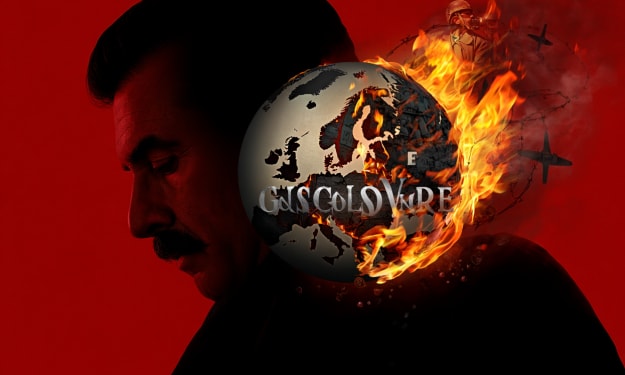
"The Man Who Altered History: The Dark Rise That Ignited the Deadliest War
History does not easily forget the names of those who change the course of humanity—sometimes for the better, and sometimes with devastating consequences. Adolf Hitler is a name etched into the darkest pages of the 20th century. His life and actions not only shaped the destiny of Germany but also plunged the entire world into a brutal conflict known as World War II, one of the deadliest wars in human history.
By Kamran khanabout a year ago in History
The Swing Still Hangs in the Garden.
The old garden behind my childhood home is silent now. The grass grows wild, the flowers bloom without anyone appreciating them, and the color of the fence has faded in years of sun and rain. But one thing remains — the swing.
By Echoes of Lifeabout a year ago in History
Why No Human Remains Have Ever Been Found Inside the Titanic Wreckage
When the RMS Titanic sank on April 15, 1912, over 1,500 passengers and crew members lost their lives in one of the deadliest maritime disasters in history. Yet, despite the tragedy’s magnitude and the numerous deep sea explorations of the wreck site since its discovery in 1985, not a single intact human body has ever been recovered from inside the Titanic wreckage. Why? It is a question that has long puzzled the public and even some researchers. The answer lies not in mystery or conspiracy but in harsh scientific realities involving the conditions on the ocean floor, natural decomposition processes, and the passage of over a century beneath crushing pressure and darkness. The Titanic lies about 12,500 feet or 3,800 meters below the surface of the North Atlantic Ocean. At this depth, the water temperature hovers just above freezing at around one degree Celsius or 34 degrees Fahrenheit. While cold temperatures slow down decomposition, they do not stop it. More importantly, the seabed at that depth is rich in microorganisms and scavengers that thrive in such extreme environments. These creatures include bacteria, fungi, and small marine animals like crabs and worms which consume organic matter including human flesh and bone. Researchers believe that any human remains that initially settled near or inside the wreck would have been completely consumed within a matter of decades. The rate of decomposition may have been slow but over more than 100 years, no biological material could realistically survive. The Titanic's wreck is also being slowly eaten away by iron-eating bacteria, particularly a species known as Halomonas titanicae, which was discovered on the ship’s hull. These microbes are devouring the metal and forming rusticles that hang like icicles from the ship’s structure. Over time, this has weakened the wreck significantly and has caused many rooms and structures to collapse. This ongoing breakdown has disturbed and buried much of the interior, making the preservation of any remains highly unlikely. Even if bones or items had once been present, they would have likely been crushed, disintegrated, or buried beneath collapsed decks and thick layers of sediment. Most of the people who died in the Titanic disaster perished in the freezing surface waters, not inside the ship itself. Their bodies were exposed to waves, currents, and marine life almost immediately. In the weeks following the disaster, about 300 bodies were recovered from the ocean. These were mainly floating or found in lifeboats. However, the vast majority were never recovered. Over time, any bodies that sank would have been scattered across the ocean floor or decomposed due to exposure, pressure, and marine organisms. Even on the seabed, bodies would not have remained whole. Bones dissolve slowly in saltwater over decades, especially if not protected in sealed, oxygen-free environments. At Titanic’s depth, such preservation is nearly impossible. Though no actual human remains have been found in the wreck, explorers have occasionally discovered haunting clues to where victims may have once rested. In some places, divers have found pairs of shoes still lying side by side on the ocean floor, suggesting that a body once lay there. These artifacts such as boots, belts, luggage, and jewelry serve as silent witnesses to the tragedy. While the organic matter is long gone, these belongings tell the stories of the people who wore or carried them. The Titanic wreck is considered a maritime graveyard and most expeditions treat it with the reverence of a sacred site. There is a strong ethical stance among researchers, explorers, and international law to respect the final resting place of those who perished. This means that even if human remains were somehow discovered in a protected pocket of the wreck, they might not be publicly disclosed or disturbed out of respect for the dead. More than a century after the Titanic vanished beneath the waves, its story still grips the world. But the absence of human remains in the wreckage is not a mystery. It is the result of natural processes, oceanic decay, and time. While the bones of those who died have long returned to the sea, their legacy endures in the ship’s ghostly corridors, in personal relics that remain, and in the lessons learned from one of history’s greatest maritime tragedies. Though the people are gone, the silence of the deep speaks volumes and the Titanic still rests, carrying with it the memories of all those who were lost.
By DigitalAddiabout a year ago in History
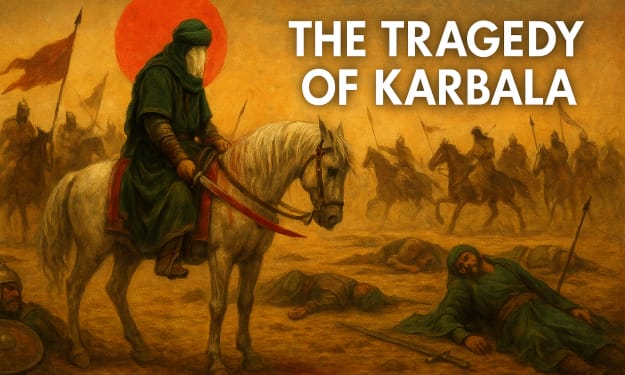
The Tragedy of Karbala
Karbala: 9th and 10th Muharram – The Eternal Stand In the year 680 CE (61 AH), on the scorched plains of Karbala, a small group of devout men, women, and children stood against tyranny in one of the most defining moments of Islamic history. It was the 9th and 10th of Muharram—the days forever etched into hearts as symbols of sacrifice, faith, and unwavering courage.
By Said Hameedabout a year ago in History
The Price of the American Dream: What I Learned on July 4th
The Price of the American Dream: What I Learned on July 4th 📖 Story: The Price of the American Dream: What I Learned on July 4th Since I was a child, I had only one wish—to see America on its Independence Day. Not because I wanted money, or to escape, or even for citizenship. It was deeper than that. I grew up in a village where the electricity would often vanish during dinner, where freedom meant not being noticed by the wrong people, and where silence was safer than honesty. But in America… they lit the sky with fireworks to celebrate being free. The First Spark I first saw the fireworks on a cracked YouTube screen in a small internet café. The video was titled: “July 4th Fireworks Over Washington DC – 2020.” The sky exploded with red and gold. People cheered. Kids waved flags. There was music and freedom in the air. That was the moment I made a quiet promise to myself: > “One day, I will see it with my own eyes.” The Journey to a Dream In 2024, I won a U.S. visitor visa through an education program. I had written an essay called “The Meaning of Freedom in My Village.” To my surprise, someone read it—and gave me a chance. On July 2nd, 2024, I stepped off a plane in New York City. My hands shook. And when I saw the American flag waving above JFK airport, I quietly whispered: > “Freedom, I am here.” The Moment I Waited For I stood near the Lincoln Memorial as families gathered, waving flags, smiling. A little girl gave me a mini flag and said, “Happy Fourth!” Then the fireworks began. The sky cracked open. The sound, the colors—it all hit my chest like thunder. My heart swelled with something I had never fully felt before. > Hope. The Shift But then… something changed. A man nearby, in military gear, said into his phone: > “Look at that guy—probably from some terrorist country. Watching us like he’s spying.” He was pointing… at me. People looked at me differently. The girl’s family quietly stepped away. One man gripped his bag tighter. Another whispered something behind me. No one stopped me. But in that moment, I felt completely alone The Realization Back in my room, I sat with the flag the girl gave me and thought deeply. > Freedom is not a show. It’s a struggle. Even in America, people fight—for equality, for justice, for identity. Some welcome you. Some fear you. But everyone is free to choose. That’s what makes it beautiful—and difficult. Thank You, America I stayed two more weeks. I met kind people. Visited libraries and museums. I saw a country that’s not perfect—but still filled with dreamers. > America is not a dream. It is millions of people dreaming differently. Now, when I think of July 4th, I smile—not for the lights, but for what I learned: > Freedom is not given. It is felt. It is fought for. And sometimes feared.
By Ali Asad Ullahabout a year ago in History
The Pyramids of Giza (Part 1)
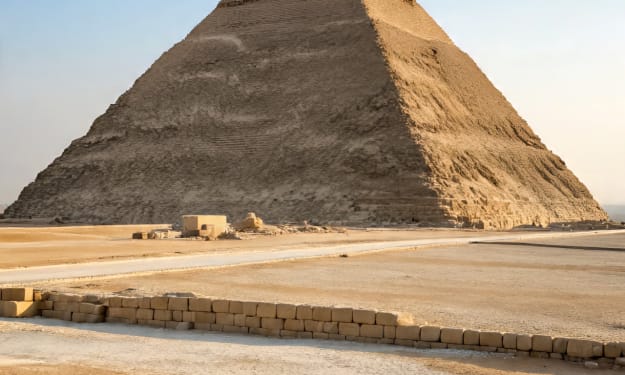
The Timeless Majesty of the Pyramids of Giza The Pyramids of Giza, rising from the desert near the Nile’s western bank, stand as eternal symbols of ancient Egypt’s grandeur. These magnificent monuments—built during the 4th Dynasty (c. 2575–c. 2465 BCE)—are among the most celebrated wonders in human history. Designated a UNESCO World Heritage Site in 1979, they continue to capture imaginations around the world. At the heart of this complex are three pyramids, each named after the kings for whom they were built: The Great Pyramid of Khufu (Cheops) is the oldest and largest. Originally standing at 481.4 feet (147 meters), it remains the most colossal single structure ever constructed. The Pyramid of Khafre (Chephren), the second-largest, is distinctive for the remaining outer limestone casing at its peak. The Pyramid of Menkaure (Mykerinus) is the smallest of the trio, yet equally symbolic of Egypt’s architectural ingenuity. Each of these massive structures was accompanied by mortuary temples, valley temples, and subsidiary pyramids for royal family members. Surrounding them are extensive fields of mastabas—flat-roofed tombs for nobles and officials, arranged in organized grid patterns. Engineering Wonders The Great Pyramid is a marvel of engineering. Comprising over 2.3 million limestone and granite blocks, it weighs approximately 5.75 million tons. The construction reflects astonishing precision: its sides are aligned almost perfectly to the cardinal points, and the internal chambers—especially the King’s Chamber lined with granite—demonstrate technical mastery still studied by engineers today. Beneath the surface, a maze of corridors connects rooms like the Queen’s Chamber, Grand Gallery, and burial chamber. Scholars debate the function of narrow shafts leading outward from the King’s Chamber—some suggest religious significance, while others propose ventilation. Who Built the Pyramids? According to ancient historian Herodotus, the Great Pyramid took 20 years to complete, using the labor of 100,000 workers. However, modern excavations near the pyramids reveal evidence of a smaller but permanent labor force—possibly 20,000 workers including support staff like bakers and physicians. These workers lived in organized communities, not enslaved but rather skilled laborers working in shifts, especially during the Nile flood season when agriculture paused. The Great Sphinx Guarding the plateau is the Great Sphinx of Giza, a limestone statue with the body of a lion and the face of a man—believed to represent King Khafre. Measuring 240 feet long and 66 feet high, the Sphinx likely formed part of Khafre’s funerary complex. Its missing nose has become a point of historical mystery, often attributed to vandalism in later centuries. Treasures and Tombs In 1925, near the causeway of Khufu’s pyramid, archaeologists unearthed the tomb of Queen Hetepheres, Khufu’s mother. Though her sarcophagus was empty, it was surrounded by exquisite furniture and jewelry, showcasing the artistry of 4th-dynasty craftsmen. Inside the pyramids, the original grave goods are missing—likely due to looting in ancient and medieval times. The structures have also lost much of their smooth outer casing of white limestone, which once gave them a radiant appearance under the sun. --- A Legacy Carved in Stone The Pyramids of Giza are not just remnants of the past—they are living monuments that bridge the ancient and the modern. They remind us of a civilization that understood architecture, astronomy, mathematics, and spirituality to a profound degree. Even after 4,500 years, they continue to inspire awe, raising timeless questions about human potential, purpose, and the legacy we leave behind.
By Muhammad Tayyab about a year ago in History
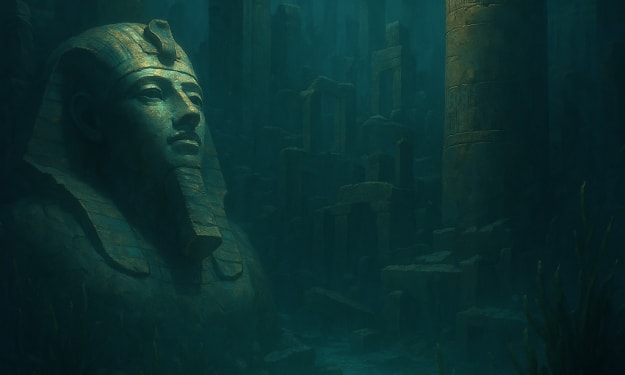
Heracleion: Egypt's Sunken Secret: The City the Gods Forgot
Beneath the Waves, a City Sleeps Located off the coast of modern-day Alexandria, at the meeting point of the Mediterranean's azure waters and the northern edge of Egypt, lies a forgotten city. Sunken beneath the waves for over a thousand years, Heracleion, known as Thonis by the Egyptians, was once a gleaming jewel of ancient power, wealth, and divine mystery.
By The Secret History Of The Worldabout a year ago in History
The Forbidden Books: Secrets Humanity Was Never Meant to Read
The Books That Frighten the World In a world overflowing with information, certain books remain locked away—sealed behind vaults, buried in monasteries, censored by religious authorities, or veiled in mystery. These are not ordinary volumes of philosophy or history. They are texts so controversial, so enigmatic, or so powerful that reading them was once punishable by death. From medieval grimoires and occult manuals to mysterious coded manuscripts and books said to be written with the devil’s hand—these are the forbidden books of history.
By DRE Explainsabout a year ago in History