Ancient
Title: The Year 536: A Tale of Unprecedented Calamity and Resilience
Once upon a time, there was a year that stood out as the paramount epitome of wretchedness. It was a year so bleak, so saturated with darkness and despair, that even historians and scientists concurred, labeling it the undisputed worst year in history. This infamous year, surprisingly, was not 2020; rather, it was the year 536, according to medieval historians. This marked the inception of an extraordinarily arduous period for humanity, and here's the tale.
By Emmanuel Nwoye3 years ago in History
Advanced Ancient Devices That We Still Uncertain About
Life in Simpler Times When we think of our ancestors, most of us probably picture them living in societies where technological advancements were limited, and people led fairly simple lives. While some might consider a life without Wi-Fi and smartphones simple, our ancestors lived even simpler lives. You might be surprised to know that some of the inventions from their time continue to baffle us today.
By Johnson Bennis3 years ago in History
''The mysterious sealed temple door that no one can open: Padmanabhaswamy's final door''
In a world steeped in history, with countless generations having come and gone, it's naive to believe that there aren't ancient secrets waiting to be uncovered. Our ancestors have passed down knowledge from one generation to the next, but what about the ancient wisdom lost to the sands of time? Is it our modern duty to unveil these enigmatic secrets, or were they intentionally buried in history's depths? One such mystery is the Sri Padmanabhaswamy Temple, a marvel of antiquity and opulence.
By Johnson Bennis3 years ago in History
The Epic Saga: The Rise and Fall of the Sumer and Akkad Empires
Today, I wind up enraptured by the captivating and complicated history of the ascent and fall of the Sumer and Akkad domains, two of the earliest and most persuasive civic establishments in the records of mankind's set of experiences. These old social orders, settled in the support of civilization known as Mesopotamia, assumed an essential part in molding the course of human turn of events, offering us significant illustrations about the ascent and fall of realms.
By Kyrol Mojikal3 years ago in History
Unraveling the Mystery of the Sakara Bird: Did the Ancient Egyptians Invent the Plane?
In 1898, you find yourself amidst the vast excavations in Sakara, a place not far from Cairo, teeming with ancient tombs and pyramids. You're in your Indiana Jones mode, hoping to unearth something truly extraordinary that could propel you to fame. Amongst the gold, manuscripts, treasure maps, and mummies of famous pharaohs, you stumble upon an unassuming wooden bird. Disappointment sets in as it appears to be a simple, albeit old, toy
By Johnson Bennis3 years ago in History
Taoism and the Concept of the Tao
Taoism, an ancient Chinese philosophical and spiritual tradition, offers profound insights into the nature of existence, the human experience, and the path to harmony and balance. At the heart of Taoism lies the concept of the Tao (pronounced "dao"), a term that defies easy definition and encapsulates the essence of this philosophy. In this article, we will explore the origins and foundational principles of Taoism, delve into the concept of the Tao, and reflect on its enduring relevance in our complex modern world.
By MysterioVerse3 years ago in History
The great Mystery of Pyramids
The Great Pyramid of Giza, one of the Seven Wonders of the ancient world, continues to captivate the imagination of millions of tourists who flock to Egypt each year. This iconic monument, situated just 50 miles from modern Cairo, serves as a time machine, transporting visitors thousands of years back in history. While the pyramids themselves contribute to this sense of time travel, the intrigue surrounding their construction has long been a topic of debate and research, raising one central question: how was the Great Pyramid built? Were aliens involved in this monumental endeavor? The good news is, you don't have to wait for time travel to be invented to find out the answer, as the mystery has finally been unraveled.
By Darshani Wijerarthna3 years ago in History
Thebes-Luxor
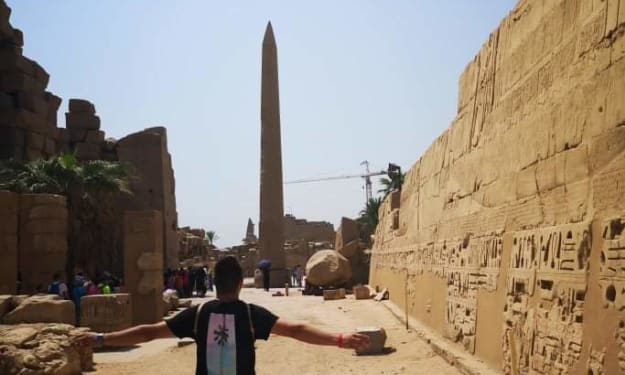
Thebes, also known as Waset in ancient Egyptian, was one of the most significant and powerful cities in the ancient world. Located on the east bank of the Nile River in present-day Luxor, Egypt, Thebes was the capital of the New Kingdom during Egypt's Middle and Late Bronze Ages (c. 16th to 11th centuries BC). It was a city of immense historical, cultural, and religious importance, and its legacy continues to influence our understanding of ancient Egypt.
By Haris Hadzic3 years ago in History