Ancient
10 mysteries about prehistoric humans
10 major problems about ancient humans still have no official answers from scientists. 10. Why do we have a big brain? There is no doubt that a large brain has given humans an absolute advantage in this world. But to maintain the brain to function normally, we have to pay an unbelievably expensive price. The brain only accounts for 2% of the body's weight, but consumes up to 20% of the body's energy. Until 20 thousand years ago, if calculated based on body shape, the brains of our ancestors were almost no bigger than monkeys or apes.
By Ken Daklak2 years ago in History
Lost City of Atlantis. AI-Generated.
In the annals of history and myth, few tales captivate the human spirit like that of Atlantis – a lost city submerged beneath the waves, shrouded in mystery and wonder. As ancient as time itself, the legend of Atlantis has transcended generations, sparking imaginations and igniting quests for discovery. From the pages of Plato's dialogues to modern-day explorations of the ocean depths, the allure of Atlantis persists, beckoning adventurers and scholars alike to unravel its enigmatic secrets. Join us on a journey as we embark on the quest to unveil the fabled city of Atlantis and unlock its hidden truths.
By Dilesmeyyy<32 years ago in History
What are the unsolved secrets of the automatic tower?
There are more than a hundred pyramids in Egypt, but the most famous are the three pyramids on the Giza Plateau. They are the tombs of three pharaohs from the Fourth Dynasty of ancient Egypt and are known as one of the "Seven Wonders of the Ancient World". Khufu Pyramid is the largest pyramid, each stone used for construction was transported from a limestone quarry across the Nile River, weighing from 2.5 tons to 15 tons.
By Ken Daklak2 years ago in History
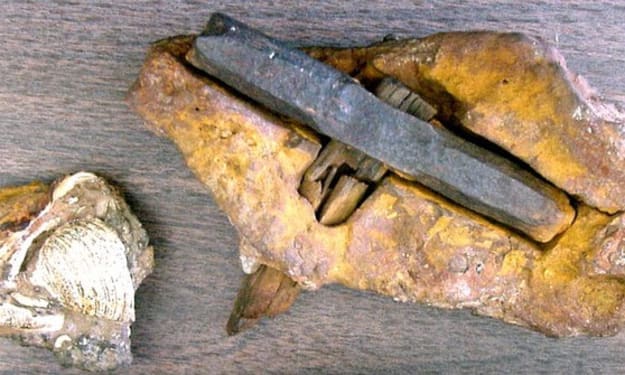
London Hammer: The mystery of the ancient hammer or an elaborate hoax?
In the annals of strange discoveries, the "London Hammer" stands as a particularly fascinating case, and it has generated debate and interest for decades. In June 1936, Emma Zadie Hahn and her husband Max Edmond Hahn stumbled upon a strange artifact as they strolled along Red Creek in the town of London, Texas – a piece of wood protruding from what appeared to be a block of wood. old stone.
By Ken Daklak2 years ago in History
The Bermuda Triangle Mystery. AI-Generated.
How many eerie stories have you heard about airplanes and ships disappearing in the Bermuda Triangle? We guess quite a few. This vast area in the Atlantic Ocean, between Florida, Puerto Rico, and Bermuda, is notorious for its mysterious phenomena. Known as the Devil's Triangle, it has been the site of numerous unexplained vanishings. Over the years, countless planes and ships have disappeared here under unknown circumstances, with some never being found.
By Dilesmeyyy<32 years ago in History
The Expansive Realm of History
**What History Includes** History encompasses a wide range of definitions and applications. In the broadest sense, it considers every action and thought that humans have had since their first appearance, recording every significant advance or setback. It attempts to evaluate all the developments in various fields such as science, art, literature, philosophy, architecture, sociology, politics, war, religion, and law. By doing so, history aims to create as complete a picture as possible of everything that has influenced humanity directly or indirectly.  **Points of View** History has not always been interpreted so broadly. For a long time, historians were primarily concerned with politics. Freeman, a prominent 19th-century English historian, defined history as “past politics.” Herodotus, the first great historian, neglected social and economic forces, focusing instead on the personal element. Today, students of history disagree on which aspects are most important. Economic determinists claim that “the fundamental condition of all life is economic,” emphasizing the role of economic forces in shaping history. Conversely, hero-worshipers and others believe that individual people are paramount, highlighting the significant impact of great men and women. These views represent extreme positions: the economic determinist view is fatalistic, ignoring ethical forces and minimizing the importance of significant individuals, while the hero-worshiper view fails to recognize that great people are products of their times rather than creators of them. The correct interpretation of history involves a combination of these views in a balanced form.  **Function of History** History has often been used and distorted for selfish purposes. Clergy members have used it to glorify and promote the interests of the church. Statesmen have utilized it to sway masses, and writers have distorted facts to support their conclusions. The spirit of war has been kindled through the undue emphasis on certain facts or even through falsification. In the United States, Northerners and Southerners insist on different interpretations of the Civil War. Historians may exaggerate their own country’s history—sometimes unintentionally because of their environment, and sometimes intentionally to facilitate the sale of their books. In all countries, there are passionate individuals in influential positions who cannot bear to have their homeland criticized. Patriotism often leads to the sacrifice of truth. Henry C. Lea, an outstanding American historian, declared that history should be “a serious attempt to ascertain the severest truth as to the past and set it forth without fear or favor.” Michelet, a famous French historian, believed that “sacrilege and the mocking of false gods are the historian’s first duty, his indispensable instrument for reestablishing the truth.”  **The "New History"** Progress in the direction indicated by Lea and Michelet has been slow, but there is a trend toward a broader and more inclusive point of view in the writing and teaching of history. World history, correctly interpreted, places individual states in the proper perspective and reduces the dangers of excessive nationalism. History has become more than war and politics. To make the story complete, modern historians use the work of ethnologists, anthropologists, geographers, archaeologists, geologists, psychologists, astronomers, zoologists, biologists, chemists, sociologists, and economists. They are concerned with cultural advances and societal changes, as well as with charters, constitutions, and wars. There are dangers, as well as virtues, in the vast scope of the “new history.” Over-popularization and under-specialization can cheapen history and undermine its depth as a serious study. Understanding the broad scope of history is beneficial, but students should also appreciate its depth. Years of research and numerous volumes have been dedicated to single topics. Without these specialized works, broad surveys would lack value. For example, Professor Bernadotte Schmitt wrote a two-volume work on the few days preceding the outbreak of World War I, while H.G. Wells wrote a comprehensive history of mankind from creation to the present time in a similar number of pages. Both authors made significant contributions to historical knowledge, but from different perspectives. Some new historians have sacrificed important facts to create a narrative filled with heroic figures and romantic events. Historians should include both grim realities and romantic incidents to make their descriptions of the past lifelike.  **Is History a Science?** There is significant debate over whether history is a science. Historians focus on the character, reliability, and flaws of their sources. Facts can be organized systematically, but the information is less precise than that available in the natural sciences. Historians do not have the direct experience of the phenomena they try to explain. For example, Napoleon’s expedition to Moscow cannot be reproduced in a laboratory. Each individual is unique, and no two people are alike in every aspect. Every person has something unique in spirit, if not in body. As Goethe said, “the best in man has no form.” Professor James H. Robinson concluded that “the historian, from a narrow scientific point of view, is a little higher than a man of letters and a good deal lower than an astronomer or a biologist.” 
By Abdulsab Hunnur2 years ago in History
The Evolution of Early Indian Civilization
The Pre-Formation of Indian Civilization Human habitation in the Indian subcontinent dates back approximately 500,000 years, as evidenced by stone age sites ranging from the southern regions of Kerala and Tamil Nadu to the Soan and Beas river valleys in northern Punjab. These early sites are scattered across the subcontinent, with some estimated to be between 400,000 and 150,000 years old. The presence of these early human communities indicates a rich and prolonged period of prehistory in the region. Middle Stone Age societies emerged between 40,000 and 10,000 years ago, followed by communities using microlithic tools around 15,000 years ago. Some of these microlithic communities coexisted with the first Neolithic communities around 7000 BCE. Both cultural types, along with hunting-gathering and nomadic pastoral economies, persisted across the subcontinent. The rich rock art found at sites like Bhimbetka in Madhya Pradesh, which includes Middle Stone Age as well as microlithic representations, provides a window into the lives and practices of these early humans. The Neolithic Transition Around 7000 BCE, Neolithic communities began forming in the valleys that drained the mountains separating the Indian subcontinent from Afghanistan and continental Asia. By 4000 BCE, these hunter-gatherer societies had evolved into more complex communities of farmers and artisans. These Neolithic communities lived in settlements characterized by circular mud-covered bamboo huts. The earliest known of these settlements were in Baluchistan, soon followed by similar communities in the Gangetic plain and on the Deccan plateau. Archaeological discoveries in these regions have unearthed Neolithic assemblages that include domesticated cattle, sheep, goats, and plants like rice. The transition from Stone Age cultures to Iron Age communities by 1000 BCE marked a significant evolution in early Indian civilization. This period saw distinct developments in different parts of the subcontinent, reflecting a diversity of cultural practices and technological advancements. The Mesopotamian Connection The microlithic tool-makers who settled in Mehrgarh, in the Bolan River basin in Baluchistan, initiated a transformative phase in early Indian society. This challenged the earlier beliefs held by European scholars, who posited that an urban civilization in northwestern India emerged suddenly in the mid-third millennium BCE, influenced by Mesopotamian colonists. They believed this urban culture was static, uniform, and collapsed due to Indo-Aryan invasions from Central Asia. This view, dominant until the 1950s, was based on limited field data and neglected the ecological variations and earlier human occupations. The accidental discovery of Mohenjo-Daro shifted scholarly focus from the antiquity of Indo-European languages to the urban ruins of the Indus basin. The emphasis on Sanskrit and the Vedic hymns had long overshadowed the indigenous origins of early Indian civilization. Revisions in Understanding Recent decades have significantly revised this understanding. Evidence of farming communities in the northwest, predating the urban phase by millennia, showed a continuous evolution from agricultural to urban societies. Mehrgarh, the earliest of these communities, provides substantial evidence for this long developmental period. This evidence suggests a gradual and indigenous process leading to the pre-formation of Indian civilization by around 500 BCE. The comprehensive archaeological findings at Mehrgarh reveal that its inhabitants, as early as the seventh millennium BCE, constructed multi-room mud-brick buildings, crafted stone tools, and cultivated barley and wheat. They buried their dead with tools and ornaments, and practiced goat sacrifice, indicating complex social and cultural practices. By 5000 BCE, buildings had grown larger and some served communal storage purposes. The increase in specialized crafts, such as basketwork, textiles, pottery, and copperware, points to significant indigenous advancements. Technological and Urban Developments By the mid-fourth millennium BCE, new technologies emerged in Mehrgarh, including wheel-thrown pottery, larger copper ingots, and advanced mining and smelting techniques. These developments illustrate a significant, indigenous evolution towards urbanization. These technological advancements challenge earlier assumptions that early Indian civilization was heavily influenced by external factors. In summary, the pre-formation of Indian civilization was a complex, multi-millennial process involving a gradual transition from simple stone age societies to advanced urban communities. This evolution was marked by significant indigenous innovations and cultural practices, laying the foundation for the rich and diverse civilization that would emerge in the Indian subcontinent.
By Abdulsab Hunnur2 years ago in History
The Journey of a Zen Master and the Birth of Kung Fu
In the year 496, the emperor of China ordered the construction of the Shaolin Temple on Mount Sung in Honan Province, southeast of Loyang. Many people today believe the temple was built for Bodhidharma, the legendary monk who brought Zen Buddhism to China, but in reality, it was constructed for another Indian meditation master. Despite its historical significance, the temple now stands as a major tourist attraction.
By Abdulsab Hunnur2 years ago in History
The truth about the mysterious hairdresser at Lovelock Cave
Lovelock Cave in Nevada (USA) was first discovered in 1913. In 1924, an archaeological expedition from Berkeley University began to investigate and explore. Lovelock Cave - about 12 meters deep and 18 meters wide - was originally called Horseshoe Cave due to its U-shaped interior.
By Ken Daklak2 years ago in History
The History of Embroidery: From Ancient Art to Modern Fashion
Embroidery is a timeless art form that has adorned clothing and textiles for centuries, weaving intricate patterns and stories into fabric. From its ancient origins to its place in contemporary fashion, embroidery has evolved significantly. Today, it adds a touch of elegance and craftsmanship to modern garments, such as the stunning black dress with embroidered flowers available at BTK Collection. Let’s delve into the fascinating history of embroidery and explore how this ancient art continues to influence modern fashion.
By BTK COLLECTION2 years ago in History