Ancient
Ancient Lovers: A 3,000-Year-Old Embrace Discovered in Ukraine
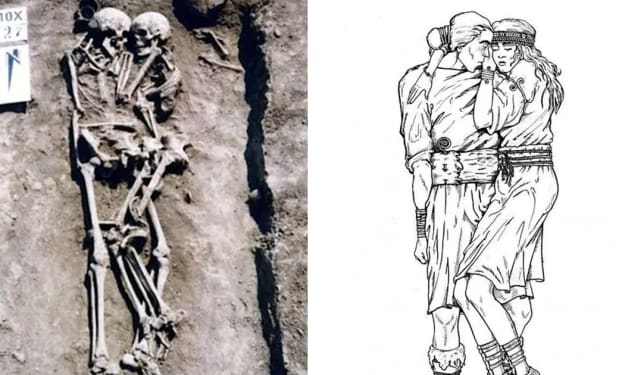
In a poignant reminder of the enduring power of love, archaeologists in Ukraine have unearthed the remains of an ancient man and woman locked in a loving embrace for 3,000 years. This extraordinary discovery near Petrykiv village, south of Ternopil in western Ukraine, offers a rare glimpse into the intimate and ritualistic practices of the prehistoric Vysotskaya—or Wysocko—Culture. The Discovery The burial site, unearthed by a team of archaeologists, revealed the skeletal remains of a man and a woman, their bones intertwined in a seemingly eternal embrace. The condition of the remains suggests that the couple were buried simultaneously, with the woman positioned in a manner that indicates she was willingly entombed alive to accompany her deceased husband into the afterlife. Such a discovery is exceptionally rare and provides valuable insights into the burial customs and social dynamics of the Vysotskaya Culture, which flourished during the Late Bronze Age. This culture, known for its distinctive pottery and burial practices, inhabited regions of modern-day Ukraine, Poland, and Belarus. The Vysotskaya Culture The Vysotskaya Culture, dating back to around 1100–700 BCE, is characterized by its unique ceramic styles, fortified settlements, and complex social structures. The people of this culture practiced both inhumation (burial) and cremation, with grave goods often accompanying the deceased to signify their social status and beliefs about the afterlife. The discovery near Petrykiv adds a deeply personal dimension to our understanding of this ancient society. The joint burial of the couple suggests a profound spiritual or ritualistic significance, indicating that beliefs about life, death, and the afterlife were central to their culture. The Loving Embrace The positioning of the bodies in a loving embrace is not only a testament to the couple's bond but also a reflection of the cultural and spiritual practices of the time. The woman's decision to be entombed alive is a dramatic illustration of the depth of their connection and the societal expectations placed upon individuals in the Vysotskaya Culture. Archaeologists believe that such practices were part of a broader tradition in which individuals, often women, would voluntarily accompany their deceased partners into the grave. This act, while shocking by modern standards, was likely seen as a noble and honorable gesture, ensuring that the couple would remain united in the afterlife. The Archaeological Significance This discovery is significant not only for its emotional impact but also for its archaeological value. The well-preserved state of the remains allows for detailed analysis, providing insights into the health, diet, and lifestyle of the individuals. Additionally, the grave goods and artifacts found at the site can shed light on the material culture and technological advancements of the Vysotskaya people. The careful excavation and study of the site will enable archaeologists to piece together the broader context of the burial, offering clues about the social hierarchy, gender roles, and spiritual beliefs of this ancient society. Broader Implications The discovery of the embracing couple adds to a growing body of evidence that prehistoric societies had complex social structures and deeply held spiritual beliefs. Similar finds, such as the "Lovers of Valdaro" in Italy and the "Hasanlu Lovers" in Iran, suggest that the expression of love and companionship in death was a widespread phenomenon across different cultures and time periods. These discoveries challenge the often simplistic views of prehistoric peoples as purely survival-focused and highlight the emotional and spiritual dimensions of their lives. They remind us that the desire for connection and the fear of separation are timeless aspects of the human experience. Conclusion The ancient couple found near Petrykiv village in Ukraine, locked in a loving embrace for 3,000 years, offers a touching and profound glimpse into the past. Their story is a testament to the enduring power of love and the complex cultural practices of the Vysotskaya Culture. As archaeologists continue to study and interpret this remarkable find, we gain a deeper appreciation for the humanity of our ancestors and the ways in which they sought to navigate the mysteries of life and death. In a world where so much remains uncertain, the discovery of this ancient embrace serves as a poignant reminder that love, in all its forms, transcends time and endures through the ages.
By Deji Akomolafe2 years ago in History
Borobudur Tample
Once upon a time, in the heart of Java, Indonesia, there stood a super cool temple called Borobudur. Picture this: it's like a giant LEGO creation, but instead of blocks, it's made of stacked stone layers, with a bunch of statues and carvings thrown in for good measure.
By Royyan Alfian2 years ago in History
Prambanan Temple
Once upon a time, in the heart of Java, Indonesia, there stood a magnificent temple complex known as Prambanan. This place wasn't just any ordinary temple; it was like stepping into a time machine, whisking you back to the era of ancient kingdoms and divine tales.
By Royyan Alfian2 years ago in History
Echoes of Ancestors: Embracing Spiritual Wisdom
Foster Williams Eboigbe, a native Esan from Edo State Nigerian, was fascinated and terrified by a mysterious dream that kept coming back to him night after night and entwined itself around his subconscious. This dream always began at the edge of an enormous, old forest. The trees towered over him, their twisted branches creating a thick canopy that let in very little light. A cool breeze sent shivers down his spine and the air was heavy with mist. An owl hooted in the distance, its eyes burning like fire as it watched him every move.
By Foster Williams2 years ago in History
Achilles
Introduction Achilles, the unparalleled hero known for his strength and bravery, is one of the most famous figures in ancient Greek literature. His story is prominently featured in Homer's "The Iliad," where he plays a central role in the events of the Trojan War. In this detailed account, we will explore the life of Achilles, from his birth to his death, and delve into the different facets of his legendary character.
By nader Asaad2 years ago in History
THE TRUTH BEHIND THE PIRAMIDS
No matter how many times you lay eyes on the Great Pyramid, it never fails to amaze. The sheer size, symmetry and the fact that it has stood here for four and a half thousand years is mind-blowing. Take a moment to absorb it all, especially when you step into the tomb of Pharaoh Cheops, also known as Khufu.
By kalasa Aaron 2 years ago in History
D-Day at 80: The Unsung Hero Eisenhower Lauded as a War Winner
Eight decades since D-Day: The Unsung Hero Eisenhower Lauded as a War Winner As we mark the 80th anniversary of the Normandy invasion, it's time to remember a figure whose unconventional path and innovations played a pivotal role in the Allied victory. Andrew Jackson Higgins, often overlooked, was not your typical war hero. A maverick in the defense industry, Higgins had a rough-and-tumble past, having been expelled from high school over fights and known for his penchant for bourbon—even while working. Despite facing bankruptcy several times, Higgins became a key player in World War II, described by Dwight Eisenhower as "the man who won the war for us."
By Olawale Abaire2 years ago in History
Christian Denominations Explained: Differences and Similarities
Understanding the variety of Christian denominations can feel a bit like navigating a candy store with a blindfold on. You know it's all sweet, but you have no idea what you're about to bite into. While all Christian denominations share a core belief in Jesus Christ and his teachings, the flavors of their doctrines, practices, and traditions can vary widely. Here’s a humorous and engaging guide to some of the major Christian denominations, their differences, and their similarities.
By Alexander Mensah2 years ago in History
Christian Perspectives on Social Justice and Charity
When you think of social justice and charity, you might picture grand movements and influential figures making waves in society. But if you throw Christianity into the mix, you get a historical cocktail that's been stirring things up for centuries. From quirky saints who probably smelled like they've been rolling in the holy dirt for days to modern-day missionaries who could put marathon runners to shame, the Christian perspective on social justice and charity is anything but dull. Let's take a light-hearted yet enlightening journey through the Christian lens on these critical issues.
By Alexander Mensah2 years ago in History