Ancient
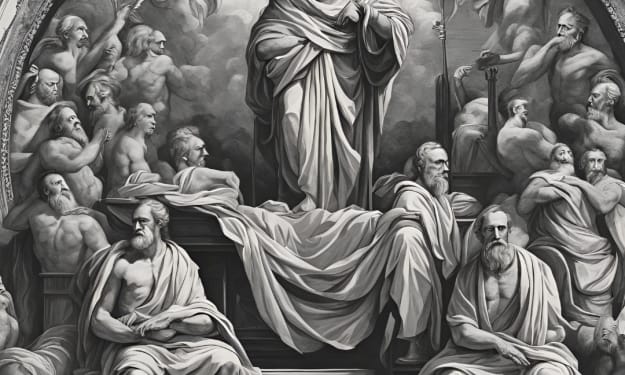
The Morning Ritual of the Stoics: Ancient Practices for a Peaceful and Meaningful Life
Start Your Morning with These 7 Valuable Questions 1.What am I grateful for today? 2.What challenges might I face, and how can I handle them with wisdom and composure? 3.What are my priorities for the day? 4.How can I act in accordance with my values and principles? 5.What actions can I take to advance my goals? 6.How can I embody virtues like wisdom, courage, justice, and temperance? 7.What are the worst-case scenarios I might encounter, and how can I handle them with grace?
By Amaan khan2 years ago in History
An Imaginary Journey into a World Without Humans: What Would Have Happened If Our Ancestors Had Disappeared?
Today, with over 8 billion people on Earth, it's hard to believe that around 900,000 years ago, humanity was on the brink of extinction. Our ancestors faced such a severe crisis that only 1,280 individuals remained—a number equivalent to a small village. During this critical period, nearly 98% of the human population disappeared, and this demographic bottleneck lasted for over 100,000 years. The exact reasons for this crisis remain unclear, but drastic climate changes were likely the main cause.
By Nathan Talek2 years ago in History
5 of the World's Grandest Natural Secrets
Our planet, a vibrant tapestry of life and landscapes, holds countless mysteries waiting to be unveiled. From the depths of the ocean to the peaks of the highest mountains, nature has crafted wonders that continue to baffle scientists and inspire awe in explorers. Let's delve into five of the world's most enigmatic natural phenomena.
By Moharif Yulianto2 years ago in History
Six of the most lovely segments of the Incomparable Mass of China
Having lived in Beijing for right around 12 years, I've had a lot of opportunity to travel generally in China. I've visited in excess of 100 urban areas, also endless towns and towns all through the central area's 31 territories.
By Alfred Wasonga2 years ago in History
Exploring Myanmar
Myanmar's shift from seclusion to accessibility has been a swift one since 2011, with the country embracing reforms and opening up to the world. The IW River serves as a vital artery for transportation in Myanmar, linking significant historical sites. Living in a Buddhist nation along the river brings a unique perspective. The river's constantly shifting navigable channel is due to the large amounts of sediment it carries from the mountains. In a riverside village, the tradition of domesticated elephants with personal trainers is deeply rooted. Women spend long hours working barefoot in the cold water, amidst the deafening noise of pumps. Gold is transported on ramps with flowing water. The influence of British writer George Orwell can be seen in Qatar, particularly in his novel 'Burmese Days,' which highlights the British elite's elitism and arrogance. Tin Andai's business relies heavily on the river and the famous Napier fish found in Qatar. Mr. U Tin Tang, a fisherman, shares a house with his extended family of 28 people. The presence of dolphins in the river uniquely aids fishermen. Bamboo is a crucial commodity transported widely on the river, with families journeying downstream on rafts. Mandalay, the former royal capital of the Burmese Kingdom, now presents a modern facade. British troops dethroned Mandalay in 1885, and the city, with a population of 1.6 million, remains deeply influenced by Buddhism. Monasteries in Mandalay offer free education and internet access to young monks and orphans, with the Fang Dau monastic school being renowned for its dedication to providing education to those in need.
By Isaac Ekow Anyidoho2 years ago in History
Unearthing Ancient Enigmas
In the remote sand dunes of northwestern Peru, archaeologists have uncovered a remarkable find that sheds new light on the ancient religious practices and architectural prowess of pre-Incan cultures. A team of researchers, led by Luis Armando Muro Ynoñán, director of the Cultural Landscapes Archaeological Project of Ucupe — Valle de Zaña, has unearthed the remnants of a ceremonial temple dating back an astonishing 4,000 to 5,000 years.
By Kevin MacELwee2 years ago in History