Ancient
Extremely Rare Statue of Ancient Ruler Unearthed: A 3,000 Year Old Discovery
Extremely Rare Statue of Ancient Ruler Unearthed: A 3,000 Year Old Discovery In the dust laden silence of an ancient excavation site deep in a once-forgotten valley archaeologists have unearthed a discovery that has sent ripples across the global historical community a remarkably well preserved and extremely rare statue of an ancient ruler believed to date back over 3,000 years. This isn't just a discovery of stone and sculpture; it’s a bridge to a world long buried beneath time wars and silence. It is moments like these that remind us how little we know about the rich tapestries of civilizations that thrived long before modern memory.
By Adnan Rasheedabout a year ago in History
The Roaring Silence: Revealing the Greatest Enigma of the Yali
Origins and Early Representations: The earliest recorded illustrations of Yalis can be traced to the Pallava and Chola temples in Tamil Nadu, dating as early as the 7th century CE. These mystical beings embellish columns, gopurams (temple towers), and even thrones. In these representations, the Yali frequently appears mid-roar, with colossal claws, razor-sharp fangs, and a serpentine tail coiling around ancient stone. In contrast to the well-documented deities of Hindu mythologyShiva, Vishnu, and Brahmathe Yali lacks a definitive origin narrative. It is neither a god nor does it play a significant role in the Puranas, Mahabharata, or Ramayana. Nonetheless, it appears repeatedly, almost obsessively, throughout temple architecture in Tamil Nadu, Karnataka, Andhra Pradesh, and Kerala. What is a Yali? Descriptions of the Yali differ widely. It is often depicted with the body of a lion, the head or tusks of an elephant, and at times, wings reminiscent of a bird or a trunk akin to a Makara (sea dragon). It is also illustrated engaged in combat with warriors, symbolizing triumph over malevolence or disorder. The composite aspect of the Yali has led numerous scholars to regard it as a guardian chimeraa mythical amalgamation of various animals, crafted to evoke fear and reverence. Despite its intimidating appearance, the Yali is not malevolent. Indeed, it is viewed as a guardian, vigilantly overseeing temple entrances and symbolizing bravery, valor, and the preservation of dharma (cosmic order). Symbolism and Function: The Yali is believed to embody the forces of naturepotent, unpredictable, and protective if honored. In Vastu Shastra (the ancient science of architecture), Yalis are thought to repel negative energies, serving as spiritual guardians. There is also a belief that Yalis represent manifestations of inner strength. Just as temples symbolize the microcosm of the universe and the human body, Yalis embody the inner beasts we must conquer through knowledge, devotion, and discipline. But why such significant emphasis on a creature with no established position in scriptural mythology? This inquiry leads us to the essence of the mystery. The Mystery: Why Was the Yali So Prominent? Historians and art analysts have suggested various theories: Dravidian Heritage: The Yali may derive from pre-Vedic Dravidian traditions, making it a remnant of a more ancient symbolic system that predates Hindu orthodoxy. This would elucidate why the Yali appears more frequently in South Indian temples than in the North. Royal Symbolism: The lion (Simha) and elephant (Gaja) represent long-standing symbols of authority and nobility. Merging these could have produced a super-symbol for dynasties such as the Cholas and Vijayanagar rulers to assert their divine sovereignty and invulnerability. Architectural Requirement Transformed into Myth: Some assert that the Yali originated as a design elementa robust, artistic embellishment utilized to reinforce heavy beams and constructions. Over time, individuals began to mythologize the being, ascribing powers and significance to its appearance. Lost Texts and Oral Traditions: Numerous regional legends were never inscribed but transmitted verbally. It is plausible that the Yali possessed a well-developed narrative tradition that has since disappeared or survived solely in temple art and folklore.
By Say the truth about a year ago in History
"I Spent a Week Living Like a 19th Century Aristocrat — Here’s What Modern Life Has Completely Forgotten"
My best friend, a history nerd with a flair for dramatics, challenged me to live an entire week like a 19th-century aristocrat. No electricity. No phones. No Uber Eats. Just corsets, candlelight, and carriages—or at least, their closest modern-day equivalents. I laughed. How hard could it be? A week of tea, long baths, and lounging around in lace sounded like a luxury spa retreat. Right? Wrong. Day One: The Corset Conundrum Before I even opened my eyes on Monday morning, I was already breaking modern rules. No alarm clock. Instead, I’d instructed a friend to knock on my door at 7 a.m. sharp, like a loyal footman. He was less loyal, more amused. I woke up to the sound of him snickering outside my apartment door. Getting dressed was the first hurdle. The corset I ordered online looked beautiful in the photo. In reality, it felt like a boa constrictor with anger issues. After 30 minutes of struggling and googling “how to breathe in a corset” (oops—cheated there), I was finally laced in and barely mobile. My gown, an explosion of ruffles and petticoats, turned a simple walk to the kitchen into a small-scale military operation. Day Two: Tea Time and Typing Trouble I swapped my usual iced coffee for a strong cup of Earl Grey, steeped using a stovetop kettle, naturally. Breakfast was toast and jam, made with ingredients I picked up from a local farmer’s market. So far, so good. Then came the letter writing. Since aristocrats didn’t text, I decided to write a handwritten note to my landlord about a leaky tap. My cursive was atrocious, my ink pen kept blotting, and by the end, my hand ached like I’d just transcribed a Shakespearean play. Still, there was something oddly satisfying about sealing a letter with red wax, like I was sending battle plans. Day Three: Candlelit Chaos That evening, I banned all artificial light. Out came the candles—dozens of them—giving my apartment a warm, flickering glow. It was romantic in theory. In practice, it was a fire hazard. I nearly set my curtain ablaze trying to light the chandelier knockoff I’d found at a thrift store. Bath time was another ordeal. I heated water on the stove and filled the tub, bucket by bucket. By the time it was ready, the water was lukewarm and I was exhausted. Aristocrats had staff. I had sore arms and a newfound appreciation for water heaters. Day Four: Dining with Decorum I hosted a dinner party, 19th-century style. No pizza. No takeout. Just roast chicken, potatoes, and an attempt at a pudding that resembled a Victorian jellyfish. My friends showed up in thrifted vintage outfits and were oddly excited to follow strict etiquette rules. No elbows on the table, napkins in laps, speak only when spoken to. Conversation, though, was the highlight. Without phones, we actually talked. For three full hours. About books, relationships, ambitions. It was intimate in a way I hadn’t experienced in years. Nobody checked their notifications. Nobody posted their plate on Instagram. We were fully present. And it felt… revolutionary. Day Five: The Great Outdoors (and Inconveniences) I decided to “take the air,” as 19th-century folks called it. I strolled through the park with a lace parasol and drew a few confused glances and more than one compliment. Without earbuds, I noticed birdsong, wind in the trees, and even a child giggling on a swing set. Nature felt louder. But so did the blisters from my leather boots. Fashion was pain back then—and let me tell you, they weren’t exaggerating. Day Six: Letters and Loneliness By now, the novelty was wearing off. My back ached from corsets, and I missed the convenience of streaming Netflix in my pajamas. The silence became louder too. Without constant digital distractions, I was left with my own thoughts. It was both peaceful and jarring. I wrote long letters to family members, which felt more vulnerable than a quick text or meme. Somehow, putting feelings on paper made them more real. I began to see why people once treasured love letters and journals. They were physical proof of connection. Day Seven: Reflection and Reality On the final day, I lay in bed—corset-free—watching the morning light pour in through the window. I hadn’t touched my phone in a week. I missed it, but not the way I expected. What I craved wasn’t the screen itself, but the illusion of productivity it gave me. The truth was, I’d gotten more done this week than in a month of multitasking. I’d read an entire book. Cooked actual meals. Slept like a log. I’d also learned what modern life has forgotten. We’ve forgotten how to be still. To truly connect. To let one task, one conversation, or one moment hold our full attention. We’ve traded presence for productivity, speed for depth. Living like a 19th-century aristocrat was inconvenient, exhausting—and profoundly enlightening. Final Thoughts No, I won’t be giving up my phone permanently or writing every message with a quill. But I’ll be lighting more candles, writing more letters, and treating dinner like a sacred pause rather than a pitstop. The past isn’t a place I want to live in forever—but it’s a place worth visiting. Because sometimes, the slowest way is the richest way.
By Nizam khanabout a year ago in History
The female horror film audience : viewing pleasures and fan practices. Part: 03
front a) mixed sex groups (usually) b) couples (often) c) female groups (sometimes) d) male groups (rare) middle a) couples b) groups (mixed sex?) rear a) couples b) female pairs or groups c) lone males (old)5 d) lone males (young) Even assuming that women make up only a small proportion of the mixed sex groups (these may well be dominated by males), anywhere between 25 and 50 per cent of Twitchell's audience could well be female. Clover's breakdown of the audience (p. 6) offers a slightly different picture: At theatre screenings ... the constituencies typically breakdown, in order of size, as follows: young men, frequently in groups but also solo; male-female couples of various ages (though mostly young); solo 'rogue males' (older men of ominous appearance andlor reactions); and adolescent girls in groups. Clover did not collect any data or make any personal observations of the cinema audience, instead relying on data reported by Austin (1983). She did, however, conduct a small scale survey of video rentals (p. 6-7), but these were from a very small sample of video stores and should not be taken as statistically significant. Clover collected rental figures for two rape-revenge films from three rental outlets in the San Francisco area for four weeks. Results showed that between 80 and 90 per cent of renters were male and renters of both sexes were mostly in their early twenties. However, these figures are unlikely to give any indication of who viewed the film once it had left the store. The mixed-sex group is notably absent from Clover's cinema audience. She also maintains that young men in single sex groups make up most of the audience, whereas Twitchell rarely or never saw such groups. Clover ranks all female groups as the lowest proportion of the audience, yet Twitchell's observations seem to contradict this. It may be that Clover and Twitchell are reporting on audiences from different geographical or class backgrounds, or different generic or historic audiences; it may also be possible that, while the adolescent male remains the majority viewer of the 80s slasher film, Clover.
By Silas Blackwoodabout a year ago in History
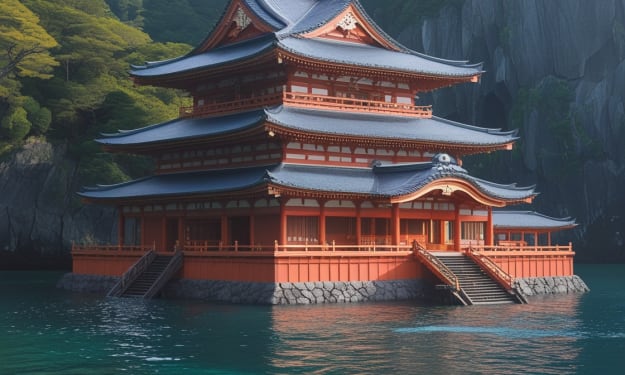
The Dragon King's Palace: Revealing the Subaquatic Treasure City of Japanese Mythology. AI-Generated.
The Mythical Origins of Ryūgū-jō Within the expansive realm of Japanese mythology, few narratives resonate with such awe as the chronicle of Ryūgū-jō (竜宮城), the Dragon Palace located beneath the ocean. Alleged to be the sphere of Ryūjin (龍神), the Dragon Deity of the sea, Ryūgū-jō is a splendid underwater palace crafted from coral, crystal, and precious metals. Its mythological foundations originate from early Shinto convictions and were further developed by Buddhist influences, folklore, and oral traditions transmitted through generations.
By Say the truth about a year ago in History
"The Dragon Through Time: Tracing the History and Origin of the Mythical Beast"
The Genesis of the Dragon Myth The notion of dragons predates documented history. Long before societies inscribed records on tablets or scrolls, tales of serpentine monsters and sky-beasts were transmitted orally through generations. Anthropologists speculate that the dragon myth may have originated from ancient humans discovering colossal fossilized bonespossibly of dinosaurs or large prehistoric mammalsand envisioning them as remains of formidable, mythical creatures. Another hypothesis posits that dragons are a fusion of humanity's primal fears: serpents, large felines, birds of prey, and flames. When amalgamated into one entity, you obtain something remarkably akin to the dragona formidable, fearsome predator that reigns over land, air, and occasionally even water. Dragons of the East: Symbols of Authority and Prosperity Nowhere is the dragon more esteemed than in Chinese culture. Contrary to being malicious, Chinese dragons (termed long or lung) are emblems of wisdom, rainfall, imperial power, and strength. Their likeness is observed in everything from ancient scrolls to contemporary festivals. The earliest allusions to dragons in Chinese mythology date back over 6,000 years. Archaeologists have uncovered dragon-like designs on pottery from the Neolithic Hongshan culture, and jade sculptures in the form of coiled serpents indicate that the myth held profound religious or ceremonial significance. In Chinese cosmology, dragons govern weather and waterrivers, oceans, precipitation, and floods. Unlike their Western counterparts, they are wingless, elongated, serpentine beings often depicted soaring effortlessly through the clouds. Emperors of China asserted lineage from dragons and frequently donned dragon robes. The "Dragon Throne" referred to the seat of imperial authority. Japan, Korea, and Vietnam cultivated similar dragon traditions, albeit with local modifications. The Japanese ryū is likewise a water deity, while Korean dragons were regarded as guardians residing in rivers or mountains and were known to admonish wrongdoers. Dragons of the West: Formidable and Ferocious In contrast, Western dragons emerged as representations of chaos, avarice, and devastation. They are commonly illustrated as winged, fire-breathing reptiles that accumulate treasure and terrorize settlements. One of the earliest references to such dragons originates from Mesopotamian mythology. The Babylonian creation epic Enuma Elish recounts the story of Tiamat, a primordial chaos dragon vanquished by the storm god Marduk. Similarly, in Greek mythology, the hero Heracles must conquer the Hydra, a multi-headed serpent-like creature, as one of his tasks. Dragons entered European mythology through Greco-Roman narratives and subsequently through Norse, Celtic, and Christian conventions. In Christianity, the dragon frequently represents Satan or wrongdoing. The narrative of Saint George conquering the dragon evolved into a well-known medieval fable that illustrated Christian morality prevailing over malevolence. Such narratives functioned as allegories for the dichotomy of good versus evil and were intended to impart ethical principles. Medieval dragons were also protectors of immense treasuressimilar to the dragon in Beowulf, which hoards gold, or in Norse sagas like the Völsunga saga. This portrayal of the dragon gained notable popularity in later fantasy literature. The Dragon in Mesoamerican and Other Mythologies Dragons are not limited to Eurasia. In Mesoamerican mythology, Quetzalcoatlthe Feathered Serpentis a deity of knowledge, wind, and civilization. Although not a dragon in the Western context, this divinity possesses numerous dragon-like characteristics: serpentine shape, ability to fly, and divine strength. In Hindu mythology, the serpent-dragon Vritra is a demon of drought vanquished by the deity Indra. Similarly, the Naga in Southeast Asia are semi-divine serpent entities linked with water, fertility, and the underworld. Even in Australia, Aboriginal legends recount the "Rainbow Serpent," a creature that formed rivers and landscapes as it traversed the land. The Modern Dragon: From Myth to Media The representation of the dragon continues to progress. In the 20th and 21st centuries, dragons have evolved into symbols of fantasy literature and mainstream culture. From Smaug in The Hobbit to Daenerys’s dragons in Game of Thrones, the creature has assumed new significance. In numerous contemporary interpretations, dragons are not inherently evil. They are ancient, intelligent entitiessometimes companions, sometimes foes. They embody enigma, strength, and the uncontrollable forces of nature. In games, books, and films, dragons now symbolize the connection between the ancient realm and fantasy. Conclusion: A Creature of Imagination and Identity The dragon remains one of the few universal beings of myth, emerging independently in nearly every ancient society. Whether a benevolent bringer of rain or a ferocious beast, the dragon encapsulates our deepest fears and highest hopes. It is a being of dualitieslife-giver and annihilator, sagacious mentor and daunting creature. Its ongoing relevance attests to a universal reality: regardless of time or location, humans are captivated by tales of the formidable and the enigmatic. And few symbols are as potent or mysterious as the dragon.
By Say the truth about a year ago in History
Kappa: The River Demon of Japanese Mythology. AI-Generated.
Kappa: The River Demon of Japanese Mythology Japan's mythological realm is abundant with intriguing and peculiar beings, collectively referred to as yokai. Among these, the kappaa water-dwelling sprite or demonstands out as one of the most mysterious and enduring figures in Japanese legend. Typically portrayed as a small, humanoid entity with amphibious traits, a shell on its back, and a bowl-like indentation on its head that retains water, the kappa serves both as a menace and a moral educator. It represents Japan’s profound reverence for nature, particularly its waterways, and its longstanding tradition of storytelling. Origins and Description The term kappa is inscribed in kanji as 河童, which roughly translates to “river child. ” Kappa are believed to inhabit rivers, ponds, and lakes, where they lurk beneath the surface anticipating interactionsoften playfully or even perilouslywith humans. The creature likely emerged from ancient Shinto beliefs concerning river deities and water spirits, intertwined with Buddhist influences and local folklore transmitted through generations. Physically, the kappa is described in various manners, yet certain characteristics are universally recognized: it is approximately the size of a child, possesses a scaly or slimy green exterior, webbed hands and feet, and a turtle-like shell on its back. Its most distinguishing feature is the water-filled dish or sara atop its head. This basin is the source of its power; if the water spills, the kappa becomes feeble or may even perish. Kappa are sometimes depicted as having beak-like mouths, strong arms, and a distinctive odor reminiscent of fish or moist earth. Despite their intimidating appearance, they possess considerable intelligence and are known to communicate in Japanese, partake in games, and engage in sumo wrestlingone of their preferred pastimes. Dangerous Tricksters or Moral Teachers? Kappa are notorious for their antics, which range from innocuous mischief to more lethal confrontations. In numerous narratives, kappa pull individualsparticularly childreninto the water to drown them. They are also reputed to attack livestock and even capture shirikodamaa mythical orb believed to reside within a person’s anus, thought in certain traditions to contain the soul or vital essence. However, the kappa is not entirely malevolent. In some stories, if an individual successfully outsmarts a kappaoften by bowing deeply (which compels the kappa to bow back and spill the water from its head)the kappa may become indebted and serve the human loyally. Other narratives depict kappa as teaching humans about medicine or assisting in the irrigation of rice fields. These more benevolent representations imply a dual nature: the kappa as a reminder to honor water, and also as a symbol of how wit and virtuous behavior can triumph over peril. Cultural Significance The kappa’s significance in Japanese culture transcends mere legend. Throughout the Edo period (1603–1868), tales of kappa were extensively disseminated through literature and visual art. Woodblock prints illustrated kappa engaging in sumo wrestling, intimidating villagers, or partaking in peculiar antics. These narratives frequently conveyed a moral lesson, cautioning children against swimming unaccompanied or disrespecting nature. Shrines aimed at appeasing or venerating kappa remain present in rural Japan. Offerings of cucumbersconsidered their preferred foodare occasionally presented to deter them. Even in contemporary times, certain sushi establishments offer cucumber rolls referred to as kappa-maki, a lighthearted nod to the creature. Modern Japanese media has adopted the kappa in various formats. From manga and anime to films and video games, the kappa appears in roles that span from humorous companion to formidable spirit. Productions like GeGeGe no Kitaro and games such as Yo-kai Watch have reinterpreted the kappa for new audiences, preserving the folklore while softening its more sinister aspects.
By Say the truth about a year ago in History