Analysis
"Unlocking Inner Harmony: The Miraculous Effects of Daily AUM Chanting"
Introduction: The Resonant Key to Tranquility In the realm of ancient practices designed to soothe the mind and nurture the soul, AUM chanting stands as an undeniable powerhouse. Rooted in spiritual traditions and embraced by modern mindfulness seekers, the daily practice of chanting AUM (also spelled as OM) holds the key to a myriad of powerful effects that can transform lives. From its historical origins to the scientific understanding of its benefits, this article delves into the captivating world of AUM chanting and its ability to unlock inner harmony and well-being.
By Nishant Raj kumar3 years ago in History
Certainly! Let me tell you a story set in the USA fifty years ago, which would be around the year 1973.
In the small town of Millville, nestled in the heart of the American Midwest, life was simple and serene in the early 1970s. The town's main street was lined with charming brick buildings, mom-and-pop shops, and friendly faces that knew each other by name. It was a time when people still left their doors unlocked and children played outside until the streetlights came on.
By Dogar Kudada3 years ago in History
state of democracy in africa
For the last few years the African political landscape has been dominated by high profile changes of leaders and governments. In Angola (2017), Ethiopia (2018), South Africa (2018), Sudan (2019) and Zimbabwe (2018), leadership change promised to bring about not only a new man at the top, but also a new political and economic direction.But do changes of leaders and governments generate more democratic and responsive governments?
By Janson suikis3 years ago in History
Israeli settlements, explained!
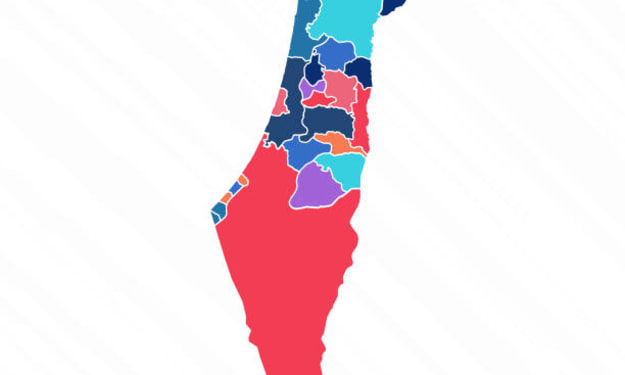
Driving through what might be one of the world's most peculiar landscapes, I find myself traversing the border between Israel and the West Bank. A glance at the map reveals a puzzle of Palestinian towns painted in green and Israeli settlements in blue. This region is often thought of as Palestine, yet what's intriguing is that almost a fifth of the three million inhabitants here are Jewish Israeli citizens. These Israelis, known as settlers, call the West Bank home while holding Israeli citizenship. As I journey along, I am witnessing the juxtaposition of two distinct nations intertwined by decades of conflict. Embarking on a quest to understand this complex panorama, I explored 15 settlements scattered across the West Bank, engaging with individuals who made the bold decision to relocate to this disputed territory. To unravel the origins of this intricate scenario, we must turn back the clock to 1948, a time when the land appeared markedly different. In those days, Great Britain held sway over this expanse. Faced with mounting tensions between Jews and Arabs, the United Nations collaborated with Britain to partition the land into separate states - Israel for Jews and Palestine for Arabs. The Jewish population embraced the proposal, heralding their independence. However, the Arab nations viewed this plan as another manifestation of European colonialism, rejecting it and subsequently engaging in war with Israel. Emerging victorious from the conflict, Israel exceeded the borders outlined by the UN. Amid peace negotiations, a ceasefire line materialized, etched in green ink and soon known as the Green Line. This demarcation was not a formal border, but rather a line separating Israel from the section now controlled by Jordan, which had seized it during the war. The land west of the Jordan River, thus acquired, earned the moniker "West Bank." The fragility of the ceasefire endured until 1967, when Israel found itself embroiled in another war with its Arab neighbors. While territorial expansion was not the objective, Israel rapidly advanced beyond the Green Line, capturing significant tracts of land, including the entirety of the West Bank. This victory posed a crucial question: should Israel incorporate the West Bank, extending Israeli citizenship and voting rights to its 1.1 million Arab inhabitants? Alternatively, should the land be returned to Jordan or given to the Palestinian people to establish their own state? This quandary ignited fervent debates within Israeli political circles. For many, the recent military triumph was perceived as a divine indication that Jews were destined to return to the land brimming with ancient Jewish heritage, the hills of ancient Judea and Samaria, encompassing the entire West Bank. While the government deliberated, Israeli civilians embarked on a bold initiative, establishing homes within the West Bank without official authorization. This grassroots movement planted the seeds of the settler movement, reshaping the dynamics of the region. However, this initiative was met with international disapproval. As settler numbers swelled, the UN issued a resolution decrying the settlements as an impediment to achieving lasting peace in the Middle East. The world witnessed the emergence of two narratives: one emphasizing Jewish civilians populating largely vacant plots of land infused with historical and spiritual significance, and the other, the predominant perspective, portraying settlers as expanding their nation through colonization. Despite global condemnation, the settler population burgeoned. Over ensuing decades, various factions within the Israeli government rallied behind the movement, channeling public resources and authorizing construction. Aiding the expansion of settlements, the Israeli housing ministry and military devised blueprints for West Bank development. Roads traversing the region facilitated movement between settlements and mainland Israel. Construction permits multiplied, and planned communities sprouted across the West Bank. From a fringe movement, settlers evolved into an integral facet of Israeli society, backed by state support. In the 1980s and 1990s, settlement activity surged, weaving these settlements around existing Palestinian towns, sparking tensions and protests. Recognizing the unsustainable nature of the situation, President Bill Clinton, Prime Minister Yitzhak Rabin, and Palestinian leader Yasser Arafat brokered the Oslo Accords in the mid-1990s. These agreements divided the West Bank into three areas: Area A granted Palestinians control over security and governance, Area B yielded Palestinian administrative power but retained Israeli security presence, and Area C remained under complete Israeli control, housing the settlements. These developments have given rise to the current state of affairs. Israelis enjoy convenient access between mainland Israel and the West Bank, traversing well-maintained roads known as "flyovers" that bypass Palestinian villages. Palestinians, on the other hand, often encounter roadblocks and checkpoints, hampering their movement. Yet, a more substantial challenge confronting Palestinians is the impact of fragmented land on their economy. The fertile agricultural land, water, and mineral resources concentrated in Area C sustain the majority of the West Bank's economy. Limited access to these resources has stifled Palestinian businesses and economic growth. An event in 2005, where Israeli Prime Minister Ariel Sharon uprooted 8,500 settlers from the Gaza Strip, reignited settler fervor. Witnessing fellow Israelis evicted from their homes galvanized the settler community, prompting further expansion efforts in the West Bank. Today, these settlers reside in established communities complete with schools, hospitals, and even a university. As thoughts turn towards resolving this intricate conflict, the idea of a two-state solution, granting Palestinians their own state within the West Bank region, emerges as a common proposal. However, the evolving settlement landscape, particularly within Area C, complicates this path. These settlements, far from being temporary encampments, have evolved into thriving communities. In conclusion, the West Bank's unique tapestry of settlements and Palestinian towns stands as a testament to the enduring complexities of the Israeli-Palestinian conflict. It is a landscape where historical narratives, religious ties, and contemporary political considerations converge, yielding a remarkable tableau that continues to shape the destiny of this region.
By Shubham Bajaj3 years ago in History
Russia's Challenges in the Conflict with Ukraine
The news emerging from Ukraine presents unfavorable developments for Russia, with 10,741 visually confirmed instances of heavy equipment losses, including 2,054 tanks either destroyed, abandoned, or captured. Estimates lacking visual confirmation suggest a figure around 3,000. More than half of its Ka-52 attack helicopter fleet has been destroyed, and during the June Ukrainian counteroffensive alone, five were lost.
By Dndjdjxn Xnxndkd3 years ago in History
Kitchen Chronicles: Tracing the Journey of Printed Tea Towels
But did you know that these seemingly humble essentials have a rich history and vibrant evolution? We'll embark on a delightful journey through time to explore the captivating story of kitchen towels and how they've evolved into the cherished kitchen companions we know today.
By Marsha kimmels3 years ago in History