Analysis
"Echoes of Colonial Wealth: A Historical Reflection"
The Expropriated Wealth: European Colonial Exploitation and Its Estimated Net Value During the colonial period, European nations harnessed extensive resources from their colonies, frequently with minimal concern for indigenous populations, ecosystems, or long-term viability. From Africa to Asia and the Americas, colonial powers appropriated valuable minerals, agricultural goods, and human labor, leaving in their wake a legacy of economic inequality, cultural erosion, and environmental destruction. Herein, we examine several of the principal natural resources appropriated by European nations, estimate their net value, and contemplate the broader ramifications of colonial exploitation. 1. Natural Resources Appropriated by European Colonizers Gold, Silver, and Precious Metals European colonial powers extracted substantial quantities of gold, silver, and other precious metals from their territories. Spain, for instance, pillaged gold and silver from Latin America, particularly from the mines in Potosí, Bolivia. Between the 16th and 18th centuries, it is estimated that Spain extracted approximately 45,000 tons of silver and 400 tons of gold from the Americas. When adjusted for inflation, the current value of these resources would approximate $2 to $3 trillion. Spices and Agricultural Riches The Dutch, British, and Portuguese empires reaped significant profits from the spice trade, controlling essential trade routes and colonies such as Indonesia, India, and Sri Lanka. Spices like cloves, nutmeg, cinnamon, and pepper were valued immensely. Additionally, colonizers exploited colonies for cash crops such as sugarcane, tea, coffee, and cotton. India alone provided vast amounts of cotton and textiles to the British Empire, contributing billions of pounds to Britain’s industrialization. The Caribbean colonies were utilized for sugar plantations, operated by enslaved African laborers, whose unpaid work contributed billions more to European affluence. Rubber, Timber, and Diamonds The Belgian exploitation of the Congo under King Leopold II stands as one of the most notorious examples of colonial plunder. Millions of Congolese individuals were compelled to extract rubber and ivory, often under inhumane conditions. It is estimated that Belgian exploitation of Congo’s resources generated wealth corresponding to hundreds of billions of dollars in present-day value. The British also governed valuable diamond and gold mines in South Africa. The De Beers diamond company, established during the colonial period, remains a symbol of European prosperity derived from African resources. 2. Human Toll of Colonial Exploitation Forced Labor and Enslavement One of the most catastrophic aspects of European colonialism was the transatlantic slave trade. Between the 16th and 19th centuries, an estimated 12 to 15 million Africans were forcibly taken to the Americas, where they were enslaved on plantations. The uncompensated labor of enslaved individuals fueled the economic expansion of European powers, particularly Britain, France, Spain, and Portugal. The economic contribution of enslaved African labor has been appraised at over $14 trillion in current terms. Loss of Human Life Colonial conflicts, coerced labor, starvation, and disease resulted in the demise of millions in colonial regions. In India specifically, British colonial strategies contributed to numerous famines, notably the Bengal Famine of 1943, which claimed approximately 3 million lives. The cumulative human cost of European colonialism amounts to tens of millions, with incalculable economic and social repercussions. 3. Exploitation of Animals and the Environment Colonial exploitation transcended human populations to encompass animals and ecosystems. European hunters and settlers caused the extinction of species such as the passenger pigeon and the quagga (a variant of zebra). In Africa, elephants were pursued for ivory, and woodlands were cleared for plantations, disrupting ecosystems and biodiversity. The environmental destruction wrought by colonial exploitation, including deforestation, soil depletion, and biodiversity loss, continues to affect former colonies today. 4. Approximate Value of Extracted Resources Although determining the precise value of all resources plundered by European powers during the colonial epoch is challenging, historians and economists have offered some staggering approximations: India under British Administration (1757-1947): British colonial exploitation is estimated to have extracted around $45 trillion from India, according to economic historian Utsa Patnaik. This estimate encompasses the value of resources, labor, and economic practices that benefited Britain at India's detriment. Africa: The wealth extracted from Africa, including gold, diamonds, rubber, ivory, and enslaved individuals, is surmised to be valued at several trillion dollars. Some assessments suggest that the reparations owed to Africa exceed $100 trillion. Latin America: The gold and silver commandeered by Spain from Latin America, particularly from the Inca and Aztec civilizations, would be valued at approximately $2-3 trillion today. 5. Colonialism's Legacy and Advocacy for Reparations The economic inequalities between former colonial powers and their erstwhile colonies stand as a persistent legacy of colonial exploitation. Numerous scholars, advocates, and organizations have urged for reparations to rectify the historical injustices of colonialism. These reparations could manifest as financial restitution, debt forgiveness, or investments in education, healthcare, and infrastructure within former colonies. Conclusion The European colonial period was characterized by the systematic plunder of natural resources, human labor, and cultural heritage. The wealth generated through this exploitation fueled Europe’s industrial growth and global supremacy, while leaving many former colonies impoverished and grappling with the ramifications of colonialism. Recognizing the magnitude of this exploitation is vital for cultivating a more equitable global future and addressing the historical injustices that continue to influence our contemporary world.
By Say the truth 2 years ago in History
The History of Coca-Cola
It’s hard to imagine a world without Coca-Cola. From its signature red cans to its iconic logo, Coca-Cola has become synonymous with refreshment and happiness. But the story of this beloved beverage began more than 130 years ago in a small pharmacy in Atlanta, Georgia.
By Bob Madden2 years ago in History
The History of Fashion. AI-Generated.
History of Fashion What is Fashion? Fashion is a dynamic and ever-evolving form of self-expression that encompasses clothing, accessories, footwear, makeup, and even lifestyle choices. It reflects cultural, social, and economic influences while allowing individuals to showcase their personality, status, and creativity. Fashion is not just about trends; it is an art form, an industry, and a means of communication.
By Md Naim Hasan2 years ago in History
Difference Between Volvo Group And Volvo Cars
Difference Between Volvo Group And Volvo Cars. Have you ever seen a big Volvo truck go by? Maybe you've also seen a nice Volvo car parked somewhere. Did you know these come from two different companies? They are called **Volvo Group** and **Volvo Cars**. It might seem odd, but it's like how one company can make different things.
By Evans Torres2 years ago in History
The War That Lasted 335 Years—Without a Single Shot Fired
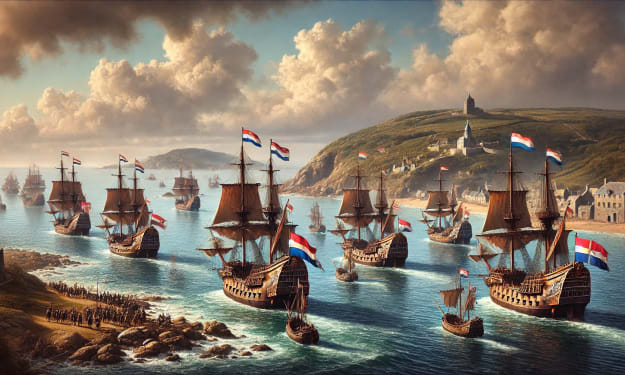
Wars throughout history have been defined by bloodshed, destruction, and political turmoil. But what if I told you there was a war that lasted for 335 years—without a single battle, casualty, or even an exchange of fire? It sounds unbelievable, yet this bizarre and largely forgotten conflict between the Netherlands and the Isles of Scilly is one of history’s strangest diplomatic oddities.
By OWOYELE JEREMIAH2 years ago in History
The Titanic’s Sister Ship
The Tragedy That History Almost Forgot Everyone knows the story of the Titanic—an “unsinkable” ship that met its tragic fate on April 15, 1912, after striking an iceberg in the North Atlantic. The disaster became one of history’s most infamous maritime tragedies, immortalized in books, films, and documentaries. But what if I told you that Titanic had a sister ship, one that faced its own catastrophe—a disaster that has remained largely overlooked?
By OWOYELE JEREMIAH2 years ago in History
"The Might of Sparta: A Glimpse into the Spartan Army"
The Strength and Wealth of Sparta: Power, People, and Legacy Sparta, a powerful military city-state in ancient Greece, is renowned for its disciplined army, strategic skill, and stoic culture. For centuries, the Spartan civilization made a significant impact on history with its unmatched strength and strict societal hierarchy. This article examines Sparta’s military, its kingdom’s structure, its inhabitants, and the wealth that supported its supremacy. Spartan Army: The Backbone of Sparta’s Power The Spartan army was the most formidable military force in ancient Greece. Unlike other Greek city-states, Sparta placed complete emphasis on military superiority. Every male citizen received training to become a soldier from an early age. Boys entered the agoge, an intense military training program, at the age of seven. They were instructed to endure hardships, survive in the wilderness, and engage in combat with unwavering bravery. The Spartan army was arranged into lochoi (units), commanded by highly skilled leaders. They fought in a phalanx formation—a compact, disciplined square of soldiers equipped with large shields (aspis), spears (dory), and short swords (xiphos). This formation, coupled with their superior training and fearless mindset, rendered them nearly invincible on the battlefield. One of Sparta’s most renowned victories occurred at the Battle of Thermopylae ( 80 BCE), where King Leonidas and 300 Spartans held the immense Persian army at bay. Although they were ultimately defeated, their courage and strategic brilliance became legendary, epitomizing sacrifice and valor. The Spartan Kingdom: A Unique Political Structure Sparta’s political framework was different from other Greek city-states. It operated as an oligarchy with two kings, each from separate royal lineages. These kings commanded the army and performed religious ceremonies. However, they shared authority with the Gerousia (a council of elders), the Ephors (five annually elected officials), and the Apella (an assembly of male citizens). This balanced power system contributed to maintaining order and prevented any single ruler from gaining too much control. Spartan society was categorized into three primary classes: Spartiates: Full citizens who served as soldiers. Perioikoi: Free non-citizens who worked as artisans, traders, and farmers.
By Say the truth 2 years ago in History
The Golden Majesty of the Mali Empire: Mansa Musa’s Legacy. AI-Generated.
The Rich and Complex History of Africa – Part 3: The Kingdom of Mali and the Wealth of Mansa Musa Africa's past is interwoven with stories of empires that flourished through trade, resources, and culture, with the Kingdom of Mali being particularly famous. At its peak, this medieval West African empire stood as a symbol of prosperity, intellectual achievement, and cultural impact. Central to its narrative is Mansa Musa, frequently regarded as the wealthiest individual in history. The Rise of the Mali Empire The Mali Empire arose in the 13th century, expanding upon the groundwork established by the Ghana Empire. By the mid-1200s, Mali had transformed into a significant trading center, gaining control over gold mines, salt reserves, and trade routes traversing the Sahara Desert. These assets enabled Mali to position itself as a crucial participant in worldwide commerce, attracting traders from Europe, the Middle East, and further. Under King Sundiata Keita's reign, Mali consolidated several smaller kingdoms and broadened its reach. Sundiata implemented foundational advancements in agriculture, trade structures, and military organization, yet it was during Mansa Musa's rule (c. 1312–1337) that the empire attained its peak. The Wealth of Mansa Musa Mansa Musa is predominantly recognized for his fabled wealth, which has frequently been characterized as unmatched in history. His riches were derived from Mali's plentiful natural resources, especially gold and salt. Throughout his reign, Mali accounted for almost half of the world's gold production. In 132 , Mansa Musa set out on a pilgrimage (Hajj) to Mecca, a venture that would solidify his legacy globally. His procession reportedly consisted of 60,000 individuals, 80 camels laden with gold, and many soldiers, attendants, and musicians. During the journey, Mansa Musa distributed gold to those in need, constructed mosques, and generously gifted the rulers he met along the way. His kindness in Cairo triggered a brief economic crisis due to the influx of gold diminishing the local currency's value. This incident not only highlighted Mali's vast wealth but also drew the attention of the broader world. Mansa Musa's Hajj is often referenced as one of the most opulent exhibitions of wealth in history. Intellectual and Cultural Achievements Beyond its material wealth, the Mali Empire also functioned as a center of education and culture. Mansa Musa allocated substantial resources to education, establishing schools, libraries, and mosques. The city of Timbuktu, especially, became a focal point of scholarship, enticing students and academics from various parts of Africa and the Islamic world. The Sankore University in Timbuktu contained thousands of manuscripts covering topics from astronomy and medicine to law and theology. This intellectual flourishing assisted Mali in earning a reputation as a beacon of wisdom and enlightenment. The Decline of the Mali Empire Like numerous great empires, Mali ultimately encountered decline. Internal conflicts, succession issues, and outside pressures undermined its central authority. By the 15th century, the empire had splintered, and its influence diminished. Nevertheless, the heritage of Mali and Mansa Musa persists. The legends of Mansa Musa’s riches, the accomplishments of Timbuktu, and the cultural influence of the Mali Empire still inspire individuals today. The empire's narrative exemplifies Africa’s historical significance as a hub for trade, learning, and culture. Modern Reflections The story of the Mali Empire and Mansa Musa acts as a reminder of Africa’s rich and varied history. It confronts stereotypes about the continent and underscores the contributions of African civilizations to global history. Currently, initiatives are in progress to safeguard and study the manuscripts of Timbuktu and other remnants from Mali’s golden era. These efforts intend to guarantee that future generations can learn from and appreciate this extraordinary period in African history. Conclusion The Mali Empire and the wealth of Mansa Musa represent just a part of Africa's intricate historical fabric. In forthcoming installments of this series, we will examine other significant African civilizations, including the Kingdom of Zimbabwe, the Swahili city-states, and the Songhai Empire, all of which played crucial roles in shaping the continent’s history and legacy. Stay tuned for the next chapter in this exploration of Africa’s past!
By Say the truth 2 years ago in History