Analysis
immigration judge for Mahmoud Khalil
Mahmoud Khalil, a Palestinian who graduated from Columbia University and is a lawful permanent resident of the United States, was given the green light by an immigration judge in Louisiana on April 11, 2025, to be deported for allegedly posing a threat to national security. This decision has ignited a national debate over free speech, civil liberties, and the Trump administration's intensified crackdown on pro-Palestinian activism on college campuses.
By Md Faruk Ali2 years ago in History
Daily News
Saturday marks the start of high-stakes negotiations between Iran and the United States to establish a new nuclear agreement, which have been anticipated by Tehran's warning that any attack on it will force the US into a wider Middle Eastern battle and President Trump's threat of military strikes in the event of failure.
By Daily Article2 years ago in History
NASA spacecraft spots monster black hole bursting with X-rays 'releasing a hundred times more energy than we have seen elsewhere'
One of the most extreme black hole outbursts ever observed has been captured by a NASA spacecraft in a spectacular cosmic display. The eruption is so powerful that it is releasing more than a hundred times the energy that is typically seen from sources similar to it. Astronomers are now scrambling to comprehend the violent behavior of this cosmic behemoth as the black hole, which is located in a distant galaxy, is erupting torrents of high-energy X-rays. A Black Hole Unique to None The event was spotted by NASA’s NuSTAR (Nuclear Spectroscopic Telescope Array), a space-based observatory designed to detect X-rays from the most energetic phenomena in the universe — including black holes, supernovae, and neutron stars. While black holes are infamous for consuming everything around them, they can also shine brilliantly under the right conditions — especially when feeding.
By rifat_hakson2 years ago in History
This super-dense cosmic 'pasta' is the strongest material in the Universe
Credit: Nazarii Neshcherenskyi Deep within the crusts of neutron stars—the ultra-dense remnants of exploded stars—exists a bizarre, nearly indestructible form of matter whimsically nicknamed nuclear pasta. It’s not made of flour or eggs, but instead of tightly packed protons and neutrons twisted into strange shapes. And despite the playful name, it’s believed to be the strongest material in the universe.
By rifat_hakson2 years ago in History
"Secrets Beneath the Waves: The Untold History of Oceanic Treasure". AI-Generated.
Secrets Beneath the Waves: The Untold History of Oceanic Treasure From age-old legends of Atlantis to the tangible discovery of Spanish galleons, the ocean has perpetually represented a realm of intrigue, peril, and astonishing wealth. For millennia, civilizations have dispatched vessels across the expansive blue unknown in quest of commerce, conquest, and discoverymany of which never returned. What they abandoned has transformed the seas into extensive repositories of lost treasures, still awaiting revelation. The Early Days: Myths and Legends The concept of concealed treasure beneath the waves can be traced to early human history. Ancient Greeks penned tales of Atlantisa formidable civilization engulfed by the sea, rumored to possess advanced technologies and unimaginable riches. While the veracity of Atlantis remains conjectural, the idea has captivated imaginations through the ages and inspired countless explorers and treasure seekers. Similarly, in Indian epics such as the Ramayana and Mahabharata, oceans are portrayed as divine realms harboring sacred objects, mythical beings, and potent artifacts lost in conflicts between deities and demons. Maritime Trade and Lost Fortunes As trade routes expanded during ancient and medieval times, particularly in the Indian Ocean and the Mediterranean, innumerable ships conveyed spices, silk, ivory, gemstones, and gold. The Romans, Egyptians, Arabs, and Chinese all operated fleets that navigated perilous waters. Natural catastrophes, piracy, and combat resulted in the sinking of many of these vessels. For instance, the wreckage along the Egyptian coastline near Alexandria has uncovered coins, statues, and ceremonial artifacts dating back to the Ptolemaic dynasty. The sea evolved into not only a conduit for commerce but also a sepulcher of wealth. The Age of Exploration: A Golden Boom The 15th to 18th centuries heralded a surge in maritime exploration. European powers such as Spain, Portugal, England, and the Netherlands scoured the globe, colonizing territories and extracting substantial wealth from the Americas, Africa, and Asia. Ships laden with treasures navigated home, transporting gold, silver, and precious stones. Many of these vessels never returned. One of the most renowned instances is the Nuestra Señora de Atocha, a Spanish galleon that sank off the Florida Keys in 1622 during a hurricane. It carried immense quantities of silver, gold bullion, emeralds, and other valuables from South America. In 1985, American treasure hunter Mel Fisher uncovered the wreck, retrieving over $450 million in artifacts. This discovery stands as one of the most significant maritime finds in history. Other notable sunken vessels include: The Titanic (1912): While noted for its sorrowful sinking, the Titanic transported valuable cargo, including gemstones and artworks. The Flor de la Mar (1511): A Portuguese vessel said to have carried the riches of the Malacca Sultanate; it disappeared near Sumatra with treasure estimates in the billions. The San José (1708): Recently uncovered off the coast of Colombia, it allegedly contained gold and silver valued at over $20 billion. Pirates, Hoards, and Concealed Havens No maritime treasure history would be complete without pirates. Ranging from the Caribbean to the Indian Ocean, pirates plundered merchant vessels and interred treasure on isolated islands. Figures such as Blackbeard, Captain Kidd, and the Barbary corsairs created legendsand perhaps left treasures still concealed today. The notorious "Treasure Island" motif isn’t entirely fictional. In certain instances, pirates did hide treasure, although locating such hoards has proven infrequent and contentious due to colonial-era legislation, conflicting claims, and contemporary salvage rights. Modern Discoveries and Technologies Innovations in sonar, deep-sea submersibles, and remotely operated vehicles (ROVs) have transformed treasure exploration. Entire teams of maritime archaeologists, supported by governments or private enterprises, now seek out shipwrecks and submerged cities. One of the most recent discoveries was a cache of gold coins and jewelry off the Israeli coast in 2015, thought to originate from a vessel that sank over 1,000 years ago. The coins featured the likeness of Caliph Al-Hakim of the Fatimid dynasty. Likewise, India’s coastline has unveiled artifacts believed to belong to sunken ancient cities such as Dwarka, linked to Lord Krishna. If validated, such sites could possess as much historical significance as monetary value. The Net Worth of the Ocean's Treasures While it’s challenging to assess accurately, analysts propose that the total worth of undiscovered underwater treasures could surpass $60 billionpotentially more. This encompasses known shipwrecks, pirate caches, lost artifacts, and rumored treasures awaiting confirmation. Moreover, beyond the monetary worth, oceanic treasures embody cultural, historical, and spiritual richness that is immeasurable. Each artifact narrates a story, provides insight into the past, and prompts us to reconsider our understanding of human history. Conclusion: A Treasure Map to Our Past The ocean’s wealth is not solely in gold and gemsit exists in the knowledge, art, and enigmas maintained beneath the waves. From royal fleets submerged in storms to mythical remnants of lost civilizations, every foray into the deep blue uncovers another chapter in our collective heritage. As long as the sea continues to safeguard its secrets, the allure of concealed treasure will resonate worldwidecaptivating adventurers, historians, and visionaries alike.
By Say the truth 2 years ago in History
Peace
Peace is a priceless treasure. Those who do not have it understand what peace is. If we look at the present world, it has become difficult to find even a little peace. The whole world is full of sedition, corruption, war, threats, and intimidation. I think it is very necessary to bring peace back to this present world. If there is no peace, what will happen with money, what will happen with luxurious buildings, what will happen with BMW Mercedes cars? Therefore, I think that the best book to bring peace back to the world is the Quran, in which even today no one has been able to doubt a single mistake. Even if someone doubts it, I think it is unnecessary because many people have already recharged it with doubts, recharged it and found that there is no mistake in it. And with that, we can talk about Dr. Maurice Bucaille. Many of us have heard about his name or many of us have come to know through some means that whenever Dr. Maurice Bucaille started recharging the Quran with doubts, it was known that he recharged it for the first time.He did not find any mistake, he started again the second time and the recharge work was completed the second time. Even then he did not find any mistake. He started the recharge work for the third time and then he did not find any mistake for the third time. Finally, seeing the beauty of Islam, he became a Muslim by studying the Quran. Dear viewers, many of you may not believe or accept my words. I will tell him that the Quran still exists. It existed before. You too should start recharging and see if you find any mistake. I hope that you will also be forced to follow the Quran after seeing the beauty of the Quran. I have also seen that the rules and regulations in the Quran are so beautiful. I cannot write and express them to you if you do not know about this. Are you in any responsibility in the village? The Quran is about managing social life. Are you a state leader? The Quran is about managing the state. Do you want to know about the universe and the earth? The Quran contains unique events for philosophers. Are you concerned about science? The Quran contains billions of knowledge for scientists. In general, the following rules You see how beautiful they are, there is no injustice for any person by making them rich, in this there is no mention of judging by wealth, no mention of judging by power, no judgment by looking at family status, generally only if you see these rules you will understand, if a person kills another person unjustly, the Quran says to kill him instead of killing him, if a person steals, the Quran has ordered him to cut off his hand, if a married person is involved in the process, then bury him up to the waist and stone him to death in public, what I think if these are implemented in reality, then there will be no murder, theft, robbery, ref, process, corruption, I hope none of these will remain, when there is no these in oneself, I think that society is in a state of peace everywhere in this world, if you like the incident, then definitely don't forget to like comment and subscribe, the incident was written by Md. Shakil Mahmud, the head of (MSM-JTV)
By Md shakil Mahmud 2 years ago in History
Argentina seals $20 billion IMF deal, tears down currency controls
BUENOS AIRES, April 11 (Reuters) - Argentina sealed a $20 billion, 48-month Extended Fund Facility deal with the International Monetary Fund on Friday and, in a major policy move ahead of the deal, dismantled key parts of its years-long currency controls and loosened its grip on the peso.
By rifat_hakson2 years ago in History
"The True Wealth of Socrates: Riches Beyond Gold". AI-Generated.
Socrates: The Abundance of a Destitute Philosopher When contemplating wealth, visions of gold, extravagant mansions, and authority frequently come to mind. However, in the core of ancient Athens resided a man who contested this notionSocrates, the progenitor of Western philosophy. Despite possessing minimal, if any, material assets, Socrates is commemorated as one of the most intellectually and spiritually "affluent" figures in history. His impact on thought, ethics, and human comprehension greatly eclipses the riches of monarchs. But who was this individual, and what form of wealth did he genuinely possess? Socrates: The Individual and His Environment Born circa 470 BCE in Athens, Socrates inhabited a period marked by political instability, intellectual resurgence, and military strife. His father, Sophroniscus, was a sculptor, while his mother, Phaenarete, served as a midwife. Socrates himself was educated in the family craft but ultimately forsook it to seek truth and wisdom. Athens represented a society where wealth was both revered and displayed. Magnificent temples, opulent residences, and bustling marketplaces illustrated the prosperity of the Athenian elite. Nevertheless, Socrates distinguished himself from this opulence, walking barefoot, attired modestly, and opting for dialogue instead of convenience. The Material Deprivation of Socrates Socrates was notoriously impoverished. He did not levy fees for his instruction, in contrast to the Sophists of his era who profited substantially from their rhetoric. He owned no land, no enterprise, nor any lavish belongings. Plato and Xenophon, his disciples, both recount his indifference toward monetary wealth. Socrates lived in asceticism, frequently depending on the generosity of his acquaintances or the community to sustain himself. To the citizens of Athens, this mode of living was peculiar. How could an individual so erudite, so esteemed, elect to dwell with so little? Socrates responded through his existence: he prioritized virtue over affluence, wisdom over luxury, and the spirit over the corporeal. The Authentic Wealth of Socrates: Intellectual and Ethical Assets Socrates’ genuine riches resided in his intellect and character. He maintained that "the unexamined life is not worth living. " He scrutinized everythingmorality, justice, politics, love, and even the divinewith unwavering logic and a quest for veracity. His philosophical approach, known as the Socratic Method, entailed posing incisive questions to assist others in recognizing their own ignorance and pursuing a deeper comprehension. This methodology has shaped education, law, science, and civil dialogue for over two millennia. Here’s how Socrates was "wealthy" in the manners that genuinely counted: Wealth of Thought – His concepts established the groundwork for Western philosophy. He influenced thinkers such as Plato, Aristotle, and, by extension, the entirety of modern philosophy. Moral Wealth – Socrates underscored ethics and the nurturing of the soul. He contended that a commendable life was characterized not by riches or rank, but by virtue, integrity, and self-awareness. Spiritual Wealth – By embodying his teachings, Socrates manifested inner tranquility and courageeven in the face of mortality. When condemned to die by hemlock for "corrupting the youth" and "impiety," he accepted his destiny with composure. Educational Wealth – Socrates never authored any texts; nevertheless, his dialogues, transcribed by Plato and Xenophon, persist in instructing generations on how to engage in critical thinking. Modern Interpretations: Socrates and the Concept of Wealth Presently, in a society dominated by material achievement and social media endorsement, the model of Socrates remains increasingly pertinent. His existence raises fundamental inquiries: What do we genuinely cherish? Is wealth defined by belongings or by intention? For Socrates, wisdom and virtue constituted the supreme riches. His wealth was not accumulated in banks or safes, but in the intellect of learners and the well-being of his spirit. He perceived knowledge not as a means for gain, but as a journey toward enlightenment and inner abundance. Legacy and Influence Socrates' legacy is invaluable. He impacted: Plato, his disciple, who established the Academy and authored philosophical masterpieces. Aristotle, who studied at Plato’s Academy and established the foundations for science and reasoning. The Stoics, who constructed a comprehensive ethical framework based on his teachings regarding inner fortitude and self-discipline. Contemporary democracies, which attribute their focus on dialogue and rational discourse to Socratic principles. Ironically, the individual who possessed nothing has emerged as one of history’s most impactful and "wealthy" figuresnot in currency, but in concepts that outlasted empires. Conclusion Socrates redefined the notion of wealth. He demonstrated that an affluent life is not characterized by material possessions, but by inquiries, comprehension, and integrity. Despite being materially impoverished, Socrates’ intellectual treasures continue to enrich humanity. His narrative serves as a reminder that true wealth resides not in what we possessbut in who we are.
By Say the truth 2 years ago in History
Nawab Siraj ud-Daulah
Nawab Siraj ud-Daulah was the last independent Nawab of Bengal, and his life story is one of valor, youthful ambition, political betrayal, and the beginning of British domination in India. Born in 1733, Siraj ud-Daulah was the grandson of Alivardi Khan, the then Nawab of Bengal. From a young age, he was trained in the art of warfare and governance, as his grandfather saw him as the future ruler of Bengal. He was energetic, intelligent, and bold—but also impulsive and often harsh in his decisions.
By Azmi Sarkar2 years ago in History
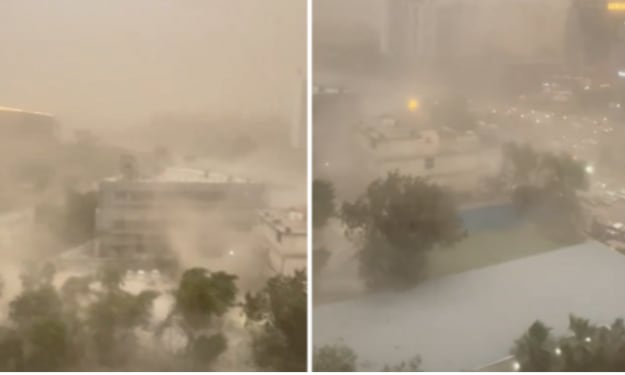
Felt like a 20-minute earthquake: Delhi-NCR residents left shaken after sudden dust storm
New Delhi, April 12 — A sudden and intense dust storm swept across the Delhi-NCR region late Friday evening, leaving residents startled and the city blanketed in a cloud of dust and debris. The out-of-the-blue weather phenomenon, which lasted about 20 minutes, reduced visibility significantly, uprooted trees, and disrupted power in several locations. Ritesh Malhotra, a Noida resident, said, "It felt like a 20-minute earthquake." He described how windows rattled and things fell inside as strong winds howled outside. Videos depicting dramatic scenes of swaying electric poles, flying debris, and people caught off guard by the storm soon flooded social media. The sudden dust storm was brought on by a combination of high surface temperatures and strong westerly winds, according to the India Meteorological Department (IMD). Wind gusts of up to 70 kilometers per hour were recorded in parts of Delhi and Gurgaon. Although the IMD had previously issued a yellow alert for the region warning of light rain and gusty winds, the severity of the storm surprised many. Power outages were reported in a number of neighborhoods as a result of damaged overhead cables and fallen trees. On important roads like the Ring Road and NH-48, traffic was disrupted, and Metro services experienced brief delays as a result of operational safety checks. As minor injuries and property damage were reported from South Delhi, Dwarka, and Ghaziabad, emergency services were on high alert. Authorities advised residents to stay indoors and avoid parking vehicles under trees or unstable structures.
By Kindless Exe2 years ago in History